Scapular Disorders (Shoulder Blade Disorder)
Introduction:
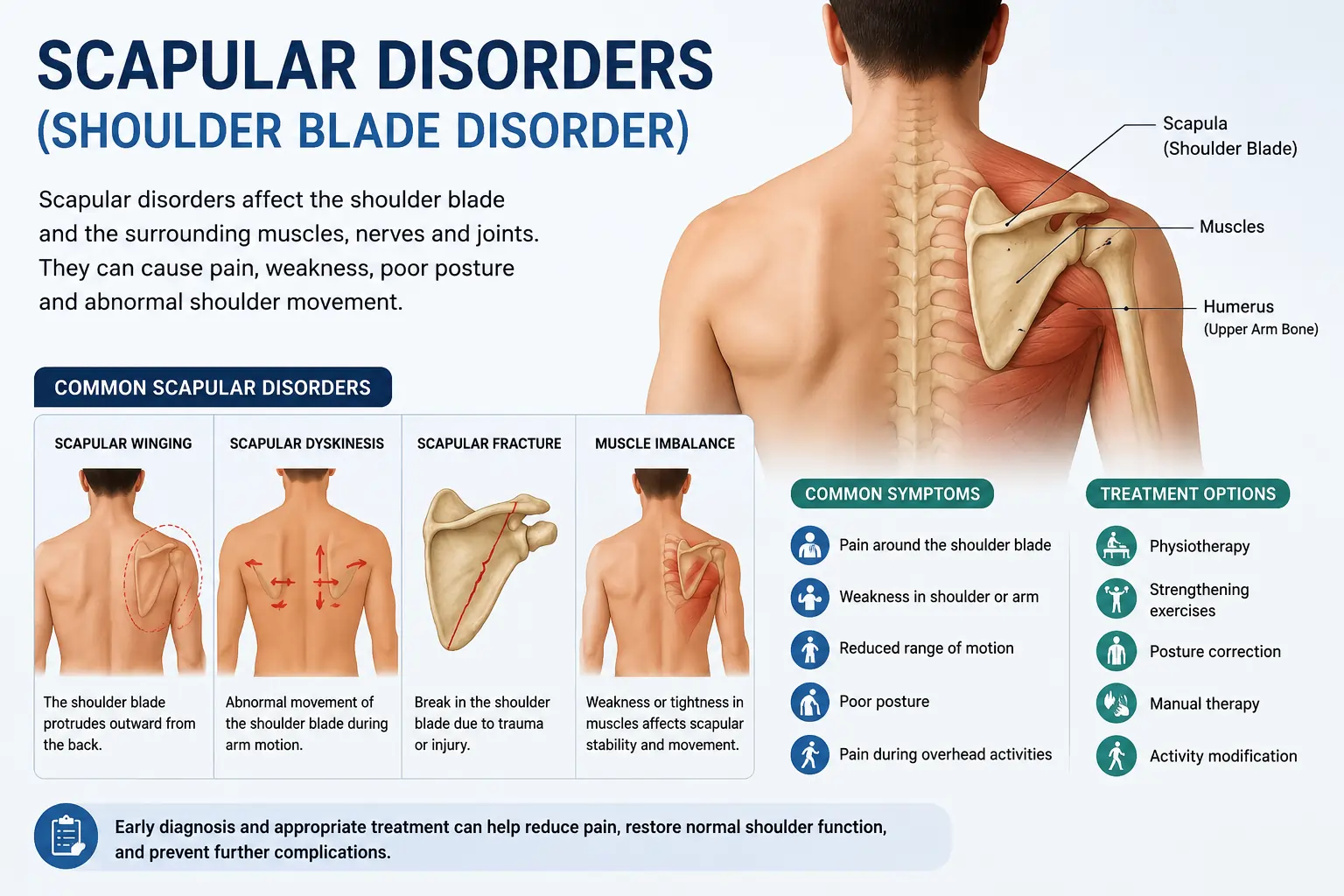
Scapular disorders are conditions that affect the scapula (shoulder blade) and the muscles, tendons, and joints surrounding it.
A triangle-shaped bone on the upper back is called the scapula, or shoulder blade. An advanced network of muscles surrounds and supports the bone, enabling you to move your arm. The scapula’s posture at rest or in action may change if a disease or accident weakens or unbalances certain muscles.
A change in the scapula’s position or motion:
Might make it challenging to move your arm, particularly when engaging in the above tasks.
Could make your shoulder feel weak.
Can result in harm if your shoulder joint’s natural ball-and-socket position is not preserved.
Physical therapy is frequently used to treat scapular problems by strengthening the shoulder muscles and restoring the scapula’s normal position and range of motion.
Anatomy:
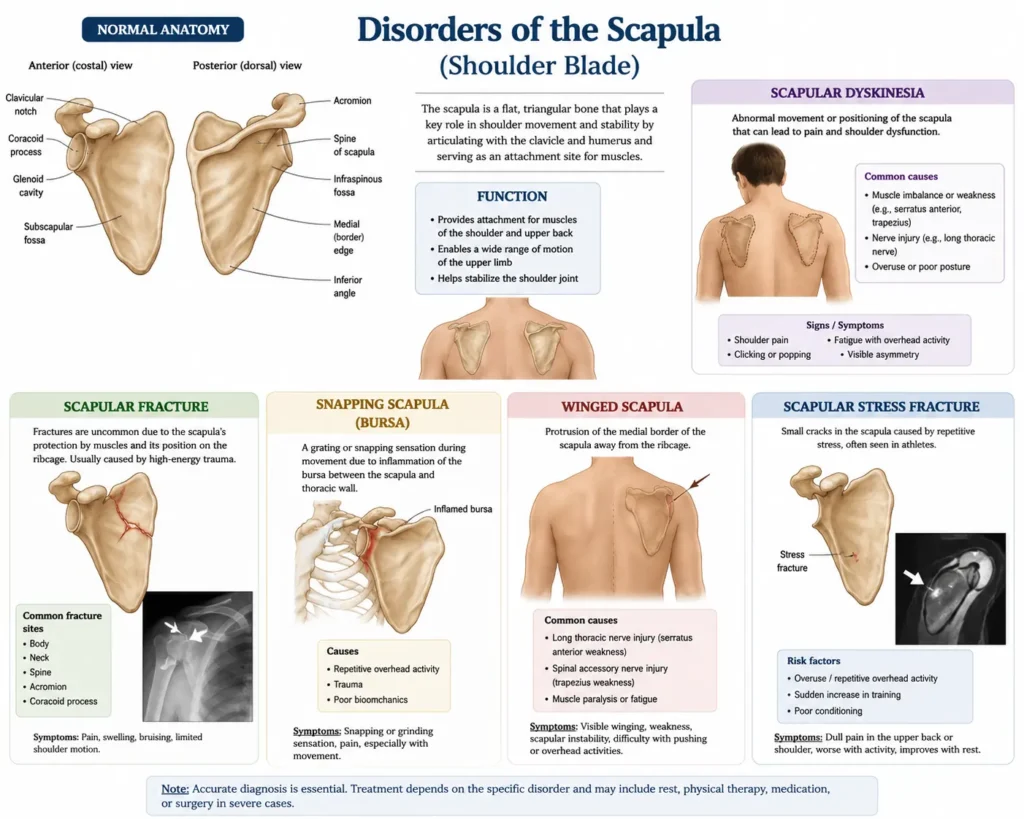
Disorder of the scapula
A ball-and-socket joint makes up the shoulder joint. The scapula, or shoulder blade, creates the socket, while the head of the humerus, or upper arm bone, is the ball.
Many muscle and ligament attachments connect the arm and scapula to the body. The acromioclavicular joint connects the clavicle, or collarbone, to the front and top of the scapula, or acromion.
Your scapula must move when you move your arm around your body to maintain the correct alignment of the ball and socket.
Causes:
- The muscles that regulate the scapula may be weak, unbalanced, tight, or (rarely) detached.
- Injuries to the nerves that supply the muscles,
- damage to the shoulder joint,
- injury to the bones supporting the scapula
Symptoms:
The most common symptoms of scapular dyskinesis are as follows:
- Tenderness and/or pain surrounding the scapula, particularly on the medial (inside) border and top.
- Weakness in the affected arm: When you attempt to use it forcefully, it may feel “dead” or exhausted.
- Weariness from repeated tasks, particularly those involving overhead motions
- A sound of snapping or crushing, along with shoulder movement.
- Noticeable “winging” or protrusion of the scapula.
- A forward-tilted or hunched posture on the affected side.
Types of scapular disorders:
- Winging of the scapula
- Scapula fractures
- Snapping scapula
- Interscapular pain
- Sprengel’s shoulder/Undescended scapula
Diagnosis
Physical Assessment:
In addition to discussing your general health and medical history, your doctor will inquire about your symptoms. They will examine your entire shoulder and scapula for injury, weakness, or tightness. The physical examination will often consist of the following:
Visual inspection. Your doctor will look at your affected scapula from behind and compare it with the other side.
Your doctor could ask you to place both hands on a wall or raise and lower your arms several times, often with small weights in your palms. And push away from it to determine whether you have scapular dyskinesis. This will typically show the aberrant motion patterns and any muscular weakening.
Muscular testing by hand. Your doctor will assess the strength of your shoulder and scapular muscles to determine whether the abnormal scapular motion is due to muscle weakness.
Corrective actions. Some tests that will assist your doctor in better grasping your issue include corrective actions.
Among these tests are:
- Test for scapular assistance (SAT). During this test, the physician will gently press on your scapula to help it rise as you raise your arm. If the arc of motion grows and your symptoms improve, your muscles are not powerful enough to raise your arm.
- Test for scapular retraction (SRT). Raise the patient’s arm to approximately 90° of shoulder abduction in the scapular plane (about 30–45° forward from the frontal plane).
- Ask the patient to resist downward pressure while the examiner applies gentle resistance.
- Compare shoulder strength and pain with and without scapular stabilization.
Imaging Examinations:
Scapular dyskinesis can sometimes be diagnosed without imaging studies. However, your doctor may ask for imaging, CT, X-rays, or other tests if they suspect a bony abnormality of the scapula (such as an osteochondroma) or an injury to another area of the shoulder. or magnetic resonance imaging (MRI).
If your doctor suspects a nerve injury, they may undertake a nerve conduction study to examine how the nerves are functioning.
Treatment:
Non-surgical Treatment
- Non-Surgical Therapy
Nonsurgical treatment will nearly always alleviate scapular symptoms. - Among the nonsurgical treatments are:
NSAIDs, or nonsteroidal anti-inflammatory medications. NSAIDs like ibuprofen and naproxen help lessen pain and swelling.
Physical therapy:
An exercise regimen tailored to the particular causes of your dyskinesis will be prescribed by your physician or physical therapist.
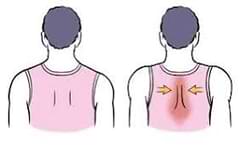
Physical therapy concentrates on:
- Stretching the tense muscles that restrict the range of motion in the scapula
- Make sure your fitness routine is balanced. Make sure your upper body strength exercises are balanced if you follow a regular at-home fitness regimen. For example, each set of “presses” should be followed by one set of “flys” and two sets of “rows.” Stretching exercises for your front shoulder muscles and shoulder joint rotation should also be part of your routine.
- Heat treatment. Shoulder muscular tension may be relieved by using a heating pad or taking a hot bath.
- Furthermore, it’s critical to:
- Maintain proper posture. Try to sit and stand correctly while you go about your daily business. Pull your shoulder blades back together and bend your elbows back and down as though you were trying to place them in your back pockets to accomplish this.
Home Remedies:
Some easy at-home treatments for scapular problems include the following.
- Restoring normal posture: Make sure you are sitting and standing correctly while you go about your daily tasks. Bend your elbows back and down as if you were going to place them in your back pockets, then draw your shoulder blades back together.
- Appropriate exercise regimen: If you follow a regular fitness regimen, ensure sure your upper-body strength sessions are well-balanced. Stretching exercises for your front shoulder muscles and shoulder joint rotation are good.
- Heat therapy: Using a heating pad or taking a hot bath might help ease tense shoulder muscles.
It’s time to see your doctor if your symptoms persist despite using the aforementioned home cures. To develop a treatment strategy, he or she can assist in determining the precise etiology of your scapular issue.
Surgical Intervention:
Surgery is not necessary for the majority of people with general dyskinesis caused by tightness or weakness in their muscles.
On the other hand, your doctor might carry out a procedure to rebuild or repair the damaged tissues if your shoulder joint injury is the cause of your Scapular Disorders. Rehabilitation to restore the scapula function to its natural range of motion and strength will come next.
Long-Term Results:
After treating the causes of your Scapular Disorders and restoring normal scapular position and motion, your doctor may recommend a maintenance conditioning program that focuses on strengthening and flexibility.
This is particularly crucial if you engage in strenuous or repetitive shoulder and arm motions during work or during leisure activities. These exercises should be done three times a week or as prescribed by your doctor.
Conclusion:
Scapular Disorders can cause pain, stiffness, weakness, and decreased mobility, all of which can have a major impact on day-to-day activities. Early diagnosis and appropriate treatment, which includes exercise, posture correction, physiotherapy, and medical care as required, can restore shoulder function and prevent long-term effects.
To keep the scapulohumeral joint healthy and lower the chance of further injuries, it is crucial to maintain shoulder strength, flexibility, and appropriate movement patterns.
FAQs
Why is my shoulder blade hurting so much?
Muscle tension, bad posture, or a pinched nerve in the neck are common causes of persistent shoulder blade (scapula) pain. However, depending on which side is impacted, it may also indicate illnesses such as heart problems (left side) or gallstones (right side).
How can I relieve shoulder blade pain?
Use ice for 15 minutes, perform doorway stretches or shoulder rolls to gently release tense muscles, and take over-the-counter NSAIDs like ibuprofen for immediate relief.
When should shoulder blade pain be a concern?
Not being able to move your arm away from your body or use your shoulder.
Reference:
- OrthoInfo, AAOS, Scapular (Shoulder blade) Disorders, n.d. https://orthoinfo.aaos.org/en/diseases–conditions/scapular-shoulder-blade-disorders
- C. C. M. Professional (2026, January 26). Soreness in the shoulder. Cleveland Clinic. https://my.clevelandclinic.org/health/symptoms/25122-shoulder-pain
- S. Patil (2024b, October 14). These ten surprising causes of shoulder blade pain can go unnoticed by you. Polaris Healthcare. https://www.polarishealthcare.in/post/10-potential-causes-of-shoulder-blade-pain