Renegade Rows Exercise
Introduction
Renegade rows are a full-body dumbbell exercise that combines rowing and planking motions at the same time. Renegade rows are a type of advanced row exercise that works the arms’ triceps, back’s rhomboids, and core’s obliques all at once.
Plank row and dumbbell renegade row are some names for it. Renegade rows develop the anti-rotational core, which can enhance balance, coordination, and even prevent falls, in addition to targeting the muscular areas used in plank and dumbbell rows.
Renegade Row Muscles Worked
Our latissimus dorsi (lats) is the main muscle group used in renegade rows.
To keep us in place and preserve torso stiffness, our entire core musculature operates. The lats, the biggest muscle in the upper body, are essential for torso stability and pulling motions.
In a similar vein, our biceps are crucial for elbow flexion, or bending, as we pull a dumbbell toward our body isometrically. In particular, the erector spinae, rectus abdominis, transverse abdominis, obliques, and glutes enable us to keep our bodies upright.
Renegade rows also involve the trapezius, infraspinatus, rhomboids, rear deltoids, and other upper back muscles. During the activity, their primary purpose is to keep our shoulder blades retracted.
During the workout, the serratus anterior, shoulders, triceps, and chest (pectorals) all play a part. For instance, the serratus anterior helps in scapular protraction while lowering the weight (shoulder blades forward), while the triceps maintain the supporting arm straight.
Tips on Proper Form When Doing Renegade Rows
One of the most important things to keep in mind when practicing Renegade rows is the use of hexagonal dumbbells. While circular weights might roll away and make the exercise hazardous, these dumbbells offer a stable surface.
The way your torso is positioned will also affect your ability to do Renegade rows. To free up your other arm, you must specifically tilt your weight slightly to one side. You wouldn’t be able to sustain your stability and perform efficient repetitions of the workout if you didn’t do that.
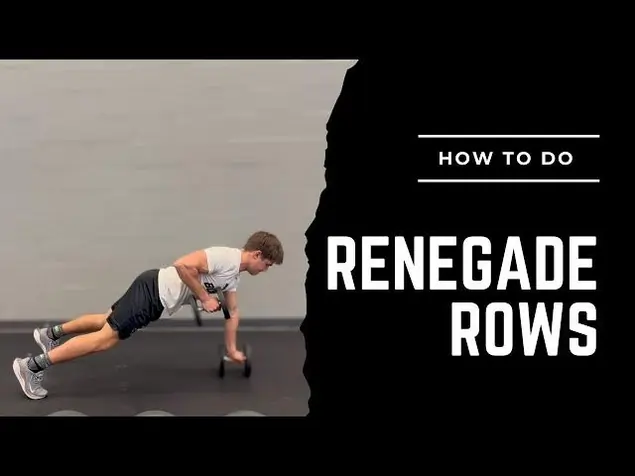
How to do Renegade Rows Video
How to do Renegade Rows?
Here’s how to perform renegade rows step-by-step.
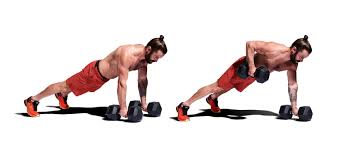
Dumbbells should be positioned parallel to each other on the floor. Place the dumbbells so that they are around shoulder-distance apart while you are in the plank position.
Now, begin by placing yourself on a table with one dumbbell in each hand. Make sure your knees are exactly behind your hips, and your hands are positioned beneath your shoulders.
With your hands and the ball joints of your feet supporting your body, step your feet back one after the other to achieve a complete plank position. From your head to your heels, make sure your body is in a straight line.
Now take a breath and move your weight slightly to the left so that your left arm supports a larger portion of your body weight. Your body shouldn’t twist while doing this. Therefore, be sure that your shoulders and hips stay squarely on the ground.
Bend your elbow and pull the dumbbell in your right hand toward your chest or shoulder as you release the breath and press your right shoulder blade against your spine. At the peak of the exercise, be sure to check your form. You should have your right elbow pointed up and in the direction of the rear of the room.
Return to the starting posture after lowering the dumbbell slowly to the floor.
Now move your weight to the right side and repeat the exercise on one side, using your left arm to draw and raise the dumbbell to your shoulder or chest.
Return to the starting posture after lowering the dumbbell slowly to the floor.
There is just one repetition.
Bring your knees to the floor, release the dumbbells, and sit up to finish the workout after you’ve completed the required number of repetitions.
Techniques for Renegade Rows
When executing renegade rows, bear the following points in mind.
- Avoid twisting your hips. Since this is a stability exercise, try to keep your body as tight as you can.
- Avoid swaying to one side. A shoulder injury can occur from poor technique when moving weights.
- Avoid using your arms to lift. When lifting, always lead with your elbows and tighten your lats.
- Avoid putting too much strain on your lower back by not dropping or sticking up your butt.
- Therefore, avoid craning or lowering your neck since this may cause your spinal alignment to be compromised. From the top of your head to your heels, your spine should make a straight line while remaining neutral.
Avoid using your arms to lift. When lifting, always lead with your elbows and tighten your lats.
Avoid putting too much strain on your lower back by not dropping or sticking up your butt.
Therefore, avoid craning or lowering your neck since this may cause your spinal alignment to be compromised. From the top of your head to your heels, your spine should make a straight line while remaining neutral.
Before starting the activity, make sure to properly warm up.
After a workout, make sure your body cools down correctly.
Benefits of the Renegade Row
- Full-body workout: A workout that engages multiple muscles in the body simultaneously is the renegade row. Latissimus dorsi, Serratus, Rhomboids, Obliques, Rectus abdominus, Anterior deltoids, Forearms, Triceps, Fingers, and Hands are among the renegade row muscles used. Back strength, control, core strength, upper body strength, and body awareness are all improved by using these renegade row muscles.
- Aids in the development of a sturdy core: The renegade row exercise calls for the core to work hard in a variety of ways and throughout the activity’s whole range of motion. A renegade row workout improves the core in a variety of ways by forcing it to maintain balance throughout the activity.
- Enhance unilateral strength and balance: Renegade row workouts have all the advantages of unilateral exercises. Strength and mobility imbalances can be found and corrected with the aid of renegade rows. Renegade rows improve muscular control, promote hypertrophy, and strengthen the connection between the muscles and the mind.
Renegade Row Variations to Try
Renegade rows come in a variety of forms. Among them are:
Renegade row push-up:
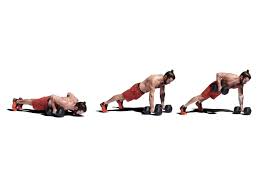
A more challenging version of the renegade row is the renegade row push-up. Renegade row push-ups include repeating the rowing motion on both sides before performing a push-up. You may quickly redefine your strength with push-up renegade rowing.
All of the muscles used in renegade rows are used in push-up renegade rows, although they are exercised more intensely. Renegade push-ups also strengthen the chest’s pectoralis muscles and increase lower back and abdominal isometric contraction, which permits the push-up motion. Renegade push-ups also work the biceps and middle back muscles.
Mountain climber to row:
This is a challenging variation of the dumbbell renegade row. After repeating the rowing motion on each side, you execute mountain climbers on each side in this variation of the DB Renegade Row. There are dynamic movements throughout this DB Renegade Row variant.
It might be really difficult to stay balanced in mountain climbers to renegade rows. Along with all the other advantages of rogue rows and mountain climbers, they can enhance balance and coordination.
Renegade rows safety and precautions:
The following advice will help you do the renegade row workout safely:
Keep your body in a straight line at all times to preserve proper form.
When performing the renegade rows, never let your back waver.
Maintain a straight neck and spine at all times.
Before you begin performing renegade rows, learn the skills from a skilled trainer. This is crucial to avoiding injury.
Avoid lifting large weights that cause you to lose control over your motions. Increase your practice gradually by starting with smaller weights.
Always do a warm-up and cool-down session before and after your renegade rows workout.
Pay attention to your body.
Conclusion:
There are countless ways to make renegade rows difficult. To keep yourself interested and motivated, you can incorporate leaps, burpees, and other dynamic exercises once you have mastered the classic version of this workout and its variations.
FAQs
Why is Renegade Row so difficult?
Kettlebell renegade rows need a lot of balance because the bell can tip. This requires the highest level of core stability and engages shoulder stabilizing muscles. There is no chance that your support will roll when using hex dumbbells; instead, it is more about core strength.
What muscle is hardest to grow?
For most people, calves and forearms are universally considered the hardest muscles to grow. Because they are used constantly every day just from walking, standing, and gripping, they are heavily conditioned for endurance rather than size and are highly resistant to standard weightlifting.
Are renegade rows full-body?
Renegade rows provide a full-body workout by working several muscle groups simultaneously. The exercise is quite effective for general strength and endurance because it works the upper body, core, and even lower body in some forms.
References
- McCoy, J. (2024, February 8). Add renegade rows to your workout for a strong core and back. Bicycling. https://www.bicycling.com/training/a40785296/renegade-rows/
- Renegade Row – how-to video, alternatives & more. (n.d.). https://www.fitnessai.com/exercise/renegade-row