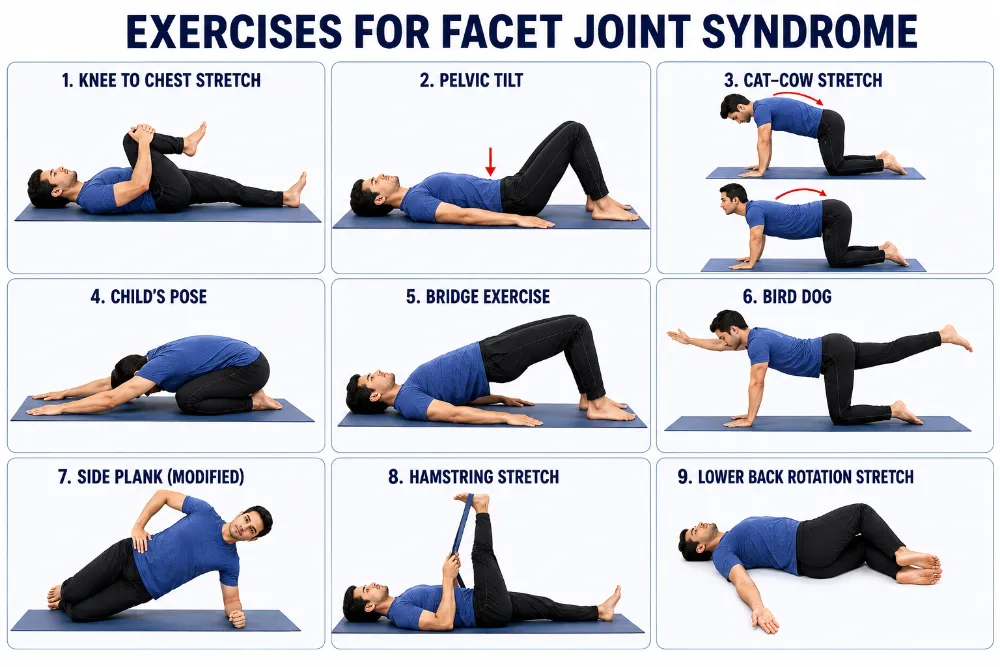
Top 10 Exercises for Facet Joint Syndrome
Introduction:
Facet joints connecting the vertebrae become irritated and inflamed. Facet Joint Syndrome is a common cause of neck and back pain that occurs when the facet joints become damaged or degenerated. These joints play a vital role in providing stability while allowing the spine to bend, twist, and move smoothly. When they are affected by aging, arthritis, injury, poor posture, or repetitive stress, they can become painful and restrict normal spinal movement.
People with facet joint syndrome often experience localized pain in the neck or lower back, along with stiffness, reduced flexibility, and discomfort that worsens with certain movements such as bending backward, twisting, or standing for long periods. In some cases, the pain may radiate into the shoulders, buttocks, or thighs, although it usually does not extend below the knee or into the hands.
This condition can affect people of all ages but is more common in adults over 40 due to age-related wear and tear of the spine. Early diagnosis and appropriate treatment can help reduce pain, improve mobility, and prevent further joint damage. Treatment typically includes physical therapy, posture correction, targeted exercises, pain management techniques, lifestyle modifications, and, in some cases, medical interventions.
With the right combination of exercises and rehabilitation, most individuals with facet joint syndrome can effectively manage their symptoms, restore spinal function, and return to their daily activities with greater comfort and confidence.
Treatment for facet joint syndrome
Facet joint pain treatments
Initially, your doctor will advise conservative approaches, such as self-care, physical therapy, and medication. Many nonsurgical therapies are available, and many of them are usually performed concurrently.
Your doctor may suggest injections, procedures, or surgery if those first therapies are unable to help you control and manage the facet pain.
Exercise For Lumbar Facet Joint Syndrome
Pelvic tilt while lying down
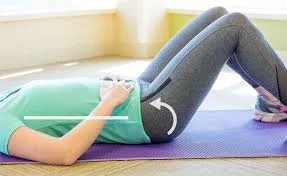
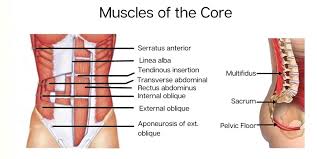
A simple core workout that develops your abdominal muscles and relieves lower back pain is the classic pelvic tilt. Bend your knees, place your feet flat, and keep your arms at your sides while lying on your back. Press your lower back flat on the floor and tighten your stomach.
How to perform
- While lying in bed, place your hand in your lower back’s arch.
- For the first ten seconds, hold your stomach in and raise your buttocks slightly to push into your hand.
- Increase the count gradually until it reaches one minute.
Hold/Repetition: hold it for six seconds, and then let go. Perform 8–12 repetitions.
Standing toe touch
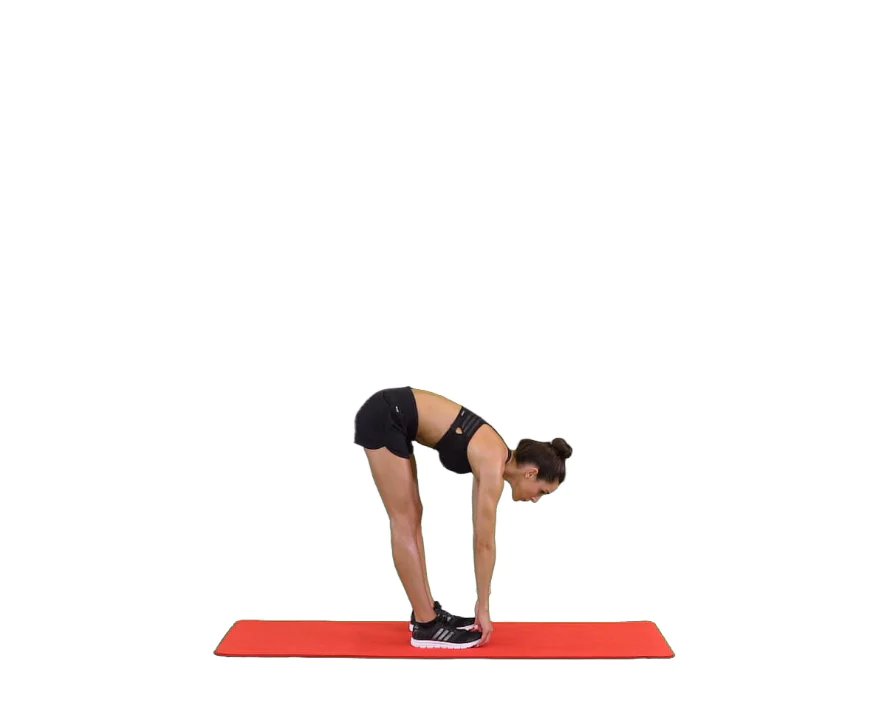
A basic mobility and flexibility exercise that stretches the lower back and hamstrings is the standing toe touch.
How to perform
- Maintain a straight back, stand tall, and place your feet hip-width apart.
- Reach for your toes or as far as is comfortable, tilt at your hips.
- Instead of rounding your back, concentrate on stretching your spine. Use a strap or bend your knees if needed. Remember, gentle stretches, no pain.
Hold/Repetiton: Hold for 20 to 30 seconds, and then gently roll back up
Cat-Cow stretch
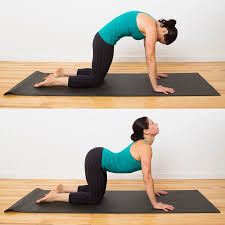
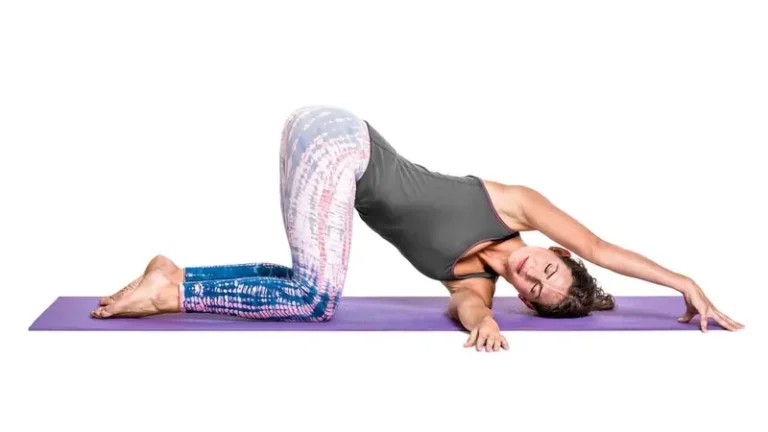
Starting position: Start in a tabletop posture on your hands and knees. Make sure your shoulders, elbows, and wrists are aligned and perpendicular to the floor, and that your knees are exactly below your hips. With your eyes fixed on the ground, center your head in a neutral position.
- The whole spine may be gently mobilized with this traditional yoga posture. Start on your hands and knees, placing your knees behind your hips and your wrists exactly beneath your shoulders.
- As you take a breath, arch your back into Cow Pose, lower your abdomen to the floor, and look up.
- Breathe and put your chin into your chest in Cat Pose, rounding your spine toward the ceiling. Move fluidly between these two postures while keeping your breathing in rhythm.
- Focus on the precise articulation of each vertebra.
Hold/Repetiton: As you repeat for ten to fifteen cycles.
Bird-Dog exercise
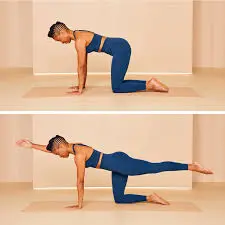
Without putting excessive stress on your neck, the bird-dog is an excellent exercise for improving balance and core stability.
Steps:
- Start in the same tabletop posture as Cat-Cow, on your hands and knees.
- Maintain a flat back and level hips by using your core. Extend your left leg straight back and your right arm straight forward at a slow pace.
- Hold for a little while, paying attention to keeping your body still and your balance.
- Repeat on the opposite side after using control to return to the starting position.
Hold/Repetition: Ten repetitions per side should be your goal.
Glute bridge
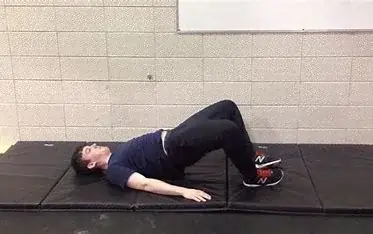
Solid, strong, and powerful glutes are essential for supporting your spine.
How to do:
- To do a glute bridge, lie on your back with your arms at your sides, knees bent, and feet flat on the ground.
- To create a straight line from your shoulders to your knees, contract your glutes and raise your hips off the ground.
- After a brief moment of holding, descend once more.
- Start a plank with your knees and forearms while maintaining a straight back and a strong core.
- You may advance to a complete plank on your toes as you gain strength.
Hold/Repetiton: For 20 to 30 seconds, hold.
Planks
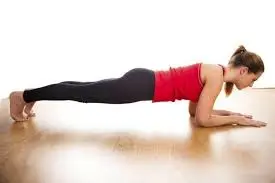
How to do:
- Start a plank with your knees and forearms while maintaining a straight back and a strong core.
- You may advance to a complete plank on your toes as you gain strength.
- Raise your hips so that your body is in a straight line from your heels to the top of your head.
Hold/Repetition: For 20 to 30 seconds, hold.
Wall sits
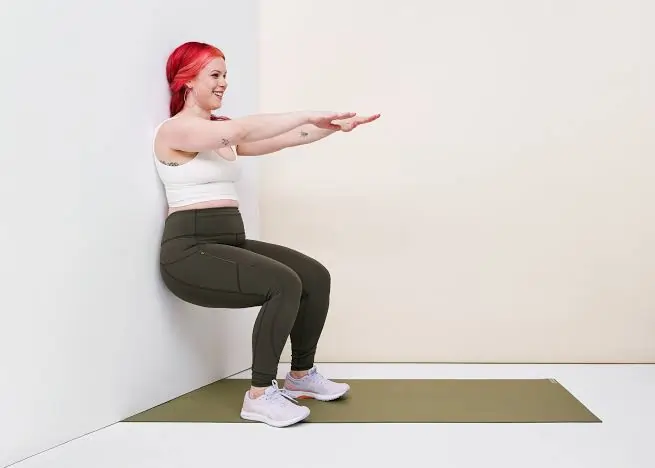
A wall sit is an easy, no-equipment bodyweight exercise that can help decrease blood pressure while strengthening the legs and stabilizing the core.
How to do:
- Strengthens the thighs, hips, and lower back.
- Stand against a wall
- Slide down slowly to make your thighs parallel to the ground.
Hold/Repetition: Hold for 20-60 seconds.
Straight leg raises.
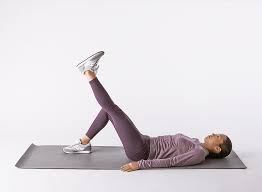
The straight leg raise (SLR) exercise strengthens your quadriceps and hip flexors. To do it correctly, contract your thigh muscles.
How to do:
- Gently push your lower back on the floor and check your core muscles.
- Raising both legs off the ground simultaneously will create a 90° angle between your upper body, thighs, and knee joints.
- After a moment of holding the pose, carefully bring your legs back down.
Hold/Repetiton: Ten repetitions in three sets, with a 30-second break in between
Hip flexor stretch in kneeling position
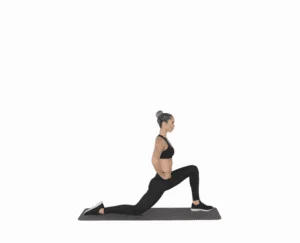
Use these straightforward directions for good form when performing the kneeling hip flexor Stretch to safely and efficiently stretch your hip flexors.
- Maintaining an upright posture, straighten your upper body and gradually press your pelvis forward until the front of your kneeling leg begins to slightly stretch.
- Do the exercise on the opposite side now.
Hold/Repetition: 20 to 30 seconds while continuing to breathe normally.
What is cervical facet joint syndrome?
Cervical facet syndrome may be the cause of your ongoing neck pain. Let’s simplify what that signifies. The vertebrae, which make up your spine, are joined by tiny, flexible joints called facet joints in your neck, which doctors refer to as the cervical spine. Consider them as small, hard joints that allow your neck to easily bend and twist, allowing you to tilt your head or look over your shoulder.
When these joints start to wear out, become irritated, or become inflamed, cervical facet syndrome results. When that happens, even tilting your head might cause pain. The pain might be a persistent, uncomfortable pain that interferes with your everyday activities, such as driving or using a computer. It’s not simply a small irritation.
This illness frequently causes stiffness and radiating pain that can be hard to identify on your own, making it a highly prevalent cause of persistent neck pain. The first step to managing the issue and regaining your sense of self is realizing that a certain joint is the cause.
Facet syndrome exercise for neck pain relief
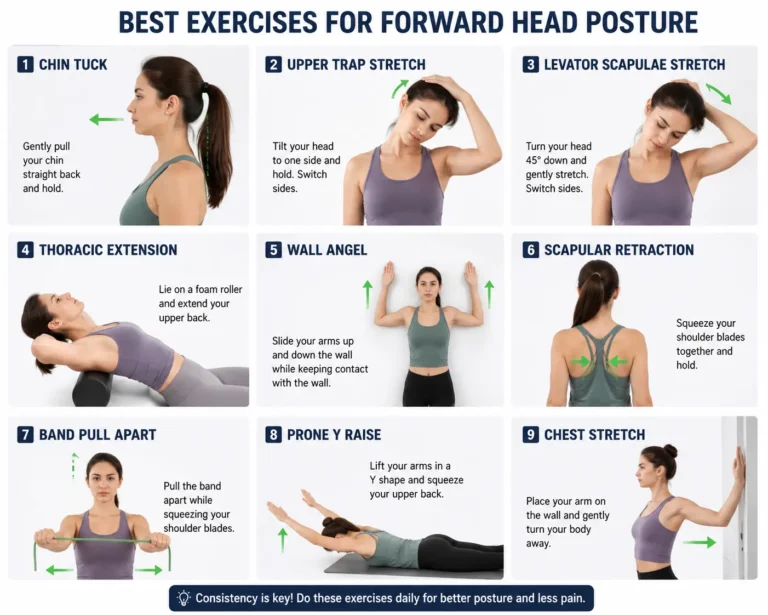
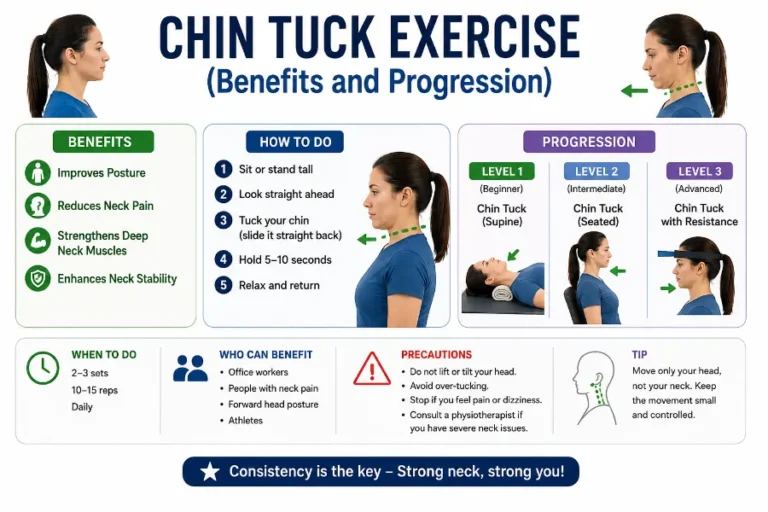
Chin tuck for deep neck strength
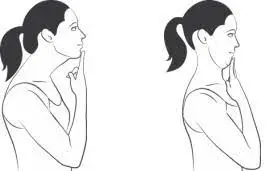
A simple posture and neck-strengthening exercise, the chin tuck helps release tension in the upper back, align the ears over the shoulders, and correct the forward head position.
The deep muscles in the front of your neck, which are important for good posture and stable spines, may be strengthened with this easy exercise.
- Sit or stand upright to begin.
- For direction, place two fingers on your chin.
- As if attempting to create a double chin, softly tuck your chin and draw your head straight back without lowering your head.
- The back of your neck should feel a bit stretched.
Hold/Repetition: After holding this posture for three to five seconds, let go. Try to finish two or three sets of ten reps.
This exercise avoids the forward-head posture that often results in chronic neck pain.
Gentle neck rotations for better mobility
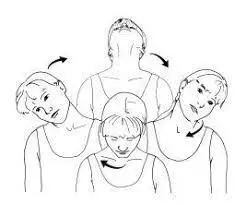
Gently rotating your neck might help restore its range of motion, since stiffness is a typical symptom associated with facet joint problems.
How to do:
- With your shoulders relaxed and down, sit up straight.
- Turn your head to the right slowly and smoothly, just going as far as is comfortable.
- After a brief time of holding, move back to the middle and repeat on the left side.
- Avoiding any uncomfortable or forceful movements is important in this situation.
- Consider it a gentle reminder of how your neck should move
Hold/Repetition: You can increase your ability to rotate your head without pain and reduce stiffness by performing ten to fifteen of these gradual rotations.
Levator scapulae stretch
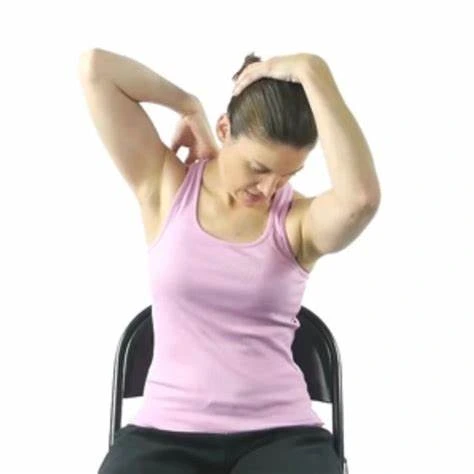
This stretch works a muscle that is frequently a big cause of stress and goes from your shoulder blade to your neck.
How to do:
- Keep your shoulder down while sitting in a chair by using your right hand to grip the seat.
- Turn your head to the left and gently move your chin closer to your chest.
- Now, lightly massage the back of your head with your left hand and move it down toward your left armpit until you feel a stretch down the right side of your neck.
Hold/Repetiton: Hold for 15 to 20 seconds while inhaling deeply. To release tense muscles and reduce pressure on your facet joints, repeat this three times on each side.
Isometric neck exercise to improve stability
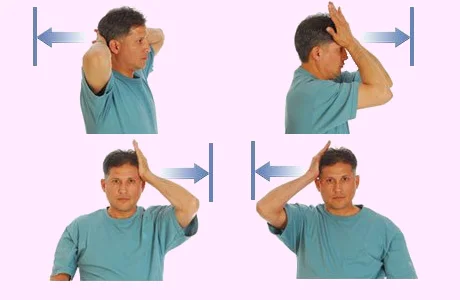
Isometric exercises are a healthy technique to support your neck since they increase strength without moving the joint.
How to do:
- Maintain proper posture whether sitting or standing tall.
- On the right side of your head, place the palm of your right hand.
- Try gently turning your head to the right, but don’t really move; instead, use your hand as resistance.
- The muscles on the side of your neck should start to tighten.
Hold/Repetiton: Hold this little contraction for ten seconds or so, then let go. Do this ten times on each side
This improves muscular endurance and control without straining the sensitive facet joints.
Upper trap and shoulder stretches for relief.
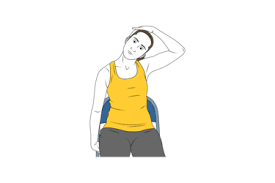
- Almost always, tension in your shoulders rises to your neck. Immediate relief can be obtained by stretching the upper trapezius muscle.
How to do:
- To help lower your right shoulder while sitting or standing, place your right hand behind your back.
- Next, angle your left ear slightly toward your left shoulder.
- You can apply very mild pressure to the side of your head with your left hand to strengthen the stretch.
- A pleasant stretch should extend into your shoulder and along the right side of your neck.
- Tightness that worsens joint pain can be released by performing this stretch a few times on each side.
Hold/Repetiton: Hold for 20 to 30 seconds, then alternate sides.
What aggravates facet joint pain?
Activities that produce a lot of movement of the spine, such as rotating or bending the spine backward, twisting, and lifting, typically aggravate facet pain. Bending forward, on the other hand, could ease the pain.
Additionally, facet pain is more likely to occur in the morning after a restful night’s sleep, after a high level of or after prolonged periods of sitting stationary, such as while driving or sitting in an office chair.
Is there a cure for facet joint pain?
While there is no known treatment for facet joint syndrome, the pain that it causes can be managed.
A higher quality of life can result from targeted care of your back pain using the appropriate mix of physical therapy, exercise, medication, and lifestyle modifications.
Is facet joint syndrome one common kind of arthritis in elderly persons?
Although injuries could worsen it, natural wear and tear is typically the cause. Younger people may also be affected by this syndrome as a result of overuse or injury.
Self care
You may minimize pain by maintaining proper posture and making sure your spine remains in alignment. You might also need to change the way you stand, sit, and sleep every day.
Losing weight is one of the best methods to lessen the strain on facet joints and, consequently, reduce pain.
Non-surgical treatment for facet joint syndrome
- Applying a hot pack.
- Doing low-impact workouts.
- Continuing to be active.
- Providing lumbar curve support.
- Applying a cold pack.
- Using a brace for support.
Conclusion
Facet joint syndrome can cause persistent back or neck pain, stiffness, and reduced mobility, but the right exercises can play a significant role in relieving symptoms and improving function. A well-designed exercise program that includes gentle stretching, core strengthening, posture correction, and mobility exercises helps reduce stress on the facet joints, improve spinal stability, and enhance flexibility.
Consistency is the key to achieving long-term results. Start with low-impact exercises, perform them with proper technique, and gradually increase intensity as your strength and mobility improve. Avoid movements that cause sharp pain or excessive spinal extension, and always listen to your body’s limits.
If your symptoms are severe, persistent, or accompanied by numbness, weakness, or radiating pain, consult a physiotherapist or healthcare professional for a personalized treatment plan. With regular exercise, good posture, and healthy lifestyle habits, many people with facet joint syndrome can reduce pain, improve movement, and return to their daily activities with greater comfort and confidence.
FAQs
What is the best exercise for facet joint?
The knee-to-chest stretch, pelvic tilt, and child’s pose are among the greatest exercises for facet joint pain since they stress mild flexion and core stability. These motions relieve painful pressure by opening up your spine’s compressed joints.
How to heal facet joint syndrome?
Conservative treatments such as physical therapy, core strengthening, heat/cold treatments, and anti-inflammatory drugs are often the first steps in the treatment of facet joint syndrome. Minimally invasive treatments like targeted steroid injections or radiofrequency ablation (RFA) to block pain signals are quite successful if pain doesn’t go away.
What exercises should you avoid with facet joint syndrome?
Movements that force the spine to twist, compress, or bend backward should be avoided if you have facet joint pain since they exacerbate the inflamed joints. Exercises like torso twists, sit-ups, deep bending, hard deadlifts, and high-impact sports like jogging should be avoided.
What is the best sleeping position for facet joint pain?
The ideal sleeping positions for facet joint pain are on your side in a fetal posture or on your back with a pillow under your knees. By “opening up” the facet joints, these positions relieve pressure and lower inflammation. Steer clear of sleeping on your stomach, as this might cause pain in your lower back.
How long do facet joints take to heal?
The degree of a facet joint problem determines how long it takes to recover. With conservative treatment, an acute sprain usually resolves in two to four weeks. Degeneration or chronic arthritis may take up to 12 weeks. You can get back to work within a week after minimally invasive operations.
References
- Kg, M. G. &. C. (n.d.). Exercises for facet joint osteoarthritis. Webpage. https://www.medi.de/en/diagnosis-treatment/arthrosis/facet-joint-osteoarthritis-exercises/
- Specialists, K. P. (2026, July 15). No title. Kentuckianapainspecialists. https://kentuckianapainspecialists.com/cervical-facet-syndrome-exercises/