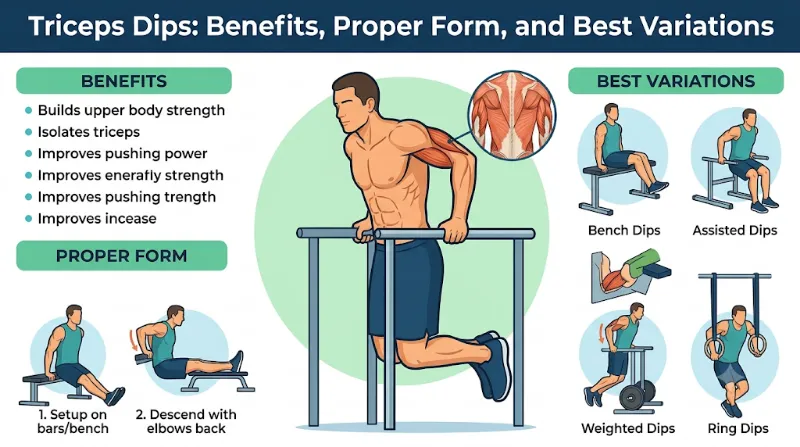
Triceps Dips: Benefits, Proper Form, and Best Variations
Introduction:
Triceps dips are an effective bodyweight exercise that primarily targets the triceps muscles at the back of the upper arms.
Several versions of this easy workout suit your fitness level, and you can do it almost anywhere. Include it in a strength training program for your upper body.
There are dips for beneath the lips and dips for chips. Additionally: triceps dips. Regardless of your level of fitness, you should immediately include these upper-body exercises in your training regimen.
What are triceps dips?
Triceps dips are a bodyweight upper-arm exercise performed using a chair, bench, box, parallel bars, dip machine, or gymnastic rings, involving a pushing motion similar to a reverse push-up. To target your triceps, pecs, delts, and core, position your body belly-up and bend your elbows.
Dips are a flexible workout that may be done outside, at home, or at a facility. Although there are other varieties, such as bench dips, triceps dips, and chest dips, the fundamental technique is the same: using your arms to support yourself, bending your elbows, and lowering yourself until your upper arm is parallel to the floor.
Dips may be a great bodyweight workout if done correctly, but they can also be made more difficult by adding weights or resistance bands.
Which muscles are trained during dips?
Dips primarily work the following muscles and are typically thought of as a triceps and chest exercise:
- Triceps brachii
- Chest muscles (pectoralis major and minor)
- Anterior shoulder muscles (deltoid anterior)
- Upper back (rhomboids and trapezius)
- Abdominal muscles and lower back as stabilizing muscles
Therefore, depending on the variant used, dips are a flexible upper body workout that mainly targets a number of important muscle groups.
This is an explanation of the muscles involved in both chest and triceps dips.
Chest Dips:
The following muscles are the main focus of chest dips:
- Pectoralis Major: The primary chest muscle, especially the bottom fibers.
- The anterior deltoid refers to the muscle located at the front of the shoulder.
- The triceps brachii is the muscle group situated along the posterior aspect of the upper arm.
- The upper back’s rhomboids facilitate shoulder blade mobility.
- The levator scapulae plays an important role in lifting the scapula upward toward the neck.
- The wide back muscle is called the latissimus dorsi.
- Teres Major: Facilitates shoulder movement.
Triceps Dips:
The following muscles are highlighted during triceps dips:
- The primary muscle worked during this exercise is the triceps brachii, which straightens the elbow joint.
- Pectoralis Major and Minor: There is reduced activity in the chest muscles.
- The front shoulder muscle (anterior deltoid) works alongside the triceps to support the movement during dips.
- Rhomboids: Offer assistance while moving.
- Levator Scapulae: Helps keep the shoulder stable.
- Latissimus Dorsi: Used to stabilize the upper body.
Who Should Try Dip Exercises?
- Beginners: Almost anyone with healthy wrists and shoulders can perform bench dips. Start softly, pay attention to form, and work your way up.
- For ladies who want to develop arm definition and upper body tone without the need for heavy equipment, women’s dips are great. They are a wonderful addition to female strength training regimens and help in the development of the type of functional strength needed for daily tasks.
- Older Adults: As they age, modified bench dips with their feet flat on the ground can assist in preserving shoulder mobility and upper body strength. If you have wrist, elbow, or shoulder issues, please see your doctor before beginning. Dips can help with gradual progress when done under the right supervision, but they should not be used in place of medical counsel.
- Working Professionals: If you spend a lot of time at a desk, dips can help prevent the rounded-shoulder posture that desk jobs promote. Three times a week, a 10-minute session promotes improved posture and energy levels throughout the day.
How to do a basic triceps dip:
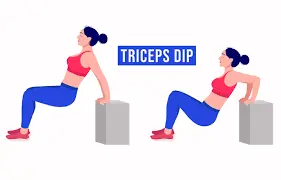
- Take a seat on a chair, step, ledge, bench, or box.
- With your hands slightly outside your hips and your fingers pointing downward, grasp the platform’s front edge.
- Raise yourself till your ass is hovering over the platform’s edge.
- Make sure your legs are fairly straight as you go outside. Then, to work your quadriceps and glutes, consider screwing your little toe into the ground.
- Pull your shoulders down away from your ears, lock your arms, and “hide” your ribs from the ceiling to tighten your midline.
- Bend your elbows straight back and take a breath as you descend toward the floor. Continue lowering while maintaining a straight eye until your forearm and biceps make a 90-degree angle (or as soon as you feel a slight tug in your shoulders or pecs, whichever comes first).
- Exhale while pushing yourself back up to the beginning posture while maintaining a tight midline.
How to Get Started with Dip Exercises:
Although the entry point is far milder than most people realize, dips appear scary. Instead of chasing repetitions during the first several weeks, the objective is to improve movement quality and joint condition.
What You Need to Begin:
You don’t require a gym. For early versions, a kitchen countertop edge, a low bench, or two robust chairs of comparable height can be used. Better still, if you have access to parallel bars or a dip station. When performing bench dips, a yoga mat below provides foot cushioning.
Setting Realistic Goals:
Two to three times a week, begin with two to three sets of five to eight repetitions of a novice version. During the first month, avoid dipping every day since your elbows and shoulders need time to heal. Intensity over days is inferior to consistency over weeks.
Start with the Basics:
The best starting points are assisted dips and bench dips. Learn the controlled descent initially, then as your triceps and chest strengthen, the push back up will come easily. Examine strength training activities to evaluate how dips fit into a well-rounded weekly schedule. Combine dips with free pulls and core movements.
Benefits Of Dip Exercises:
Dips are a very powerful upper body workout that has several advantages for building muscle and strength. The following are the main benefits of including dips in your exercise regimen:
- Strengthens Several Muscle Groups: Dips work the core and back muscles in addition to the triceps, chest, and shoulders. Because of this, dips are a complex exercise that efficiently trains many upper body muscles at once, enhancing general strength and muscular definition.
- Improves Muscular Definition: Doing dips on a regular basis might result in more muscular mass and definition, especially in the chest and triceps. Those who want to enhance the appearance of their arms and upper body will particularly benefit from this.
- Core Engagement: In order to maintain appropriate technique and build the abdominal muscles, dips demand a great deal of core stability. Better general core strength and stability in other workouts may result from this.
- Versatility and Accessibility: Dips may be done at home on firm surfaces or with a variety of equipment. No matter how their gym is set up, people may add dips into their exercises because of this adaptability.
- Progressive Overload Potential: Dips may be easily changed to add resistance as strength grows, for as by utilizing a dip belt with weights. This makes it possible for a training program to advance and change over time.
- Enhances Functional Strength: By simulating movements from everyday life and other sports, dips increase functional strength, which leads to improved performance in a variety of physical tasks.
- Time Efficiency: Dips are a quick and efficient technique to target several muscle groups, which makes them perfect for people who don’t have much time to work out. They have a substantial strength-training impact and may be completed quickly.
Although dips are good, they can put strain on the elbows and shoulders, so it’s important to use good form and proceed gradually to prevent injury. Strength and muscular tone in the upper body may be significantly increased by including dips in a well-rounded exercise regimen.
Best Dip Exercise Variations to Try:
Variations highlight various muscles. Select the ones that fit your objective and current level.
Bench Dips (Beginner):
With your feet on the ground and your hands at your hips, take a seat on the edge of a bench. Lower your body until your elbows bend to a 90-degree angle after sliding your hips off the bench. Press the back button. Three sets of eight to twelve repetitions should be your goal.
Chest Dips (Intermediate):
Lean your chest forward a little while using parallel bars, and let your elbows flare slightly. This moves the focus to the chest. Press up after lowering until your shoulders are slightly below your elbows. Try three sets of six to ten repetitions.
Tricep Dips (Intermediate):
With your elbows tucked close to your sides, maintain a straight position similar to that of chest dips. The triceps take control. Aim for three sets of six to ten repetitions.
Assisted Dips with a Resistance Band:
Place one knee in a resistance band that has been looped over the dip bars. By partially offsetting your body weight, the band enables you to securely increase your range of motion. Excellent for transitioning from bench to bar dips.
Straight Bar Dips (Advanced):
Performed while bending forward over a single straight bar. Strong shoulder mobility is required, and it’s great for developing the front deltoids and chest.
Weighted Dips (Advanced):
Add a light dumbbell between your feet or a weighted belt once you can perform 12+ clean bodyweight dips with ease. Reduce the number of repetitions to four or six and move gently.
Common Mistakes:
Arms To the Side:
The forearms should remain perpendicular to the floor as you descend into the triceps dip, and your elbows should always be pointing backward. In order to prevent putting additional strain on your shoulders, pay attention to whether your elbows swing out to the sides.
Hip Distance:
Place your hands slightly behind your hips. To prevent shoulder pain, make sure the space between your hands and hips doesn’t grow regardless of the variant you select. This implies that for the whole bench dip variant, your back should be near the bench.
Rushing:
You should be lowering and ascending in a controlled manner, pausing at the top to engage your glutes, in order to fully benefit from the triceps dip. Thus, don’t hurry!
What to avoid when doing a tricep dip:
There are five things you should never do when performing tricep dips.
- Don’t dip too low
- Don’t lean forward
- Don’t lock your elbows
- Don’t keep your body upright while performing the dip
- Don’t push from your legs
Conclusion:
That concludes our comprehensive tutorial on the well-known triceps dips. This workout is fantastic since it doesn’t require any particular equipment and can be done at any time, anywhere from the park to your kitchen floor.
The proper form is essential to preventing injury, yet this exercise can be difficult for your shoulders. Well-planned programs can ensure you’re doing it correctly and receiving the greatest results.
FAQs:
What are the benefits of doing tricep dips?
With significant advantages for the entire upper body, tricep dips are a strong compound bodyweight exercise that mainly works the back of your upper arms.
Are dips better than pull-ups?
Pull-ups and dips are complementary exercises that target entirely distinct shoulder mechanics and muscle areas, so neither is inherently “better” than the other.
What are some variations of triceps dips?
Triceps dips, which may be adjusted for varying skill levels, equipment designs, and difficulty levels, target the triceps brachii muscles on the back of your arms.
What happens if I do dips every day?
Your upper body is subjected to significant mechanical stress when you perform dips on a daily basis. Although it may quickly increase the size and strength of your shoulders, chest, and triceps, there is a significant danger of overtraining and injury.
Which muscles are trained by dips?
Dips are a complex upper-body workout that works the triceps, anterior deltoids (front shoulders), and chest (pectorals) while stabilizing the upper back and core.
What’s better than tricep dips?
Depending on your equipment and whether you need to prevent shoulder pain, the optimal substitutes for tricep dips may vary.
How many tricep dips are good?
Aiming for 20 to 40 total dips in a training session (divided into sets) is a good goal for upper-body strength for the majority of healthy individuals, and it should be done two to four days a week.
Your present level of fitness, whether you’re using parallel bars or a bench, and how rigid your technique is are important factors in determining the precise number you should perform.
Do tricep dips hit all three heads?
The lateral, medial, and long heads of the triceps brachii are all affected by tricep dips because any complex activity requiring complete elbow extension activates the whole muscle group.
What dips are best for triceps?
Parallel bar dips (upright form) and chain dips are generally regarded as the most efficient versions for targeting and strengthening the triceps.
References:
- Kassel, G. (2020, September 9). Dip into good form with triceps dips. Greatist. https://greatist.com/fitness/the-lift-triceps-dips
- Bothra, T. (2026, September 19). What are dip exercises? Benefits, types & how to start. Habuild. https://habuild.in/habitology/strength-and-fitness/what-are-dip-exercises
- Hiller, R. (2025, March 2). Dips Exercise – The Correct Execution for the Triceps & Variations. FITNESSKIT GmbH. https://en.fitnesskit.de/en/blogs/calisthenics-knowledge-tips/dips-exercise-proper-form-for-triceps-variations
- Groves, I. (2025, February 8). What muscles do dips work | Types of dips & Benefits. Training Station. https://trainingstation.co.uk/blogs/news/what-muscles-do-dips-work?srsltid=AYCX9vLaId9n4V3zVZfoHdbl1miFb_aWv5ZrjKckfHklS1DOHQ9MkKVd
- Element. (2018, October 17). Tricep Dips: our complete guide. One Element. https://www.one-element.co.uk/tricep-dips/