
Cross-Training
Combining several forms of exercise into your training programs is known as cross-training. Exercises that target three distinct areas should be included, even if many people have a favorite activity: strength, cardio (aerobics), and stretching/flexibility. Overuse injuries will be less likely as a result.
Your body is kept guessing when you switch things up rather than doing the same thing every week, which might increase your level of fitness.
Athletes can also target muscular parts that aren’t typically used in their preferred sport through cross-training. To increase leg strength, for example, a runner can cross-train with cycling and weightlifting.
Benefits
One popular training method is cross-training. Whether you’re a competitive athlete or just want to get fitter overall, it provides many advantages:
- You can work all of your body’s muscles with cross-training. You could sustain fewer overuse injuries since you are not always working the same muscles in the same manner as you would while performing a single athletic activity.
- You may avoid boredom in your workout routine by using a range of activities. This might assist you in keeping to the regimen.
- Your muscles may be able to adjust to new tasks more easily if you exercise different muscle groups.
- In most cases, you won’t have to stop exercising or give up your entire fitness routine if you do get hurt. Depending on what your doctor recommends, you might be able to change or replace your hobbies.
How Cross-Training Works
This is an example of a cross-training schedule:
- Swim laps on Monday.
- Tuesday: Go to the gym and lift weights.
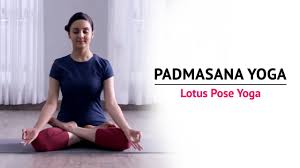
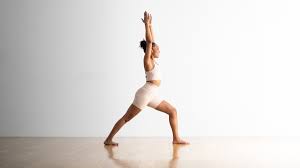
- Practice yoga on Wednesday.
- Thursday: Attend an aerobics exercise that includes workouts to strengthen your muscles.
- Go in-line skating on Friday.
- A full-body workout can also incorporate a variety of exercises, such as aerobic and strength training. In this case, you may walk or jog for ten minutes, lift weights for ten minutes, and then do yoga for ten minutes during a thirty-minute session. Not enough time? You’ll still benefit if you divide it up into shorter, 10-minute portions throughout the day.
At least two days a week should be dedicated to strength training, and most days should involve at least 30 minutes of moderate-intensity cardiovascular activity. Make an effort to perform daily flexibility exercises, such as yoga and stretching.
The perfect cross-training program begins with a warm-up and concludes with a cool-down.
How intense is cross-training?
It is entirely up to you how intense a cross-training exercise is. Your level of fitness and the exercise you select will determine this.
For example, you may increase the intensity by performing higher-impact activities with larger weights or decrease it by strolling instead of jogging.
Which areas are the goal of cross-training?
Depending on the workouts you’re performing, yes. Here’s an example:
Core: Your cross-training routine should include sit-ups, planks, and other core movements.
arms. Biceps, triceps, and other arm exercises using hand weights, weight-related machines, or resistance bands should be part of the patient’s strength training routine. Exercises like chair dips, pull-ups, and push-ups allow you to use your own body weight as resistance.
legs. Leg muscles are used during strength-training movements like squats and lunges. Running, climbing stairs, and other aerobic exercises that use your legs can also help strengthen them.
glutes. Exercises that target your legs, such as squats and lunges, are also beneficial for your glutes.
back. Your back muscles are targeted by pull-ups and rows.
Cross-Training Exercises
Your objectives will determine which cross-training routines work best for you.
For instance, if you’re a runner preparing for a race, your weekly running schedule may consist of:
- During a 30-minute workout, interval training alternates one to two minutes of sprinting with five minutes of steady running.
- Running a longer distance at a slower pace is known as slow distance running.
- Running at the pace you want to maintain throughout the race is known as pace running.
- In addition to strength training, runners can also take part in other aerobic activities like swimming or cycling.
For overall health, select exercises that:
- You find enjoyable
- Work toward your level of fitness.
- Are practical for you.
Take into consideration the American Physical Therapy Association’s (APTA) beginner-level programs listed below for the strength and flexibility components of your routine. Using any of the routines:
Before beginning, make sure you warm up for a few minutes. March in place or walk quickly.
Don’t hold your breath throughout any workout; instead, breathe.
Maintain proper posture and form. Using less weight with proper form is preferable to using greater weight with bad form.
Before beginning a new fitness program, it’s usually a good idea to see your doctor, particularly if you’re new to working out.
Next, consider the kinds of exercises that might assist you achieve your objectives. There are countless options.
flexibility. Stretching, Pilates, or yoga
- Aerobic. Zumba, jogging, climbing stairs, dancing, cycling, swimming, in-line skating, or walking
- Strength. Resistance training with bands or tubes, bodyweight workouts like push-ups, or weightlifting with free weights or machines at least twice a week
30-minute home strengthening program
Phase 1 of strengthening exercises involves moving from your beginning position to the end position (e.g., lifting a dumbbell or your body weight), and Phase 2 involves returning to the starting position (e.g., moving the dumbbell back down). Count aloud “1, 2” as you finish the move during Phase 1. Count “1, 2, 3, 4” throughout Phase 2. The patient may avoid holding their breath by counting out loud. Phase 2 should require more time than Phase 1.
The following components are part of the APTA’s starter strengthening routine:
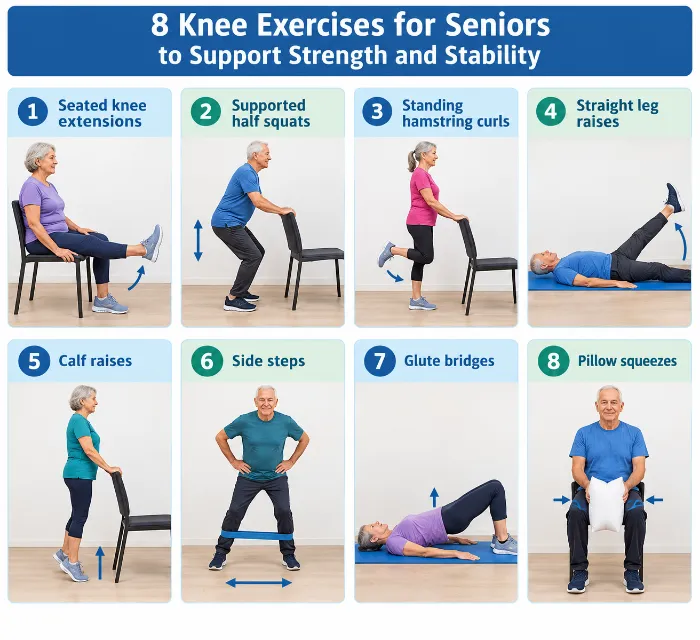
Bridge exercise
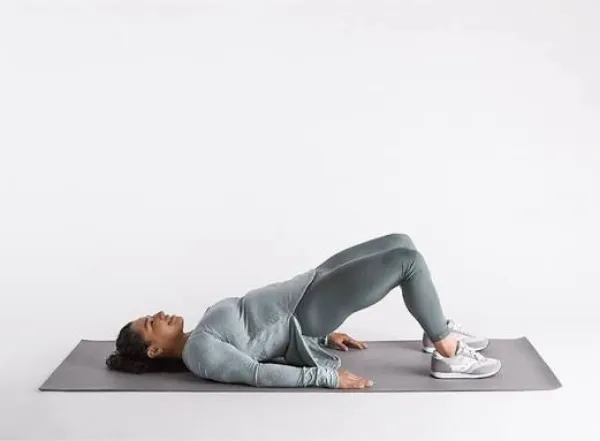
- With your feet flat and hip-width apart, lie on your back on the ground with your knees bent.
- With your hands facing down, put your arms by your sides.
- Lift your hips off the floor gradually while using your core to create a straight line with your knees, hips, and shoulders.
- At the top, tighten your glutes and hold the position for a short while.
- Return your hips to the floor slowly and gently.
- Continue until 10 to 20 repetitions are reached
Calf raise
- Standing on a yoga or exercise mat, place your feet shoulder-width apart and point your toes forward.
- Keep your shoulders down, your back straight, and your abs tight.
- Raise your heels slowly while keeping your knees extended but not locked.
- Take a moment to stand as near to the tips of your toes as you can.
- Lower your heels to the ground to return to the starting position.
Back extension
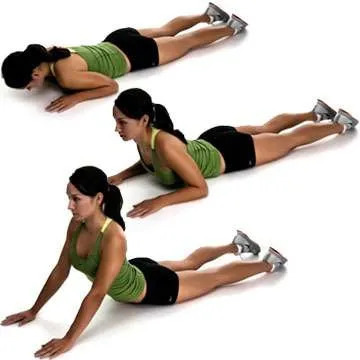
- In a roomy and comfortable space, lie on your stomach with your hands by your sides.
- Squeeze your glute muscles and compress your lower back to elevate your chest off the floor as you exhale.
- Squeeze the lower back muscles while pausing for a moment at the top.
- Breathe in, then release the tension in your lower back and glutes to slowly drop your chest back to the floor.
- 2 or3 sets of eight to fifteen repetitions should be your goal.
Bicep Curl
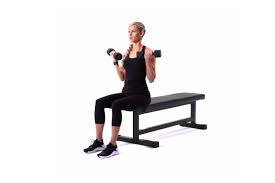
- Start with your feet hip-width apart and a high posture. Continue to contract your abdominal muscles.
- Each hand should hold one dumbbell. With your palms facing front, let your arms drop to the sides of your body.
- Bend at the elbow and raise the weights until the dumbbells are close to your shoulders while maintaining a stable upper arm and relaxed shoulders. Alternatively, elevate the dumbbells to your forehead or eyeballs for a full range of motion. Keep the patient’s elbows tucked in tight to your body.
- Breathe out as you raise.
- Return the weights to their initial position.
- Stay within three to five repetitions of complete failure while performing the required number of reps.
Chest Press
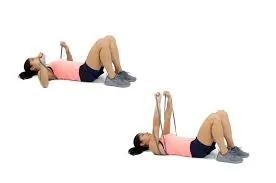
- Hold a dumbbell in each hand while lying on the floor or a bench. patient’s feet may be on the floor or the bench if you’re using one. You can safely and correctly do traditional heavy object-lifting workouts like chest presses with the support of a weight bench.
- With your elbows bent at a 45-degree angle, place the dumbbells at your shoulders. To prevent strain on the shoulder joint, keep your elbows in front of the shoulder line. The patient’s thumbs should be around the grip, palms facing front.
- Tilt your chin slightly toward your chest while contracting your abdominal muscles.
- In an explosive motion, push the weights up while inhaling without locking your elbows. The weights should nearly meet over the top of your chest and form a shallow arc.
- As long as you don’t use sudden or powerful force, it’s acceptable to straighten your arms. Keep your head and shoulders on the floor or seat.
- Breathe in, regulate the return to the starting position, and lower the weights while using your muscles.
FAQs
What is cross-training for beginners?
Cross-training is essentially incorporating many forms of exercise into your fitness routine rather than focusing on a single activity. In this case, a runner may incorporate weightlifting, cycling, or swimming into their weekly routine. Building strength, flexibility, endurance, and balance in various muscle groups is the aim.
What is the benefit of cross-training?
Cross-training can help you stay at your current level of fitness and return to “normal” as quickly as possible. Additionally, cross-training is a great advantage for people who might have sustained an injury along the route. Runners, for example, usually run in a straight path.
Is walking better than cross-training?
Cross trainers offer significant cardiovascular health advantages, just as many other aerobic exercises. Frequent use of a cross trainer is associated with increased endurance, improved general aerobic fitness, and overall body toning.
What is the recommended number of days per week for cross-training?
Cross-train once a week if you run 4 or five times a week. Cross-training two times a week is advised if you run three times a week. The duration of each cross-training session should be between thirty and fifty minutes.
What diet is recommended by CrossFit?
Consume some fruit, meat, veggies, nuts, and seeds, as well as little carbs and sugar. Limit consumption to amounts that will promote physical activity but not body fat. These two phrases encapsulate a dietary strategy that, when combined with exercise, produces amazing fitness and health.
References
- Watson, S., & Whitbourne, K. (2025, March 25). What to know about Cross-Training. WebMD. https://www.webmd.com/fitness-exercise/cross-training
- Cross-training – OrthoInfo – AAOS. (n.d.). https://www.orthoinfo.org/staying-healthy/cross-training/