Cawthorne-Cooksey Exercises
What are Cawthorne-Cooksey exercises?
Cawthorne-Cooksey exercises are vestibular training activities that can benefit people with balance issues, such as vertigo. Each ear’s balance components work together to provide the brain with the signals required for proper balance. When either balance center is injured, the patient may feel dizzy.
Cawthorne-Cooksey exercises assist in increasing tolerance. The more regularly they are performed, the faster your problems will resolve.
How to use the exercises?
- Twice a day, the exercises should be done for around ten minutes.
- To get the most out of the exercises, you should do them every day.
- Avoid overdoing the workouts. Take a break if the patient’s symptoms are too bad.
- Start with exercise 1 and progress through the exercises in ten minutes.
- If an exercise causes you to feel unsteady, lightheaded, or unbalanced, continue doing it for the remaining ten minutes.
- Every time, carry out the activities as instructed above. Until you can perform the exercise in question without experiencing any symptoms, do not proceed to the other exercises.
- Continue doing the aforementioned exercises until you can do them all and maintain your activity level over time.
- If at all possible, try to apply some of the ideas to your daily life.
- In the event that your symptoms recur, you might resume exercising.
What Is Vertigo?
Vertigo is a sensation of tilting or whirling, even while at rest. This occurs when your body’s perception of its location in space is disrupted. Vertigo is classified into two types: peripheral, which arises as a result of inner ear malfunction, and central, which is caused by a brain condition such as an infection, stroke, injury, or tumor.
Common symptoms of vertigo are:
- Nausea and vomiting.
- Dizziness
- Headaches
- Ringing in the ears.
- Fullness of the ears
- Motion Sickness
While vertigo may go away on its own, Cawthorne-Cooksey exercises can help you manage your vertigo or balance problem symptoms. Your doctor can use audiometric testing to determine if you have an issue.
What Are the Causes of Vertigo?
Many medical diseases can induce vertigo, including Meniere’s disease (fluid buildup in the ear), labyrinthitis (inflamed or infected inner ear), or benign paroxysmal positional vertigo (produced by a shift in the head’s posture). Some more prevalent causes of vertigo are:
- Diabetes
- Head injuries.
- An irregular heartbeat
- Low blood pressure.
- Migraines
- Multiple sclerosis
- Stroke
What is Vestibular Rehabilitation?
The goal of vestibular rehabilitation (VR), an exercise-based therapy, is to stimulate the central nervous system to compensate for inner ear issues.
Your audiologist will collaborate with you to develop a treatment plan after a comprehensive assessment, which may involve at-home exercises.
The head and eye motions used in VR workouts are crucial for retraining and engaging the vestibular system.
For the majority of individuals with vestibular system abnormalities, virtual reality (VR) has proven to be more beneficial than general exercises in alleviating imbalance symptoms.
Cawthorne-Cooksey exercises
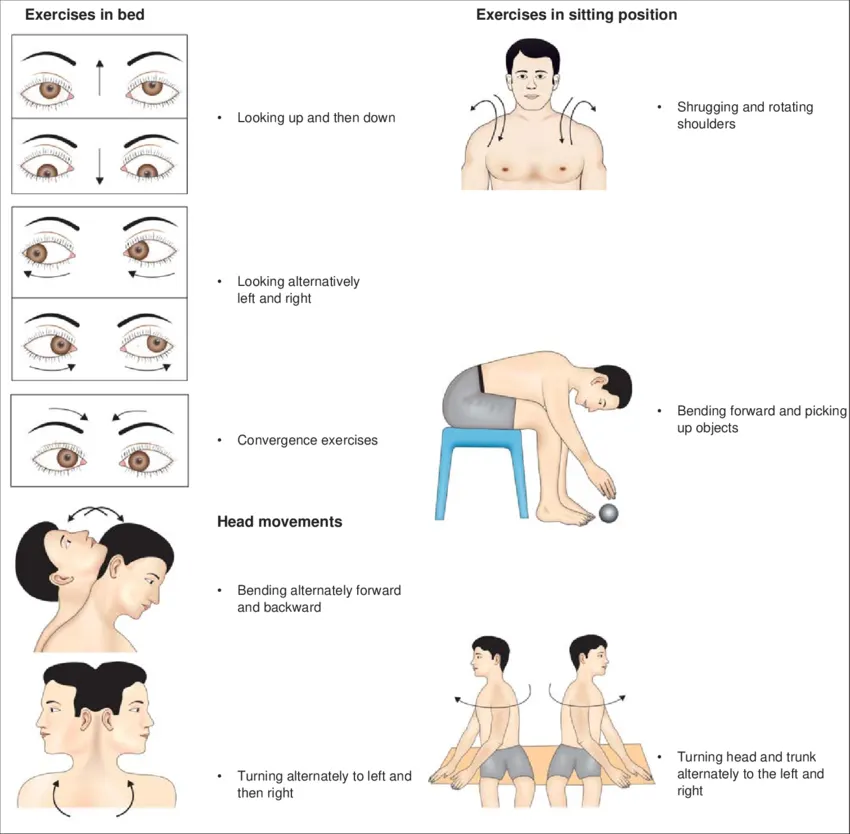
Exercise set 1 – Supine or sitting:
Eye movements: move more quickly after beginning slowly.
- Rising and falling
- From side to side
- Pay attention to the finger’s movement from 60 to 30 cm from the face
Head movements: Move more quickly after starting slowly. Try closing your eyes later.
- Bending both forward and backward
- Swiveling back and forth.
Exercise set 2 – Sitting:
- Head and eye motions as described above
- Circling and shrugging one’s shoulders
- Bending down to get items from the floor
Exercise set 3 – Standing:
- The above eye, head, and shoulder motions
- Switching between the sitting position and the standing position while keeping your eyes open and closed
- Throwing a little ball above eye level from hand to hand
- Throwing a little ball beneath the knee from hand to hand
- Turning around between sitting and standing
What Are the Benefits of Vestibular Rehabilitation?
The following are some advantages of using the Cawthorne-Cooksey routine and other exercises for balance disorders:
- Diminished symptoms of vertigo
- Better equilibrium
- Reduced chance of injury or falling
- Improved vision
- Enhanced power
- Return to regular operations
- A higher standard of living
FAQs
Are Cawthorne-Cooksey exercises effective?
Cawthorne-Cooksey exercises are unique exercises that can help overcome disequilibrium problems in numerous situations. The goal of these workouts is to develop a tolerance mechanism; the more consistently and slowly they are performed, the sooner the symptoms go away.
What are the BPPV Cawthorne exercises?
Eye Exercises: Look up and down 20 times, first slowly and then fast. 20 times, looking from one side to the other, first slowly and then rapidly. Head Exercises: 20 times, slowly and swiftly bend your head forward and backward while keeping your eyes open. Twenty times, turn your head from side to side, first gently and then fast.
What are Cawthorne-Cooksey exercises?
Cawthorne-Cooksey exercises are unique exercises that can help overcome disequilibrium problems in numerous situations. The goal of these workouts is to develop a tolerance mechanism; the more consistently and assiduously they are performed, the sooner the symptoms go away.
What vitamin deficiency causes vestibular problems?
Lack of vitamins is one of the causes of vertigo, which patients characterize as a “feeling of turning.” The Otolaryngology and Head & Neck Surgery Specialists at Yeditepe University Hospitals highlighted the most recent findings by stating, “Iron deficiency anemia, vitamin B12 deficiency, and D deficiency
References
- Mousseau, J. (2026, March 23). What are Cawthorne-Cooksey exercises? WebMD. https://www.webmd.com/brain/what-are-cawthorne-cooksey-exercises
- Department of Audiovestibular Medicine, St. George’s Hospital. (n.d.). Cawthorne-Cooksey exercises information for patients. In Department of Audiovestibular Medicine, St. George’s Hospital (pp. 1–8). https://www.stgeorges.nhs.uk/wp-content/uploads/2019/03/Cawthorne-Cooksey-Exercises.pdf
- Vestibular Rehabilitation Cawthorne-Cooksey Exercises – United Lincolnshire Hospitals. (2025b, August 5). United Lincolnshire Hospitals. https://www.ulh.nhs.uk/patients/patient-information-library/vestibular-rehabilitation-cawthorne-cooksie-exercises/