Best Exercises for Forward Head Posture
Introduction:
Forward head posture (FHP) is a frequent problem caused by hunching over computers or staring down at phones for extended periods of time. Deep neck flexors become weaker, and the muscles in the neck and chest tense as a result of this imbalance. These muscles can be strengthened and stretched with certain targeted exercises, which will improve your alignment and reduce related pain.
Headaches, shoulder stress, neck pain, reduced range of motion, muscular fatigue, and even breathing issues can eventually result from a forward head position. If untreated, it could result in long-term pain and impair general posture and movement effectiveness.
Fortunately, several exercises can assist in correcting forward head posture by extending tight muscles in the neck and chest and strengthening the shoulder, upper back, and deep neck flexors. Frequent use of these exercises can increase flexibility, lessen pain, improve spinal alignment, and encourage better posture when doing regular tasks. When combined with proper ergonomics and body awareness, forward head posture exercises may help restore balance and support long-term neck and spine health.
When the head is positioned in front of the body’s center line instead of directly above the shoulders, it is referred to as forward head posture. This imbalance is often associated with sedentary lifestyles, repetitive daily routines, long-term screen use, and poor workstation ergonomics. The muscles of the neck, shoulders, and upper back must exert more effort to maintain stability as the head advances, which increases strain and pain.
FHP can lead to:
- Tension Headache
- Osteoporosis (and associated fractures)
- Limited shoulder range of motion
- Cervical spine arthritides
- Pain in the shoulder blades
- Disc bulging
How can you determine whether your head posture is forward?
It’s easy; just take a quick test.
With your back to a wall, position your heels with your shoulders apart.
Make sure your shoulder blades are in contact with the wall as you press your buttocks against it.
Squeezing your shoulder blades together can help you line your shoulders with the wall and achieve a more neutral posture.
Ensure that the back of your head is in contact with the wall.
If not, you should try to change the way your head is positioned forward.
Forward Head Posture Video
Muscles Involved in Forward Head Posture:
A forward head posture is caused by an imbalance in the muscles of the neck, shoulder, and upper back.
Among the weakened muscles are:
- The muscles of the upper back, or rhomboids
- Serratus anterior, which connects the shoulder blade to the side of the ribcage
- The posterior rotator cuff, or the rear part of the shoulder
- Mid-back lower trapezius
- Tight muscles include:
- The base of the skull, or the suboccipitals
- Sternocleidomastoid (front and side of the neck)
- Upper back (upper trapezius)
- Major and minor pectoralis (chest muscles)
- Levator scapulae (shoulder blade to neck)
- Shoulder blade area, or subscapularis
- Latissimus dorsi, or mid-to-lower back
Causes:
- Poor posture
- Weakness of your neck muscles
- Previous neck strains or sprains
- Sleeping with your head elevated too high on pillows
- Frequently dozing off on a couch with your head resting on the armrest
- Extended computer use
- Extended cellphone use
- Prolonged driving
- Incorrect breathing habits
- Carrying heavy backpacks
- Engaging in sports where one side of the body is used dominantly, such as golf, tennis, hockey, baseball, etc.)
- Some occupations—such as hair stylists, massage therapists, writers, computer programmers, painters, and others—are especially vulnerable because of the repeated motions of their bodies.
Symptoms:
- Muscle tightness
- Overly rounded shoulders, or kyphosis
- Tightness or soreness in the neck
- Dowager’s Hump
- Back pain
- Muscle spasm
- breathing difficulties
- Inadequate Balance
- Migraines and headaches
- Tingling and numbness in the hands and arms
- Temporomandibular joint (TMJ) pain
Side effect:
FHP can change the muscles in your neck, shoulders, and upper back that support your head.
Misaligned posture can cause these muscles and connective tissue to become overworked. Muscle strength and length are altered as a result. The muscles at the rear of your neck lengthen and tighten, while the muscles at the front of your neck become weaker and shorter.
The tendons, ligaments, and nerves connected to those muscles are also impacted by FHP.
Among the possible side effects are:
- Neck pain
- Muscle tension
- Reduced neck range of motion
- Headaches
- Back pain
- Temporomandibular joint pain in the jaw, numbness and tingling in the hands and arms, and diminished control over balance
- Muscle spasm
How to fix a forward head posture?
When your head is positioned with your ears in front of your body’s vertical midline, it’s known as forward head posture (FHP). Your ears align with your shoulders and midline when you have a normal or neutral head position.
Among other adverse consequences, FHP may result in stiffness, neck pain, and an uneven stride. It is also commonly associated with rounded shoulders, or kyphosis.
The good news is that you can typically correct it by performing strengthening and stretching activities and paying attention to proper posture, which reduces adverse effects and improves posture.
Because it is caused by prolonged bending toward a computer screen or hunching over a laptop or cell phone, FHP is also known as “text neck” or “nerd neck.” It is also linked to the aging-related decline in muscle strength.
Exercise to try:
Many of the workouts and stretches intended to combat FHP are easy to incorporate into your everyday practice. Additionally, deep breathing helps improve your posture.
To begin with, here are a few:
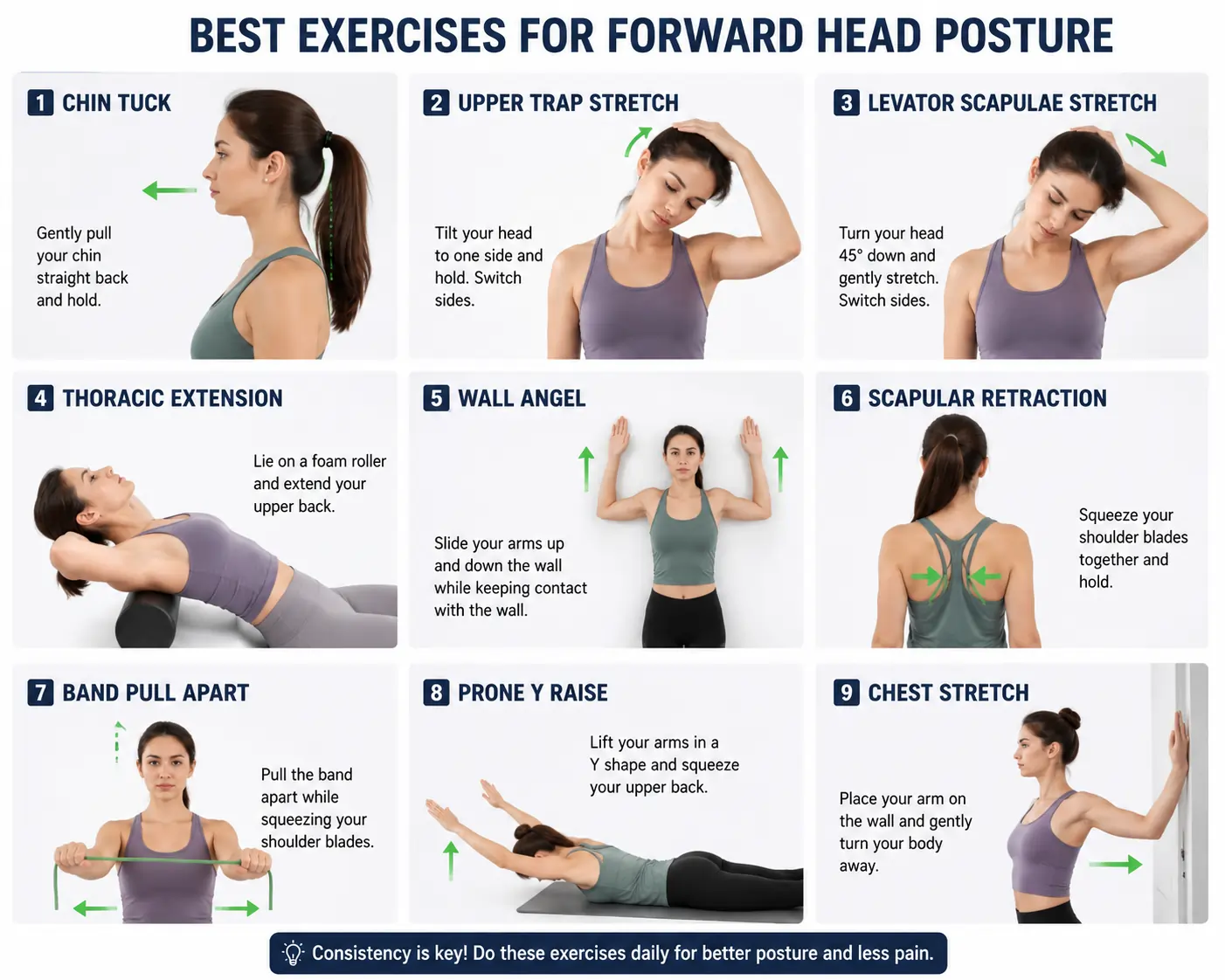
Chin Tuck:
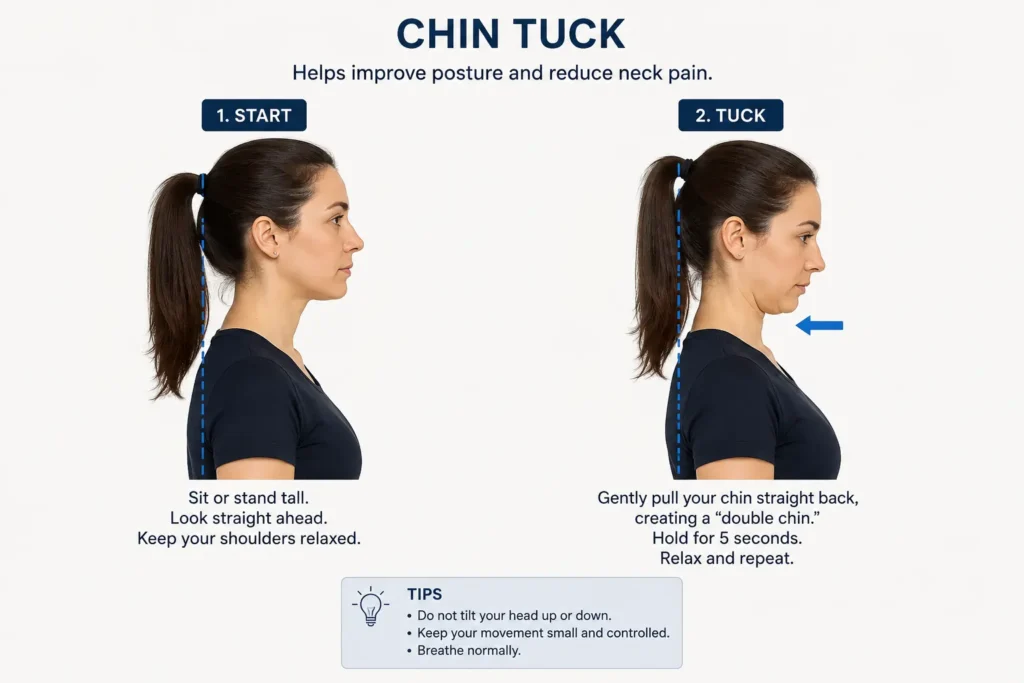
Chin tucks may be done almost anywhere, whether you’re seated or standing. It strengthens the muscles in your neck.
- Keep your chin parallel to the floor
- Keep your head straight.
- To make a double chin, pull your chin back toward your chest.
- Keep your chin tucked in and move the back of your head away from the base of your neck.
Take three deep breaths while maintaining this position.
Repeat with your chin in its typical posture.
Chin tucked in supine position:
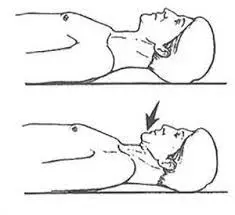
Doing this stretch right before getting out of bed in the morning is a wonderful idea. Place a small towel roll beneath your neck and lie flat on your back.
Put your chin in.
Repeat with your chin in its typical posture.
Standing with your chin tucked against a wall:
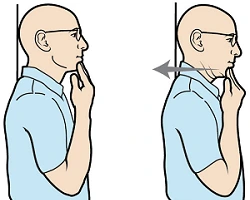
This exercise will help you with your posture.
- Place your head, back, and shoulders flat on a wall.
- Put your chin in.
- Hold for a short while.
- Repeat with your chin in its typical posture.
- From the same starting posture, put both arms, palms out, against the wall.
- You should raise and lower your arms in relation to the wall.
- Tuck the two fingers of one hand into your chin, whether standing or sitting.
Gently press with your other hand on top of your head until you experience a stretch, and bring your head closer to your chest. Hold the stretch for 20 seconds.
One-arm pec stretch-At a wall (Do both sides):
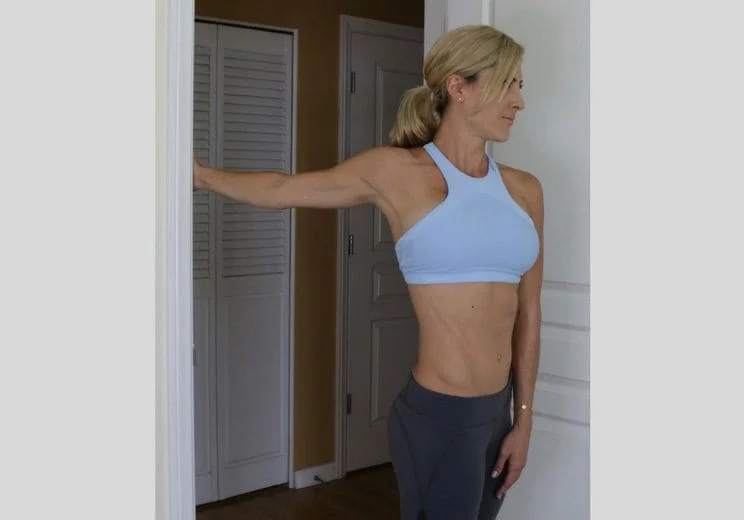
- Stretch one arm behind you with the palm on the wall as you approach a wall.
- Do not arch your back; instead, pull in your stomach.
- Lean forward now, a little away from the outstretched arm.
- Your chest should feel stretched.
- Hold for thirty seconds.
- Continue on the opposite side.
- Be sure to extend your chest as well as your shoulders. Adjust the position’s elevation to focus on the muscles in your chest.
Foam Rolling of the Thoracic Spine:
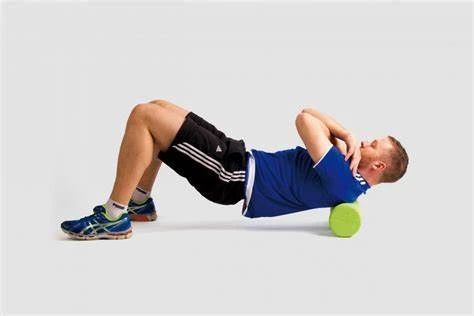
This is an excellent method for releasing tension in the upper back.
- Place a foam roller beneath your upper back while lying on your back with your hands behind your head.
- Roll up and down softly, starting at your mid-back and working your way up to the top of your shoulders.
- Keeping your core firm, roll with your legs.
- Roll gently and slowly; don’t rush.
Stretching the Upper Trapezius and Scalene:
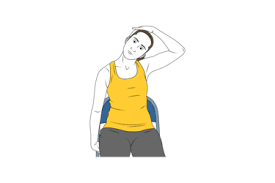
The neck and upper back muscles (Scalene & Upper Trapezius), which can become quite tight in people with forward neck syndrome, will be stretched out by this.
- Either rise or take a seat to begin.
- Place one hand behind your back and place the other on the other side of your head.
- Now bring your head down to your shoulder.
- Gently push your head down with your hand on top for a deeper stretch.
- Hold for 20 to 30 seconds after doing both sides.
Yoga pose for neck pain:
Child’s pose exercise
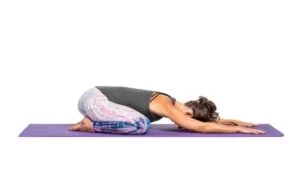
Numerous yoga poses can ease shoulder and neck pain and strain.
Here’s a straightforward example:
- Align your feet with your hips when you stand.
- Slowly lean forward while gently bending your knees.
- Put your hands on the ground or on your lower legs.
- Allow your head and neck to rest while tucking your chin in.
- To reduce tension, move your head side to side or in circles if you can.
- Hold the position for at least a minute.
- Elevate your arms and head last as you lift your spine to a standing position.
Posture alignment:

In addition to reducing pain, better posture increases flexibility and strength. Numerous exercises are beneficial.
Understanding what good posture is when standing, sitting, or walking is a fantastic place to start.
Maintaining proper posture is particularly crucial if you spend a lot of time at a desk using a computer. To maintain proper posture while working:
- Make use of a chair that provides back support.
- Place your keyboard so that your hands and wrists are not stretched; keep your feet flat on the floor; use a mouse that doesn’t strain your wrists; and put your screen at eye level.
- Proper posture requires awareness as well as practice. Try to improve your slouching posture by exercising and adopting healthy habits. To avoid bending over your phone or other screen, for instance, place it at eye level.
Other treatment:
Exercise is usually helpful in reducing FHP-related pain. Your posture is also improved by exercise.
For assistance in creating a customized workout regimen, you might wish to speak with a chiropractor, occupational therapist, or physical therapist. They can also assist you in improving your workstation and learning more efficient methods to stand or sit.
There were no visible variations in the outcomes of a 2017 study that examined various forms of exercise and stretches. FHP was improved by all of the workout regimens.
Ergonomics:
Making sure your computer monitor is positioned correctly to keep your neck in a neutral and relaxed posture while you work is the most crucial thing you can do to enhance your workstation if you spend a lot of time sitting at a computer.
Make sure your screen’s top third is at eye level.
The ideal distance between your display and your face is 18 to 24 inches.
Although exercise was found to be more effective, another 2017 study indicated that using kinesio tape was also beneficial in treating FHP.
Conclusion:
Exercises for forward head posture are a good approach to create improved posture generally, lessen pain and stress in the muscles, and improve neck and shoulder alignment. People can improve mobility, correct postural imbalances, and avoid future pain by regularly engaging in stretching and strengthening activities.
These exercises can greatly enhance long-term spine health, function, and quality of life when paired with appropriate ergonomic practices and frequent exercise.
FAQs
How quickly can forward head position be corrected?
Combining daily workouts to strengthen underutilized neck muscles, regular stretching to relieve tension, and ergonomic workplace modifications is the quickest approach to correcting forward head posture.
Forward head position is caused by which weak muscles?
Scapular stabilizers (the rhomboids and middle/lower trapezius) and deep neck flexors (such as the longus capitis and longus colli).
Is the forward head permanent?
It is usually treatable with targeted stretches, strengthening exercises, and regular ergonomic adjustments because it is often caused by everyday routines, muscle imbalances, and prolonged sitting.
How fast can the forward head position be corrected?
The fastest method to correct a forward head posture is to combine strict ergonomic changes to prevent repetitive strain with regular corrective exercises to strengthen weak neck and upper back muscles. Since “text neck” takes years to form, the secret to swiftly fixing it is regularity.
Is it possible to correct forward head position when sleeping without a pillow?
Forward head posture cannot be corrected by sleeping without a pillow; however, it can be beneficial if you sleep on your stomach most of the time. Removing the pillow, however, typically worsens neck pain and spinal alignment in back or side sleepers.
Which sleeping position maintains a forward head posture?
Sleeping on your back is the ideal position. Without putting your head forward, lie on a firm mattress with a single, thin pillow or cervical roll, maintaining the natural curve of your neck. To naturally lower your shoulders, place half of the padded surface behind your head and the other half beneath your upper back.
References:
- Hecht, M. (2020, July 24). How to fix a forward head posture. Healthline. https://www.healthline.com/health/bone-health/forward-head-posture
- McQuilkie, S., DC, & McQuilkie, S., DC. (2024, November 21). How to fix forward head posture – 5 exercises. Back Intelligence (Creators of PostureFlow App). https://backintelligence.com/how-to-fix-forward-head-posture/
- Checking your browser – reCAPTCHA. (n.d.). https://pubmed.ncbi.nlm.nih.gov/38302926/