Wrist Joint Mobilization Technique
Definition:
The body’s joints are treated with passive skilled manual therapy techniques. In the therapist’s “toolbox,” one “tool” is used only when a comprehensive assessment has shown that joint mobilization is required. More successful when paired with a proactive rehabilitation program.
Indications
- Joint hypomobility.
- Moving the column of carpal bones either palmarly to encourage wrist flexion or dorsally to encourage wrist extension is the mobilization. These methods can also be used to treat hypermobile wrists after extended immobilization (casting).
Contraindications
- The goal of wrist and hand mobilization is to improve hand function or restore normal joint range of motion.
- The following considerations should be considered when moving the wrist and hand: unstable joint.
- Healing a joint that is nearby or involved in a fracture.
- Acute inflammation.
- Bony illness
- The mid-position should be used to mobilize the radioulnar joint. Since pronation often has a higher functional value than supination, restoring pronation is the top priority.
- The hand works better when the wrist is somewhat extended, allowing the long flexors of the fingers to provide a firmer grip than when the wrist is flexed. Eating, however, may be challenging if wrist flexion is restricted since it is required for some tasks, such as putting food in the mouth with a spoon.
- The distal palmar arch is deepened, and pulp-to-pulp pinching of the thumb and little finger is made possible by flexion and lateral rotation of the fifth metacarpal joint.
- Improving the thumb’s range of motion and returning it to a functioning posture will require immediate attention.
- For the thumb to approximate the tips of the fingers, there must be sufficient palmar abduction and opposition at the CMC joint.
- Therapists should take into account the patient’s usual recreational activities and activities of daily life.
- Enhancing grasp, pinch grip, and finger flexion before extension is crucial.
- After an accident or surgery, hands and wrists with limited range of motion can be effectively restored with a combination of thermal ultrasound and joint mobilizations.
- A broad distraction of the radiocarpal joint, including both rows of carpal bones, is the first step in performing wrist mobilization. To achieve complete range of motion, each carpal bone must be mobilized separately following the overall mobilization.
Grade
- Grade I: rhythmic oscillation with a small amplitude, executed at the start of the range. Mainly used to lessen muscular spasms and relieve discomfort.
- Grade II: large-amplitude, repetitive oscillation carried out in the center of the range that was accessible. Utilized to control joint irritation and discomfort as well.
- Grade III: large-amplitude, repetitive oscillation that reached the maximum range possible. Used to improve joint play and extend the joint capsule.
- Grade IV: rhythmic oscillation with a small amplitude, executed at the end of the range. Used to stretch tight, shortened tissues and increase range of motion.
- Grade V: (Manipulation): force given near the end of the range of motion with a small amplitude and high velocity.
Glide
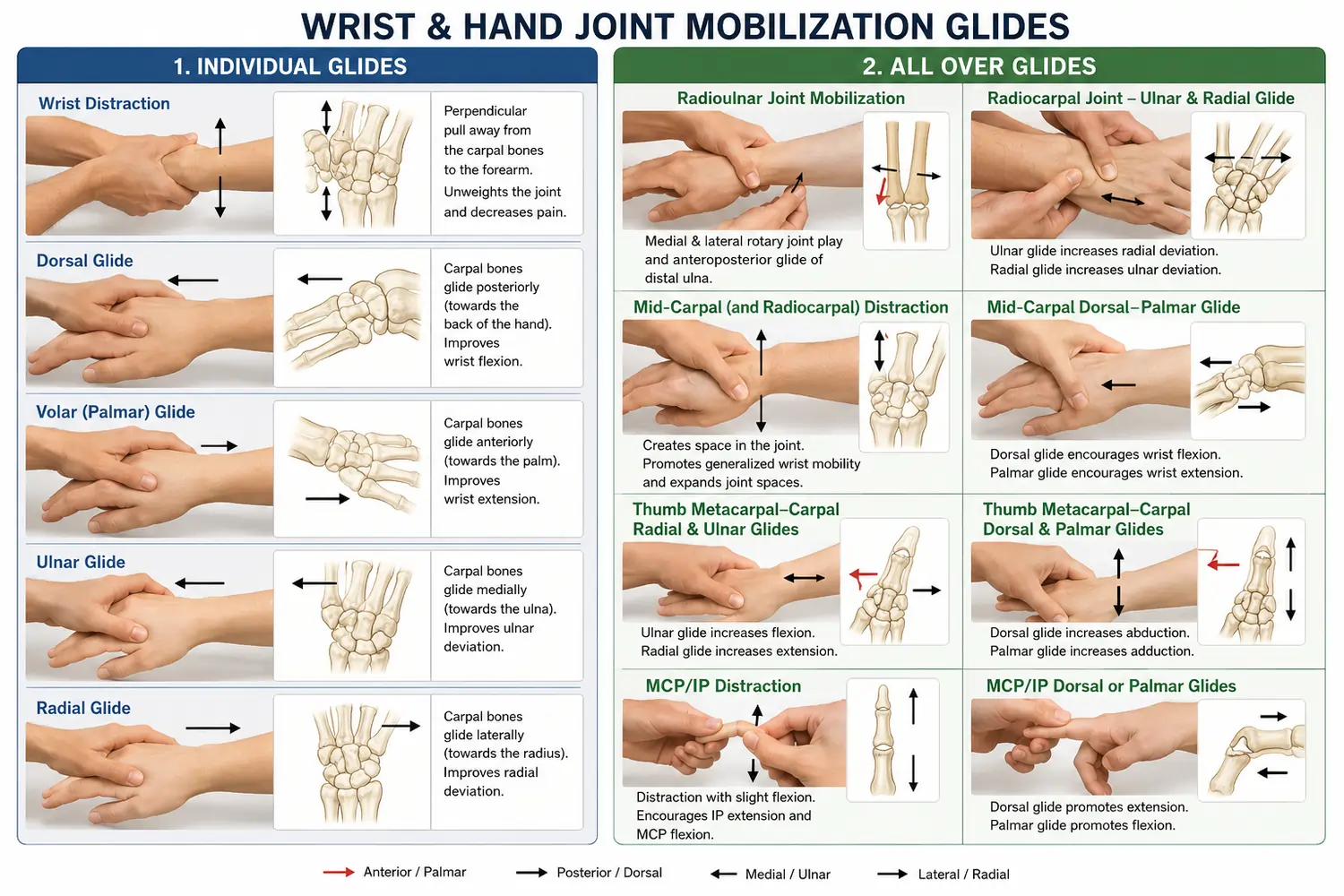
- Wrist Distraction: The therapist applies a perpendicular pull away from the carpal bones to the forearm. Used generally as a preliminary technique for any motion restriction to unweight the joint and decrease pain
- Dorsal Glide: The carpal bones are glided posteriorly (towards the back of the hand). This motion improves wrist flexion
- Volar (Palmar) Glide: The carpal bones are glided anteriorly (towards the palm). This motion improves wrist extension
- Ulnar and Radial Glides: To address particular capsular tightness and aid in the restoration of radial and ulnar deviation, the wrist is glided medially or laterally.
Normal ROM of the wrist joint
- Ulnar Deviation: (bending toward the pinky): 30° to 45°
- Radial Deviation: 15° to 20° when bending toward the thumb
- Flexion (bending downward): 80° to 90°
- Extension (bending upward): 70° to 90°
- Supination: 80° to 90° (palm up)
- Pronation: 80° to 90° (palm down)
Procedure
- In order to execute mobilizations at the distal radioulnar joint, the therapist stabilizes the patient’s hand and radiocarpal area by holding the distal radius and proximal carpals with the middle, ring, and little fingers and inserting the index finger in the thumb’s web and thenar eminences.
- The distal ulna is grasped by the therapist between the thumb and finger pads.
- The distal ulna’s medial and lateral rotary joint play motions and anteroposterior glide are then provided.
- Moving the column of carpal bones either palmarly to encourage wrist flexion or dorsally to encourage wrist extension is the mobilization. These methods can also be used to treat hypermobile wrists after extended immobilization (casting).
Radio Carpal Joint – Ulnar and Radial Glide
- Procedure: The wrist is maintained in a mid-range posture.
The therapist applies force around the distal column of carpals with their hand - Indication: Radial glide increases ulnar deviation of the wrist joint, while ulnar glide increases radial deviation.
Mid-Carpal (and Radiocarpal) Distraction
- Procedure: These two methods are carried out similarly but with somewhat different hand postures. The stabilizing hand is positioned over the styloid processes for mid-carpal distraction, while the mobilizing hand is positioned over the distal carpal row for radiocarpal distraction.
- Indication: Since wrist extension is a closed-packed posture of the wrist, these procedures are designed to promote generalized wrist mobility and expand the joint spaces.
Mid-Carpal Dorsal-Palmar Glide
- Procedure: To stabilize the distal radioulnar joint, the stabilizing hand holds the patient’s wrist immediately proximal to the styloid processes. The distal carpal column is covered by the mobilizing hand.
- Indication: The mobilization entails moving the row of carpal bones either palmarly to encourage wrist extension or dorsally to encourage wrist flexion.
Thumb Metacarpal-Carpal Radial and Ulnar Glides
- Procedure: The patient’s hand is placed with the ulnar side down and the joint resting; the mobilizing hand grasps the first metacarpal, while the stabilizing hand grasps the distal forearm with the grip around the trapezium. Apply light traction and move the metacarpal toward the ulna to improve flexion or toward the radius to increase extension with the mobilizing hand.
- Indication: To enhance flexion, glide ulnarly; to increase extension, glide radially.
Thumb Metacarpal-Carpal Dorsal and Palmar Glides
- Procedure: Patient’s hand is positioned with the palm down, joint in a resting position; stabilizing hand grasps distal forearm with the grip around trapezium while mobilizing hand grasps the first metacarpal. With the mobilizing hand, glide the metacarpal toward the palm to increase adduction, or toward the dorsum to increase abduction while applying gentle traction.
- Indication: Dorsal glide to enhance abduction; palmar glide to enhance adduction.
MCP/IP Distraction
- Procedure: After supporting the patient’s forearm, the therapist must grasp the distal bone between the thumb and index finger of the mobilizing hand and the proximal bone of the joint being moved with one hand. The mobile hand is used to provide distraction while the joint is gently flexed.
- Indication: These methods are utilized to encourage IP extension and MCP flexion in addition to normal joint activity.
MCP/IP Dorsal or Palmar Glides
- Procedure: After supporting the patient’s forearm, the therapist must grasp the distal bone between the thumb and index finger of the mobilizing hand and the proximal bone of the joint being mobilized with one
hand. - Indication: The distal bone’s base is moved either palmarly or dorsally to promote flexion or extension, respectively, to impart mobilization.
FAQs
What is a grade 3 joint mobilization?
A gradual, large-amplitude passive movement applied to a joint from its mid-range to the end of its allowed range of motion is known as a grade 3 joint mobilization. Its main objectives, when carried out by physical or manual therapists, are to enhance joint mobility, break up scar tissue, and extend constricted joint capsules.
What are the 4 primary wrist movements?
The four main wrist motions are radial deviation or abduction (tilting the wrist toward the thumb), ulnar deviation or adduction (tilting the wrist toward the pinky), flexion (bending the palm down), and extension (bending the hand back).
What is a normal ROM for the wrist?
Ulnar Deviation (bending toward the pinky): 30° to 45°
Radial Deviation (bending toward the thumb): 15° to 20°
Flexion (bending downward): 80° to 90°
Extension (bending upward): 70° to 90°
Regarding forearm motions that impact hand placement:
Supination: 80° to 90° (palm up)
Pronation: 80° to 90° (palm down)
What are the different types of joint mobilization?
1. Oscillatory Mobilizations
2. Sustained Mobilizations
3. Manipulation
References
- (2026). Knee Mobilizations. Physiopedia. https://www.physio-pedia.com/index.php?title=functional anatomy of wrist _Mobilisations&lang=en
- (2026). Knee Mobilizations. Physiopedia. https://www.physio-pedia.com/index.php?title=wrist_Mobilisations&lang=en
- Kisner, C., & Colby, L. A. (1996a). Therapeutic Exercise: Foundations and Techniques. F. A. Davis Company.