Hip Mobility Exercises for Runners
Introduction:
All runners should prioritize hip mobility since tight hips impair performance and raise the risk of injury. A key component of effective, sustainable, and healthful running is the development and maintenance of hip mobility.
Runners can establish the groundwork for better performance and greater endurance on the sidewalk or road by addressing limitations, strengthening mobility, and regularly including mobility stretches and exercises into training.
What is Hip Mobility?
The ability to move your hips through their whole range of motion with control is known as hip mobility. Mobility allows you to raise your knee as high as you can while standing without experiencing pain or stiffness. Flexibility, on the other hand, is passive and does not develop strength.
Since most individuals are more flexible than mobile, I may have been able to access a wider range in the active drill by warming up with the passive stretch.
Important muscles of the hip mobility:
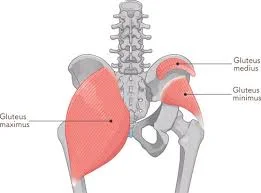
The hip group consists of several muscles. The maximus, medius, and minimus are your glutes. The iliacus muscle and psoas muscles are typically mentioned when someone refers to their hip flexors. Then there are the hamstrings on the back, the adductors on the inner thigh, and several muscles that comprise your deep hip rotators.
These muscles and the connective tissues in the hips must cooperate for a runner to be healthy and functional. It is impossible to exaggerate the importance of these muscles’ strength, mobility, stability, and dynamic stability.
There is a link between strong hips and running performance. Runners with strong hips demonstrate superior running mechanics and lower risk for specific disorders, including patellofemoral and iliotibial band pain. Stronger hips can contribute to more pelvic stability and enhanced hip drive as well.
Importance of hip mobility for runners:
Effective and powerful running is mostly dependent on having strong, mobile hips. The rest of the body must compensate when the hips are limited or tight, which frequently results in inefficiency and even possible harm. Due to the length and repeated nature of trail and ultrarunning, hip mobility issues can eventually become significant limiting concerns.
Weak hip flexors are among the most frequent outcomes of limited hip mobility. Stride length shortens, running uphill becomes more difficult, and strain moves to the lower back when the hip flexors are unable to stretch freely. In a similar vein, limited hip rotation may affect the IT band and result in lateral hip or knee discomfort. Reduced hip extension reduces running efficiency even in the absence of acute pain, exhausting vital energy stores for long races.
Over time, an athlete with limited hip mobility may also develop compensatory mechanisms.
How Poor Hip Mobility Increases Injury Risk:
Poor hip mobility raises your chance of injuries in addition to decreasing your athletic performance. Your knees and lower back ache when your hips are unable to move freely. Poor movement patterns and overuse injuries are frequently the result of this. Tight hip flexors, for instance, frequently cause the knees or lower back to normalize, which can result in instability or discomfort.
Poor hip mobility is frequently associated with the following problems:
- Strained hip flexors and tight hamstrings
- Chronic lower back pain
- Knee instability and reduced joint control
The Difference Between Flexibility And Mobility:
It’s important to differentiate between flexibility and mobility to figure out whether someone lacks mobility. Passive range of motion, such as using your hands to draw your knee to your chest, is referred to as flexibility.
The active and deliberate use of that range, such as pushing the knee higher when running, is known as mobility. For runners, both are essential: flexibility to reduce tissue limitations and mobility to effectively utilize that range under conditions such as speed, fatigue, and changing surfaces.
Exercises and stretches for increased hip mobility:
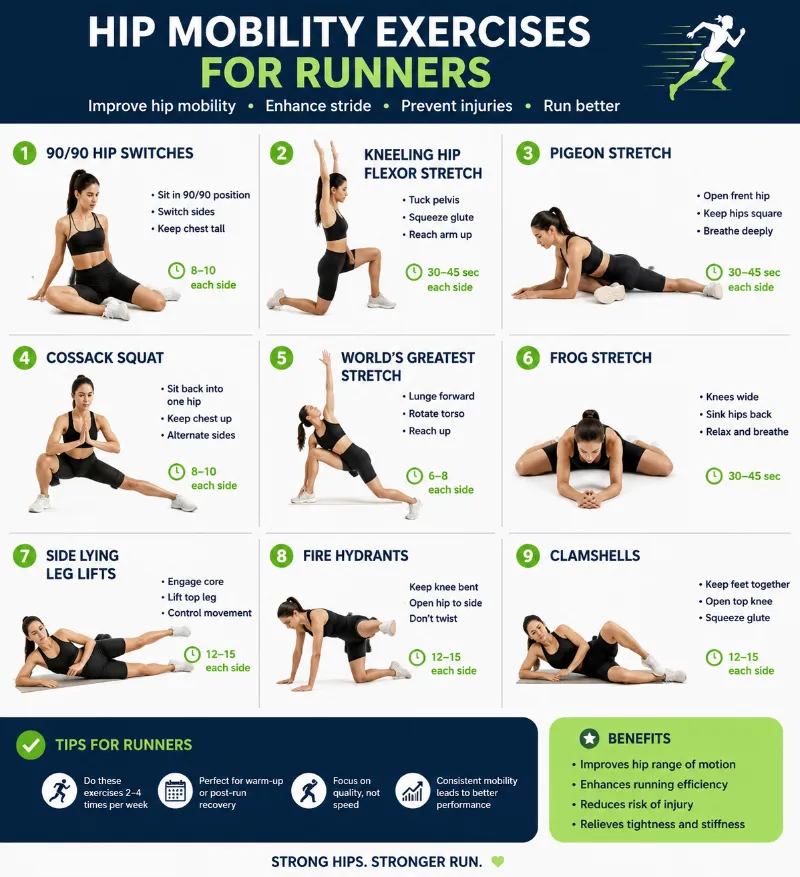
Increasing hip mobility doesn’t have to be hard, but it does require consistency. Simple exercises like dynamic leg swings, couch stretches, controlled articular rotations (CARs), and 90/90 hip rotations are quite beneficial.
It’s a wonderful idea to perform dynamic exercises like swings or CARs before a run. Longer static holds, such as the pigeon position or sofa stretch, are beneficial later. Quad squats and other loaded mobility exercises work very well with strength training.
The following exercises can help runners improve their hip mobility:
Warmup exercises
Always warm up the big muscles surrounding your hips before beginning an exercise. This improves circulation and boosts the flexibility and activity of these muscles before you start harder exercises.
You can start with the following warm-up exercises:
Frankenstein walk:
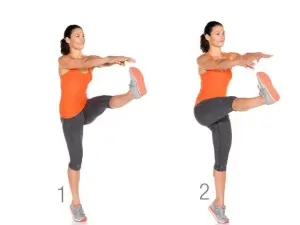
This workout strengthens your hamstrings, quadriceps, and hips. Additionally, it improves range of motion. As you advance, keep your posture upright, avoid bending at the waist, and pick up the pace.
- Place your arms out in front of you, palms down.
- Swing your right leg up and stretch it straight out as you advance, forming a 90-degree angle with your body.
- After lowering your right leg to the floor, swing your left leg up in the same way.
- If you have little room, change directions and keep going for one minute.
- For each leg, you can perform two or three sets of ten to twelve repetitions.
Hip circles:
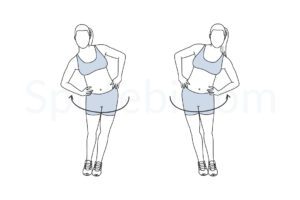
This exercise improves stability and flexibility. Use a stable object to provide more support.
- Stand on your right leg after raising your left.
- Make circles with your left leg.
- Make 20 circles in each direction.
- Next, switch to your right leg.
- You can perform 10 to 15 repetitions on each leg in two or three sets.
Exercises with bands
For such exercises, a resistance band is required. To increase the resistance, use a thicker band.
Sidestep exercise:
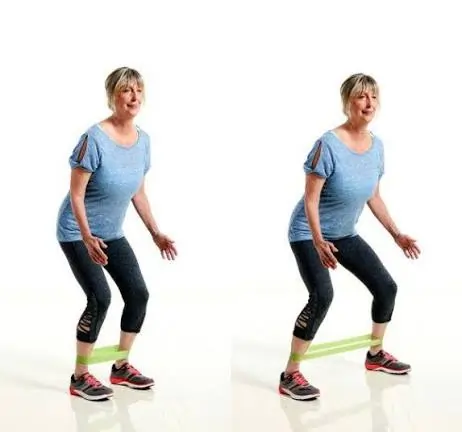
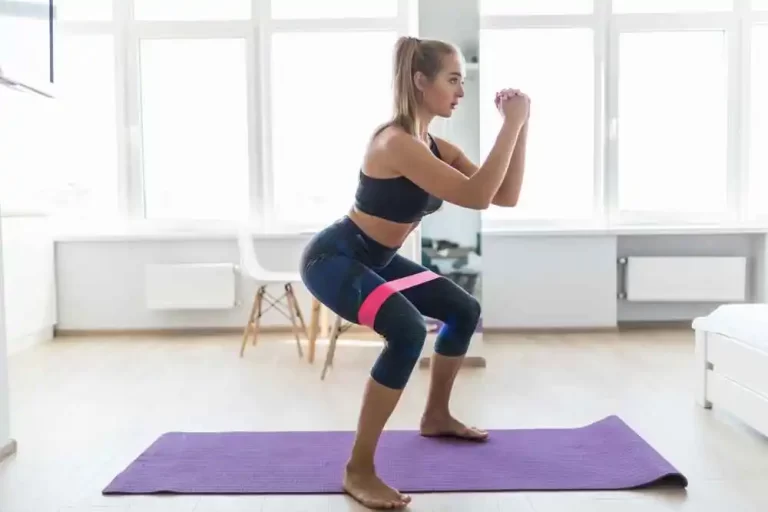
Keep your toes and hips facing straight ahead. Decreasing the band till it is above your ankles and decreasing your knee stance will increase the intensity.
- Put a resistance band around your lower thighs and stand in a half-squat position.
- Take gentle, little steps to the side while using your hip muscles.
- Take eight to fifteen steps in a single direction.
- Perform on the other side after that.
Clamshell exercise:
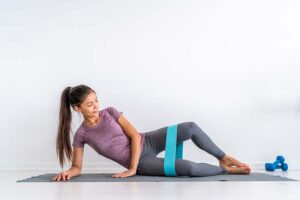
This workout improves your thighs, glutes, and hips. It helps avoid overuse and injury by stabilizing your pelvic muscles and easing lower back tension. Check out a few changes after you’ve learned the basic stance.
- Place a resistance band over your lower thighs and lie on your side with your knees bent.
- After rotating your upper leg as high as you can, take a little break.
- Return to the initial position.
- Perform one to three sets of eight to fifteen repetitions.
Exercises with weights
Lateral step-up:
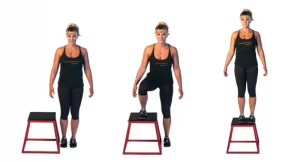
This workout works your quadriceps, hamstrings, and glutes while strengthening and stabilizing your core. Increase the weight to increase the intensity.
- Hold a weighted plate or dumbbell in front of your chest with both hands.
- Place a box or bench to your right.
- Put your right foot on the bench and bend your knee.
- Tap your left foot on the bench while maintaining a straight posture.
- Return your left foot to the ground slowly.
- You can perform two to three sets of eight to fifteen repetitions on each side.
Single-leg Romanian deadlifts:
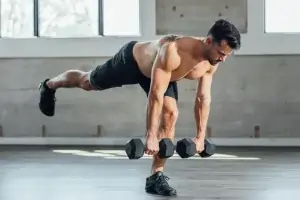
Your hip mobility, balance, and core strength will all improve with this workout. It also works your hamstrings and glutes.
- With your knee bent slightly, stand on your right foot. In your left hand, grasp a dumbbell.
- As you bend forward to align your body with the floor, keep your spine neutral. Raise your left leg.
- Return to your upright position. Bring your left leg down.
- Do five to twelve repetitions in two to three sets.
Exercises for seniors
By improving balance, coordination, and movement patterns, these activities can help reduce the risk of falls and injuries.
Hip marching:
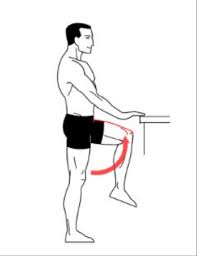
This exercise will increase flexibility and strength in your thighs and hips.
- Take a seat close to the chair’s front edge.
- Keeping your knee bent, raise your left leg as high as you can.
- Lower your foot carefully and slowly.
- Following that, work on the right side.
- There is one repetition of this.
- Do five to twelve repetitions in two to three sets.
Floor hip flexors:
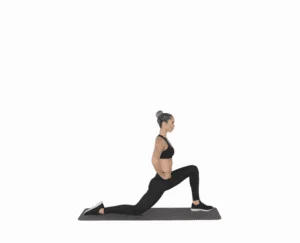
Your thighs, glutes, and hip flexors are all stretched by this workout.
- Lift your right leg into your chest while lying on your back.
- Feel your hip stretch as you press the back of your left knee into the ground.
- For up to 30 seconds, maintain this posture.
- Repeat two to three times on each side.
Exercises for those with arthritis
Stretching every day, even for a short period, is recommended if you have arthritis. When you have arthritis, it is best to stretch daily instead of just a few times a week.
Butterfly pose:

This workout increases blood circulation while stretching your hips. To assist the pelvic tilt, place your sitting bones on the edge of a folded blanket or pillow. Put pillows or blocks beneath your thighs for support if you feel restricted.
- Bend your knees and place the soles of your feet together while seated.
- Put your fingers together beneath your feet. Gently push your knees to the floor with your elbows.
- As you let go of tension, feel an opening in your hips.
- After 30 seconds, fold your arms forward and stretch them in front of you.
- For no more than a minute, hold this position.
Knee-to-chest pose:
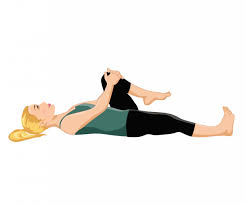
This position expands your hips and stabilizes your pelvis.
For more assistance, place your head on a flat pillow or folded towel. Put your hands over the backs of your thighs if you are unable to extend your arms around your thighs. The exercise will be simpler if you take one leg at a time and either stretch it straight out or bend it at the knee.
- Bend your knees towards your chest while lying on your back.
- To grasp your hands, forearms, or elbows, put your arms around your legs.
- To extend the back of your neck, gently pull your chin toward your chest.
- For up to 30 seconds, maintain this posture.
- You may perform this stretch once or twice.
Exercises for runners
Runners may experience hip pain and reduced flexibility due to high-impact movements and overuse. By strengthening and extending tense muscles, these workouts help address imbalances.
Donkey kicks:
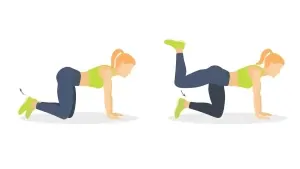
This exercise will help you tone and strengthen your hips and glutes.
- Lift your right knee from a tabletop posture and kick upward while maintaining it bent.
- Bring the bottom of your foot up toward the ceiling.
- Go back to where you were.
- Do 12–20 repetitions on each side in two to three sets.
Side leg raises:
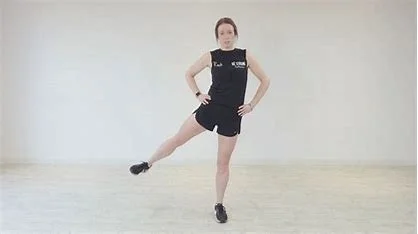
Your thighs and glutes will get stronger with this workout. Put a weight on your thigh to make it harder.
- With your legs stacked, lie on your right side.
- As much as you can, lift your left leg.
- After pausing here, go back to where you were before.
- Perform twelve to fifteen repetitions on each side in two to three sets.
Exercises for relieving hip pain
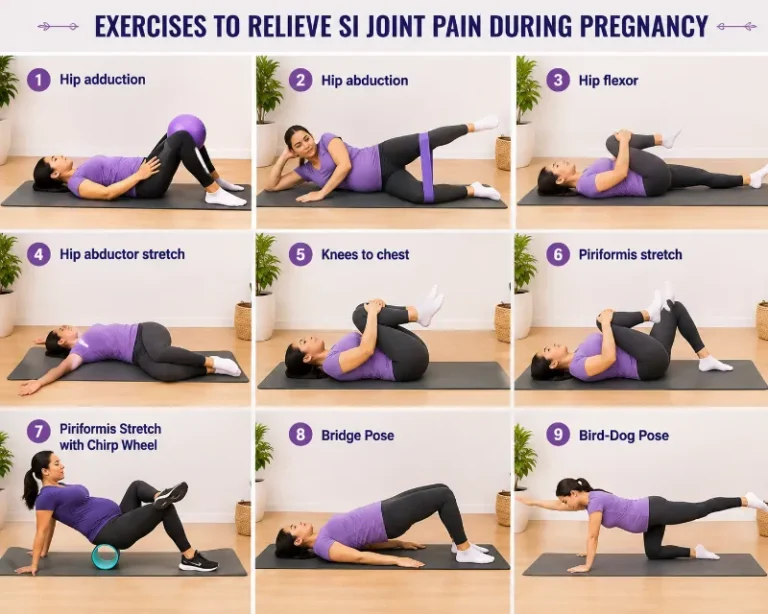
Single-leg bridge:
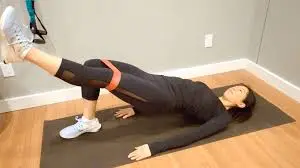
In addition to extending your hips and promoting proper posture, this exercise improves your hamstrings, glutes, and core.
- Bend your knees and bring your feet closer to your hips while lying flat on your back.
- Put your hands on the ground next to your body.
- Make your right leg straight by extending it.
- As high as you can, raise your hips.
- For thirty seconds, maintain this posture.
- Do each side two or three times.
Figure Four:
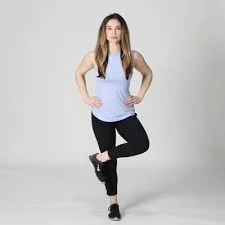
In this position, your glutes and hips are stretched.
- Bend your knees and bring your feet up to your hips while lying on your back.
- At the base of your left thigh, place your right ankle.
- Bring your leg closer to your chest by wrapping your fingers around your shin or thigh.
- Hold for a maximum of one minute.
- On the other side, repeat.
Exercises that are more harmful for hip pain:
- If you have hip pain, you should stay away from specific workouts. Rest and stay away from hard routine tasks for as long as you can.
- Running, squatting, and lifting weights are examples of high-impact workouts that should usually be performed extremely carefully. When exercising or walking on uneven ground, pay close attention to how you move and try to build stability.
- Step-ups, lunges, and squats are hip-stressing exercises. When practicing these exercises, use caution and avoid doing them if you’re having a flare-up of any type.
- Follow your body’s instincts. Go only as far as is comfortable and avoid any moves that might cause you pain.
FAQs:
How do you fix runner’s hip?
Reduced load with rest and ice is necessary to treat runner’s hip. Focused physical therapy is then used to address imbalances. Use exercises like lateral band walks and single-leg deadlifts to strengthen your glutes and core. Increase your weekly volume by no more than 10% to gradually resume running.
What are the 4 muscles that flex the hip?
The rectus femoris, sartorius, and iliopsoas are the main muscles that flex the hip. Other muscles that can help with this activity include the pectineus and tensor fasciae latae (TFL).
How to strengthen hips for running?
Improve your single-leg mechanics and stabilize your pelvis to strengthen your hips for running. Clamshells, single-leg bridges, and lateral band walks are three specific exercises that you can practice in three sets of ten to fifteen repetitions. Try to do these two or three times a week.
Why do runners have weak hips?
Improve your single-leg movements and stabilize your pelvis to strengthen your hips for running. Clamshells, single-leg bridges, and lateral band walks are three specific exercises that you can practice in three sets of ten to fifteen repetitions. Try to do these two to three times per week.
Can running shoes cause hip pain?
However, hip pain can result from wearing running shoes. Your body must adjust to improper footwear, which puts additional strain on your hip joints and muscles, whether the shoes are worn out, don’t support your gait properly, or have so much comfort that they change your normal stride.
References:
- Rahman, F., Muwaffaq, M. S., Febriansyah, R., Ishad, M. R., & Azizan, A. (2026). Posterior thigh muscles flexibility profiling: a comparative study of trail and road runners. Sports Medicine Research and Practice, 16(1), 67–78. https://doi.org/10.47529/2223-2524.2026.1.6
- Kawanabe, K., Kawashima, A., Sashimoto, I., Takeda, T., Sato, Y., & Iwamoto, J. (2007). Effect of whole-body vibration exercise and muscle strengthening, balance, and walking exercises on walking ability in the elderly. The Keio Journal of Medicine, 56(1), 28–33. https://doi.org/10.2302/kjm.56.28
- Hamilton, B. (2011). Vitamin D and athletic performance: The potential role of muscle. Asian Journal of Sports Medicine, 2(4), 211–219. https://doi.org/10.5812/asjsm.34736