Nervous System
Introduction:
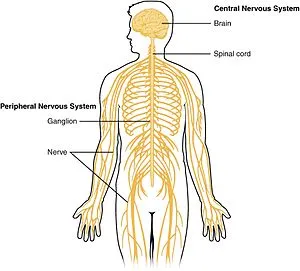
Everything you do involves your nervous system. Your brain, spinal cord, and nerves are the three main elements of your nervous system. It assists in your movement, cognition, and emotional experience. It almost controls activities you perform without conscious thought, such as digestion. It includes both the central nervous system and the peripheral nervous system.
What does the nervous system consist of?
Your body’s command center is your nervous system. Your spinal cord, nerves, and brain constitute it. Your nervous system acts by transmitting messages or electrical signals between your brain and the various other parts of your body. For example, these signals indicate that you should breathe, move, speak, and see. Your nervous system monitors internal and external events and chooses how to react to the situations you face.
Your nervous system controls complex processes such as thoughts and memory. It is also essential for physiological functions that occur automatically, such as blushing, sweating, and blinking.
Anatomy:
Which components make up the nervous system?
The nervous system consists of two primary components:
Central nervous system (CNS): The CNS consists of your spinal cord and brain. Your brain analyzes signals from your nerves to control your thinking, movement, and feelings.
Peripheral nervous system (PNS): Your nervous system is made up of a network of nerves. The spinal cord is the source of the branching nerves. This system transmits information from your brain and spinal cord to your organs, arms, legs, fingers, and toes.
Your peripheral nervous system consists of two components:
Your somatic nervous system controls your voluntary motions.
The autonomic nervous system regulates involuntary motions or acts that occur without conscious thought.
What is the structure of the nervous system?
Your nervous system is built on nerve cells (neurons). Your brain contains 100 billion neurons. These cells connect up across your whole body.
Consider the nervous system to be a tree. Your central nervous system is the trunk that contains your brain and spinal cord. The branches represent your peripheral nervous system (nerves). The branches extend from the trunk (brain and spinal cord) to connect with every area of your body.
Central nervous system (CNS):
The CNS includes the brain and spinal cord.
Brain:
The average weight of the brain is 1.3 to 1.4 kg, with fat making up approximately 60% of its composition. The brain’s remaining 40% is made up of proteins, water, carbohydrates, and salts.
There are four separate regions into which the brain can be divided: the cerebrum, cerebellum, brainstem, and diencephalon. When combined, these various brain regions regulate thought processes, memory, emotions, tactile sensations, motor functions, vision, respiration, appetite, body temperature, and every other bodily function.
Gray and white matter make up the brain. Gray matter, which is darker in color and encircles white matter, comprises neuron filaments and round central cell bodies. Conversely, white matter—located in the brain’s interior and lighter in color—is mainly composed of axons, which are the expanded structures that connect neurons.
Gray matter is usually responsible for processing and interpreting information, while white matter serves to transmit information to different regions of the nervous system.
Brainstem:
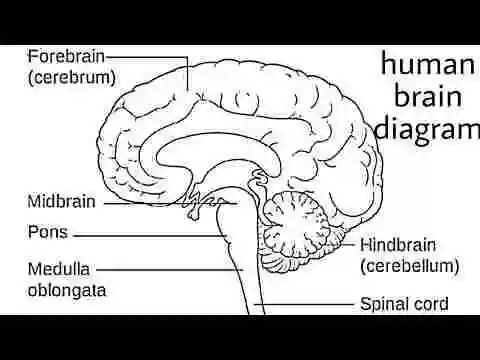
The brainstem is the stalk-like structure in the center of the brain that connects the brain to the spinal cord. It measures approximately one inch in length. This area of the brain controls vital processes like heart rhythms, blood pressure, breathing, and swallowing.
Further subdivision of the brainstem produces the midbrain, pons, and medulla.
The mesencephalon, often known as the midbrain, is crucial for regulating long-term memory, hearing, emotions, and eye movements. It is important to point out that Parkinson’s disease often impacts the substantia nigra, which is located in the midbrain and contains a high concentration of dopamine neurons.
Four of the 12 cranial nerves originate from the pons. The pons regulates various functions, including facial movements, hearing, breathing, and balance.
The medulla is located at the junction of the brain and spinal cord, at the bottom of the brainstem. This area of the brainstem controls heart rate, blood pressure, and respiration.
Cerebrum:
The cerebral cortex is a deeply folded layer of nerve tissue that covers the cerebrum, the most important area of the brain. The cerebrum, which is situated in the front of the brain, is separated into the left and right cerebral hemispheres, which are joined by the corpus callosum.
While the left hemisphere is dominant in language and processing social emotions, the right hemisphere is in charge of consciousness, emotions, posture, and the perception of facial expressions. While the left hemisphere controls the right side of the body, the right hemisphere controls the left.
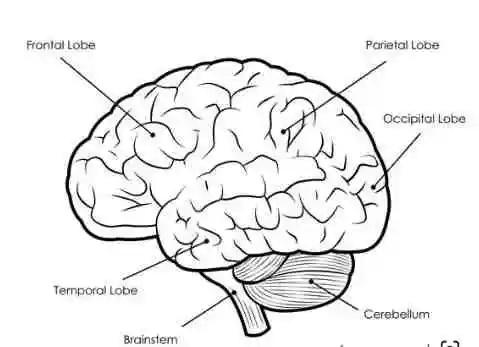
The frontal, temporal, parietal, and occipital lobes are the four lobes that make up the hemispheres.
Before the central sulcus, the frontal lobe controls speech, memory, emotions, personality, judgment, motor function, short-term memory, planning, and organization.
The parietal lobe sits above the occipital lobe and behind the central sulcus. By regulating location relationships, this lobe allows people to understand their body’s position with respect to nearby things. Additionally, the parietal lobe allows the perception of touch and pain.
Wernicke’s and Broca’s regions are essential for both understanding and producing speech. The frontal lobe contains Broca’s area, which regulates speech production. Wernicke’s region, on the other hand, is found in the parietal lobe and enables people to understand spoken language.
The lateral fissure is superior to the temporal lobes, which are situated at the sides of the brain. Processing of sight, smell, and taste, as well as the interpretation of language and sound, memory, and hearing, all depend on these lobes.
Processing visual information, such as colors and shapes, is the responsibility of the occipital lobe, which is situated at the back of the brain behind the parietal and temporal lobes.
Cerebellum:
The cerebellum is situated above the brainstem and below the temporal and occipital lobes. Balance, coordination, and voluntary motor performance are all controlled by the cerebellum. According to recent research, the cerebellum may also have a role in the pathophysiology of addiction, autism, and schizophrenia, as well as in thought, emotions, and social behaviors.
Diencephalon:
The diencephalon includes the thalamus and hypothalamus. While the hypothalamus sends hormone signals to the body via the pituitary gland, the thalamus serves as a transmission point for sensory information.
The thalamus, hypothalamus, amygdala, and hippocampus comprise the limbic system. The brain’s reward system, stress, emotion, memory, and the “fight or flight” reaction to danger are all regulated by the amygdala.
Long-term memory depends on the hippocampus, which is situated beneath each temporal lobe. Additionally, learning, managing, and location perception are influenced by this structure.
Spinal cord
The long, tube-like structure that emerges from the brain is called the spinal cord. The neck, chest, and lower back contain the cervical, thoracic, and lumbar regions of the spinal cord.
The spinal cord is made up of 31 pairs of nerves and nerve roots. The spinal segment is the area of the spinal cord that gives rise to a pair of spinal nerves.
Eight nerves that originate from the neck and primarily travel to the face and head make up the cervical spinal cord.
The thoracic area of the spinal cord has a total of twelve pairs of nerves. The extension of the chest, upper back, and abdomen are among the upper body movements made possible by these neurons.
Ten further pairs of nerves, five of which are in the lumbar and sacral areas, arise from the lower back. While the sacral nerve pairs run from the low back into the pelvis, the lumbar nerve pairs continue to the legs and feet.
Meninges
The brain and spinal cord are covered and protected by three layers of membranes called meninges. The layers of the meninges are called dura mater, arachnoid, and pia mater.
The periosteal and meningeal layers are additional divisions of the dura mater, the outermost layer of the meninges. The arachnoid, a web-like layer of connective tissue that lacks blood vessels and nerves, is the middle layer of the meninges. Lastly, the thinnest layer of the meninges is the pia mater.
Neurons
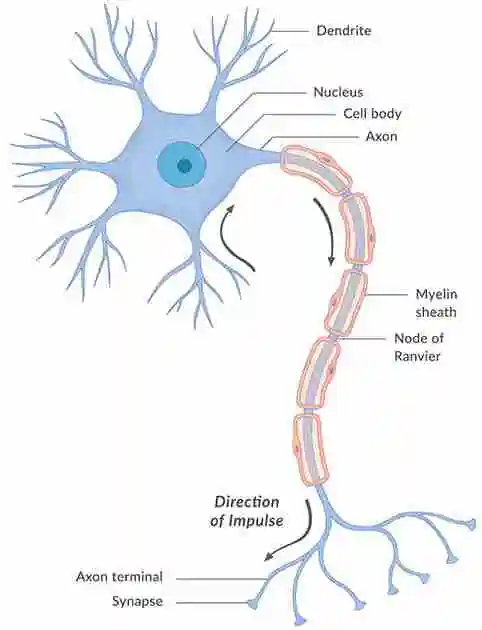
The basic component of the nervous system is the neuron, a specialized conductor cell that connects the brain to the rest of the nervous system by receiving and sending electrical nerve signals.
A neuron is composed of cell bodies, dendrites, and axons. The cell body contains the nucleus, which contains genetic material and controls cellular processes.
Branching projections called dendrites protrude from the cell body and accept input from neighboring neurons.
An axon is a long, thin process that originates from the cell body and carries electrical signals. The synapse is the passageway via which these chemical signals—more often known as neurotransmitters—move between neurons.
While motor neurons transmit signals from the brain to various nerves, muscles, and glands, sensory neurons transmit signals from sensory receptors to the brain. Interneurons belong to the third class of neurons.
Except for the nodes of Ranvier, the myelin sheath, which surrounds neurons, runs continuously along axons or dendrites. Myelin, which is made up of proteins and lipids, protects neurons, transmits electrical impulses between neurons, and keeps the signal strong as it moves down axons.
Peripheral Nervous System (PNS):
The autonomic and somatic nerve systems make up the PNS.
Somatic nervous system
Peripheral nerve fibers that transmit sensory data or sensations from peripheral organs to the central nervous system (CNS) make up the somatic nervous system (SNS). Motor nerve fibers that exit the brain and deliver movement commands to the skeletal muscles are also a part of the SNS.
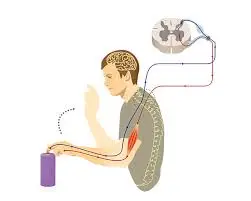
For example, sensory nerves alert the brain to the presence of heat when an object is touched. The hand muscles are then quickly instructed to remove it by the brain via motor nerves. It takes less than a second to finish this process. Usually found in the brain or spinal cord, the neuronal cell body that conveys this information extends straight to a skeletal muscle.
Autonomic nervous system
The nerves of the body’s internal organs that are not under conscious control are managed by the autonomic nervous system (ANS). The sympathetic, parasympathetic, and enteric nervous systems are further divisions of the ANS. The ANS regulates a variety of functions, such as blood pressure, digestion, sexual activity, heartbeat, and subconscious breathing.
Function
What is the role of the nervous system?
Your nervous system’s main function is to send signals from your brain to your body, telling it what to do. These messages control your:
- Learning, memory, thoughts, and feelings.
- Motion (balancing and coordination).
- Senses (the way your brain makes sense of what you see, hear, taste, touch, and experience).
- Wound healing.
- Sleep.
- Heartbeat and respiration patterns.
- Reaction to stress-inducing circumstances, which includes perspiration generation.
What is the working of the nervous system?
As part of your nervous system, your body relies on nerve cells called neurons to send impulses or messages throughout. These electrical impulses travel through your muscles, glands, organs, skin, and brain.
You can feel pain and other feelings and move your limbs thanks to these communications. Your eyes, ears, tongue, nose, and the nerves throughout your body gather information about your surroundings. You can feel pain and other feelings and move your limbs thanks to these communications.
There exist various kinds of neurons. Every neuron type has a specific function:
Motor neurons in your brain and spinal cord provide signals to your muscles. They help you move. Additionally, they facilitate speech, swallowing, and breathing.
Your brain receives sensory data—what you see, touch, taste, etc.—through sensory neurons.
Interneurons function as a junction for communication between motor and sensory neurons. These neurons help manage your movements based on sensory data (such as withdrawing from a hot surface) and contribute to your learning, thinking, and memory processes.
Conditions and Disorders:
Which conditions or disorders commonly affect the nervous system?
Your nervous system can be affected by a variety of conditions. Among the most frequent are:
- Alzheimer’s disease.
- Cancer.
- Cerebral Palsy.
- Seizure disorder.
- Huntington’s disease
- Infection (meningitis).
- Parkinson disease.
- Stroke.
- Traumatic Brain injury.
Which signs or symptoms are common for nervous system disorders?
The following symptoms and indicators may be present in nervous system disorders:
- Movement and coordination changes.
- Memory loss.
- Numbness, pain, or a tingling sensation.
- Behavioral and mood changes.
- Difficulty with thinking and reasoning.
- Seizures.
- One side of your body may be paralyzed or have weak muscles.
- Sudden vision loss.
- Slurred speech.
- Confusion.
FAQs:
Which three nervous system types are there?
Sympathetic Nervous System.
Parasympathetic Nervous System.
Enteric Nervous System (ENS)
Which seven nervous system organs are there?
The medulla, pons, cerebellum, midbrain, diencephalon, cerebral hemispheres, and spinal cord are the seven fundamental components of the central nervous system.
Which three major nerve types are there?
Nerves can be classified as motor, sensory, or mixed.
What is an axon?
Axons are tiny fibers that allow neurons, or nerve cells, to communicate with one another. In reaction to electrical impulses, neurons release “chemical messengers” called neurotransmitters. Electrical impulses are also sent from gland and muscle cells to the brain via axons.
References:
- Professional, C. C. M. (2024d, December 19). Nervous system. Cleveland Clinic. https://my.clevelandclinic.org/health/body/21202-nervous-system
- News-Medical. (2022, September 5). What is the Nervous System? https://www.news-medical.net/health/What-is-the-Nervous-System.aspx
- Thau, L., Reddy, V., & Singh, P. (2022, October 10). Anatomy, central nervous system. StatPearls – NCBI Bookshelf. https://www.ncbi.nlm.nih.gov/books/NBK542179/
- Wikipedia contributors. (2025b, March 6). Nervous system. Wikipedia. https://en.wikipedia.org/wiki/Nervous_system