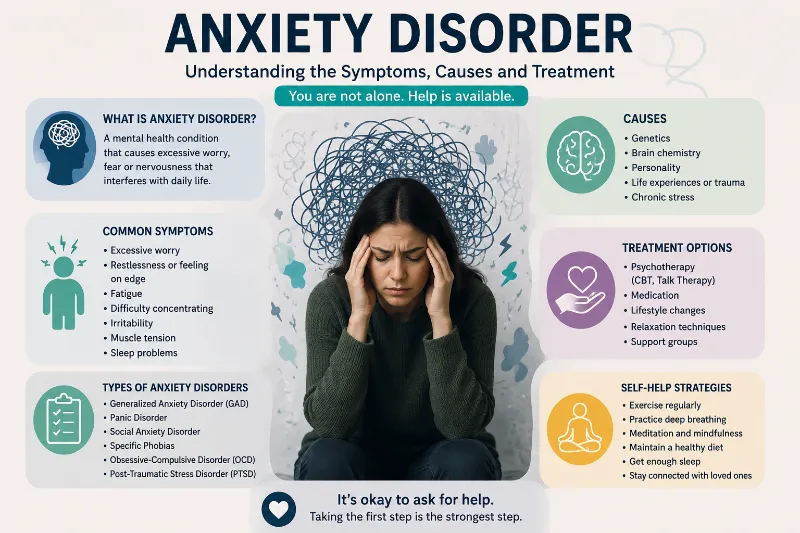
Anxiety Disorder
What is an Anxiety Disorder?
Anxiety disorder is a prevalent mental health problem that can interfere with day-to-day functioning by causing persistent emotions of excessive anxiety, dread, or nervousness.
Anxiety is a typical emotion. When you have to deal with an issue at work, attend an interview, take an exam, or make a significant decision, you might experience anxiety or worry. Even a small bit of worry can be beneficial, as it helps keep us safe by directing our attention and identifying potentially dangerous situations.
However, an anxiety disorder is more than just the normal apprehension and mild fear you may experience occasionally. Anxiety disorders occur when:
- You can’t function well when you’re anxious.
- You have little control over how you react to things.
- Anxiety problems can affect kids, teens, and adults. Compared to men, women are around twice as likely to have one.
- Managing anxiety problems can make daily tasks challenging. Thankfully, there are a number of efficient ways to treat chronic conditions.
Types of anxiety disorders:
Several types of anxiety disorders are:
Generalized anxiety disorder (GAD): This illness results in anxiety, terror, and a persistent sense of overwhelm. Excessive, frequent, and illogical worry over everyday matters like responsibilities, work commitments, and health are its hallmarks.
Agoraphobia: An intense fear of being overwhelmed or of being unable to escape or seek help is caused by this illness. Individuals with agoraphobia tend to avoid large, open, or confined spaces, crowds, and unfamiliar circumstances.
Panic disorder: There are several unplanned panic episodes associated with this illness. The fact that the attacks usually happen quickly and aren’t caused by any medical or mental health problems is one of the condition’s main features. Some sufferers of agoraphobia also have panic disorder.
Specific phobias: When something makes you feel so afraid or anxious that it constantly and severely interferes with your life, you have a phobia. Agoraphobia is the only phobia that has a separate diagnosis.
Social anxiety disorder: This disorder, formerly known as social phobia, is characterized by a persistent and severe dread of receiving unfavorable judgment and/or being seen by others.
Separation anxiety disorder: While you have excessive anxiety when you are removed from a loved one, such as your primary caregiver, you may develop this illness. Although separation anxiety in infants and toddlers is a typical developmental stage, separation anxiety disorder can impact both adults and children.
Selective mutism: This disorder develops when you avoid talking in particular circumstances due to anxiety or dread. While young children are most affected, adults and teenagers may also be affected.
Other mental conditions have similarities with anxiety disorders. These include obsessive-compulsive disorder (OCD), acute stress disorder, and post-traumatic stress disorder (PTSD). However, they are classified as separate illnesses rather than anxiety disorders by the American Psychiatric Association.
How common are anxiety disorders?
- Up to 12% of Americans suffer from specific phobias.
- Approximately 7 percent of Americans suffer from social anxiety disorder.
- The prevalence of generalized anxiety disorder in the United States is approximately 3%.
- It is estimated that 1.7% of Americans suffer from agoraphobia.
- About 4% of children, 1.6% of adolescents, and up to 1.9% of adults suffer from separation anxiety disorder.
- The least prevalent type of anxiety disorder is selective mutism. Between 0.47% and 0.76% of Americans are impacted.
Symptoms and Causes
What are the symptoms of anxiety disorders?
Depending on the type, anxiety disorders have different symptoms.
Among the psychological symptoms are:
- Experiencing unease, dread, panic, and fear.
- Feeling agitated.
- Compulsive, uncontrollable thoughts.
- Having trouble focusing.
Physical symptoms may include:
- Restlessness.
- Heart palpitations.
- Shortness of breath.
- Muscle tension.
- Cold or sweaty hands.
- Dry mouth.
- Nausea.
- Your feet or hands could feel tingly or numb.
- Insomnia is the inability to fall or remain asleep.
If you frequently encounter these symptoms, it’s crucial to speak with a mental health expert or your healthcare practitioner.
What causes anxiety disorders?
As with other mental health conditions, the exact cause of anxiety disorders is unknown to researchers. However, they believe that several factors are involved:
Chemical imbalances: Norepinephrine, serotonin, dopamine, and gamma-aminobutyric acid (GABA) are among the neurotransmitters and hormones that contribute to anxiety. These chemical imbalances may be a contributing factor to anxiety disorders.
Brain changes: The amygdala, a region of the brain, is crucial for controlling anxiety and fear. Research indicates that individuals with anxiety disorders react to anxiety cues with elevated amygdala activity.
Genetics: Biological families are often affected by anxiety problems. This implies that genetics might be involved. If you have a biological parent or sibling who has an anxiety problem, you may be more likely to acquire one yourself.
Environmental factors: The balance of neurotransmitters that regulate your mood might be altered by extreme or protracted stress. Anxiety disorders can be made worse by prolonged exposure to high stress levels. Anxiety disorders can also be caused by a traumatic incident.
Diagnosis and Tests:
How are anxiety disorders diagnosed?
Consult a healthcare professional if you or your child are exhibiting signs of an anxiety problem. A medical evaluation will be the first step. During a physical examination, they will inquire about your medical history, current medications, and whether any family members have been diagnosed with an anxiety disorder.
Anxiety disorders cannot be diagnosed by imaging scans or blood testing. However, your doctor might run some of these tests to rule out medical conditions like hyperthyroidism that could be the source of your symptoms. Your healthcare physician can recommend that you see a mental health specialist if there isn’t a medical cause.
In an interview or survey, a mental health specialist—such as a psychologist or psychiatrist—will inquire about your symptoms, sleeping patterns, and other activities. To diagnose anxiety disorders, they refer to the DSM-5 criteria.
Typically, the provider bases a diagnosis on:
- Your symptoms as reported, including their duration and intensity.
- Symptoms affect your daily activities.
- The provider’s assessment of your disposition and conduct.
Management and Treatment:
How are anxiety disorders treated?
Treatment of anxiety disorder just like any other medical problem. It cannot be willed away. It is unrelated to self-control or attitude. Researchers have made tremendous progress in treating mental health conditions over the last few decades. A treatment plan that suits you will be customized by your healthcare professional. Psychotherapy (talk therapy) and medication may be part of your plan.
Medication for anxiety disorders:
Anxiety disorders cannot be cured by medication. However, they can help you operate better and alleviate the discomfort. The following drugs are frequently prescribed to address anxiety issues:
Antidepressants: These drugs are mostly used to treat depression, although they can also be used to treat anxiety disorders. To elevate your mood and lessen stress, they modify the way your brain uses specific neurotransmitters. Be patient, as antidepressants may take a while to start working. The most commonly prescribed antidepressants for anxiety are SSRIs and SNRIs. Another choice is tricyclic antidepressants, but these have more adverse effects.
Benzodiazepines: This class of drugs may help you feel less worried, anxious, and panicked. You must use caution when using them because they can also lead to addiction.
Benzodiazepines such as lorazepam, diazepam, clonazepam, and alprazolam can be used to treat anxiety disorders.
Beta-blockers: These drugs can lessen trembling, shaking, and a fast heartbeat, which are some of the physical signs of anxiety disorders.
Together, you and your healthcare provider will determine the appropriate dosage and combination of medications. Never stop taking your medication or alter the dosage without first consulting your doctor. They will keep an eye on you to ensure that the medications are having no adverse effects.
Psychotherapy for anxiety disorders:
An anxiety problem can be better understood and managed with the support of a mental health professional. Methods consist of:
Cognitive behavioral therapy (CBT): The most popular kind of psychotherapy for treating anxiety disorders is this one. After that, you focus on altering your thoughts and responses to events that trigger you.
Exposure therapy: In this kind of treatment, a mental health professional provides a secure setting for you to confront your anxieties. Through exposure treatment, you can demonstrate your ability to face your worries. You’ll discover how to give your fears new, more grounded beliefs. You will grow more accustomed to feeling afraid.
Prevention:
As of right now, anxiety problems cannot be avoided. However, treatment can reduce many of the associated problems.
Summary:
If anxiety disorders are not treated, they can lead to serious issues like:
- Societal challenges and a decline in life satisfaction.
- Substance-related disorders, such as alcohol consumption disorder.
- Major depression.
- Suicide (when extreme anxiety is present).
- Additionally, chronic anxiety increases the risk of heart attacks and other cardiac issues.
Because of this, you need therapy if you have an anxiety issue. Therapy is effective. Your relationships, productivity, and quality of life can all be enhanced with the proper treatment. Additionally, it might enhance your overall health.
FAQs
How can I manage my nervousness?
Anxiety can be managed in a variety of ways, such as talking to others, exercising, and using relaxation techniques. Such as yoga, meditation, and breathing.
Can I have anxiety and have a normal life?
Yes, if you have help and treatment, you can manage your anxiety and lead a normal life. Such as self-help, medication, and psychotherapy.
The 3-3-3 rule of anxiety: what is it?
By concentrating on the here and now, the 3-3-3 rule is a grounding strategy that helps people control their anxiety. It doesn’t need any supplies and may be used anytime, anywhere.
How the 3-3-3 rule is applied
Name three visible objects.
Pay attention to three audible sounds.
Make three body movements.
Is it possible to treat anxiety?
Although there is no cure for anxiety disorders, they can be controlled and treated. Most people can lessen or completely eradicate their anxiety symptoms with the correct care.
How can I stop thinking too much?
You can stop overthinking by using mindfulness practices like deep breathing, scheduling specific “worry time” to deal with worries, actively distracting yourself with interesting activities, challenging negative thoughts by doubting their veracity, and concentrating on being in the present rather than thinking about the past or the future.
How can anxiety be accepted?
You can lessen anxiety’s control over you by accepting it. By recognizing your emotions, engaging in mindfulness exercises, and creating space for your worry, you can learn to accept it.
References:
- Anxiety disorders. (2025, February 11). Cleveland Clinic. https://my.clevelandclinic.org/health/diseases/9536-anxiety-disorders
- Anxiety disorders – Symptoms and causes. (n.d.). Mayo Clinic. https://www.mayoclinic.org/diseases-conditions/anxiety/symptoms-causes/syc-20350961
- Wikipedia contributors. (2025d, March 5). Anxiety disorder. Wikipedia. https://en.wikipedia.org/wiki/Anxiety_disorder