Hero Pose (Virasana)
Introduction:
Hero Pose, also known as Virasana (where “Vira” means “Hero” and “Asana” means “Pose”), is a sitting yoga pose of intermediate difficulty that is best performed following Wide Hero Pose. because joining the knees in Hero Pose may be difficult for certain learners. Thus, yoga instructors instruct them to start with the Wide Hero Pose and work their way up to the Hero Pose.
Hero Pose (Virasana) is a calming pose for the legs that releases tightness in the knees, thighs, and ankles. A hero is someone who is respected for their bravery and moral behavior. In a similar vein, the hero in this posture is the learner who fights inner turmoil to achieve a relaxed body and mind. You might be able to embrace your spiritual side if you practice the posture consistently and without interruptions.
As a result, the pose has been used in yoga poses for meditation. Hero Pose has been included in the Bikram Yoga Sequence Advanced in consideration of this meditative component, breath awareness, and the heat produced during the pose.
Since the posture puts pressure on the bowels, it is best to perform it on an empty stomach. As a result, yoga instructors advise their pupils to do the posture either early in the morning or late at night, at least two hours after eating. learners must warm up their knee, ankle, and foot joints before practicing this pose because it tests them.
Important joint-freeing exercises to perform before the Hero Pose are ankle rotations, seated knee bending, and seated knee rotations. The position prepares the body for advanced poses like Hero position Variation Hands Raised, Hero Pose Cow Face Arms, etc., by strengthening the hips, knees, and hamstrings and combining stretch and internal hip rotation.
How to Do Hero Pose (Virasana):
The steps for practicing Hero Pose are as follows:
- Dandasana (Staff Pose) is where learners can start the pose. Take a few deep breaths while you sit there.
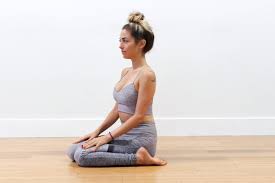
- Take a breath now and return your right knee to the side of your right buttock. The left knee should also be folded back and positioned to the side of the left buttock. Make sure to rotate the ankles externally and raise awareness of the ankles during each fold. Additionally, make sure the face is behind, and the ankles are open. Additionally, take note of how you keep your body balanced when sitting with your legs folded.
- The Wide Hero Pose is achieved by folding both knees and positioning the legs side to side to the hips. In order to go from Wide Hero Pose to Hero Pose, learners must pull their knees closer together. Initially, it would be difficult to balance at the knees. But after a few days of practice. The posture gets easier. Now feel the pressure around your knees and ankles.
- Place your arms on your thighs as you move your knees closer together. The knees must come into contact with one another in the last position. The heels make contact with the outside of the buttocks and upper thighs. The Hero Pose is now ready for you. You can extend the duration later. Stay here for at least 30 seconds.
- To gain additional strength and balance while in this pose, learners are urged to execute Hero Pose Variations.
- To go to Staff Pose from where you began, release, exhale, and bring your legs up front one after the other. Spend some time relaxing while sitting with your legs extended. If you have tingling in your ankles or any other region of your legs, shaking your legs will make you feel more at ease.
Benefits of Hero Pose (Virasana):
One pose that allows you to focus on your inner strength and become your own hero is the Hero Pose, also known as Virasana. There are numerous advantages to this straightforward pose that combines stretch, mindfulness, and balance, some of which are listed below:
- Stretches, Strengthens, Lengthens: When positioned firmly between the feet, Hero Pose stretches and strengthens the hips. It exerts pressure on both knees and strengthens them by pulling them closer together. Additionally, the quadriceps and thigh-to-foot muscles are strengthened by bringing the knees together. The spine also lengthens with consistent practice and prolonged holding of the pose. This posture strengthens the pelvic muscles and alters blood flow and nerve impulses in the pelvic area, as the spine is lifted and away from the floor.
- Flexibility and Range of Motion: By flexing the knees and ankles while seated, this position maximizes the stretch of the thigh muscles by applying pressure at the ankles. As a result, the muscles in the knees, ankles, and thighs become more flexible, making it easier to execute difficult twisting yoga postures that require leg range of motion. The flexibility of the foot around the ankles increases as the ankles reach their maximum stretch, and any heel pain from prolonged standing causes the feet to relax greatly.
- Awareness and focus: Hero Pose supports mental attention during pranayama and meditation by strengthening the spine and maintaining an upright, strong posture. The learners must position their buttocks between their feet on the mat. Teachers can set up a block or cushion for the pupils to sit on if they are having trouble with this alignment. This enables them to strike a pose and advance over time.
- Organs and Stimulation: Sitting softly in Hero Pose keeps the gut area slightly compressed, which aids in better digestion. The Manipura Chakra, which is in charge of the fire element inside the body that burns out the toxins, and the Sacral Chakra (Swadisthana Chakra), which is well-known for energizing the sexual and creative energies, are both activated by the light pressure applied to the lower abdomen. Similarly, the Root Chakra (Muladhara Chakra), which provides the basis for life and other chakras, is stimulated by light pressure applied to the lower back.
- Therapeutic, Healing, and Ailments: Hero Pose helps treat rheumatic knee pain by flexing the hips and knees. Flat feet can be cured by stretching the ankles, thighs, and feet to create the right arches.
- Systems and Circulation: The meru danda, the termination of the spinal column, is so exquisitely positioned between the feet that it gives the body a lovely posture and facilitates the smooth circulation of prana throughout the body. The first step in healing the body from the inside out is thought to be the flow of prana. The knees and thighs become more flexible when they are folded, which facilitates blood flow throughout the legs.
- Emotion and Balance: When you’re fully in Hero Pose, your mind stabilizes along with your body. Pranayama and meditation can therefore be encouraged while in position. With prolonged and consistent practice, one can reach the mental condition of equilibrium because of a stabilized mind. Therefore, as a quiet mind is beneficial for a healthy memory, this pose can be suggested to children and teenagers.
- Others: Because the Hero Pose can be done while sitting and doesn’t require additional bending or twisting, senior learners with strength and flexibility in their legs and feet can accomplish it. Because it is done while seated, it is a fantastic stretching intermediate yoga pose for children to start with. This pose is an excellent way for women to transition smoothly from perimenopause to menopause since it strengthens the pelvic area. Additionally, because the position strengthens the pelvic and core, it can be beneficial for women during the postpartum phase.
- Preparatory Pose: learners can practice more difficult poses such as Hero Pose Variation Hands Raised, Revolved Hero Pose, Hero Pose Cow Face Arms, Side Twist In The Hero Pose, and Revolved Hero Pose Bound Hands Elbow Floor once they have mastered the Hero Pose.
Contraindications of Hero Pose (Virasana):
Hero Pose may not be beneficial in the following circumstances:
- Injury and Surgery: Hero Pose necessitates adequate hip, quadriceps, knee, and ankle flexibility. learners should rest and avoid this position if they have recently had surgery or an injury to any of the aforementioned areas.
- Physical Strength and Weak Body: The Hero Pose causes the knees, hips, and ankles to feel incredibly stretched. Therefore, if someone is healing from a recent injury to their knees or ankles, or if they are really stiff in these areas, there may be a significant risk. The position is not recommended for senior learners or those with severe arthritis. This pose will be difficult for learners with swollen varicose veins and should be avoided. It can result in Painful blockages in the veins. This pose should be avoided for learners who have piles or a prolapsed uterus. The position of the genitalia and anus may worsen the condition and increase pain.
- Others: This pose should be avoided by women who are nearing the end of their pregnancy since it will cause hip and knee pain. Yoga instructors must assist learners in breathing and provide them with validation if they are not aware of the body-breath linkages. In these kinds of circumstances, appropriate instruction from an experienced teacher is always beneficial.
Hero Pose Variations:
Many Rishis (Saints) practice Virasana, which is regarded as a meditative pose with numerous variations. Below is an explanation of the several versions of this position.
- Place your feet with their soles pointed behind you and all of their toes contacting the floor while sitting on your knees and shins on the floor. The basic Virasana pose is this.
- Bringing the feet close to one another and placing them one on top of the other with the soles pointing back is the second variation on this. The hip rises when you place your sit bones on the heels of your feet. This needs to be done carefully because it will put additional strain on the ankles.
- Uddiyana Bandha, also known as the Abdominal Lock, can be performed by placing the hands on the thighs, pushing the hands down on the knees, and lifting the upper abdomen and chest. This exercise should be carried out under appropriate supervision and with proficiency in this type of pranayama.
- Another way to perform Virasana is to raise your arms above your shoulders and stretch your head upward while interlocking your fingers. Tightening the muscles in the upper abdomen and chest should be aided by this upward stretch.
- Sitting in a basic Virasana, place the palms on the soles of your feet. As you inhale, raise your body forward, and as you exhale, extend forward until your forehead touches the floor in front of you. This tones the lower abdominal muscles, maintains hip strength, and tightens the buttocks.
Conclusion:
Hero Pose (Virasana) is a grounding seated pose that promotes calm, steady breathing, extends the thighs and ankles, and enhances posture.
It is a great pose for meditation and recovery because, with consistent practice, it helps increase lower-body flexibility while encouraging focus and relaxation.
FAQs:
Is Virasana harmful to the knees?
Virasana with the feet turning out is an extreme twist that will harm the knee ligaments, even though the femur must rotate slightly, and the knee can safely accept some twist in a bending, non-weight-bearing position.
For whom should the Virasana pose be avoided?
Virasana should be avoided by those who have any kind of chronic pain, such as arthritis. The pose should be avoided or modified for those who have stiff knee joints. The pose should be avoided by those who have significant back pain. The pose should be adjusted using props for those who have trouble sitting on the floor.
Are Vajrasana and Virasana the same?
No, even though they are both sitting, kneeling yoga poses that call for a lot of knee flexion, Virasana (Hero Pose) and Vajrasana (Thunderbolt Pose) are not the same.
The main distinction is where the hips and feet are positioned: Vajrasana requires sitting on top of the heels, while Virasana requires sitting between the feet.
Does Hero Pose harm the hips?
Injury and Surgery: Hero Pose necessitates adequate hip, quadriceps, knee, and ankle flexibility. learners should rest and avoid this position if they have recently had surgery or an injury to any of the aforementioned areas.
What are typical Hero Pose errors?
In Hero Pose with a Twist, steer clear of the following typical blunders: collapse of the back. To prevent lower back collapse, make sure the spine is active and extended during the twist. Knee pain: If you experience knee pain, apply a blanket or block to ease the pressure.
What gives it the name Virasana?
The Sanskrit terms vajra (meaning “thunderbolt” or “diamond”) and asana (meaning “posture” or “seat”) are the source of the name.
Why am I unable to sit in Hero Pose?
Use a modification if you feel strain in your joints or muscles, or if your sit bones don’t reach the floor. For support, take a seat on a block, cushion, or folded blanket. Hold the pose for several deep breaths, up to a few minutes, if it feels comfortable. Pay attention to keeping your breathing pattern calm and steady.
How much time should be spent in Hero Pose?
First, hold this position for 30 to 60 seconds. Increase your stay gradually to five minutes. Press your hands to the floor and raise your buttocks just above your heels to emerge.
Who shouldn’t perform Virasana?
Virasana should only be performed under the supervision of a certified instructor if a person has knee diseases, ligament tears, recent knee surgery, or persistent knee pain. The pose may also be dangerous or painful for anyone with tight quadriceps, severe arthritis, or ankle problems.
Why is Hero Pose so challenging?
Virasana, which is frequently used for meditation and pranayama, can be quite difficult for many practitioners because it requires lower-body flexibility.
What is the yoga pose known as Hero Pose?
A sitting yoga pose that encourages quiet and grounding is called Hero’s Pose, or Virasana in Sanskrit. It encourages an erect and open posture via the chest and spine while stretching the quadriceps, knees, and ankles. This pose, despite its simplicity, is meant to evoke serenity and mental clarity.
References:
- Yoga Journal. (2025e, February 27). Hero pose. https://www.yogajournal.com/poses/hero-pose/
- Hero Pose Yoga(Virasana)| Yoga sequences, benefits, variations, and Sanskrit pronunciation | Tummee.com. (n.d.). Tummee.com. https://www.tummee.com/yoga-poses/hero-pose
- Jain, K. H. (2025, March 17). How to practice Hero Pose safely + Variations for all levels. Arhanta Yoga Ashrams. https://www.arhantayoga.org/blog/how-to-practice-virasana-hero-pose/
- Cheung, J. (2025, October 6). How to do the hero pose (Virasana). Liforme. https://liforme.com/blogs/blog/virasana?srsltid=AfmBOorBRK7RxQyeRN8qPV36unKex6xOJwI8Bn2MZHc0zUk3NMCFV9uU
- Wikipedia contributors. (2025a, May 23). Virasana. Wikipedia. https://en.wikipedia.org/wiki/Virasana