
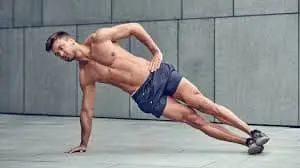
Side Plank Exercise
Introduction
The Side Plank Exercise is an effective core-strengthening exercise that mainly targets the oblique muscles, shoulders, hips, and lower back. It helps improve balance, stability, posture, and spinal support while reducing the risk of back pain and injuries.
We focus mostly on the benefits of the side plank exercise. Compared to conventional planks, which mostly work the front of your core, side planks emphasize posture, balance, and lateral stability.
Whether you prefer Pilates, yoga, or sports training, the side plank is a versatile exercise that can be included in any routine. It’s especially beneficial for enhancing performance in sports requiring twisting, turning, or single-leg balance, such as running, tennis, and soccer.
Throughout this workout, you must develop your shoulder, arm, hip, and knee muscles while supporting your foot muscles. Because isometric hold exercises are essential for strength training, side planks help you strengthen your core muscles.
Muscles involved in the side plank
- Internal oblique: The entire belly is covered by this muscle, which is responsible for forward bending.
- External oblique: The bigger, flatter oblique muscles that run along the sides of your belly and sit on top of the internal obliques—which are closer to the surface—are called external obliques. This muscle is primarily responsible for spine stabilization, forward bending, and twisting.
- Gluteus medius: Since the hip muscles are in control of all hip movements, you should consider them.
- Shoulder Muscles: A side plank stimulates the rotator cuff and other shoulder muscles since it demands you to stabilize through the shoulder joint on the weight-bearing side.
Side plank exercise Video
How to do the side plank exercise?
- Position: Side-lying position.
- After exhaling, align your hip, knee, and foot. The structure of your body does not bend or slump in any way. Continue playing the part.
- After a few breaths, take another inhalation and return to the starting position.
- Repeat after switching sides.
- Hold duration: 5 seconds is enough.
Variations of the side plank
Side Twist
- Start with a few of straight-on curl-ups.
- When you’re ready, do the curls on one side, softly moving up and down for the finest strengthening results.
- Perform a minimum of five on each side.
- Hold duration: 5 seconds is enough.
Side Plank From Knees
- You should fold both knees and divide your body weight between your hands and knees, just like in the side plank exercise.
- This will provide some isometric workout for your obliques. Switch to the opposite side.
- Repeat the process.
- Hold duration: 5 seconds is enough.
Single-Knee Side Plank
- Your weight should be equally distributed between your hip and the side of your thigh that is closest to the floor as you lower yourself from a sitting posture. The modest curve in this leg will provide precise and stable alignment.
- The proper alignment must be considered. Get your abs toned. Hold one hand straight on the area of your hips.
- Each time you practice, try to extend it by one or two seconds and focus on maintaining the proper form of the pose.
- Hold time: 5 seconds is sufficient.
Stability Ball Side Plank
- You should perform the side plank exercise with consideration for everyone because this technique is quite difficult. Your forearms should be used to hold the gym ball.
- Your body weight is balanced by the gym ball.
- To strengthen your base of support, consider putting the top foot on the floor in front of the other foot if you find this challenging.
- Use the muscles in your shoulders to keep the gym ball stable.
- Hold time: 5 seconds is sufficient.
Benefits of side plank exercise
- Shoulder muscle strength enhances upper-body endurance by activating the supporting arm and shoulder.
- Hip & Glute Activation: enhances hip stability by strengthening the gluteus medius and minimus, two side hip muscles.
- Injury prevention reduces the chance of injury by promoting proper movement patterns and correcting muscle imbalances.
- Increase your muscular strength score: By strengthening your muscles, strength training helps you prevent lower back and knee problems.
Side effects of the side plank exercise
- Muscular strain or spasm: Shoulder and neck muscle spasms are brought on by overusing the muscles. Pain or injury may result from overstressing the obliques or spinal stabilizers without enough development.
- Wrist or Elbow Pain: Supporting your body weight on one arm might put strain on your wrist or elbow if you already have joint problems.
- Unequal strength: If you simply execute this exercise on one side of your body, you may experience unequal strength. To achieve equal strength, do this exercise on both sides.
- Limited Muscle Growth: Side planks don’t require any movement and are an isometric exercise.
- Difficulties for novices: It may be difficult for novices to maintain correct alignment, which raises their risk of injury.
Mistakes to avoid with side plank variations
- Lower back pain and a decrease in core activation may result from lowering your hips.
- Misalignment of the neck: Keep your head down and don’t gaze up. One of the main reasons for pain is your neck posture, which can lead to muscular spasms or soreness.
- Hold your breath: In between workouts, many patients strain their neck muscles and hold their breath. Without a doubt, you should avoid making this mistake.
- Overpressure on a specific joint: Excessive pressure on a certain joint and bad posture are the causes of the soreness or spasm.
- Shoulder not stacked over elbow or hand: You run the danger of overstressing yourself and possibly injuring your joints if your shoulder is not precisely over the elbow or wrist it supports.
References:
- Patel, D. (2026, May 17). Side plank – how to perform, benefits and variations. Physiotherapy Treatment and Exercises at Home. https://homephysiotherapyexercises.com/side-plank/
- JanviMangukiya, J. (2026, May 17). Vasishtasana (Side Plank Pose) – Benefits, How to do? – Variations. Mobile Physiotherapy Clinic. https://mobilephysiotherapyclinic.in/vasishtasana-side-plank-pose/
- Side plank. (n.d.). [Video]. Hingehealth. https://www.hingehealth.com/resources/articles/side-plank/
- Sparacino, A. (1970, January 1). Why side planks deserve more of your attention—and 8 spicy variations to try. https://www.onepeloton.com/blog/side-planks

2 Comments