Marjaryasana (Cat Pose)
Introduction:
Marjaryasana (Cat Pose) is a gentle yoga posture that helps improve spinal flexibility, relieve back tension, and promote better posture.
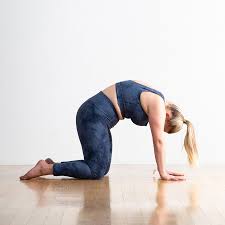
One of the most basic postures in many yoga traditions, the Cat stance (Marjaryasana) is practically everyone’s favorite happy-spine stance. The body is positioned in Table Top Pose (Bharmanasana), with the back rounded, the chin tucked against the chest, and the navel drawn toward the spine. Cat Pose gets its name from the body’s resemblance to a cat’s form.
The Sanskrit words Marjari (which means “Cat”) and Asana (which means “Pose”) are the source of the term Marjaryasana. Cat Pose is also known by the alternate names Billiasana, Bidalasana, or Viralasana.
As part of a fluid sequence known as Cat Cow Pose, Cat Pose is frequently performed in association with Cow Pose (Bitilasana). Cat Pose’s forward stretch enhances blood flow to the discs that connect the vertebrae. The spinal nerves’ effectiveness is enhanced by this better circulation, which relaxes the muscles surrounding the entire spine and heals the shoulders, neck, and back. Therefore, it can be included in restorative and therapeutic yoga poses. It is a part of yoga poses for women and relieves lower back pain and stiffness related to menstruation or PMS.
Cat Pose is a yoga pose that helps improve posture for athletes, youths, children, and working professionals. This beginner-level posture is accessible to everyone, regardless of age, gender, or skill level.
As a result, it may be incorporated into yoga sequences for everyone, including students who have been ill for a long time, senior citizens, and pregnant or postpartum mothers. Bharmanasana can be practiced while sitting in any seated-meditative pose, such as Easy Pose, Thunderbolt Pose, or Bound Angle Pose, for individuals who are having trouble following it while kneeling. As an alternative, people can follow it while standing or sitting on a chair or a bed.
Cat Pose is a fantastic cool-down pose after any kind of physical activity, sports, or advanced yoga regimen. It is frequently used as a warm-up to awaken the spine. This position, which is a part of peak yoga sequences, helps the spine become ready for forward-backward-twist-turn motions. When paired with deliberate breathing, the rhythmic motion can help balance the autonomic nervous system, reduce the “fight or flight” response, and support well-being and relaxation. As a result, it is a component of nearly every type of yoga.
Cat Pose in a flow is an excellent asana to begin toning the belly and can be incorporated into Power Yoga, Hot Yoga, or Pilates sessions. Spiritually, this exercise energizes the mind, body, and spirit by balancing the chakras and removing energy blockages.
Since marjaryasana variations can be generated from this pose, marjaryasana is regarded as a base pose. Marjaryasana is regarded as a yoga warm-up that gets the body ready for more challenging poses and sequences.
How to Do Marjaryasana:
The steps to enter Marjaryasana, also called Bidalasana or the Cat Pose in English, are as follows:
- In Vajrasana, begin by sitting in the middle of the mat on your knees and shins with your hips on your heels.
- Here, relax your body and inhale deeply while extending your spine upward.
- Prioritize alignment by aligning the palms with the knees while maintaining hip spacing between them. Place the upper feet just behind and in line with the knees while keeping them on the ground. As a result, the feet, knees, and palms should all line up.
- Maintaining alignment, ensure that the torso is parallel to the floor, the knees are just below the hip joint, and the palms are just below the shoulders.
- After you’re comfortable with the alignment and position, shift your body’s weight to the middle of your spine so that it doesn’t fall over your shoulders and wrists.
- Here, take a few breaths while staring directly ahead. Pay attention to how your body moves and how you breathe.
- Breathe in, elevate your back, and pull your belly in. Then, fully exhale, bring your neck inward, and move your shoulders into an arch. Breathe out fully while moving your neck and belly.
- Start the slow, deep breathing after stretching the back farther upward and forming it as much as possible into an arch.
- The body should now have a deep rounding of the back, resembling a cat stretching its back. A cat stretches its entire body and flexes its spine to its greatest extent when its neck is lowered inward.
- To get the most out of this pose, begin with deep, calm breathing, engaging both the diaphragm and abdominal muscles. Here, when you inhale, you round your back and loosen your body while keeping your neck in. When you exhale, you will stretch deeply and draw your belly in.
- Maintaining balance and stability can be achieved by engaging the core muscles and ensuring that the body weight is not entirely focused on the wrists and shoulders.
- Watch how the upper back, chest, and belly move while you remain in this position for roughly four breaths.
- Breathe in, lift your head, let go of your body, and anticipate relaxing as you exhale. Relax and return to sitting in Vajrasana after releasing yourself from the pose. Repeat the Cat Pose exercise by taking another breath and holding it for at least eight breaths.
- Because the movement of the spine with contractions of the various muscles helps to enhance flexibility and posture, Cat Pose and Cow Pose are typically performed together.
- Fully relax.
Benefits of Marjaryasana:
The advantages of Cat Pose (Marjaryasana) can be cited because it is based on Table Top Pose. Additionally, the rounded spine of Cat Pose (Marjaryasana) provides the following advantages:
- Stretches, Strengthens, Lengthens: An easy, gentle stance opens out the entire spine. Therefore, a perfect peak pose strengthens the wrists, knees, and ankles while stretching and strengthening the muscles of the shoulders, neck, and middle and upper back. The exercise strengthens the chest and abdominal muscles by compressing them. The pelvic area and spine have better blood flow.
- Flexibility and Range of Motion: For nearly everyone, the rounding or curving action of the neck and back increases the flexibility of the neck and spine. As a result, Cat Pose is an excellent method to start a yoga practice because it helps improve neck and back mobility for forward or backward bending poses. Even so, it aids in getting the spine ready for the curves. It can therefore be incorporated into morning yoga poses.
- Chest, Diaphragm, and Breath: While the chest is constricted during Cat Pose, the diaphragm is kept active by conscious awareness. Ensure that the lungs are functioning as well. Knowing how to breathe, however, can assist in maintaining the posture longer or prime the lungs for difficult poses. Additionally, breath awareness improves breathing.
- Alignment and Posture: The star-marked stance for a contented spine is the cat stance. It facilitates the relaxation of the shoulder, neck, and back muscles. Yoga instructors should ensure that the hands are directly beneath the shoulders and the knees are directly beneath the hips when doing Table Top Pose (Bharmanasana), which is a kneeling pose. The distance between the hands is shoulder-width. The distance between the knees is hip-width. The knees and ankles line up. The feet are flat, with the toes pointing backward and the front foot on the ground. The spine should be level and parallel to the floor before rounding it in Cat Pose. In actual practice, the belly is drawn in, creating a lovely curve in the spine, and the chin is tucked into the chest (as we do in Jalandhara Bandha). The fingers are large and pointed in front, and the palms are neatly planted. Additionally, the feet are gently forced into the ground.
- Energizing, De-stressing, and Relaxing: This straightforward forward bend increases circulation to the discs between the vertebrae, which is energizing, de-stressing, and relaxing. Better circulation increases the spinal nerve’s effectiveness, which calms the muscles around the entire spine. Eventually, it soothes the mind. Because Cat Pose de-stresses the muscles around the neck and shoulders, it can also be incorporated into a nocturnal yoga regimen for students who work long hours, particularly those who work desk jobs. This pose can assist in balancing the autonomic nervous system, lowering the “fight or flight” reaction, and strengthening relaxation and well-being when accompanied by deliberate breathing. Therefore, students who are struggling with stress, depression, or mental disorders can be taught Cat Pose.
- Therapeutic, Healing, and Conditions: Cat Pose helps to recover the neck, back, or shoulders from daily activities that cause stress and tension to the corresponding muscles by extending the spinal muscles to make the back curved. Therefore, when done at a desk, this pose corrects posture and helps students with cervical problems as well as neck, shoulder, and back pain. Included in women’s yoga poses, it relieves lower back pain and discomfort caused by menopause, PMS, or period cramps. One of the greatest ways to treat fibromyalgia is to do the cat pose, which is a soothing stretch for the back and spine.
- Organs and Stimulation: The reproductive organs and digestive processes are stimulated by the squeezing action in the belly cavity. As a result, it aids in the treatment of indigestion, constipation, and even postpartum recovery. Thyroid imbalances are alleviated by the chin to the chest.
- Balance and Emotions: The Solar Plexus Chakra is stimulated as you round your back in Cat Pose, which can help you access inner power and improve your self-esteem. Practicing taking your chin to your chest activates the Throat Chakra, which enhances your capacity for self-expression and communication. Additionally, the round back creates a sense of immense excitement and expansion by opening the rear of the chest. The avenue for the release of trapped energies is made possible by the elegant rounding of the spine. This little stretch helps to balance the body’s chakras and allows prana to circulate freely throughout the body.
- Others: Cat Pose is accessible to everyone and may be incorporated into any style of yoga, regardless of age, skill level, or gender.
- Level-up Poses: Since Cat Pose is more of a warm-up exercise, it can be done at the start of a program or in a flow similar to a Moon or Sun Salutation. Even forward folds like Downward Facing Dog Pose, Cat Pose Variation Knee, Puppy Dog Pose, Head To Knee Pose, and Bowing Yoga Mudra Seated benefit from it.
Contraindications of Marjaryasana:
Some safety tips to consider when performing Cat Pose (Marjaryasana) are listed below:
- Physical Strength and Weak Body: Students can alter the stance if they have weak muscles, severe arthritis in their knees and wrists, or general body weakness. It can be performed in any sat-meditation pose using a pillow or folded blanket beneath the sit bones, either on the floor or while seated on a bed or chair. This pose is not recommended for students who have severe backaches or persistent lower back pain. Students should practice slowly if they have high blood pressure, migraines, vertigo, or chest, rib cage, or abdominal pain.
- Injury and Surgery: Students should stay away from it if they are recuperating from a hip, knee, back, shoulder, spine, or pelvic joint injury. Students can practice it while seated if they have injuries to their knees, wrists, or ankles. The pose should also be avoided by students who have neck or spinal ailments.
- Others: During the first trimester of pregnancy, women should refrain from squeezing their bellies; however, in subsequent trimesters, they should gradually adopt the technique and make any required adjustments. Similar to using a folded blanket or pillow to cushion the knee. Otherwise, it’s a simple forward-folding kneeling exercise that can be done every day to promote a healthy spine.
Conclusion:
Marjaryasana improves posture and relaxation, eases neck and back stress, and increases spinal flexibility. Regular practice of this posture helps improve breath-movement coordination, which makes it a great complement to any yoga practice for both beginners and experts.
FAQs:
Does scoliosis benefit from marjaryasana?
This pose extends the tendons and muscles that support your spine and expands the gaps between your vertebrae. Tension in the lower back and neck is also released by the smooth transition between rounding and arching the back.
Which muscles are used in Marjaryasana?
Marjaryasana develops the muscles of the abdomen as well as the mamsa dhatu (muscle tissue), particularly those surrounding the hands, shoulders, and spine. These muscles are also well-stretched by the asana. The asana strengthens the kandaras (tendons) and snayus (ligaments) of the wrist, shoulder, and spine.
Is Marjaryasana suitable for beginners?
Marjaryasana is appropriate for the following: both beginners and expert yogis. Those with slight stress or stiffness in their backs. Those seeking a mild method of increasing spinal range of motion.
What differentiates Bitilasana from Marjaryasana?
Bitilasana/Cow stretches the front of the shoulders, chest, core, and back of the hips while strengthening the spine and back of the shoulders. In contrast, Marjaryasana/Cat strengthens the front of the shoulders, chest, core, and back of the hips while stretching the spine and back of the shoulders.
What are the advantages of Marjaryasana?
The Cat Pose, or Marjaryasana, is a fundamental yoga pose that improves posture and spinal flexibility. This pose gets its name from its fluid spinal motions that resemble a cat arching its back.
References:
- Yoga Journal. (2025, February 25). Cat pose. https://www.yogajournal.com/poses/cat-pose/
- Cat Pose Yoga(Marjaryasana)| Yoga sequences, benefits, variations, and Sanskrit pronunciation | Tummee.com. (n.d.). Tummee.com. https://www.tummee.com/yoga-poses/cat-pose
- Admin. (2023, June 18). Cat Pose (Marjaryasana) : How to Do It, Benefits & Precautions. Vinyasa Yoga Ashram. https://www.vinyasayogaashram.com/blog/cat-pose-marjaryasana-how-to-do-it-benefits-precautions/