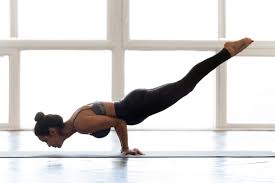
Peacock Pose (Mayurasana)
Introduction:
Peacock Pose (Mayurasana) is an advanced yoga posture that requires strong wrists, arms, and core muscles.
In Peacock Pose, the body represents the peacock (mayura), with the hands shaped like the bird’s legs and the legs resembling its feathers.
To avoid excessive strain on the elbows and wrists, it is essential to warm up properly before starting a shoulder and arm yoga sequence because this is where a significant portion of the stretch takes place.
The Peacock Pose can be used in flow yoga sequences since it increases the body’s energy.
How to Do Peacock Pose:
The detailed instructions for performing Mayurasana (Peacock Pose) are provided below:
- Start the exercise by sitting in Malasana, also known as Garland Pose, with your feet wide apart, opening your hips to stretch, and remaining in this position for four to six breaths.
- From here, drop to your knees, keeping your hips apart, and place your feet on the floor behind you. Taking a breath, place your palms on the ground and turn them inward, with your fingers pointing inward toward your body and your wrist facing forward.
- Stretch your elbows and forearms while exhaling and moving your head and chest such that your forehead rests on the floor in front of you.
- After laying the forehead on the floor, pull the elbows together so that they are slightly below the navel, then place the rib cage on the elbows.
- Breathe deeply, then fully exhale. Then, without breathing again, stretch your legs behind you, balancing on all of your toes as you extend from your hips.
- As you do this, reposition and settle on your forearms by pushing your tummy and chest. Take a breath, adjust the toes, forehead, hips, stomach, and chest, then slowly raise the head and legs off the ground.
- Make sure the thighs, knees, feet, and forearms are all together while doing this. The gluteus is tight, the pelvic floor muscles are active, and the respiration is deep and slow.
- Lengthen your entire body while balancing on your elbows and progressively raise your eyes in front of you as you gradually achieve stability, balance, awareness, and control.
- For the first three breaths, remain in this balanced position in Mayurasana (Peacock Pose).
- To sit straight in Vajrasana (Thunderbolt Pose), exhale, relax your legs, bring them down, rest your knees on the floor, and raise your torso. To become aware of your breathing, unwind and take a nap.
Benefits of Peacock Pose:
In addition to strengthening the arms and shoulders, Mayurasana is a difficult arm balance posture that offers numerous other advantages. The wrists are stretched to keep the body balanced. Below is an explanation of these:
- It promotes greater stability and serenity by fostering a deeper awareness of the body.
- It strengthens the muscles in the chest, forearms, and core.
- The body is elevated above the ground, maintaining its suppleness, while the spine remains parallel to the floor. The spine is not as active in Mayurasana as it is in most advanced yoga poses.
- Awareness enhances brain-to-brain communication, which promotes increased nervous system performance and a flexible, soft spine. aids in enhancing focus and vision.
- The internal organs, especially the stomach for improved digestion, are gently massaged while the belly and abdominal muscles are pressed against the elbows.
- When you come out of the posture, your blood circulation will be better, your internal organs will be stimulated, and toxins will be eliminated.
- Boosts the body’s metabolism and aids in preventing sadness and stress.
- The muladhara chakra’s dormant kundalini (serpent energy) is claimed to be awakened by the delicate practice of Mayurasana. However, this should be done under the right supervision.
- It is supposed to develop a deeper consciousness on a spiritual level by converting the sexual energy into a subtle psychic power.
Contraindications of Peacock Pose:
Given that Mayurasana (Peacock Pose) is an advanced arm balance pose, the following safety measures should be considered while practicing:
- Mayurasana (Peacock Pose) should not be performed by learners who have injuries to their wrists, elbows, shoulders, hips, lower back, neck, or rib cage.
- Mayurasana (Peacock Pose) should not be performed by people with back pain, back surgery, arthritis, high blood pressure, heart problems, pregnancy, menstruation, problems with the stomach organs, etc.
- The Peacock Pose should only be attempted in these situations under the supervision of a yoga instructor.
Conclusion:
Peacock Pose, also known as Mayurasana, is a potent arm-balancing pose that improves focus and digestion while strengthening the arms, wrists, and core. Even though it can be difficult, regular practice with the right technique can improve mental discipline and physical stability. This position can be a fulfilling addition to your yoga practice if you are patient and gradually advance.
FAQs:
For what duration is the peacock pose appropriate?
Work your way up to one to three minutes of Pincha Mayurasana by staying in it for ten to fifteen seconds. To release, bring both knees to the floor together while bending from the waist using the strength of your shoulders and core.
What advantages do peacocks offer?
Male peacocks, in particular, are prized for their ornamental attractiveness, which includes their yearly molted feathers used in crafts, as well as for their natural ability to control pests and serve as noisy “watchdogs” to warn owners of predators or outsiders. They are skilled foragers that consume rodents, insects, snakes, and ticks.
Are peacocks lucky or unlucky?
Hera grew to value the new creation—a peacock—so much that they were selected to pull her chariot. The lovely hues and “eyes” on the peacock’s tail, which increased alertness and protection, were symbolic of renown and good fortune in Chinese mythology.
Are peacocks native to India?
With their eye-catching tail feathers, male peafowl, commonly known as peacocks, are easily identifiable. Peafowl are revered in their native India and have become emblems of riches and power all around the world.
Is it safe for everyone to strike the peacock pose?
To prevent wrist injury, release the pose carefully and gently. Avoid if you already have elbow or wrist issues. Avoid if you’re pregnant.
What is the peacock pose’s history?
The Sanskrit terms “peacock” (mayūra) and “posture” (sana) are the source of the name. One of the first non-seated poses in hatha yoga is mayurasana, which was originally recorded in the 10th century by Vimānārcanākalpa.
Does the peacock position help with digestion?
Mayurasana, often known as “Peacock Pose,” is a potent and invigorating yoga practice that enhances your balance and posture, strengthens your core, and aids in cleansing and digestion.
Is it possible to reduce stress with the peacock pose?
An extremely energizing inversion is Pincha Mayurasana/Peacock. It extends the shoulders and strengthens the arms, spine, and shoulders.
Is the peacock position difficult?
Because women have a lower center of gravity than men, mayurasana is usually more challenging for them. Because the center of gravity won’t be over the elbows, lifting the lower body will require a lot more effort from somebody with short arms and heavy legs and pelvis.
What does “peacock pose” mean in Sanskrit?
Mayurasana
The pose is called Mayurasana in Sanskrit, where Mayura means peacock. The position is similar to that of a peacock with its tail down.
For what duration is the peacock pose appropriate?
Work your way up to one to three minutes of Pincha Mayurasana by staying in it for ten to fifteen seconds. To release, bring both knees to the floor together while bending from the waist using the strength of your shoulders and core.
Is it safe for everyone to strike the peacock pose?
To prevent wrist injury, release the pose carefully and gently. Avoid if you already have elbow or wrist issues. Avoid if you’re pregnant.
References:
- Peacock Pose Yoga(Mayurasana)| Yoga sequences, benefits, variations, and Sanskrit pronunciation | Tummee.com. (n.d.). Tummee.com. https://www.tummee.com/yoga-poses/mayurasana
- Yoga Journal. (2025b, March 14). Peacock pose. https://www.yogajournal.com/poses/peacock-pose/
- Allen, W. (2025a, August 26). Mayurasana. https://myyogateacher.com/yoga-asana/mayurasana