Eagle Pose (Garudasana)
Introduction:
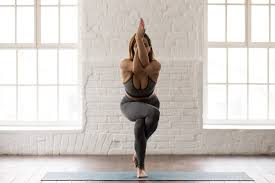
Eagle Pose (Garudasana) is a standing yoga posture that improves balance, flexibility, and body awareness. In this pose, the arms and legs are wrapped around each other, creating a gentle stretch in the shoulders, upper back, hips, and thighs.
This classic Hatha yoga pose is a great way to open your heart and hips. Additionally, this wrapping procedure can be carried out individually, offering the following special advantages:
- The lower body, quadriceps, hip flexors, gluteus, and feet-ankles are all strengthened by the eagle pose legs.
- The arms, shoulders, neck, and upper back are all strengthened by Eagle Pose Arms.
Therefore, when combined, Eagle Pose is a great way to strengthen the upper and lower body while enhancing awareness and focus to discover stability and balance in this balancing yoga pose. Warm-up and joint-freeing exercises are necessary to build the necessary strength, balance, and flexibility, even though this is a beginner-level position.
To build the strength and balance needed for Garudasana, the last basic yoga pose, try doing poses like Tree Pose, Warrior Pose III, Chair Pose Variation, Eagle Arms, Warrior II Eagle Arms, or Half Eagle Pose. To increase joint mobility, try the Arms-Shoulder Rotation, Knee-Ankle Rotation, and Seated Butterfly Pose. Additionally, to strengthen your core for this difficult balancing exercise, try Plank Pose and Boat Pose.
The Sanskrit terms Garuda, which means Eagle, and Asana, which means Pose/Posture, are the source of the name Garudasana. Eagle Pose got its name from this. Additionally, Garuda is portrayed in Hindu mythology as the king of birds and a strong, majestic bird-like creature.
Furthermore, Garuda has an important role as the vehicle (vahana) of Lord Vishnu, one of the main Hindu deities. Therefore, striking this pose offers the chance to connect with the following attributes and symbols that Garuda represents, in addition to being a physical workout:
- Strength and Power: the ability to wrap their arms and legs together while balancing on one leg.
- The delicate wrapping of arms and legs while preserving posture and balance is known as grace and precision.
- Unity and Balance: In Hindu mythology, Garuda stands for the ideal harmony between conflicting forces. In a similar vein, the Eagle Pose highlights the unification of the top and lower extremities as well as the balance between the left and right sides of the body.
- Transcendence: By performing such Sthira poses, one can transcend mental and physical constraints and advance toward increased freedom and self-awareness. Therefore, experienced practitioners of yoga can incorporate this stance to guide them toward their higher yogic practices, Dharana and Dhyana (meditation and concentration, respectively).
Garudasan creates a stronger mind-body connection, which boosts confidence and gives a sense of accomplishment. It encourages solidity and anchoring. Spiritually, this standing-balancing exercise stimulates a clear vision by activating the Ajna Chakra. Eagle Pose, which is a part of yoga for teenagers, fosters their interest in yoga by offering them positions that are both creative and difficult.
This yoga stance strengthens the lymphatic system by balancing, twisting, stretching, and stimulating. This lovely fundamental yoga stance is part of yoga for athletes and can help them perform better. This helps tone the arms and thighs, leaving the body strong, toned, and energetic. It is a part of Power and Flow yoga sequences.
Since eagle pose variations can be generated from eagle pose, eagle pose is regarded as a base pose. Eagle Pose can be used in flow yoga sequences since it increases the body’s energy.
How to Do Eagle Pose:
- Take a few deep breaths and relax while standing in Tadasana (Mountain Pose).
- Take a breath, lift your right foot off the ground, and position your right leg across your left thigh, over your left knee. Place the right thigh’s rear against the left thigh’s front. Here, fully exhale and observe the equilibrium.
- Now place the right foot behind the left calf so that the right big toe hooks slightly over the inside side of the left ankle, and the right shin contacts the left calf. The left leg is now locked with the right leg.
- Lower your hips and maintain your balance for a while when you feel comfortable.
- Raise the arms to the level of the chest while bending the elbows. Place the left elbow close to the elbow joint on the front of the right upper arm. Next, reunite the palms by moving the left hand back to the right and the right hand back to the left. The right arm is clasped around the left arm.
- Make sure your back is straight and maintain your attention on one spot. Pull your navel in and hold this stance for a few seconds, or roughly six breaths, concentrating from the core.
- You can maintain your balance by paying attention to your breath, gaze, equilibrium, stretch, and the weight of your body on your foot.
- Return to Tadasana (Mountain Pose) and let go by relaxing your arms and legs.
- Repeat the posture with your right arm wrapped around your left arm and your left foot interlocked behind your right calf while standing on your right leg. As you lower your hips, maintain your balance for roughly six breaths and make sure your spine is straight.
- Focusing on the core is crucial for improved balance, and the more tightly the legs are interlaced, the better the balance.
Benefits of Eagle Pose:
Eagle Pose (Garudasana) is a stunning and difficult pose that combines strength, balance, stability, stretch, and total concentration.
- Stretches, Strengthens, Lengthens: Wrapping or crossing the arms lengthens and strengthens the lats, rhomboids, subscapularis, supraspinatus, teres minor, and trapeze muscles in the upper back, neck, arms, rotator cuff, and shoulder. All of the joints in the arms and shoulders are also strengthened and opened by wrapping the hands and palms. Stretching the muscles of the hips, thighs, lower back, knees, ankles, and gluteus, as well as actively engaging the pelvic floor muscles, strengthens the leg muscles and joints. Conversely, the standing leg strengthens the knees, feet, and ankles since they are automatically engaged.
- Flexibility and Range of Motion: The upper body (shoulder, elbows, wrist, arms, upper back, rhomboids) and lower body (calves, pelvic floor, quadriceps, along the hip-knee-ankle joints) can both be made more flexible and mobile by stretching the muscles of the arms and shoulders and locking the legs.
- Chest, Diaphragm, and Breath: The interlocking of the arms activates the diaphragm, rib cage, and chest while also slightly opening the chest (back lungs). For people who suffer from asthma, colds, allergies, or other respiratory conditions, efficient activation of these muscles improves lung and heart function. Students with acute and severe respiratory illnesses, on the other hand, follow the motion of locking their arms and legs separately when balancing. If not, it may have an impact on their respiration. Finding equilibrium can be aided by striking a balancing position in the outdoors and maintaining deep, rhythmic breathing. This will help you find balance in the stance and increase your lung capacity.
- Awareness and Focus: Because Eagle Pose is a difficult standing-balancing yoga pose, you will feel powerful and emotionally and mentally stable as a result of the integration of all body parts. Furthermore, if the mind strays from the body, alignment, and breath, the equilibrium is lost. Therefore, breathing is improved, and the sensation of focus and attention is developed by maintaining balance by placing the entire body weight on all fours of the grounded foot and hand, and intentionally keeping the body light and loose. Furthermore, by strengthening the body and mind, such poses enable practitioners to sit in Dharana (concentration) and Dhyana (meditation) for extended periods of time while learning about the inner aspects of existence.
- Alignment and Posture: Understanding the alignment portions of Garudasana makes it easier to balance. The entire body weight is split equally between the heel and the ball of the foot when the grounded foot is securely planted. The hips face front, and the elevated leg is locked from the front (from the front thighs to behind the calf). This will help strengthen the hips, legs, and lower back while toning the legs and reducing joint and lower back pain. At shoulder level, the hands and elbows are locked in front. The alignment and stretch strengthen the upper back, help with posture, and reduce neck and upper back pain brought on by a sedentary lifestyle. Throughout the exercise, the core is active, and the chest is raised. At all times, the eyes are fixed on the front. Yoga instructors advise pupils to concentrate on their breathing rather than falling to the opposite side. Frequent practice improves the condition of the affected muscles and joints and helps with hunchback and tight hips.
- Energizing, De-stressing, and Relaxing: Eagle Pose demands patience and practice due to its nature. However, as time goes on, it will become simpler to coordinate the body, breath, and mind, which will stabilize the flow of prana (energy) throughout the body. As a result, deep breathing throughout the pose promotes mental and physical relaxation.
- Furthermore, the lymphatic system is stimulated by the squeezing and massaging action of the wrapped arms and legs, which helps the body eliminate waste and toxins. As a result, this improves energy flow and fosters well-being and relaxation.
- Stimulation and Organs: This exercise strengthens the digestive system by using the core to achieve a steady sensation of balance and stability deep through the legs. It also affects the reproductive system as a hip-opener with pelvic engagement, which helps women with infertility problems and restores hormonal balance. The blood circulation is temporarily restricted while the arms and legs are locked. The gushing blood flow improves circulation after the lock is released. It improves the body’s blood flow.
- Therapeutic, Healing, and Conditions: Wrapping the legs relieves sciatica nerve problems and back pain. It can help students who have urine incontinence because it works wonders with the pelvic floor muscles. Additionally, if you spend a lot of time at your desk during the day or at night before bed, Eagle Pose can assist prevent cramps and relieve your lower back and legs. By energizing the body and mind, this pose lessens epileptic symptoms. Additionally, the practice of wrapping the arms may help students with symptoms of frozen shoulder, golfer’s elbow, fibromyalgia, carpal tunnel syndrome, and finger tingling. Students with cervical spondylosis also get significant improvement from shoulder and neck stiffness.
- Others: Garudasana is a lovely posture that may be used in yoga sequences for runners, climbers, athletes, or others who participate in vigorous sports to build strength and stability because it stretches and strengthens the arms and legs while increasing lung capacity. Garudasana is a creative activity that may be introduced to yoga for teens or children while they develop their interstate in yoga by performing the same pose with partners or with the help of a prop (Eagle Pose Hands Trapeze). This pose is beneficial for toning the arms and legs and is a part of Hot Yoga, Power Yoga, and Flow Yoga sequences.
- Balance and Emotion: The Eagle Pose strengthens the musculoskeletal system. Spiritually, this pose helps students regulate their emotions and deal with day-to-day obstacles by subtly activating the Root Chakra, Sacral Chakra, and Ajna Chakra.
- Level-Up Poses: This hip-opening exercise helps stabilize the body and gets it ready for more difficult balancing poses like the Firelog Pose, Half Moon Pose, Revolved Triangle Pose, and Cow Face Pose. Additionally, it helps the body become ready for arm balance postures like Firefly Pose and Crow Pose.
Contraindications of Eagle Pose:
Therefore, when instructing students in yoga, instructors should be mindful of the following safety measures:
- Injury and Surgery: Because Eagle Pose places pressure on the grounded foot’s knees, ankles, and toes, students who have a history of joint injuries or are currently recuperating from one should avoid it entirely. Additionally, students who have recently had surgery on their abdomen, hips, knees, or back, or who have injuries to their legs, hips, rib cage, hamstrings, quadriceps, lower back, or visceral organs (damage to internal organs and tissues), should avoid this balancing pose and only practice Eagle Arms. Students who have shoulder, neck, or arm issues should avoid this position, although they can still practice Eagle Legs on their own.
- Physical Strength and Weak Body: Due to this pose’s nature, students who have any kind of weakness or strain on any part of their body—especially those who are elderly, such as an old injury that still causes weakness, a physical illness, brittle bones, arthritis, or general body weakness- should avoid it. Additionally, students should avoid this practice if they have high blood pressure, a history of heart problems, depression, dizziness, vertigo, migraine, sleeplessness, nausea, a ruptured disc, severe sciatica, or pain in the neck, arms, legs, shoulders, or back. This procedure should be avoided by those recuperating from illness and postpartum women who have not yet given birth for more than eight weeks.
- This procedure should be avoided by those recuperating from illness and postpartum women who have not yet given birth for more than eight weeks. Students who suffer from wrist pain, tennis elbow, or carpal tunnel syndrome should go slowly. This stance should be avoided by students who have varicose veins. Leg locking may restrict blood flow and cause discomfort and pain in the nerves. For these pupils, as well as those who are obese or women with enormous busts and chests, a strap may be an option. Additionally, pupils who are obese or have hefty thighs may find leg wrapping difficult. A chair or wall can be used as support in this situation.
- Lack of Body-Breath Connection: Garudasana requires awareness and concentration to maintain balance. The technique may cause discomfort and disruption of energy levels if the body-breath link is not properly understood. Therefore, this exercise should not be introduced to the kids until they are fully prepared. On the other hand, a chair or wall can be used as support.
- Others: Pregnant women and elderly people (who would not normally do Eagle Pose) should avoid it because it is a difficult balancing exercise. A yoga strap can help students with poor flexibility who are unable to fully cross their elbows. With the help of a chair or wall, students who struggle with balance can maintain the pose.
Modifications of Eagle Pose:
One could utilize the wall for support in this pose because it can be challenging to balance the body. A smart method to start the pose gradually is to relax the crossed leg foot on the floor. If the arms and elbows are difficult to interlock, one can simply perform a basic Namaste near the chest or interlock according to comfort.
To perform Garudasana flawlessly, a few pointers are crucial. They are:
- When done correctly, this yoga stance develops power, grace, and composure.
- Tighten your arms and thighs together. You will get more balance the more you do this.
- Maintain a straight line with your hands, thighs, and arms.
- Start actively sliding the toes down the rear of the calf instead of simply attaching the raised foot to the standing calf.
- Stack your shoulders over your hips and raise your chest away from your thighs while keeping your depth.
- Sink your tailbone as close to the floor as you can while bending your knees deeply.
- Avoid glancing up or down; instead, focus your attention on a single location.
Eagle Pose Breath Awareness:
Soft, deep breathing is what keeps the hips steady and balanced throughout Garudasana. To help you better grasp this position practice, the following breathing instructions are provided:
- Take a breath, lock your foot, and bring your right thigh over your left.
- Breathe out and drop your hips.
- Take a breath and lock your right elbow beneath and around your left elbow.
- Breathe out and bring your arms down to your chest.
- Take a breath and tighten your hold on your thighs and elbows.
- Exhale by pulling your belly in and lowering your hips.
- Inhale and exhale gently to interlock the thighs and elbows, then exhale gently to descend the hips and maintain balance.
- Breathing in and out gently will help you stay balanced while looking straight ahead.
- To return to Tadasana, exhale and relax the arms and thighs.
- Instead of holding your breath, it is recommended to be conscious of your deep, gentle belly breathing.
Conclusion:
Garudasana, or Eagle Pose, is a potent balancing pose that improves body awareness, focus, and stability. It helps strengthen muscles, stretch tight spots like the shoulders and hips, and enhance coordination by intensely working the arms, legs, and core.
This pose is a great complement to any yoga regimen since it fosters mental focus and serenity in addition to increasing physical strength and flexibility.
FAQs:
What makes the Eagle Pose so challenging?
Men’s broader frames make the eagle position infamously challenging for them. The wrapping motion needed for the eagle position is particularly challenging for people with broader shoulders and legs.
Which Eagle Pose errors are frequently made?
Most people don’t fully benefit from the eagle pose because they perform it incorrectly. Let’s break it down. Common errors include attempting to bring the hands together and even slightly crossing the legs without applying pressure. Put your hands together and slightly cross your legs.
How long should Garudasana be held?
Don’t arch your back. For 30 to 60 seconds, maintain the posture. On the other side, repeat the posture.
What is the most beneficial yoga pose?
One of the most crucial yoga poses is the corpse pose. It is designed to help you focus on your inner self while revitalizing your body and mind after practice.
Is Eagle Pose beneficial for sciatica?
Because it expands the back lungs and improves breathing, Eagle Pose is a great pose for people with sciatica and lower back discomfort. Additionally, the fact that we are balancing can assist prevent knee injuries. It strengthens your legs and expands your shoulders and back.
For an eagle to soar, which body part is most crucial?
For flight and movement, the tail is crucial. The bald eagle spreads its tail feathers to maximize surface area and enhance the impact of thermals and updrafts while soaring or gliding in flight.
What disadvantages do eagles have?
They don’t need to hunt by sound, and they don’t. Additionally, eagles’ senses of taste and smell are not particularly developed. Given that eagles are scavengers, we might view this as a disadvantage.
How much time should you spend in Eagle Pose?
Bring the backs of your hands together by bending your elbows, or wrap your palms together to make contact. As you lower your shoulders away from your ears, raise your elbows a little. Sitting down into the bent standing leg, draw your tummy in. Hold your gaze gently at a fixed location for five to ten breaths.
Does Garudasana enhance blood flow?
Garudasana promotes lymphatic drainage and blood flow by twisting and compressing specific body parts.
Does Eagle Pose open your heart?
The difficult pose known as Eagle Pose (Garudasana) involves balancing on one leg while encircling the arms and legs. This classic Hatha yoga pose is a great way to open your heart and hips.
Is Eagle Pose difficult?
Men’s broader frames make the eagle position infamously challenging for them. The wrapping motion needed for the eagle position is particularly challenging for people with broader shoulders and legs.
Which disease does Garudasana treat?
Sciatica pain, which affects the back, hips, and legs, is caused by pinching of the sciatic nerve. This ache eventually causes constriction of the lower back’s spinal nerve. Garudasana helps by toning the lower back muscles and easing sciatica pain.
What is the purpose of the Garudasana pose?
Eagle position, also known as Garudasana, is a difficult standing balance position in yoga that entails crossing your arms and legs like an eagle. It boosts flexibility in the hips and shoulders, strengthens the arms, legs, and core, and enhances balance.
References:
- Yoga Journal. (2025, March 24). Eagle pose. https://www.yogajournal.com/poses/eagle-pose/
- Eagle Pose Yoga(Garudasana)| Yoga sequences, benefits, variations, and Sanskrit pronunciation | Tummee.com. (n.d.). Tummee.com. https://www.tummee.com/yoga-poses/eagle-pose
- Rakshak, & Rakshak. (2024, June 18). Garudasana (Eagle pose) | How to do | Benefits – The Art Of Living. The Art of Living – Making Life A Celebration. https://www.artofliving.org/in-en/yoga/yoga-poses/garudasana-eagle-pose
- Eagle pose – Garudasana – The Yoga Collective – How to do eagle pose. (2022, February 3). The Yoga Collective. https://www.theyogacollective.com/poses/eagle-pose-garudasana/