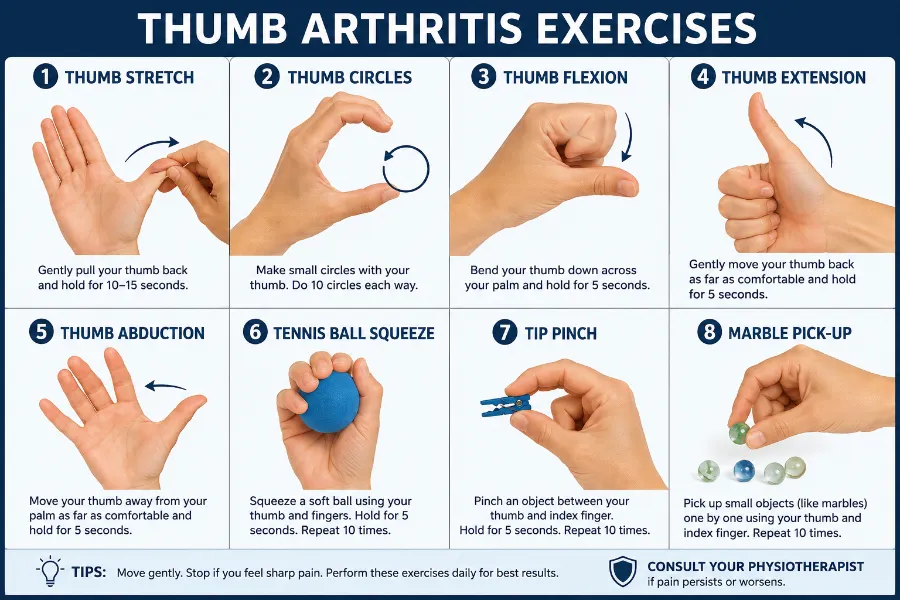
Thumb Arthritis Exercises
Introduction
Thumb arthritis, also known as thumb osteoarthritis, is a common condition that causes pain, stiffness, swelling, and reduced strength around the base of the thumb. It can make everyday activities such as gripping, opening jars, turning keys, writing, or using a phone uncomfortable.
Mild workouts can assist in improving hand function, increasing strength, and preserving thumb mobility. In order to lessen stiffness and maintain comfortable thumb movement, this article will go over easy and safe thumb arthritis exercises that may be done at home.
Thumb arthritis, particularly arthritis at the base of the thumb (thumb CMC joint), can gradually affect hand movement and grip strength. Symptoms may include pain at the base of the thumb, stiffness, tenderness, swelling, and difficulty with activities that require pinching or gripping. These symptoms can interfere with everyday tasks such as buttoning clothes, holding a cup, opening containers, writing, or using a mobile phone.
Regular, gentle exercises can be an important part of managing thumb arthritis. Exercises that are appropriate can help maintain joint mobility, strengthen the muscles that support the thumb, reduce stiffness, and facilitate everyday hand movements. The goal is not to force the joint but to keep it moving within a comfortable range.
Exercises for thumb arthritis
Make a fist
How to do
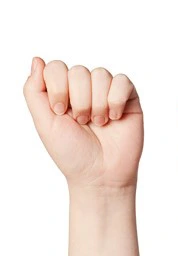
- Extend your left hand with all of your fingers straight to start.
- Next, carefully bend your hand into a fist by placing your thumb on the outside of it.
- Don’t squeeze your hand; instead, be soft.
- Reopen your hand until your fingers are straight once again.
Hold/Repetition: Repeat the exercise ten times with your left hand.
Use your right hand to repeat the entire sequence.
Thumb bend
How to do
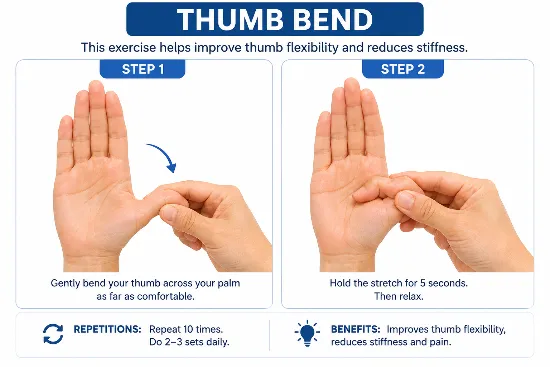
- First, extend your left hand with all of your fingers straight.
- Bend your thumb inward toward your palm.
- Reach for the base of your pinky finger with your thumb.
- If you are unable to reach your pinky finger, don’t worry.
- Just reach as far as you can with your thumb.
- Hold the position for one or two seconds, then return your thumb to its starting position.
Hold/Repetition
Ten times over, repeat.
Use your right hand to perform the exercise.
Make an ‘O”
Several times a day, perform this exercise on each hand. Try this stretch if your hands hurt or are tense.
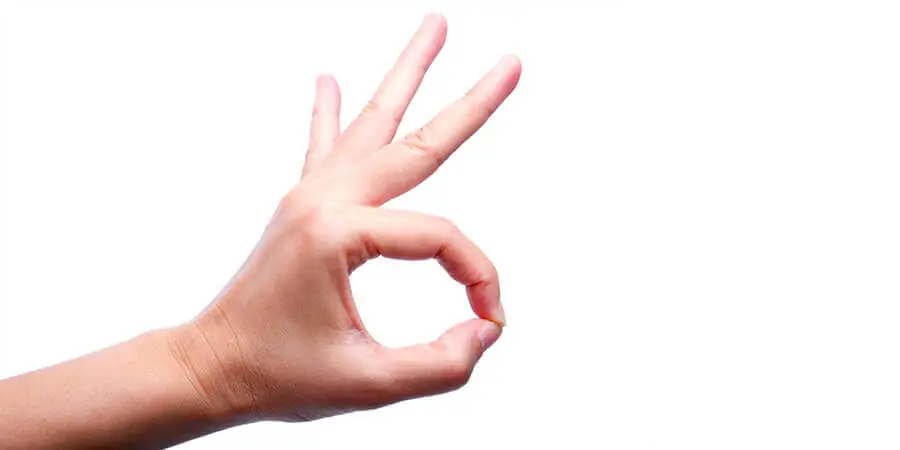
- Start with your left hand out and your fingers straight.
- Your fingers should all be bent inward until they come into touch.
- Your fingers should create an “O” shape.
- For a few seconds, maintain this posture.
- Next, straighten your fingers once more.
Hold/Repetition
Conversely, repeat.
Table bend
How to do
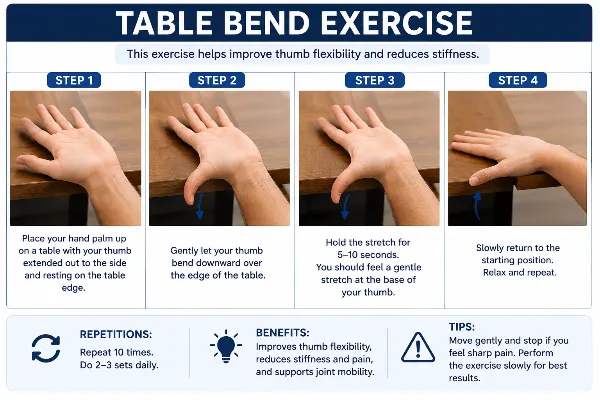
- Place the pinky side of your left hand on a table with your thumb pointing up and your palm stretched straight.
- Keeping your thumb in place, bend the remaining four fingers inward to form an “L” shape with your hand.
- Hold it for a few seconds, then straighten your fingers back to their original position.
Hold/Repetition
Ten times over, repeat.
Use your right hand in the same order.
Wrist stretch
Keep in mind that wrist pain and tightness can also be symptoms of arthritis.
How to do
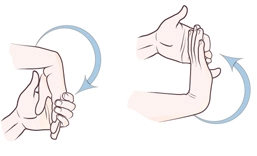
- To exercise your wrist, extend your right arm with the palm facing down.
- Use your left hand to gently press down on your right hand until your arm and wrist begin to stretch.
- Maintain the posture for a little while.
- Next, finish the entire layout with your left hand.
Hold/Repetiton
Ten times over, repeat.
Ball rolling exercise
Use a tiny ball, such as a stress ball or tennis ball, to perform this exercise.
How to do
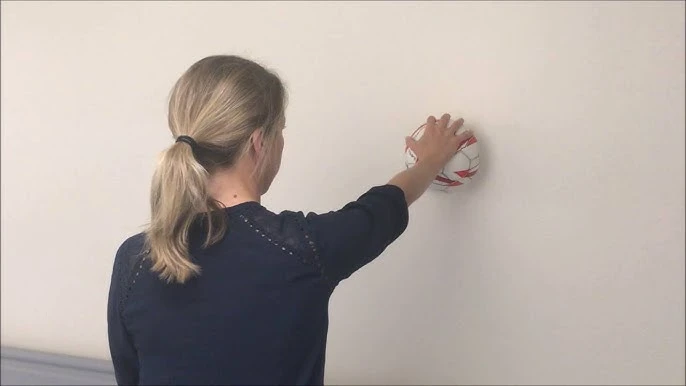
- Put the ball on a level surface.
- Using your right hand, slide the ball from your palm to the tips of your fingers to lengthen each digit.
- Return the ball to its initial place by rolling it.
- Use your left hand to repeat this practice.
Hold/Repetition
Ten times over, repeat.
Full grip
Try these exercises with a tennis ball, stress ball, or any comparable-sized soft ball.
However, you might need to avoid this exercise and discuss alternate solutions with a doctor if you have a thumb joint injury or an active flare in your hands.
How to do
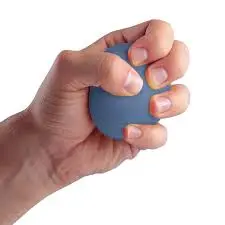
- Squeeze the ball as hard as you can for a few seconds using your right hand.
- Let go of the ball.
- Next, use your left hand to perform the exercise.
Hold/Repetition
Do this exercise fifteen times.
Thumb extension
Three times a week, perform this exercise.
How to do
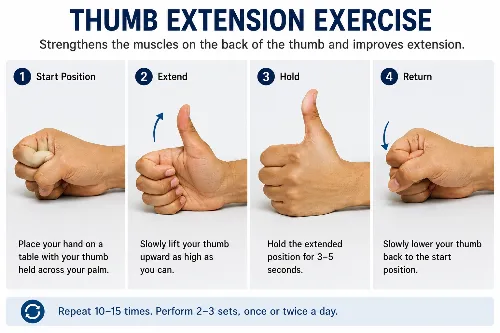
- Make a loose fist with your right hand after wrapping one or more elastic bands around each finger.
- Put your hand down on a level surface.
- Your thumb should be bent and moved away from the hand.
- Use your left hand to perform the exercise.
Hold/Repetition
Hold for five seconds.
Do this exercise ten to fifteen times.
Resistance band exercises
Exercises with resistance bands are excellent for developing the thumb muscles.
These bands provide a mild yet difficult resistance.
The resistance may be changed to suit your degree of strength.
How to do
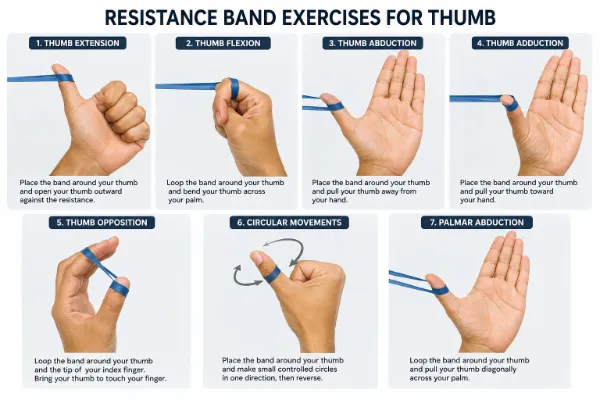
- Attach the resistance band to a sturdy object.
- Make sure the band is around your thumb by holding the other end of the band with your affected hand.
- Move your thumb away from your palm to extend the band.
- Go back to the beginning position slowly.
Hold/Repetition
To increase thumb strength, perform 10–15 reps every two days.
Putty or clay exercises
Another great method for strengthening thumb muscles is to use clay or putty.
This technique enables a variety of motions that focus on distinct thumb functions.
How to do

- Form the material into a thick ball by rolling it.
- Firmly cover the tip of your thumb with the middle of the strip.
- Using your other fingers, hold the remaining loose ends against your palm.
- Then, press your thumb outward and upward against the resistance.
- To strengthen your grip, squeeze the putty between your thumb and fingers.
Hold/Repetition
10-15 repetition
Isometric thumb strengthening
Exercises that are isometric involve contracting muscles without moving joints.
Strengthening at 40–50% effort is highly beneficial for thumb arthritis.
To strengthen your thumb isometrically:
How to do
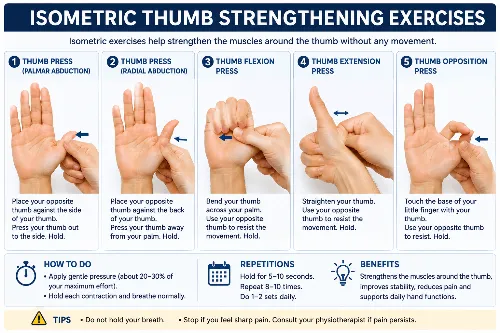
- With your thumb pointing up, place your hand flat on a table.
- When you attempt to move your thumb, use your other hand to oppose.
- 40–50% of your maximal effort should be used to contract your thumb muscles.
- Therapeutic exercises that don’t strain the thumb can be performed at 40–50% effort.
Hold/Repetition
After five seconds of holding, let go.
Thumb circumduction exercises
This workout requires you to move your thumb circularly.
How to do
- Start by extending your thumb.
- Make a little clockwise and counterclockwise circle with your thumb.
- Advice: To get the most out of it, move slowly and carefully.
Hold/Repetition
Do this five to ten times in each direction.
Web space stretching
How to do
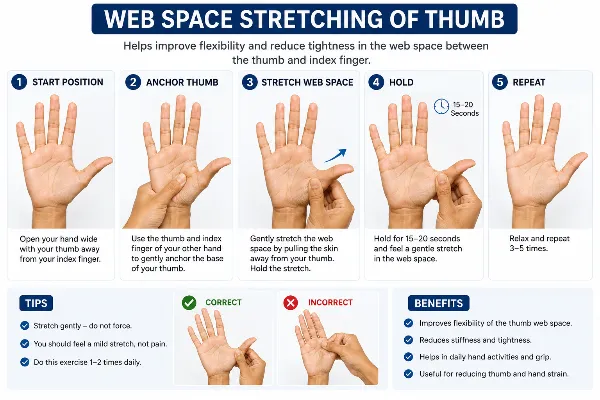
- Stretching the web space maintains the flexibility of your thumb and index finger.
- Stretch the web space by gently pulling your thumb away from your index finger.
Hold/Repetition
After holding for five to ten seconds, release the grip.
Do this stretch ten to fifteen times.
Thumb abduction and adduction movement
The muscles surrounding your thumb are strengthened by these exercises.
How to do
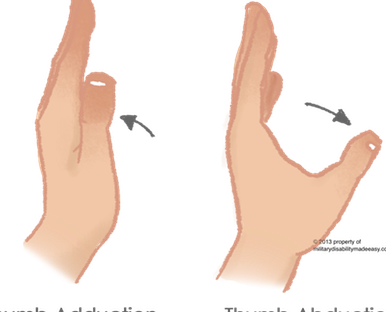
- Abduction is the movement of your thumb away from your hand.
- Adduction is the process of moving it back toward your hand.
- Benefit: Thumb function and stability can be enhanced with consistent practice.
Hold/Repetition
Do this ten to fifteen times.
Balance and control technique
Balance and control are at the heart of proprioceptive exercises.
Simple actions can boost thumb stability.
How to do
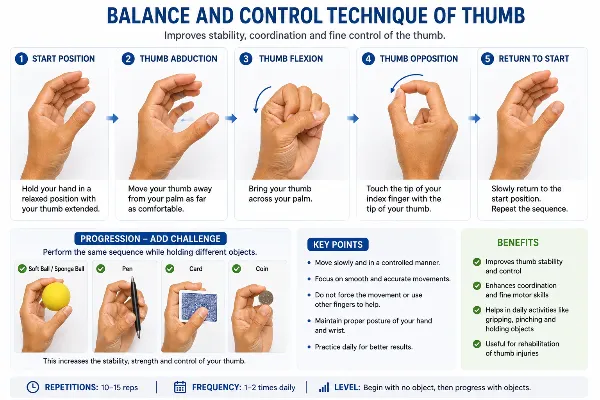
- Holding a pen or pencil between your thumb and index finger, for example, improves control and balance.
- Release and repeat the action
- Gradually increase the duration and frequency
- Thumb muscles can also be strengthened by using a resistance band.
- This improves control.
Hold/Repetition
Hold the object for a few seconds
Joint position and awareness exercises
How to do
It’s important to understand where your thumb is. It aids in injury prevention. Activities that support this awareness include:
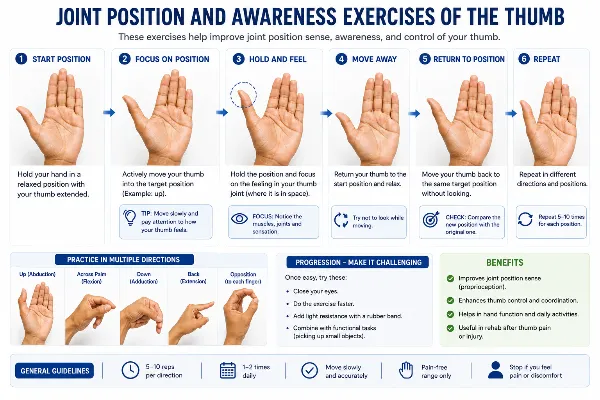
- Exercises for thumb opposition that include touching your thumb to each fingertip
- Exercises for extending and flexing the thumb to increase range of motion
- These exercises improve your ability to feel the location of your thumb.
- This lowers the risk of harm.
Conclusion
Thumb arthritis can make everyday activities challenging, but regular exercise can play a key role in managing symptoms and maintaining hand function. Gentle stretching and strengthening exercises help improve thumb mobility, support joint stability, reduce stiffness, and enhance grip and pinch strength over time.
For the best results, perform these exercises consistently and within a pain-free range. Avoid forcing movements or exercising through severe pain, as this may aggravate the joint. Combining exercise with joint protection strategies, proper hand positioning, and adequate rest can further help manage symptoms and improve daily function.
If pain, swelling, or difficulty using your hand continues despite exercise, consult a physiotherapist or healthcare professional for a personalized treatment plan. With patience and regular practice, many people with thumb arthritis can maintain better hand function and continue performing daily activities more comfortably.
FAQs
Should you exercise in arthritis thumb?
Yes, you should exercise your thumb lightly if you have arthritis. In addition to strengthening the supporting muscles and preventing stiffness, controlled movement maintains the joint’s flexibility. During your routine, you must, however, avoid severe pain or high-intensity squeezing. The Arthritis Foundation hand exercise booklet provides guided training.
What helps arthritis in the thumb?
Use a supporting thumb splint, apply heat or ice, take ibuprofen or other anti-inflammatory drugs, or attempt focused hand treatment to treat thumb arthritis. A physician may recommend steroid injections or, in more severe situations, surgery for chronic pain.
What causes pain in the thumb joint?
Thumb arthritis (damage to the cartilage at the base of the joint), tendon inflammation (such as de Quervain’s tenosynovitis), trigger thumb, acute sprains or ligament tears from falls, or compressed nerves (such as carpal tunnel syndrome) are the most common causes of thumb pain in the joints.
What triggers thumb arthritis?
Wear and strain on cartilage, the smooth pillow that shields the ends of the bones in the basal joint at the base of the thumb, are the cause of thumb arthritis. Bones rub against one another as this cartilage deteriorates, resulting in friction, pain, and joint injury.
What is stage 4 arthritis of the thumb?
The most severe stage of basal joint degeneration is stage 4 thumb arthritis. Complete cartilage loss, bone-on-bone grinding, bone spurs, and involvement of the neighboring wrist joints are all characteristics. This results in noticeable joint deformity, significant loss of grip strength, and severe pain.
References
- Watson, S. (2023, February 3). 11 hand exercises to ease osteoarthritis pain. Healthline. https://www.healthline.com/health/osteoarthritis/arthritis-hand-exercises
- Clinic, C. (2022, August 29). How to relieve arthritis pain in your thumb. Cleveland Clinic. https://health.clevelandclinic.org/losing-your-grip-how-to-treat-your-thumb-arthritis
- 9 exercises to help thumb arthritis. (2025, December 19). https://www.arthritis.org/health-wellness/healthy-living/physical-activity/other-activities/9-exercises-to-help-thumb-arthritis