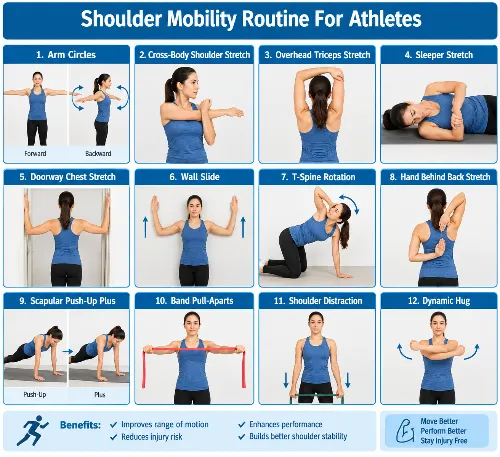
Shoulder Mobility Routine For Athletes
Introduction
For athletes who perform repetitive overhead, pushing, pulling, throwing, or weight-bearing activities, shoulder mobility is important. A wide range of motion in the shoulder joint and surrounding muscles is supported by good shoulder mobility, which also aids in maintaining appropriate movement mechanics. A consistent shoulder mobility routine can help improve flexibility, joint movement, posture, and overall upper-body performance.
Additionally, it may reduce shoulder pain following strenuous exercise and assist athletes in preparing their shoulders for training. Gentle exercises that target the shoulders, upper back, chest, and surrounding muscles can be incorporated into this practice.
Every exercise should be done with careful movements, and athletes should refrain from pushing their shoulders into uncomfortable postures.
Why are mobility exercises necessary for athletes, and what are they?
The goal of mobility exercises is to increase your muscles’ and joints’ range of motion. In addition to enhancing your athletic performance, increasing your mobility is essential for preventing injuries.
Because the muscles at the extremes of your range of motion are naturally weaker, muscle strains are more common there. As a result, focusing on your mobility helps to strengthen your body against these dangerous circumstances, lowering the likelihood of injury.
The Pre-Training Mobility Routine
The 10-minute compressed version, designed for game day or brief periods, includes five exercises.
- Wall Ankle Dorsiflexion
- World’s Greatest Stretch
- 90/90 Hip Switch
- Half-kneeling thoracic rotation.
- TRX Suspension Trainer: Shoulder Y, T, W
One set of each, running straight through.
- The complete version, which runs for 15 minutes on training days, includes the whole process.
- All ten exercises in order, one round.
- Allow 30 to 45 seconds of rest between exercises.
- Include a second round on designated mobility days.
Programming note. This program is used on a regular basis during training sessions. Minimum of three to four sessions each week. Mobility developed less often decreases by the next session, and you will notice it the next time you attempt to load a deep position.
Sports-Specific Mobility Exercise Warm-Up
To improve end-range control and lower your chance of injury, incorporate the following mobility exercises into your sport-specific warm-up.
Cossack squat
How to do
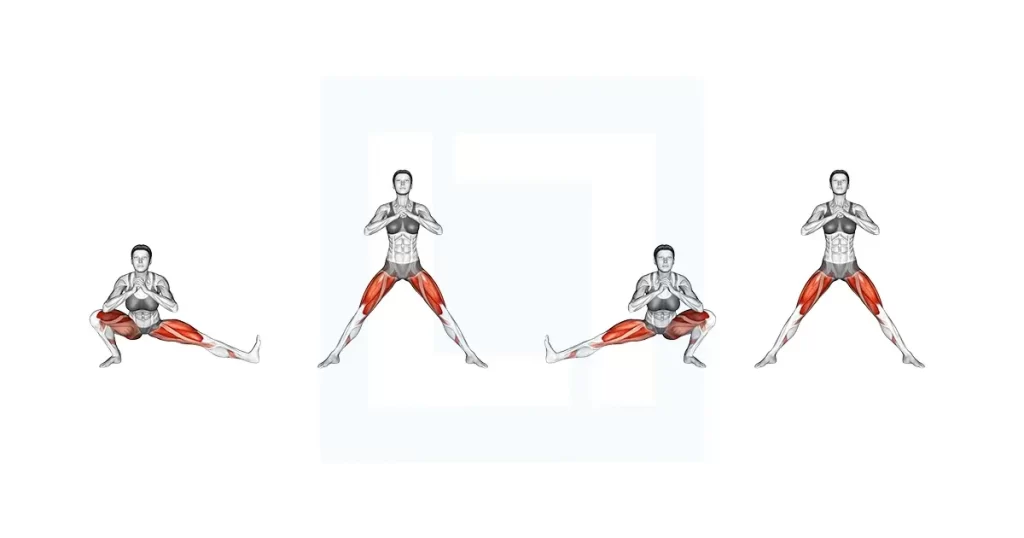
- Stand in a wide stance and go down on one leg into a deep squat, keeping the other straight.
- When you reach the lowest point, push up with your bent leg to stand.
- Repeat for each leg.
- The Cossack squat is an effective exercise for increasing adductor (groin) mobility and leg strength.
90/90 Hip Mobility
How to do
- Begin with one leg behind you and one in front of you at a 90-degree angle.
- Keep your posture straight and your core active as you bring your posterior leg in front of you and then back behind you.
- Your ability to move across the whole range of hip positions is improved by incorporating the 90/90 hip mobility exercise into your warm-up.
Wall Slide With Liftoff
How to do
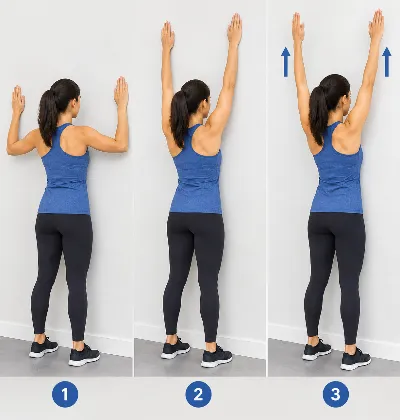
- Stand in front of a wall.
- Tighten your shoulder blades and push your arms straight back off the wall after you’ve reached the top of your range.
- Including wall slides with liftoffs in your warm-up improves mobility and control at the extremes of shoulder flexion while developing the muscles in your shoulder blades.
90/90 External Rotation
How to do
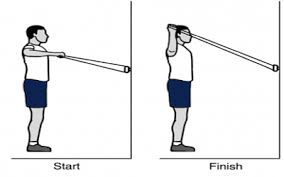
- Using a resistance band, raise your arms to shoulder height.
- Pull your hands back behind you at a 90-degree angle, then gently return them to the starting position.
- You may strengthen your rotator cuff and increase shoulder mobility by performing 90/90 external rotations.
Wall Ankle Dorsiflexion Drill
The most often overlooked mobility restriction in sports performance is ankle dorsiflexion. Research on the effects of varied degrees of dorsiflexion restriction on athletes has shown that athletes with restricted ankle dorsiflexion absorb more stress via the knee and generate less push-off force. The biomechanics of stop-jumping. The ankle joint capsule and soleus are the immediate focus of this practice.
How To Do It:
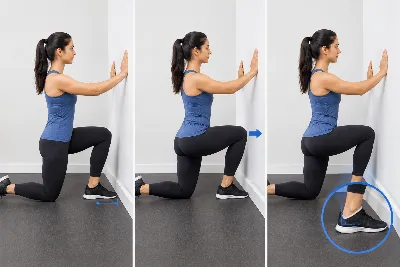
- With your front toes about four inches from the baseboard, half-kneel against a wall.
- Keeping the heel on the ground, drive the front knee forward over the toes until it makes contact with the wall.
- Hold for two seconds at the end of the range before returning.
- Complete 8–10 repetitions per side.
Form cues. Maintain the heel down, the knee tracking outside the big toe (not folding inward), and the ribcage positioned above the hips. When the heel-down version becomes comfortable, move your foot back an inch.
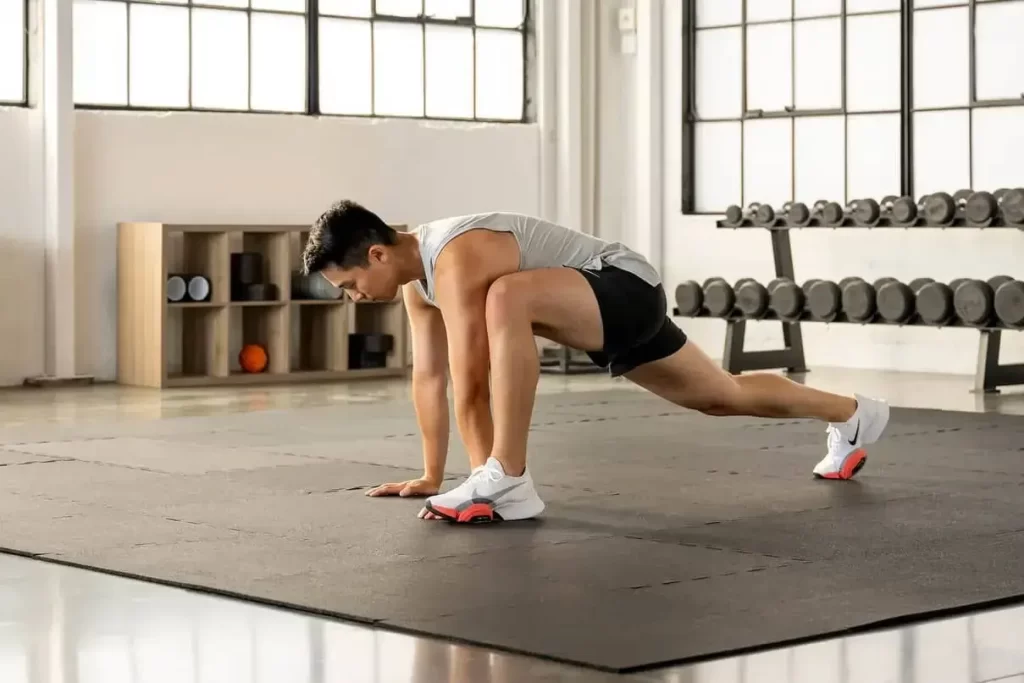
World’s Greatest Stretch
This movement should be owned by all athletes who are fast and powerful. It simultaneously affects thoracic rotation, hamstring length on the front leg, and hip flexor mobility on the rear leg. Because it opens four high-value ranges simultaneously, trainers drop it before sprints, lifts, games, and travel days.
How To Do It:
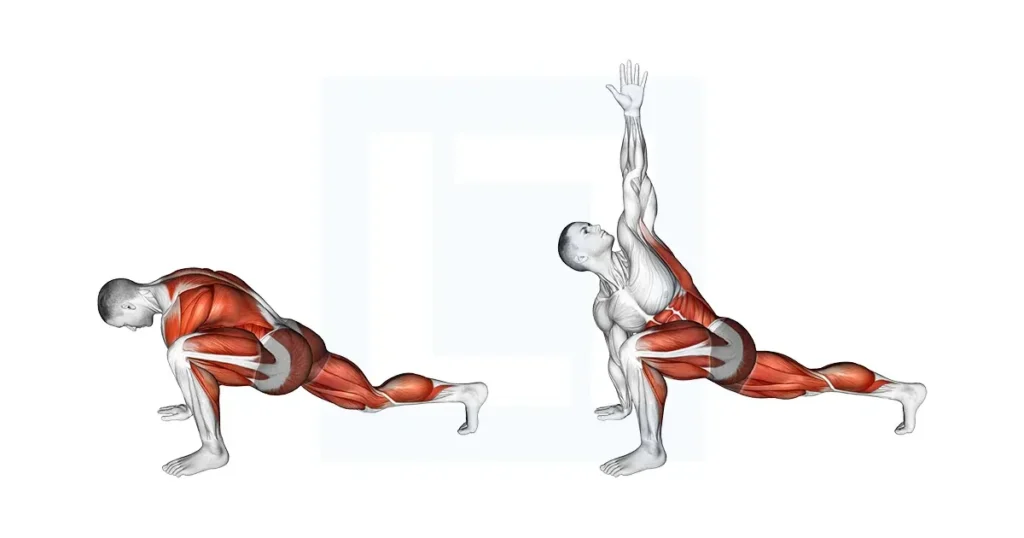
- Put your right leg forward and take a deep lunge.
- Plant both hands inside your front foot.
- Drive your right elbow toward the floor.
- Turn your right hand toward the ceiling to open your chest.
- Return the hand to the floor and drive the hips back into a hamstring stretch while maintaining the front leg straight.
- Return to the lunge and swap sides.
- Perform 5 repetitions per side.
Form cues. Keep the back knee extended and the rear foot active (toes tucked or pointed, not flat on the ground). Open both your shoulders and your chest at the peak of the rotation.
Half Kneeling Thoracic Rotation
Overhead reach, rotational throw velocity, and force transmission via the upper body are all limited by thoracic spine mobility. A study of the thoracic spine in overhead athletes published in Current Sports Medicine Reports states that insufficient thoracic extension increases injury risk by forcing shoulder and elbow compensation. and impairs performance.
How To Do It:
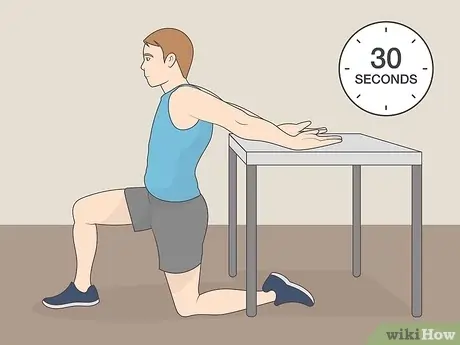
- Half-kneel, front foot raised, back knee on the floor.
- Place both hands behind the head, elbows wide
- Return to the start.
- Perform 8 repetitions per side.
Form cues. Square your hips forward and lock them in. Don’t utilize your lower back; simply rotate via your thoracic spine. Take a tall breath and release it into the rotation.
Quadruped Thoracic Open Book
The second thoracic drill in the book series covers rotation using shoulder force. Because it teaches the upper back to rotate without depending on lumbar spine compensation, manual mobility is crucial for throwers and rotational athletes. This practice benefits anybody who must use force throughout the body.
How To Do It:
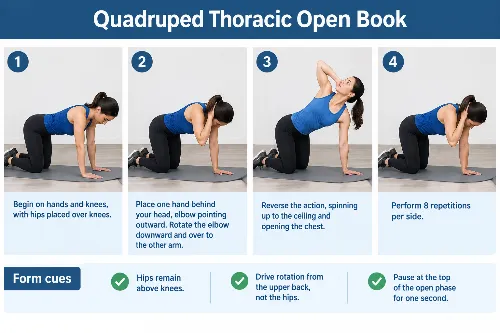
- Place your pelvis over your knees and start on your hands and knees.
- Put one hand behind the head and point the elbow outward.
- Turn the elbow over to the opposite arm and downward.
- Spin up to the ceiling, turn around, and open your chest.
- Perform 8 repetitions per side.
Form cues. Hips remain above knees. Use your upper back to force rotation rather than your hips. At the beginning of the open phase, pause for a while.
TRX Suspension Trainer Shoulder Y, T, W
Shoulder mobility is more than just range. It combines range and control. Using three different overhead patterns, the Suspension Trainer Y, T, and W series focuses on active scapular control—exactly what throwing, swinging, and pulling athletes need. Additionally, it gets the shoulder ready for pull-ups, rows, overhead presses, and bench exercises.
How To Do It:
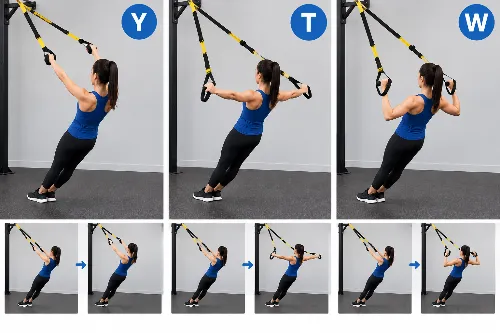
- Set the straps to mid-length and attach the Suspension Trainer overhead.
- Lean back and extend your arms in front of you while walking your feet below the anchor.
- Pull the arms upward into a Y posture for 8 repetitions, starting from the suspended position.
- Return, then bring the arms out into a T posture for 8 repetitions.
- After returning, perform eight repetitions of bending your elbows into a W position.
Form cues. Plank-style, maintain rigidity from head to heels. Keep your shoulders and ears apart. Squeeze your upper back to initiate the pull. For stronger anchors, walk your feet under them; for simpler anchors, walk your feet away from them.
Banded Hip Distraction With Internal Rotation
Rotate the femur after removing it from its socket. That is what this practice accomplishes, and it is the quickest method to loosen up a hip that has lost internal rotation due to sitting, lifting, or recurrent athletic demand. Internal rotation generates sprint stride and rotational power.
How To Do It:
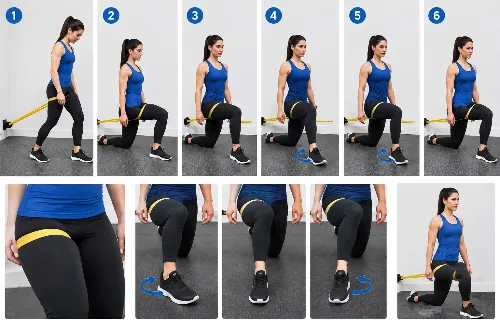
- Anchor a resistance band, such as the TRX Bandit, low and behind you.
- Step away from the anchor to generate tension.
- With the banded leg bent at a 90-degree angle behind you, drop into a half-kneeling position.
- Perform 10 repetitions per side.
Form cues. Place the band around the hip crease, high on the thigh. Chest is tall. Make gradual, intentional rotations.
TRX Suspension Trainer Hip Hinge To Squat
A full-body integration exercise that uses support to groove the hinge-to-squat sequence. By allowing you to sit deeper into a squat than your unsupported flexibility permits, the Suspension Trainer progressively teaches your nervous system to manage higher ranges. The ability of an athlete to load deep enough determines power output.
How To Do It:
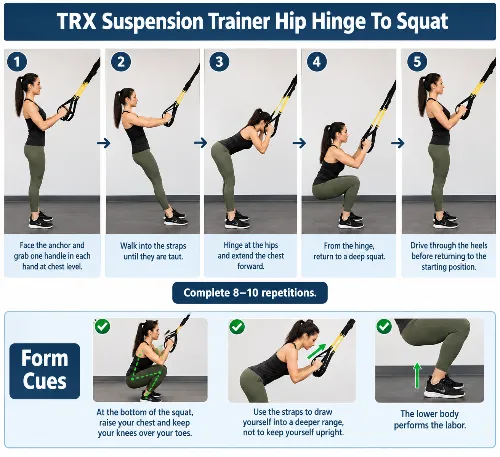
- Facing the anchor, hold one handle at chest height in each hand.
- Walk into the straps until they are taut.
- From the hinge, return to a deep squat.
- Before returning to the starting position, drive through your heels.
- Complete 8-10 repetitions.
Form cues. Raise your chest while maintaining your knees over your toes at the bottom of the squat. Instead of using the straps to stay upright, use them to pull yourself into a deeper range. The lower body performs the labor.
TRX Standing Rotation
Rotational mobility under stress facilitates warm-up and athletic performance. The offset resistance of the RIP Trainer requires that the athlete control rotation throughout the whole thoracic and hip chain, which is precisely what is needed for a baseball swing, tennis serve, punch, or sprint.
How To Do It:
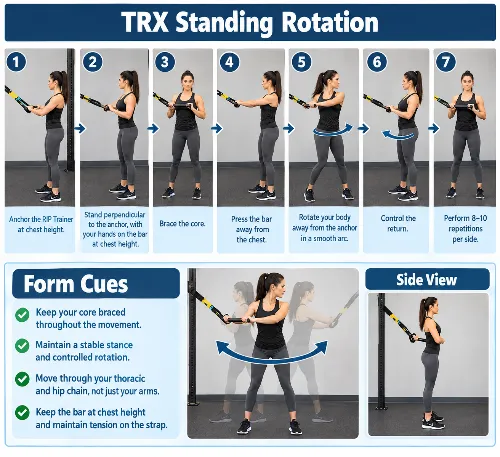
- Anchor the RIP Trainer at chest height.
- Place your hands at chest height on the bar while standing perpendicular to the anchor.
- Brace the core.
- Press the bar away from the chest.
- Make a smooth arc with your body as you turn away from the anchor.
- Control the return.
- Perform 8–10 repetitions per side.
Form cues. Make a smooth arc with your body as you turn away from the anchor. Lower back. Stack ribs over hips. Maintain strain on the rope throughout the rep to ensure the resistance remains loaded.
How to Increase Your Mobility Work to Improve Performance?
The fundamentals become easy quickly. Several progression controls keep the adaptations flowing.
Time is under stress. After each rep, add a two- to three-second hold. Active end-range holds improve neuromuscular control more quickly than repetitions alone.
Get it loaded. You can do Cossack squats, Ripper Trainer rotations, and World’s Greatest Stretch reaches with a small weight (a TRX, YBell, or a single dumbbell). Athletic output is quicker when mobility is loaded than when it is unloaded.
Specificity. Make the routine more favorable to your sport. Jumpers and sprinters use both their hips and ankles. The thoracic and RIP Trainer movements were performed twice by throwers and rotational athletes. Defensive and lateral athletes focus mostly on Cossack and 90/90 routines.
Professional wrestlers and combat athletes employ hip swaps and open-book rotations. Athletes preparing for hybrid fitness contests should focus on hip and thoracic mobility, as these events alternate between running, lifting, and functional stations with little break.
Common Mobility Mistake That Reduces Athletes’ Power and Speed
Five traps that end adaptation.
Static stretching before training. The muscles become less responsive for the duration of the session when long passive stretches are performed before the activity. Save these for rest days or after the exercise.
Mobility is treated as an extra. Long passive stretches before the exercise cause the muscles to become less sensitive for the duration of the session. After exercise or on days off, save these.
Working on only one joint. Tight ankles affect the knee and hip mechanics. Train the entire chain, not just the symptoms.
Holding the breath. Mobility training is transformed into stress exercises by bracing without breathing. Inhale tall and exhale into the range.
We’re skipping consistency. Mobility developed three times each week sticks. When mobility is determined once a week, it declines by the next session.
Benefits oF Shoulder Mobility Exercise
Increased Overhead Range and Pain-Free Everyday Movement
The recovery of functional overhead range—the ability to reach a higher level, lift a bag into an overhead locker, or press weight above the head without impingement—is the most obvious advantage. When the shoulder can move freely across its full arc, the biceps tendon and rotator cuff are no longer compressed at the highest point of the movement.
Research repeatedly reveals that focused mobility work enhances musculoskeletal health, with regular exercise related to up to a 35% decrease in soft-tissue injury recurrence over 12 months. The most visible advantage of regular shoulder mobility exercises in day-to-day living is this.
Reduced Upper Back Tension, Tightness, and Stiffness
The majority of people looking for shoulder mobility exercises are dealing with a particular issue, such as a feeling that one shoulder is higher than the other, stiffness that develops, or a tugging feeling while reaching behind the back during the afternoon. These are signs of elevated scapular resting posture, reduced posterior capsule movement, and persistent tension in the levator scapulae and upper trapezius.
Shoulder Mobility Exercises: include thoracic rotation, doorway pec openers, and cross-body stretches. Within a few weeks, regular daily practice—even 15 minutes—significantly lowers collected postural stress.
Helps Maintain Proper Technique :
Adequate mobility can make it easier to maintain correct positioning of the shoulders, arms, and upper back during strength training and sports-specific movements.
Supports Shoulder Stability:
Mobility work combined with strengthening exercises can help the shoulder move through its available range while maintaining control.
Reduces Movement Restrictions :
Regular mobility exercises may help reduce stiffness around the shoulders, chest, and upper back, particularly after training or prolonged periods of activity.
Helps Prepare the Body for Training :
Dynamic shoulder mobility exercises can be incorporated into a warm-up to gradually prepare the shoulders for more demanding movements.
Supports Recovery After Exercise:
Gentle mobility movements can help athletes maintain comfortable shoulder movement after training sessions and may reduce feelings of stiffness.
Benefits Overhead Athletes:
Athletes involved in volleyball, tennis, swimming, baseball, basketball, and weightlifting often perform repeated overhead movements. Maintaining appropriate shoulder mobility can support these activities.
Promotes Better Posture and Upper-Body Movement :
Shoulder mobility exercises often involve the thoracic spine and shoulder blades, helping athletes develop better upper-body movement patterns.
Helps Maintain Long-Term Shoulder Function :
Mobility exercises may be an important part of an athlete’s overall conditioning program when combined with appropriate strength, recovery, and sport-specific training.
Why Is Shoulder Mobility Important in CrossFit?
Improved Technique: Whether you’re completing snatches, overhead presses, or muscle-ups, perfect technique is essential. You can place your arms, stay stable, and move effectively with optimal shoulder mobility, all of which contribute to increased power production and improved performance.
Preventing injuries: CrossFit is a physically demanding exercise routine that strains your shoulders a lot. Your joints and surrounding tissues are more susceptible to impingements, rips, and strains when you don’t have enough mobility. Making shoulder mobility a priority can help you develop resilience, strength, and stability while lowering the chance of long-term issues that might compromise your training.
Increased Range of Motion: Flexibility is the key to completing challenging tasks. If you performed handstand walks or ring falls with rigid, unflexible shoulders, it would be like attempting to run with cement blocks attached to your feet. You’ll be able to do those demanding exercises with more comfort and confidence if your shoulder mobility improves.
Conclusion
A regular shoulder mobility routine can be a valuable part of an athlete’s training program. Improving shoulder range of motion, maintaining controlled movement, supporting proper technique, and reducing stiffness can help athletes perform everyday and sport-specific movements more comfortably. In order to preserve healthy movement and prepare the shoulders for training, mobility exercises can also be included in warm-ups and recovery sessions.
For the best results, shoulder mobility should be combined with appropriate strengthening, stability exercises, proper warm-up, and adequate recovery. Perform each movement slowly and within a comfortable range, avoiding painful or forceful stretching. Both long-term shoulder function and effective upper-body movement can be improved by routinely adding shoulder mobility to your exercise routine.
FAQs
How to train shoulders like an athlete?
Shoulder exercises that balance rotator cuff stability, overhead strength, and scapular control might be beneficial for athletes.
Why is shoulder movement restricted?
Lifestyle choices, muscle imbalances, and underlying health conditions that limit the joint’s normal range of motion can all contribute to a lack of shoulder mobility.
What exercise is best for mobility?
The World’s Greatest Stretch is often regarded as the finest all-in-one full-body mobility drill, but there isn’t a single “best” exercise for mobility because various movements target different joints.
Why is shoulder mobility so important?
Because it allows your most mobile major joint to move easily over its complete range of motion, shoulder mobility is crucial for supporting everyday tasks, improving sports performance, and preventing injury.
Why are shoulder muscles so weak?
Poor posture, tight chest muscles, and overused stabilizing muscles around the shoulder blades are common causes of shoulder weakness.
References
- Zheng, T. (2026, June 5). 10 Mobility exercises for athletes to increase speed & power. TRX Training – United States. https://www.trxtraining.com/blogs/news/mobility-exercises-for-athletes?srsltid=AU7gw4WryWxawjc8c-BG6vK2OFjQI3jP37xWURdZGy66YJBUYIKZvJnD
- Sparacino, A. (1970, January 1). Why you need to build shoulder mobility—and 6 exercises to do just that. https://www.onepeloton.com/blog/shoulder-mobility-exercises
- Our 7 best shoulder mobility exercises & stretches. (n.d.). https://www.gowod.app/blog/our-7-best-shoulder-mobility-exercises