Morning Exercises for Neck Stiffness After Sleeping
Introduction:
Waking up with a stiff neck can be irritating. Many individuals believe that sleeping in the incorrect position is the cause; however, there are typically a number of contributing variables. Poor posture during the day and while you sleep at night can cause muscle pain and stiffness. In addition to discussing pillow techniques to avoid future stiffness, we’ll look at stretches that work well for relieving stiff necks.
It can be painful and surprising to wake up with a tight neck. Even though a stiff neck can cause significant, sharp pain and limited range of motion, some people may feel pressured to continue with their daily activities, such as going to work or class. The development of a stiff neck during sleep is explained below, along with methods for obtaining immediate relief before deciding what may actually be done during the day.
When you wake up, what hurts your neck?
You may not consider the type of pillow you use or how you sleep. However, your sleeping position and pillow may be the source of a stiff, hurting neck and other musculoskeletal problems.
You may be able to reduce morning neck pain by changing your sleeping habits because many of these factors are within your control.
Your sleeping position:
- Everybody has a favorite way to sleep. However, you’re not helping your neck if it’s on your stomach.
- Sleeping on your stomach can cause your neck to rotate to one side for hours at a time. This strain might cause your neck muscles to feel stiff and tight in the morning.
- Additionally, stomach sleeping may result in back pain if you sleep on a bed with minimal support. Your spine and back muscles may be stressed and compressed if your tummy falls into the bed.
Your pillow:
- Your head and neck spend a lot of time on the pillow every night; therefore, choosing the right one is crucial for a pain-free, healthy neck. Your neck muscles may be strained, and you may get neck pain if your head and neck are not adequately supported by a pillow.
- Your head can be positioned at night using feather or memory-foam pillows, keeping your neck and spine neutral.
Sudden movement:
- Your neck muscles might be strained by sudden movements, such as sitting up suddenly or throwing your limbs around in a dream. Tension and stress in your neck might also result from tossing and turning when you’re attempting to fall asleep.
Previous injury:
- Sports injuries and trauma are two examples of conditions that might not necessarily cause pain right away. Days may pass before the full physical consequences become apparent.
- If you were hurt in a way that would have affected your neck, you might go to bed feeling fine and wake up the next morning with a very painful and stiff neck.
Additional reasons for waking up with neck pain:
You may wake up with neck pain for a variety of other causes. You may also get neck pain during the day in specific situations.
Causes of neck pain:
- Improper posture throughout the day
- Osteoarthritis in one of the higher spinal joints; nerve compression caused by a herniated disc or bone spur in your neck; prolonged computer usage or television viewing without shifting postures
How Neck Stiffness Develops During Sleep:
Stiff neck can occur during sleep in several situations, including:
- Uncomfortable viewpoint. When sleeping, the head or neck may settle at an unnatural angle for a long time, stretching and stressing joints, muscles, and ligaments beyond what is usual.
- Quick movement. Sudden neck movement that can strain or sprain the neck may happen while you sleep, sometimes as a result of rolling over or responding to a dream.
- Prior injury. Certain wakeful injuries, like whiplash, may take several hours to appear as pain and stiffness when you’re asleep.
The most common reason for a stiff neck is a neck strain, which may result from a sprained ligament or strained muscle. Other potential reasons include cervical degenerative disc disease and facet joint osteoarthritis.
Remedies for a Stiff Neck After Waking Up:
The following are some ways to treat a stiff neck in the morning:
Ice or heat therapy:
Soon after a neck strain, applying ice may assist in reducing swelling. It’s usually better to apply ice for 10 to 20 minutes at a time. By loosening and relaxing the muscles, heat therapy—such as using a heating pad or having a warm shower—may also reduce pain and increase range of motion.
Over-the-counter pain medication:
It might be recommended to use an over-the-counter drug if the pain and stiffness are severe enough to considerably restrict movement in one or more directions. Acetaminophen, naproxen, and ibuprofen are a few examples.
Gentle stretching or self-massage:
Stretching and/or massage might help further release the muscles and ligaments after some immediate pain relief. It’s okay if you can’t finish some stretches because of neck pain and stiffness.
The objective is to progressively improve flexibility without increasing discomfort. Similarly, as long as it doesn’t aggravate the pain, the hands and fingers can be used to massage the hurting spot on the neck.
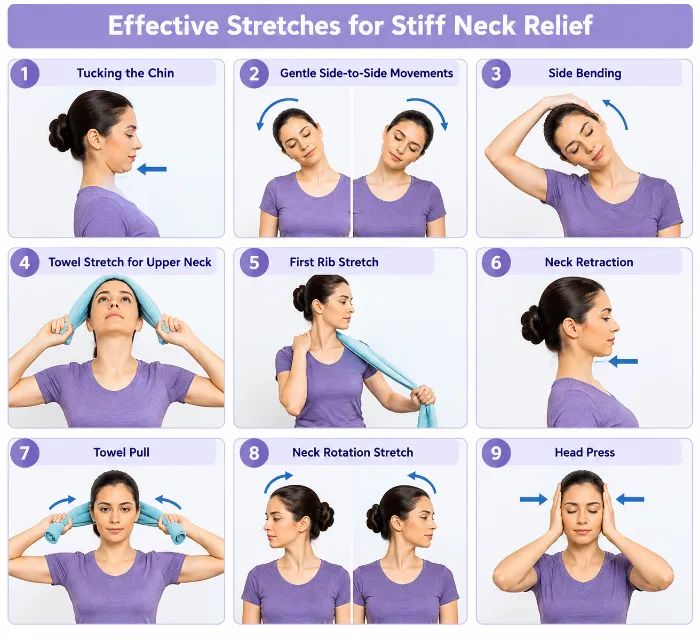
Effective Stretches for Stiff Neck Relief:
Tucking the Chin:
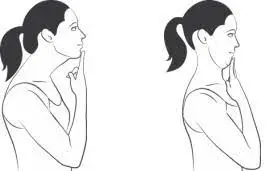
- Tightness in the suboccipital muscles near the base of your skull is one of the main reasons for neck stiffness.
- Start by softly tucking your chin down to relieve this.
- Using one hand to gently pull up at the back of your head and the other to press down on your forehead, you can help with this movement.
- The tight muscles are successfully targeted by this stretch.
Gentle Side-to-Side Movements:
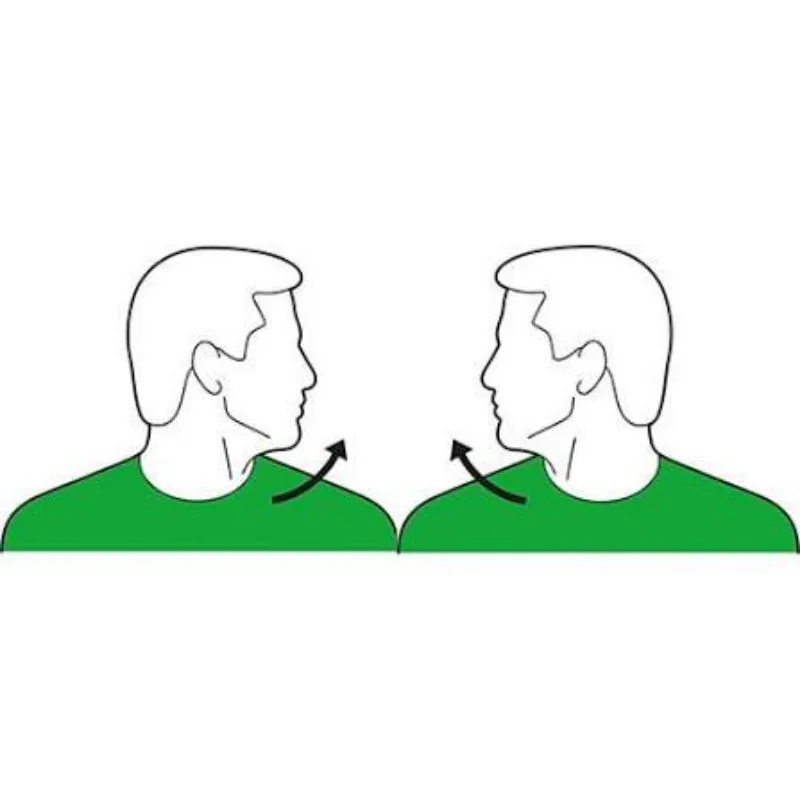
- After the suboccipital muscles are relaxed, gently rotate your neck from side to side.
- Imagine an axis of rotation passing through your skull as you start with simple, modest movements.
- To create more room between the joints at the back of your neck, tuck your chin slightly.
- Let your muscles warm up naturally by trying for roughly 10 reps in each direction.
Side Bending:
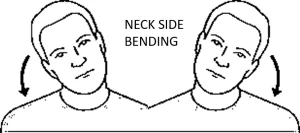
- Exercises including side bending help release more upper neck stress.
- Imagine an axis of rotation across your nose as you tilt your head from ear to shoulder.
- To isolate the action, gently press down on the top of your head with your palm.
- This may increase the stretch’s efficacy.
Towel Stretch for Upper Neck:
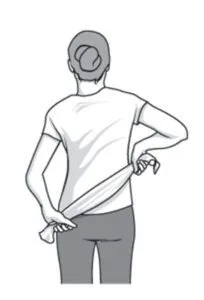
- Your range of motion can be greatly increased by using a towel.
- Hold either end of a towel that has been wrapped around your neck.
- Turn your head in the opposite direction and pull down on one side.
- Observe any variations in stiffness between the two sides as you perform roughly ten repetitions on each side.
First Rib Stretch:
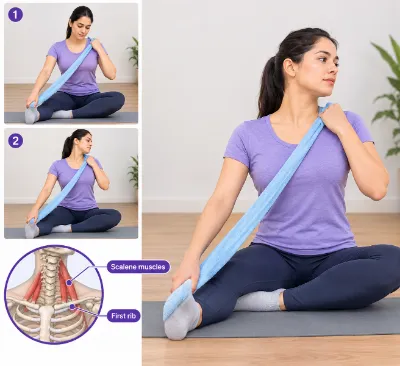
- Finally, use the towel again to target the muscles connected to your first rib.
- Stretch slightly away from the towel’s hold while sitting on one end of it and pulling the other end over your shoulder.
- This will assist in releasing tension in the scalene muscles by isolating them.
Neck Retraction:
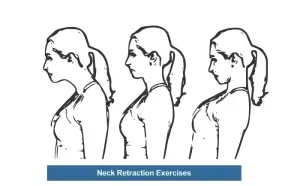
Retracting, or taking back, your head and neck is part of this stretch. This may be done either standing or sitting.
- Keep your chin slightly tucked down and look straight ahead.
- As though attempting to create a double chin, carefully pull your head and chin backward. Without exerting yourself, pull back as far as you can.
- Avoid tilting your head in either direction.
- For three to five seconds, maintain this posture.
- Return your head to its initial position.
- Repeat ten to fifteen times.
Towel Pull:
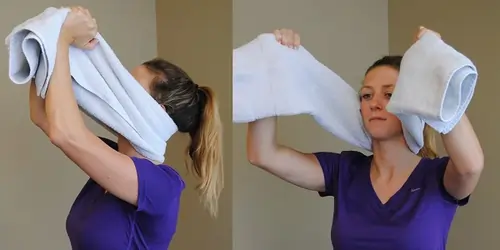
You will need a rolled-up towel for this stretch. Get to your feet and stare straight ahead.
- Using your hands to hold both ends of the rolled-up towel taut, wrap it over the back of your neck.
- Look as high as you can while tilting your head back.
- You should lift your hands as you look up so that the towel may support your head and neck while you walk.
- Pull lightly on the towel.
- Return your head to its initial position after raising it.
- Do this ten times.
Neck rotation stretch:

- Maintain a straight posture while keeping your hands at your sides.
- Turn your head slightly to the left until you feel a mild stretch while maintaining a straight neck and back.
- After holding for ten to twenty seconds, carefully move your head to the right and repeat the action.
- On each side, repeat three or four times. This is a daily activity that you may perform.
Head press:

- With your head in a comfortable position, sit upright in a chair.
- Press your right hand’s palm to your forehead.
- To prevent your head from moving, press your head to your palm while contracting your arm muscles.
- Hold for ten seconds.
- Release your head’s grip on your hand gradually.
- Do this five times.
Pillow Recommendations for Better Neck Support:
Consider your pillow choice to reduce the likelihood of waking up with neck pain. A quality pillow should fill the space between your neck and shoulders and support your head. Here are some tips:
- If you sleep on your side, choose a pillow that keeps your shoulder and neck in position.
- Back Sleepers: Your pillow should be just the right thickness to accommodate your neck’s natural curve.
- Comfort: To tailor support to your body size and sleeping posture, think about pillows with adjustable characteristics.
Posture Awareness During the Day:
Keep in mind that neck stiffness takes time to develop. Muscle strain can be greatly aggravated by bad posture throughout the day. When using your phone or sitting at a desk, pay attention to how your neck is positioned. Stress can be reduced with regular pauses and posture correction exercises.
How to Prevent a Stiff Neck While Sleeping:
While it is not possible to completely avoid neck stiffness, there are things that can be done to reduce the likelihood of developing it.
- Think about your sleeping position. The head is pulled to one side or the other when sleeping on one’s stomach, which increases strain on the cervical spine. To minimize strain on the cervical spine, it is advised to sleep on one’s back if at all possible. Sleeping on the side is an additional choice. Some people find that sleeping in a reclined position—whether in a chair or bed—provides greater neck relief.
- Choose the appropriate pillow. Similar to sleeping positions, there isn’t a one-size-fits-all pillow style that works best for everyone. A cervical pillow or wrapped towel placed under the cervical spine may offer more support for those who sleep on their backs. To keep their spines straighter, side sleepers can find it helpful to put an extra pillow between their knees. It usually takes some trial and error to find the ideal cushion.
- Maintain a comfortable temperature. Many people claim that after being exposed to cool air throughout the night—for example, through an open window, fan, or vent—they wake up with a stiff neck. Although this particular topic has not been thoroughly studied in the medical literature, some people might benefit from setting up their sleeping environment so that cool air does not blow directly across their necks.
A firm enough mattress is one of several other variables that can lower the likelihood of a stiff neck or other sleep-related conditions. It should be mentioned that sleeping in unsuitable locations, like a chair or couch while watching TV, may make it more likely that you’ll wake up with a stiff neck.
Conclusion:
It can be painful to wake up with a stiff neck, but you can get instant relief by including these five morning stretches in your routine.
Furthermore, choosing the right pillow and maintaining good posture throughout the day will help avoid future pain. For a more comfortable tomorrow, start using these suggestions now.
FAQs:
How to fix a tight neck after sleeping?
It might be challenging to even turn your head when you wake up with a crick in your neck, but you can typically treat a stiff neck at home with temperature treatment, mild movement, and over-the-counter pain medication. The most crucial guideline is to continue moving slowly; if you freeze totally, your muscles will become much more taut.
Can walking reduce neck stiffness?
Walking is a low-impact aerobic activity that improves spine mobility, enhances blood circulation, and supplies food and oxygen to relax muscles, so the answer is yes.
What causes neck stiffness after sleeping?
The most common causes of waking up with a stiff neck are sleeping in an uncomfortable posture or using a pillow that doesn’t support the natural curvature of your spine.
Can neck stiffness be reversed?
Since a typical stiff neck is often a transient muscular strain or small postural problem that resolves on its own in a few days to two to three weeks, the answer is yes.
How do I know if my neck pain is muscular or nerve-related?
By examining the type of pain, its distribution, and any associated symptoms, you can tell the difference between muscle- and nerve-related neck pain.
How can I release tight neck muscles quickly?
Use a mix of self-massage methods, mild stretches, and targeted heat or ice to immediately relax tense neck muscles and reduce stiffness.
How long can a stiff neck from sleeping wrong last?
Although mild cases can go away in 24 hours and stiffer muscles may take up to a week, a stiff neck from improper sleep often lasts one to three days.
What vitamin deficiency causes tight neck muscles?
Vitamin D or magnesium deficiencies are most commonly associated with tight neck muscles and muscular spasms, but vitamin B12 insufficiency may be the cause of nerve-related stiffness or radiating pain.
References:
- Candy, D. (2026, May 26). Stiff neck after sleeping? 5 morning stretches for relief. Over Fifty Coach. https://overfiftycoach.com/stiff-neck-after-sleeping-5-morning-stretches-for-relief/
- Cooper, G., MD. (2018, July 19). How to treat a stiff neck after sleeping. Spine-health. https://www.spine-health.com/conditions/neck-pain/how-treat-stiff-neck-after-sleeping#google_vignette
- Burtka, A. T., & Dumain, T. (2026, May 13). Neck stretches for pain relief: How to stretch your neck. WebMD. https://www.webmd.com/fitness-exercise/fitness-neck-stretches
- The Healthline Editorial Team. (2025, July 1). What causes neck pain after waking up and how to treat it. Healthline. https://www.healthline.com/health/neck-pain/waking-up-with-neck-pain#home-remedies