Hip Joint Mobilization Technique
Introduction
Reduced hip function and hip osteoarthritis (OA) are thought to be associated with limited hip range of motion (ROM). Reduced flexion, internal rotation, and adduction range of motion are frequently seen in patients with labral tears or femoroacetabular impingement (FAI), which is also a predictor of the development of OA.
A reduction in hip abduction It has been proposed that range of motion can be used to measure the probability of lower extremity injuries in the future. Anterior knee pain has also been linked to decreased hip joint range of motion.
In order to enhance patient function and lower the risk of injury, doctors must incorporate therapies that increase hip range of motion, such as joint mobilizations. Additionally, hip joint mobilizations may cause a neurophysiological reaction that lessens pain perception and increases strength and mobility.
Peripheral hormonal systems may be activated by mobilizations, resulting in decreased inflammation that may restore range of motion and lessen mechanical irritation to peripheral nerves, hence lowering pain.
Hip Mobilizations
To improve hip complex range of motion, several methods are employed. When compared to hip stretching alone, Mulligan Concept mobilizations with movement (MWM) and high velocity low amplitude thrust approaches have been demonstrated to enhance patient function, range of motion, and discomfort. Maitland’s mobilization techniques are based on oscillatory techniques that can be used in different grades throughout each glide.
Contraindications
- Before using any manual therapy approach, it is important to rule out any contraindications.
- Hip joint mobilizations, especially self-mobilizations, may be contraindicated by a history of fractures, recent surgery, anticoagulant medication, worsening symptoms, widespread or localized ligament stiffness, joint effusions, or inflammation.
- To guarantee patient safety, clinical judgment should be applied prior to any hip joint mobilization.
Grade
- Grade I: Early in the range, a small-amplitude rhythm is played. Mainly used to treat joint spasms and discomfort.
- Grade II: A high-amplitude rhythm, performed in the middle of the range without going beyond the limit. Utilized to control inflammation and pain as well.
- Grade III: High-amplitude rhythm executed into resistance and to the end of the range. Used to improve joint mobility and extend the capsule.
- Grade IV: Small-amplitude rhythm executed into resistance and at the end of the allowed range. Utilized to improve joint mobility and stretch tissue (usually in stiffer joints).
Common Hip Glides and Their Purposes
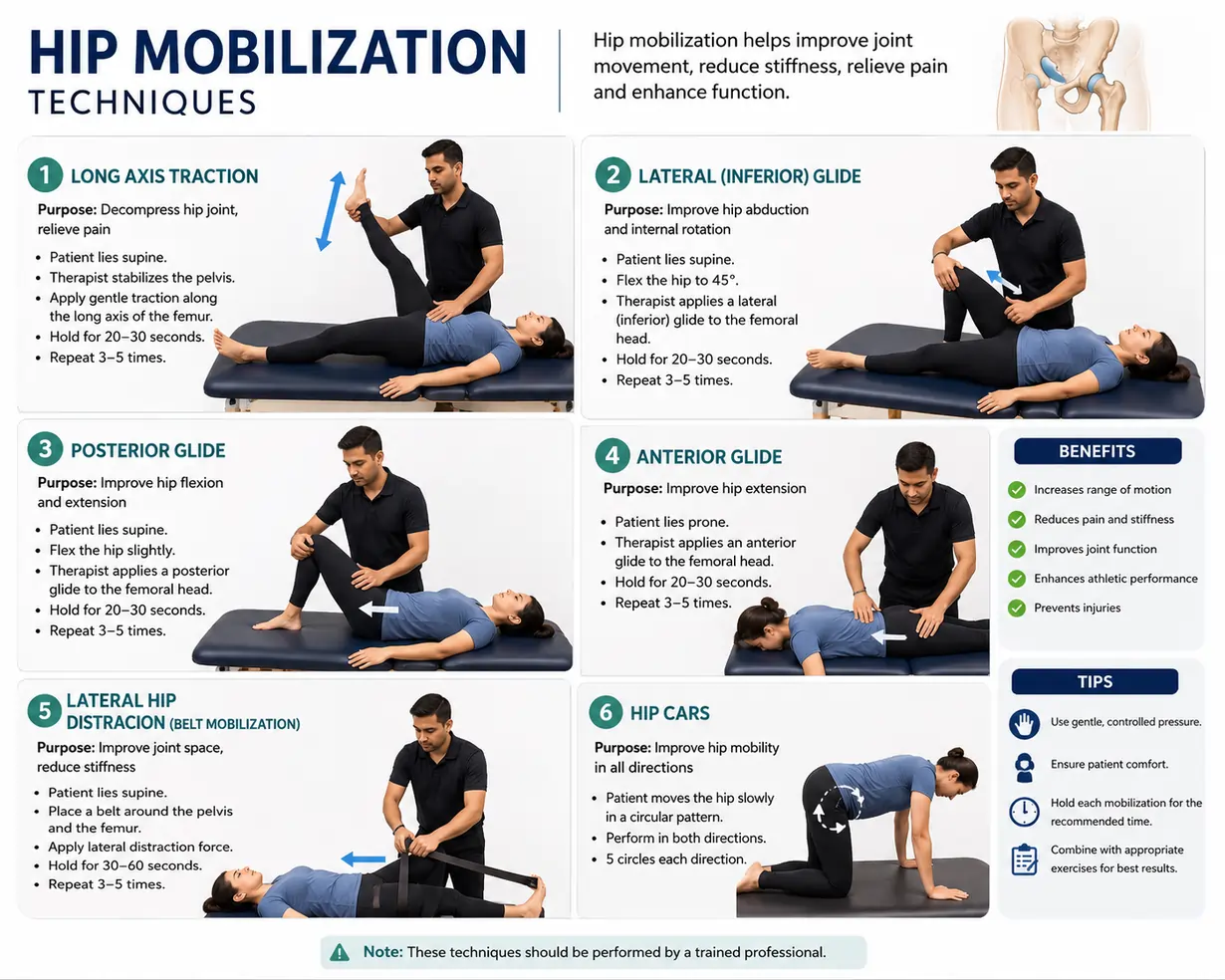
- Anterior Glide: The femur is pulled forward during an anterior glide. Used to enhance external rotation and hip extension.
- Posterior Glide: The femur is forced backward during a posterior glide. Used to enhance internal rotation and hip flexion.
- Inferior (Caudal) Glide: The femur is forced downward during an inferior (caudal) glide. Used to improve hip flexion and abduction in particular.
- Lateral (Distraction) Glide: Distraction on the side Glide: The femur is drawn straight out. Used to improve general mobility and lessen total joint compression.
Anterior Glide
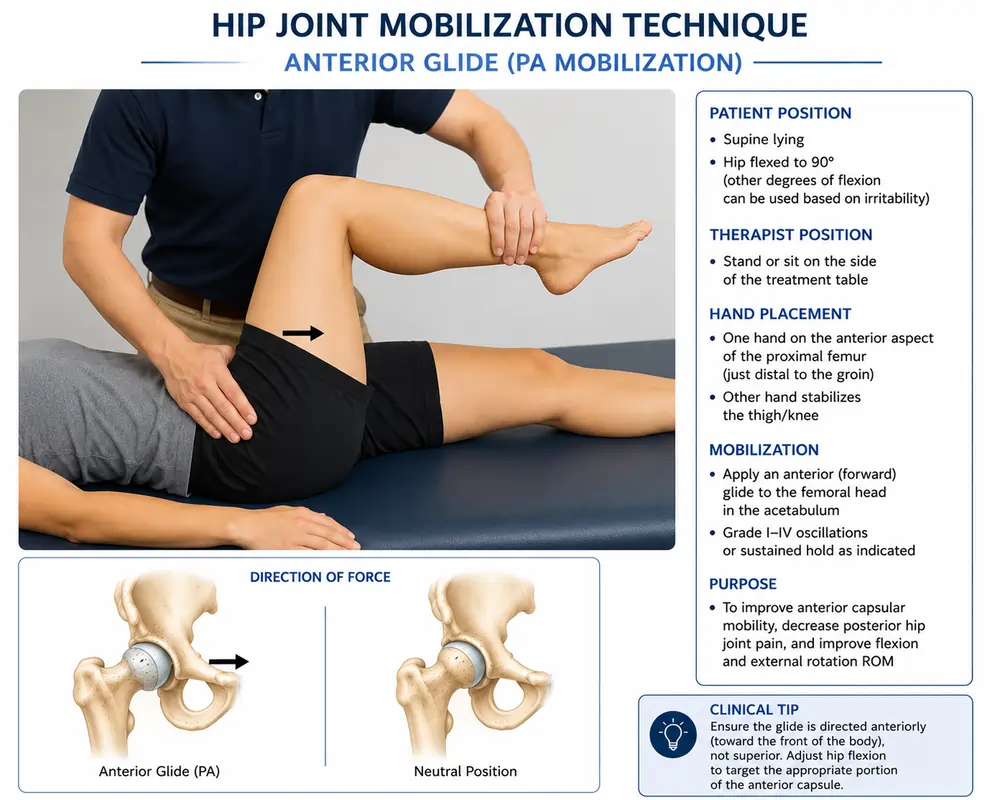
Indication
To promote external rotation and extension range of motion, anterior glide is used to increase joint play and capsular stretch.
Technique
The patient is placed in prone with the affected-side knee bent. The therapist uses one hand to hold the knee, and the other to place the posterior proximal femur of the affected side. A glide that is exactly perpendicular to the femur’s long axis is imparted by the mobilizing hand. Depending on the intended result, the femur can be rotated or abducted to different degrees. It may be advantageous to practice anterior glides before strengthening exercises as they may provide a brief increase in gluteal muscular strength.
Posterior Glide
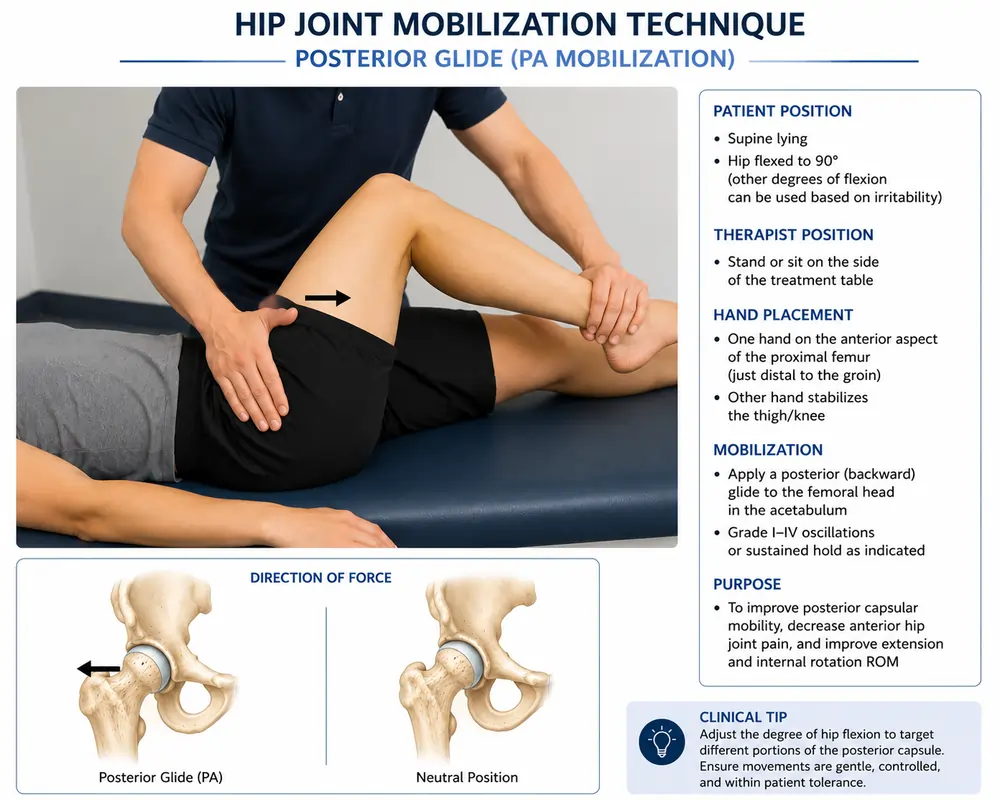
Indication
Increasing the joint play required for internal rotation can be performed with this method.
Technique
The patient is in a supine position. The therapist places the mobilizing hand on the anterior part of the proximal femur while the stabilizing hand supports the knee. By keeping the arm straight and bending with the trunk, a posterior glide is transferred directly downward using the heel of the hand. It is also possible to apply a downward push by placing hands on top of the knee.
Inferior Glide
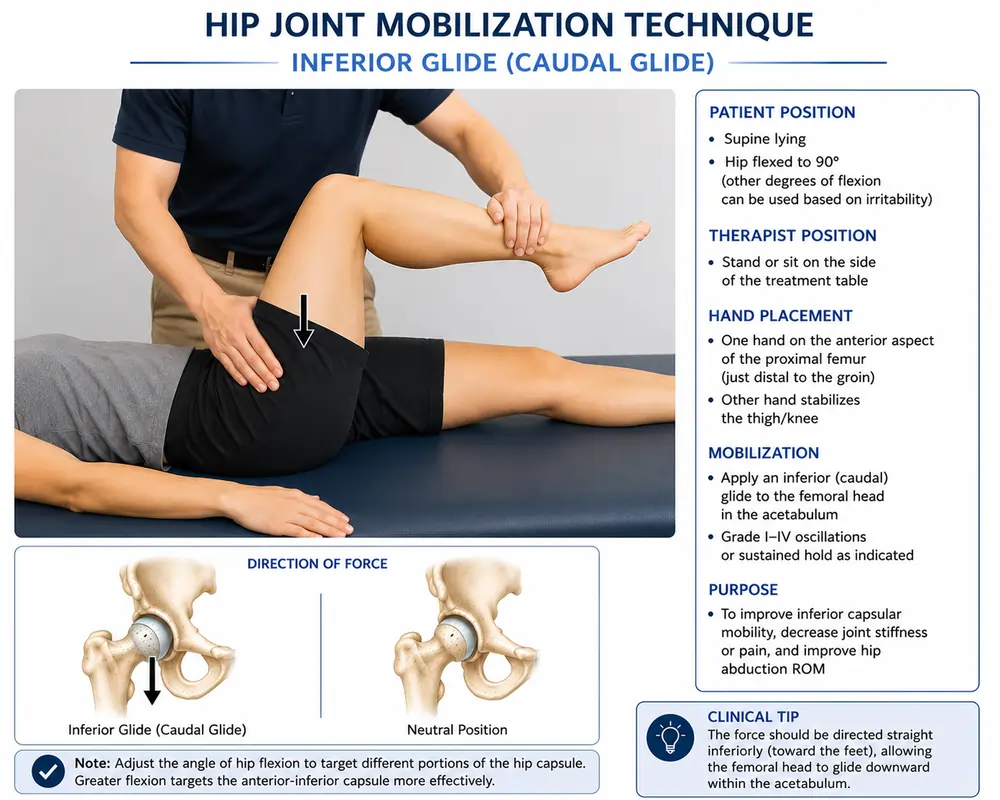
Indication
This method can be utilized to promote accessory motion required for hip flexion and rotation as well as capsular stretching.
Technique
The patient is in a supine posture with their knee and hip flexed at a 90-degree angle. In flexion, the therapist’s shoulder supports the opposing leg. The hands or a mobilization belt are used to apply an inferior glide of the femur. Depending on the desired outcome, this technique can be used with different degrees of flexion and/or rotation. Grades I–V mobilizations are possible when the therapist holds the patient’s leg over the medial and lateral malleoli at lower degrees of flexion. To execute a Grade III–IV mobilization, the therapist will hold closer to the joint line at increasing flexion levels.
Hip Distraction
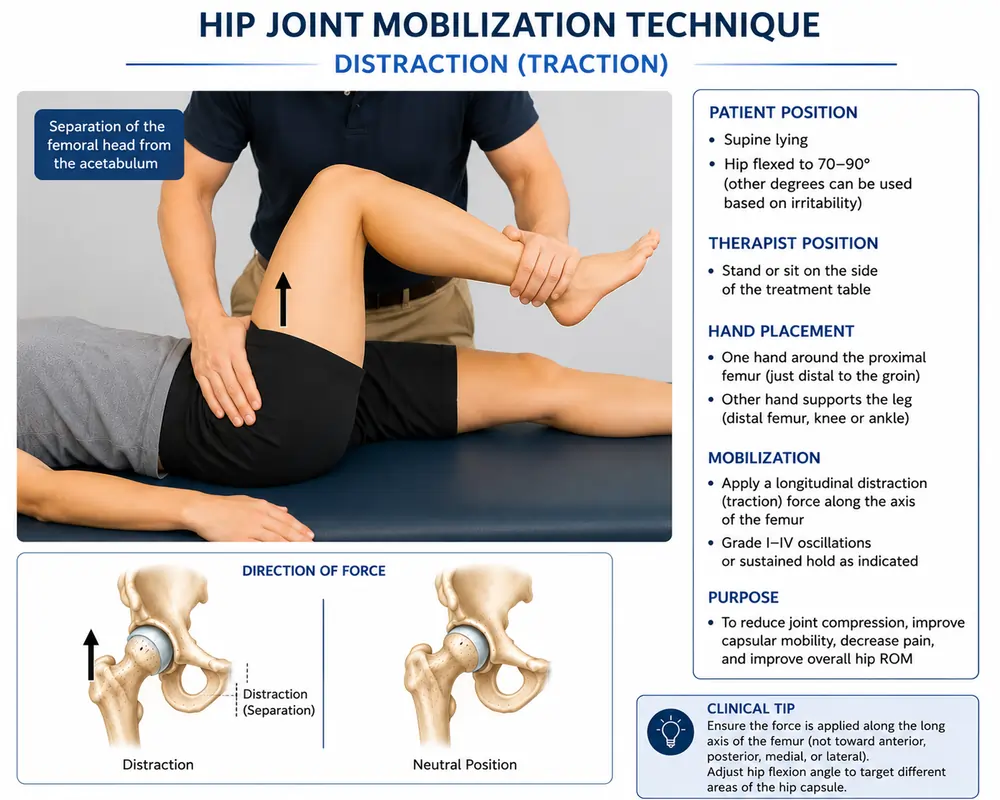
Indication
According to the goal of assessment and pain alleviation.
- Technique: Hip Distraction with Knee Extended
- The patient is in a supine position with their leg extended and their hip slightly flexed. The patient’s ankles are securely wrapped with a belt or the hands of the therapist. Depending on the preferences of the doctor, hand posture may change. The therapist’s backward tilt causes the hip to get distracted, creating a small gap at the femoroacetabular joint. In addition to improving accessory joint movement for flexion and abduction motions, this approach can be utilized to reduce muscle spasm or pain. Oscillations can be introduced to help ease hip soft tissue tension, promote hip muscle relaxation, and increase joint capsule suppleness.
- Technique: Hip Distraction with Knee Flexed
- The patient is in a supine posture with the target leg in “crook lying” with the knee at around 100 degrees of flexion and the hip at 50 degrees. The patient is seated on the therapist’s foot. The hand farthest from the patient rests on the patient’s thigh, and the forearm closest to the patient is situated between the thigh and lower leg. The knee is distracted by the forearm and hand pulling in the direction of the therapist.
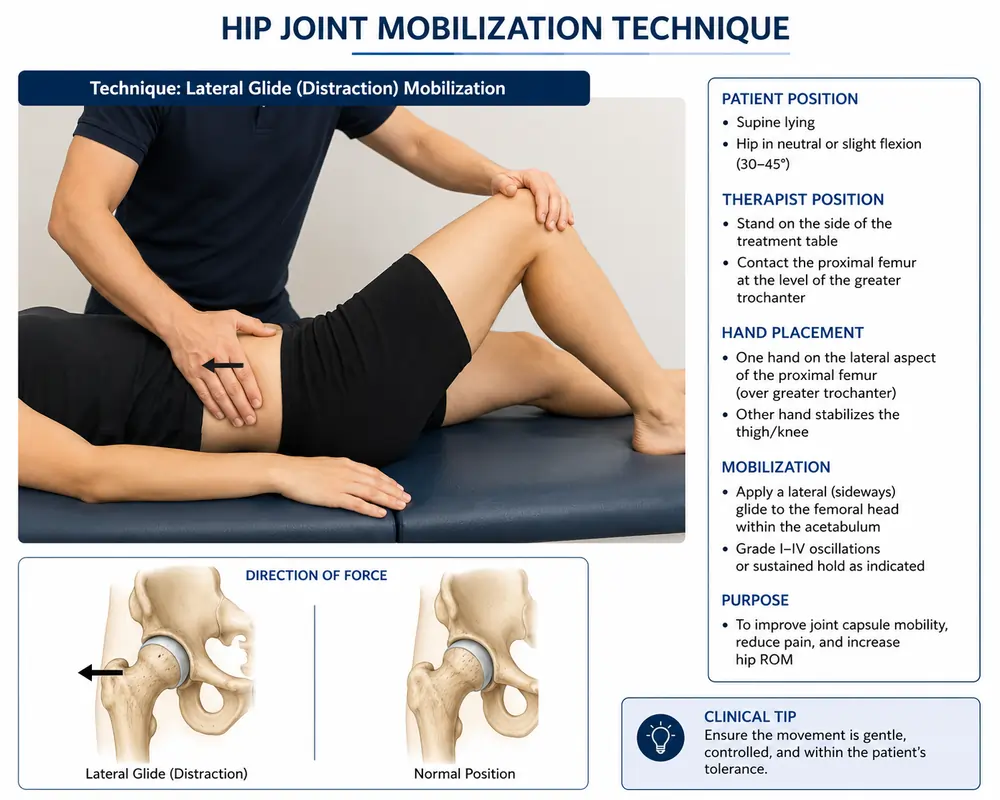
Lateral glide
Indication
Reduced pain and increased range of motion, especially in internal rotation and abduction.It has been demonstrated that grade III/IV mobilizations at 3×10 enhance adduction, internal, and external rotation range of motion.
Technique
When using a mobilization belt, the patient lies in a supine position with their knees and hips flexed. It is possible to employ other combinations of hip and knee flexion, but the most popular ones are 45 degrees of hip flexion and 135 or 90 degrees of knee flexion. The mobility belt is positioned around the therapist’s hip and the proximal femur, as close to the hip joint as feasible. Applying lateral glide involves leaning posterior, stabilizing the femur with the hands, and avoiding abduction or external rotation.
Rotation Oscillations in Crook-Lying
The patient is in a supine posture with the primary leg in “crook lying” with the hip at 50 degrees of flexion and the knee at about 100 degrees. The therapist moves the target leg into abduction and adduction while placing hands around each side of the knee.
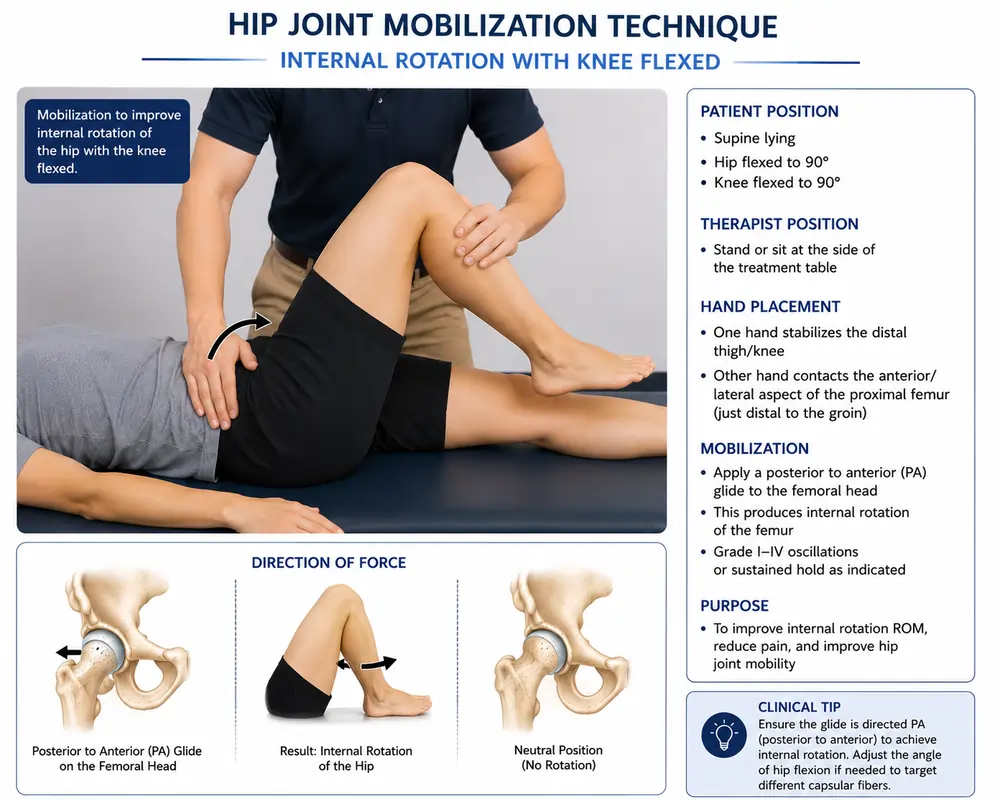
Internal Rotation with Knee Flexed
Indication
To increase internal rotation ROM of the hip
Technique
The patient is in a supine posture with the target leg in a “crook lying” position with the hip at a 50-degree angle. knee is elevated off the plinth but in maximum flexion. The therapist “hugs the target leg” by placing the ventral hand on the patient’s thigh and the caudal forearm around the patient’s abductors. The therapist will draw the thigh toward themselves by internally rotating the femur.
Conclusion
A safe and efficient technique to increase hip range of motion, lessen pain, and momentarily boost muscle function is through hip joint mobilizations. Additionally, they might lessen the likelihood of additional injuries, the onset of OA, and the frequency of anterior knee discomfort.
FAQs
How to do hip joint mobilizations?
The patient is placed in prone with the affected-side knee bent. The therapist uses one hand to hold the knee, and the other to place the posterior proximal femur of the affected side. A glide that is exactly perpendicular to the femur’s long axis is imparted by the mobilizing hand.
What are the 7 motions of the hip?
Flexion, extension, abduction, adduction, external rotation, internal rotation, and circumduction are all possible with the hip joint, which is a multi-axial joint.
What is a grade 4 joint mobilization?
A small-amplitude passive movement at the start of range with no tissue resistance was considered grade I mobilization. A small-amplitude passive movement at the end of range against tissue resistance was known as grade IV mobilization.
References
- (2026). Knee Mobilisations. Physiopedia. https://www.physio-pedia.com/Knee_Mobilisations
- Albertin ES, Miley EN, Baker RT, Reodan D. The effects of hip mobilizations on patient outcomes: a critically appraised topic. J Sport Rehabil.
- Pluegler G, Borkovec M, Kasper J, McLean S. The immediate effects of passive hip joint mobilization on hip abductor/external rotator muscle strength in patients with anterior knee pain and impaired hip function.
- Medeiros JM, Rocklin T. Manual therapy, therapeutic exercise, and HipTracTM for patients with hip osteoarthritis: a case series. Orthopaedic Practice