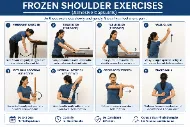
Top Exercises for Frozen Shoulder
Introduction:
Frozen shoulder, also known as adhesive capsulitis, is a painful condition that causes stiffness and a gradual loss of movement in the shoulder joint. It develops when the connective tissue surrounding the shoulder joint becomes inflamed, thickened, and tight, making even simple daily activities such as reaching overhead, getting dressed, combing your hair, or sleeping on the affected side difficult and painful.
The condition typically progresses through three stages: the freezing stage, where pain gradually increases and shoulder movement becomes limited; the frozen stage, where stiffness is most severe but pain may begin to decrease; and the thawing stage, during which shoulder mobility slowly returns. This entire process can take several months to over a year, depending on the severity of the condition and the treatment received.
Frozen shoulder most commonly affects adults between the ages of 40 and 60, with women being more frequently affected than men. People with diabetes, thyroid disorders, prolonged shoulder immobilization, or those recovering from shoulder injuries or surgery have a higher risk of developing this condition.
The good news is that most people recover successfully with the right combination of physiotherapy, stretching exercises, pain management, and patience. Early diagnosis and consistent rehabilitation can significantly improve shoulder mobility, reduce pain, and help restore normal function.
The Three Progression Phases:
Typically, the illness progresses gradually over three different stages, each lasting one to three years:
1. Freezing (6 to 9 months): Your active and passive range of motion gradually decreases, and your progressive pain gets worse, particularly at night.
2. Frozen (4 to 12 months): The shoulder joint becomes “stuck” due to extreme stiffness, although pain frequently decreases.
3. Thawing (5 to 24 months): As movement recovers, the range of motion progressively increases and pain decreases
Exercises for a Frozen Shoulder:
Frozen shoulder may be prevented and treated by increasing shoulder mobility with mild stretching exercises. Before doing any exercises for frozen shoulder, it’s a good idea to see your doctor. Proceed gently, and alter or discontinue any extremely uncomfortable exercises.
Stretch until you feel pain, but not so much that it hurts, for the exercises that follow.
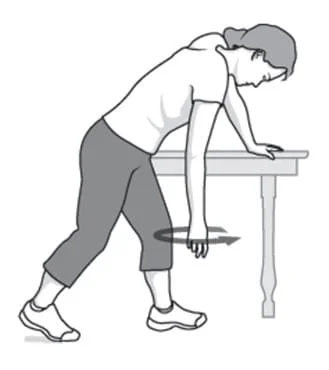
Pendulum stretch:
How to perform:
- Keep your shoulders relaxed and your arms at your sides as you stand. Allow your affected arm to hang while bending slightly forward. If necessary, you can place your good arm’s hand on a table for support.
- Swing your hanging arm ten times in one direction and ten times in the opposite direction in a circle that is about a foot in diameter.
- Make the circles larger as your mobility improves and your pain subsides.
Cross-body reach:

How to perform:
- Put your good arm’s hand on your injured arm’s elbow.
- Raise your injured arm over your chest until your shoulder begins to expand.
- Repetition/Duration:
- Hold for 15 to 20 seconds.
- Repeat ten to twenty times a day.
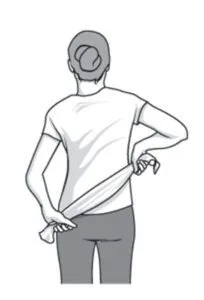
Towel stretch:
How to perform:
- Hold both ends of the towel vertically behind your back.
- Keep your normal arm on the top edge of the towel while your affected arm is on the bottom.
- Raise the unaffected arm slowly up your back until your shoulder begins to expand.
Repetiton/Duration: Hold for ten seconds. For five days, do this five times, twice a day.
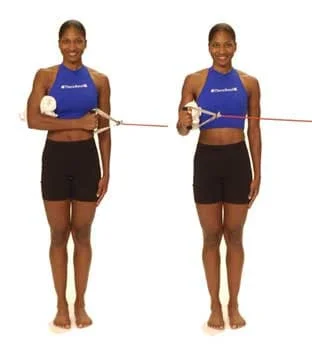
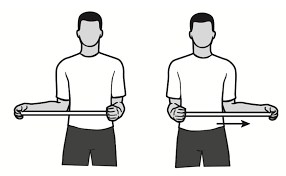
External rotation:
How to perform:
- Stand with your elbows bent at a 90-degree angle and your upper arms pushed against your sides. Take a rubber workout band and hold its ends in each hand.
- Pull the affected arm out to your side by two to three inches while keeping your healthy arm still.
Repetiton/Duration: Hold for five seconds. Repeat 10 to 15 times a day.
Internal rotation:
How to perform:
- Stand beside a closed door. Hold the opposite end of an exercise band in the hand of the affected arm while bending one end around the doorknob.
- Pull the band two to three inches toward your body while keeping your upper arm at your side and your elbow at a 90-degree angle.
Repetition/Duration: Repeat ten to fifteen times a day, holding for five seconds each time.
Wall-Crawl:

By gradually increasing the distance that the fingers can crawl up the wall, the wall crawl exercise can help increase the range of motion. The tendons and muscles of the shoulder are stretched and worked as the fingers climb up the wall, which can help to improve the shoulder joint’s general flexibility.
How to perform:
- With your affected arm stretched forward and your fingertips in contact with the wall, face a wall.
- Move your fingertips carefully up the wall so as not to injure yourself.
- Return to the beginning position by slowly climbing your fingers down the wall.
- It’s important to go gently since this exercise tests shoulder flexibility.
- Stay clear of climbing the wall too high,h as this may result in further pain or harm.
- Stop the workout right away and speak with the physical therapist if you experience any pain.
Shoulder abduction
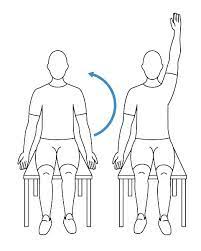
The goal is to restore or improve shoulder abduction.
How to perform:
- starting position
- Hold the stick shoulder-width apart while maintaining a forward posture.
- As much as you can within the pain-free range of motion, raise the affected arm laterally.
Repetiton/Duration:
- Hold for two to three seconds.
- Go back to where you were.
- For a second rep, repeat. Aim for two to three sets of ten repetitions.
Ideal time to perform: Phase 1-2(freezing and frozen)
Sleeper Stretch
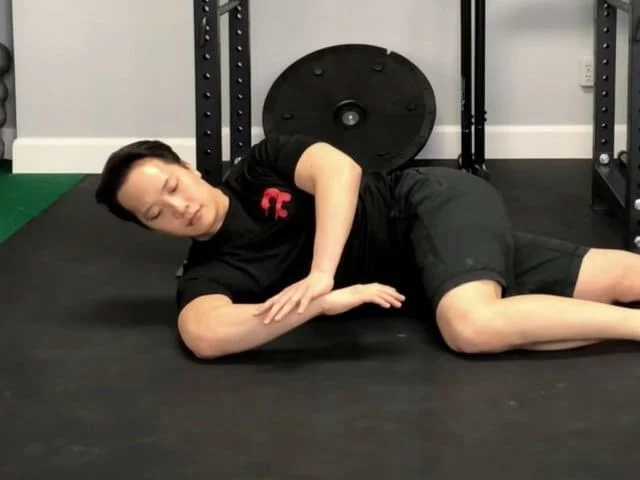
- The sleeper stretch is a more difficult shoulder flexibility exercise.
- The main focus of the workout is the internal rotation movement, which is frequently obstructed by frozen shoulder.
- For this exercise to be effective, technique is very crucial; thus, it’s critical to stick to the physical therapist’s recommendations. Additionally, the physical therapist can monitor and modify the activity to make sure it is done correctly.
How to perform:
- With your affected arm at a 90-degree angle to your body, lie on your unaffected side.
- Lower your affected arm gently in the direction of your feet toward the bed.
- After holding for a few seconds, go back to where you were.
- The unaffected arm can progressively guide the movement. Stay clear of applying excessive pressure to your affected arm, as this may result in further pain or damage.
- Although this exercise has several advantages, it may damage or irritate the shoulder if done incorrectly.
- Stop the workout right away and contact the physical therapist if you experience any pain.
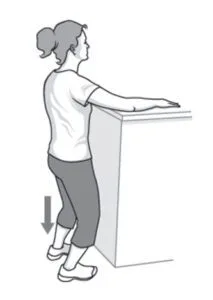
Armpit stretch
How to perform:
- Lift your affected arm onto a table at chest height using your good arm.
- As you relax your arm on the shelf, stretch your armpits and gently bend your legs.
- Next, carefully straighten your knees.
- To gently deepen the stretch, bend your knees once more; do not push yourself.
- Gently repeat the motion.
Repetition/Duration: Do 10–20 each day.
Ideal time to perform: Phase 3: Thawing and Freezing
Scapular Retraction
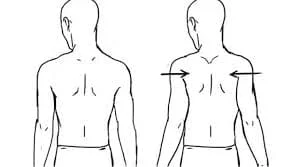
How to perform:
- Keep your back straight whether sitting or standing.
- Squeeze your shoulder blades together gently.
- Hold for five seconds, then gradually let go.
- Do the exercise again.
Repetition/Duration: Two sets of 20 repetitions, 2-4 times a day6
Best time to perform: Frozen phase3
Precautions should be taken: Before commencing workouts, always warm up your shoulders; you may take a warm bath or use a wet heating pad. Stretch till you feel minor tightness; stop beyond it. Do not force. You may avoid using weights or offering a considerable range of motion. Also, avoid quick, jerky movements.
If you have any worries regarding these exercises, it’s advisable to learn them from a skilled expert first.
Passive stretch(External Rotation)
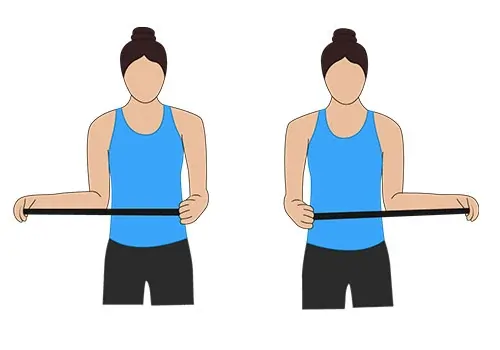
How to perform:
- The therapist will advise you to stand in a doorway.
- He will assist you in placing the hand on the door frame and bending the affected arm’s elbow to a 90-degree angle.
- He will instruct you to hold the hand still, slowly turn your body away, and hold it for 30 seconds before allowing you to relax and repeat.
Repetition/Duration: The therapist may recommend performing the exercise ten to twenty times a day for thirty seconds each time.
Best time to perform: The freezing or frozen phase
Forward flexion (Supine Position)
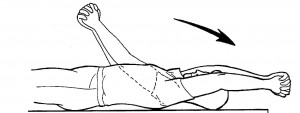
How to perform:
- Lie flat on your back on a bed or other stable surface. Continue to take part (injured or after surgery).
- completely at ease, frequently lying by your side or on your stomach.The Action: Grasp the affected arm’s wrist or hand with your non-involved hand.
- The Lift: Pull and guide the affected arm gently toward the floor and overhead with your strong arm until you feel a slight stretch.
Repetition/Duration: Slowly lower the arm back down after holding the extended posture for 10 to 20 seconds while maintaining a regular breathing pattern.
Best time to perform: He could advise doing it in step three of freezing.
Resistance band external rotation
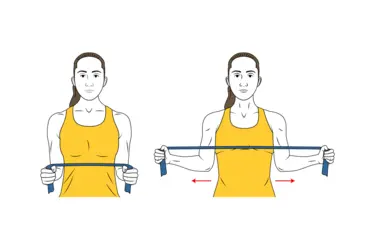
How to perform:
- The therapist will instruct you to use both hands to grasp a rubber workout band.
- Then assist you in bending at a 90-degree angle while keeping your elbows close to your sides.
- He will ask you to hold this position for five seconds after guiding you to slowly extend the bottom portion of the affected arm outward by two to three inches.
Repetition/Duration: Ten to fifteen repetitions of the workout each day may be requested by the therapist.
Best time to perform: He could advise doing the activity when it’s cold and frozen.
Only under the supervision of a physician or physiotherapist can these activities be carried out. He may give you a booklet on frozen shoulder exercises. To reduce the chance of further injuries, don’t overdo the workouts or stretch too much.
Benefits of frozen shoulder exercise
Exercises may have some beneficial effects on our bodies. The following are some possible advantages of physical activities for frozen shoulder.
- Mobility Improvement: Mild workouts prevent future stiffness and improve shoulder joint mobility.
- Pain Reduction: Over time, slow motions may lessen pain and inflammation.
- Improvement of Flexibility: Stretching exercises maintain the flexibility of the shoulder tissues.
- Strength Maintenance: Strengthening workouts help to keep the shoulder muscles strong.
- Daily Function Improvement: Shoulder exercises may help with daily tasks including reaching, lifting, and dressing.
- Speedy Recovery: Regular activity can speed up the healing process.
At-home frozen shoulder exercises may offer these potential advantages, but to get them and prevent needless side effects, appropriate supervision and care are required.
Common exercise mistakes to avoid
The following are some typical mistakes you can keep clear of when doing frozen shoulder workouts.
- Overstretching or pushing the shoulder
- Bad posture when working out
- Skipping the warm-up
- Performing too many repeats too quickly
- Not selecting exercises that are stage-specific
- Ignoring pain when stretching
- Avoiding the sequence of exercises
- Not taking a break in between sessions
- When doing frozen shoulder exercises, care should be given to prevent these types of mistakes and lower the chance of any additional injuries.
Is exercise safe for frozen shoulder?
Physical activities for frozen shoulders are usually regarded as safe, but only when performed correctly, softly, and without using force. It is essential for improving shoulder mobility and decreasing stiffness. Additionally, regular, regulated exercise may assist in maintaining shoulder joint mobility. Particularly in the early stages, doctors and physiotherapists advise stretching exercises and a pain-free range of motion.
When to seek medical help?
- Even with appropriate care, the pain is becoming more intense.
- Reinjury to the frozen shoulder
- Feeling depressed or low due to a frozen shoulder
Physical therapy Treatment
It’s frequently used to treat frozen shoulder, though it’s not always successful. In some stages of frozen shoulder, it could be more helpful than in others.
How to cure frozen shoulder quickly?
Unfortunately, there isn’t a fast cure for frozen shoulder. However, you may be able to reduce some of the symptoms of frozen shoulder by using techniques such as:
compression packs, both hot and cold. Pain and swelling in your shoulder might be reduced by applying heat or ice. While ice packs limit blood flow and lessen pain and swelling, hot packs increase blood flow to the inflammatory region. You can switch between the two. Use a heating pad or heat a damp towel in the microwave for a hot pack. Three times a day, apply to your shoulder for up to twenty minutes.
Use a cloth to wrap an ice pack or bag of frozen vegetables for cold compression. Every two to four hours, apply it to your shoulder for up to twenty minutes at a time. Apply heat for 15 to 20 minutes if you’re switching between the two. Apply ice a few hours later.
Transcutaneous electrical nerve stimulation (TENS). TENS treatment blocks or modifies your perception of pain with a low-voltage electrical current. Further investigation is required to determine how it could function. According to some medical professionals, it could trigger nerve cells that block pain impulses. Additionally, the current may increase endorphins, a class of substances that your body naturally produces as analgesics.
The TENS device resembles a little smartphone in size. It consists of many sets of wires that attach to adhesive-backed pads that are applied to your skin along nerve routes. Low electrical current pulses are sent by the device. Usually, a medical professional does it at their clinic or office. However, you may also purchase home-use units. Never use one without first consulting your physician. People with certain illnesses, such as cancer or heart problems, shouldn’t take them.
Home remedies:
Hot pack:
In addition to preventing further injury, using a hot pack aids in restoring enough blood circulation to the shoulder. Move it carefully in circular motions after warming up the shoulder with heat packs or a hot water bath. You have to make sure the action is slow and moderate. Any unexpected movement might cause shoulder damage.
Add Epsom salt while bathing:
To help with the heat given to your shoulders, you may also add a small amount of Epsom salt to your bathing water.
Practise exercise daily:
Do easy, gentle shoulder exercises two or three times a day. After the shoulder has warmed up, several exercises are advised. Exercises may improve the frozen shoulder’s range of motion and support the physiotherapy session.
Conclusion:
Frozen shoulder can be a frustrating condition that affects your daily activities, work, and overall quality of life. Although recovery may take time, most people experience significant improvement with early diagnosis, consistent physiotherapy, and a well-planned exercise program. Gentle stretching, range-of-motion exercises, and gradual strengthening can help reduce pain, restore flexibility, and improve shoulder function.
It is important to avoid forcing painful movements, as this may worsen inflammation and delay recovery. Instead, follow a gradual rehabilitation plan and perform your exercises regularly for the best results. For a thorough evaluation and individualized treatment plan, speak with a medical expert or physiotherapist if your shoulder pain is significant or if your shoulder mobility is getting worse.
With patience, consistency, and the right care, you can overcome frozen shoulder, regain normal shoulder movement, and return to your everyday activities with greater comfort and confidence.
FAQs
What is the main cause of frozen shoulder?
Although the exact origin of frozen shoulder is unknown, it happens when the flexible tissue capsule that surrounds the shoulder joint thickens, tightens, and becomes inflamed. The most common causes of this are underlying medical disorders like diabetes or shoulder immobility, such as recuperating after an injury, broken arm, or surgery.
What are the four stages of frozen shoulder?
Pre-freezing (1–3 months): Some movements cause mild, occasional pain, particularly at night. Although the range of motion is largely normal, it is beginning to feel a little limited.
Freezing (3–9 months): Pain worsens, seriously affecting daily activities and sleep. As the joint capsule thickens, the range of motion significantly decreases.
Frozen (9–14 months): Although the pain subsides, the shoulder becomes extremely stiff and rigid, making it challenging to do daily tasks.
Thawing (15–24 months): Shoulder movement gradually increases until complete or almost full mobility returns, and pain significantly decreases.
How should a frozen shoulder be treated?
Focused physical therapy, pain management, and mild at-home exercises are the most effective ways to treat a frozen shoulder to improve mobility and lessen pain. Depending on the stage of your condition, the following methods are quite helpful; however, healing may take some time.
What makes a frozen shoulder worse?
The main thing that worsens a frozen shoulder is extended immobility or complete rest. Avoiding movement causes the joint capsule to thicken and scar tissue to develop. Uncontrolled diabetes, sudden movements, challenging workout equipment, and poor posture can all rapidly increase inflammation and pain
References:
- Walker-Journey, J. (2023, November 7). Frozen shoulder (Adhesive capsulitis). WebMD. https://www.webmd.com/a-to-z-guides/what-is-a-frozen-shoulder
- What causes frozen shoulder and how is it treated?: Alpine Orthopedics and Sports Medicine: Orthopedic Surgery. (n.d.). https://www.alpineorthopedics.com/blog/what-causes-frozen-shoulder-and-how-is-it-treated
- Brandon Downs, MD. (n.d.). 3 stages of frozen shoulder: orthopaedic specialists: orthopaedics. https://www.orthopaedicspecialists.com/blog/3-stages-of-frozen-shoulder
- Mehta, P. (2026, April 30). Best frozen shoulder exercises for pain relief. PharmEasy Blog. https://pharmeasy.in/blog/bone-health-best-frozen-shoulder-exercises-for-pain-relief/