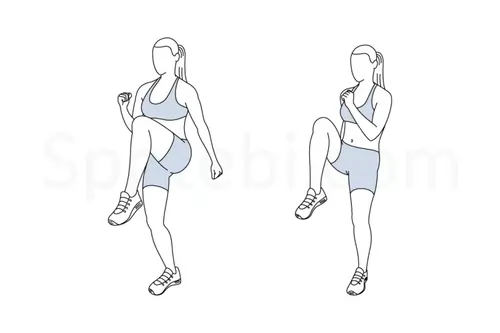
High Knee Exercise
Introduction:
High knees are a high-intensity aerobic exercise that strengthens your lower body and core, raises your heart rate, and burns calories. They are executed by rhythmically bringing your knees up to your chest while jogging in place.
The High Knee Exercise is a simple yet effective cardiovascular exercise that involves running in place while lifting your knees as high as you can toward your chest. This strenuous workout strengthens the lower body muscles, increases endurance, and enhances balance and coordination. High knees are often used in warm-up routines, sports training, and fitness activities because they quickly increase heart rate and prepare the body for more demanding physical activity.
Running or jogging while raising the knees to hip level or higher is a high-energy aerobic exercise known as “High Knee Exercise.” Warm-ups, cardiovascular exercises, sports training, and high-intensity interval training (HIIT) regimens frequently incorporate this adaptable routine. By utilizing a range of muscle groups, including the quadriceps, hamstrings, calves, hip flexors, and core muscles, high knees strengthen the heart and muscles.
How to Take the Starting Position:
With your feet hip-width apart, your core tight, and your eyes forward, take a tall stance.
Raise your right knee firmly toward your chest until your thigh is parallel to the floor.
In a manner akin to jogging, simultaneously pump your opposing (left) arm forward and upward.
Immediately drive your left knee up while pumping your right arm after gently lowering your right foot to the floor.
To maintain light, fast footsteps, switch up quickly.
Muscles Worked in High Knee
- Because it involves bearing weight, the high knees exercise works your core, lower body muscles, and some upper body muscles.
- Calves, hamstrings, quadriceps, glutes, and hip flexors
- To properly perform high knees, employ your transverse abdominis and obliques.
Finally, when you pump your arms, don’t forget to contract your biceps and triceps.
How do you do high knees?
- Most of us remember performing a series of high knees during physical education class in elementary or middle school.
- Even if we could have easily repeated this exercise when we were younger, there’s a considerable possibility we didn’t learn how to do the high knees exercise correctly.
- Before you start, make sure your shoes are comfortable and supportive. If you have knee or ankle problems, this exercise is best performed on a grassy or supportive gym floor. Here’s how to perform high knees in light of this.
- With your arms by your sides and your feet hip-to-hip and shoulder-to-shoulder apart, adopt a tall stance.
- Contract your core muscles, open your chest, and look directly ahead.
- To start, raise your right knee to your chest, just above your waist. Make a pumping motion with your left hand simultaneously. Lower your left hand and right leg quickly. Continue with your right hand and left leg. Alternate between your left and right legs for the required duration.
What are the benefits of high knees?
An excellent full-body weight-bearing workout that raises your heart rate, warms your upper and lower body muscles, and gets you ready for more difficult routines and activities is the high knees exercise. These are a few advantages of having high knees.
Raises heart rate and burns calories
One type of cardiovascular workout is high knees. Within a few seconds of beginning the workout, your heart rate and breathing will both increase. You will burn calories as you keep switching between your arms and knees.
High knees are categorized as a workout on the majority of calorie charts. Calisthenic workouts, such as high knees, can burn roughly 7 calories per minute when done briskly. You should anticipate using between 3.5 and 7 calories each minute if you labor at a moderate pace.
Focuses on your lower body.
Your quads, hamstrings, calves, glutes, and hip flexors all benefit from high knees in terms of coordination, balance, and muscular endurance.
They can help increase your lower body’s power when performed at a high intensity with forceful knee drives or bounding.
Activates the core muscles.
Your core or abdominal muscles must help you achieve high knees. In addition to increasing the effectiveness of the workout, using the core muscles also assists with posture.
A 2015 study found that running in place, which is comparable to high knees, can aid with posture by tightening the abdominal muscles.
What are some variations of high knees?
The classic high knee exercise works well and is simple to incorporate into a range of training regimens. It also doesn’t require any equipment.
However, experimenting with a modification of this traditional move can help prevent boredom, raise the difficulty, or sometimes lower the intensity to make the move more approachable. These are a few high-knee versions.
Increase the intensity:
Just raise your knees higher, move more quickly, or perform more sets if you want to intensify the classic high-knee workout. Start by either extending each set by 10 to 15 seconds or adding one set every time you practice high knees.
As long as you keep good form, you can also force your knees up faster and higher. As an alternative, you might drive your knee up toward your chest while adding a twist. The oblique muscles are the focus of this.
Reduce the effect and intensity:
Slowing down will lessen the impact and severity of high knees.
For instance, raise and lower your knee slowly in a marching or walking-in-place motion rather than thrusting it up to your chest while jogging. As a result, the activity becomes low-impact and less taxing on the joints.
High knees on the side:
To begin, stand with your arms bent 90 degrees to the sides. Next, sprint faster on the spot while raising your knees to your waist. With each stride, take two or three steps to each side, then continue switching between the sides. Continue swinging your arms while performing the lateral high knees exercise, and pretend to run.
High Knee Jumping:
Bend your knees slightly to begin this exercise. Next, extend your arms by your sides while standing comfortably. Next, perform a proper dip jump, a quarter squat, and an explosive upward move. Make sure your knees approach and try to contact your chest while you do this.
You must therefore raise your knees and jump as high as you can. Re-extend your legs and repeat the entire movement to ensure a secure landing. It has been shown that jumping high knees burns more calories than standing high knees.
When should you do high knees?
The high knees exercise may be incorporated into most exercises because it is functional and adaptable. Here are some suggestions regarding the appropriate times to execute high knees.
Warm-up:
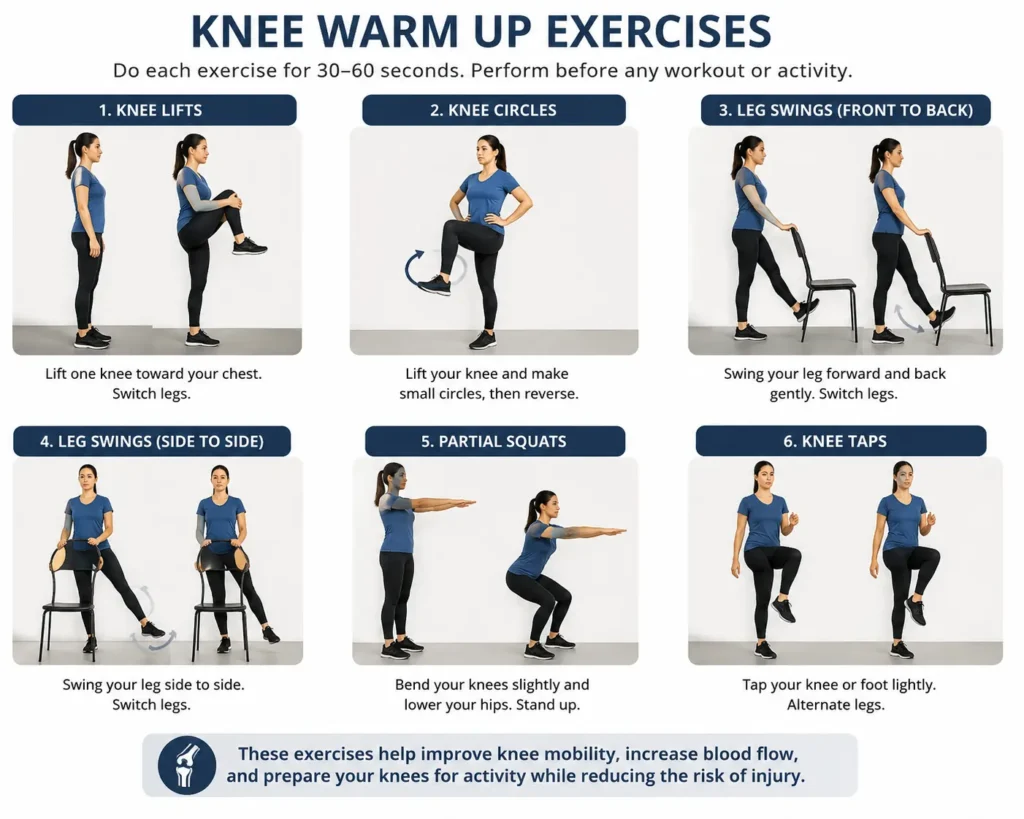
Before working out, do two to three minutes of high knees to raise your heart rate, warm up your muscles, and prepare your body for more difficult exercises. Try 30 seconds on and 15 seconds off, then repeat for two to three minutes if doing continuous high knees is too difficult.
HIIT or cardio exercise:
Any cardio or high-intensity interval (HIIT) exercise regimen can incorporate high knees. When creating a bodyweight exercise program, incorporate high knees with other aerobic exercises such as:
Jumping jacks:
Mountain climbers, lateral hops, and high kicks
Burpees, uppercuts, plank jacks, squat leaps, and skaters
Cardio bursts during weight training:
Consider circuit training, also known as high-intensity circuit training, to maintain an elevated heart rate in between strength training activities.
Circuit exercise may improve muscle endurance in groups that are reasonably fit (5Trusted Source).
For instance, in between each round of resistance training exercises, do a 30-second high-knees aerobic burst. You can still take a break before the next set, but cut the duration in half rather than taking a complete break.
When to avoid or modify high knees:
For the majority of healthy persons, high knees are safe; nonetheless, some conditions necessitate adjustment or switching from the running version to a low-impact one. None of these limitations islong-term. They serve as places to start. For individualized advice, always speak with your doctor or physical therapist.
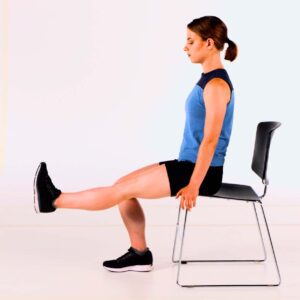
A recent knee injury, patellofemoral pain, or knee pain. Force is sent up into the knee by the plyometric landing on the ball of the foot. If you have severe anterior knee discomfort or instability, you should switch to seated knee drives or marching in place and have a physical therapist evaluate the pattern before going back to running.
A history of stress reactions or shin splints. Medial tibial stress syndrome is known to be exacerbated by repeated impact loading. Until the pain subsides for at least two weeks, switch to squat walks or marching high knees. Then, progressively resume at shorter intervals.
Pelvic-floor weakness or stress incontinence. Leakage is frequently caused by high-impact landings and jumping, which raise intra-abdominal pressure. Instead, focus on pelvic-floor coordination exercises, use marching in place, and if symptoms worsen, think about seeing a pelvic-floor physical therapist
the first six to twelve weeks after giving birth. Before the pelvic floor and connective tissue can properly absorb trauma, they must heal. Only after receiving approval from your obstetrician or a pelvic-floor physical therapist may you advance from marching to low knees and subsequently to running-style high knees.
Vertigo, vestibular problems, or balance issues. Switch to marching while using your fingers on a chair or wall to maintain your balance.
Bronchoconstriction brought on by exercise or asthma. Use a longer warm-up before high-intensity intervals, keep an inhaler close at hand, and discuss pre-exercise procedures with your doctor.
Pregnancy’s second or third trimester. Fall risk during high-cadence jogging in situ is increased by relaxin-induced joint laxity and a changed center of gravity. Instead, keep a modest cadence while marching or using low knees.
Uncontrolled hypertension or recognized cardiovascular disease. Blood pressure and pulse rate are quickly increased by high knees. Obtain a cardiologist’s approval and maintain the recommended heart-rate ranges. A much softer conditioning method for early reintroduction is marching in place.
Conclusion:
The High Knee Exercise is an effective full-body workout that combines cardiovascular fitness with lower-body training. It requires little room and no equipment and enhances endurance, agility, coordination, and calorie burning.
High knees can improve general fitness, boost athletic performance, and be a great complement to warm-up routines or high-intensity workouts when done correctly and consistently.
FAQs
What are the benefits of high knee exercises?
One high-intensity cardiovascular activity is high knees. Acquiring the skill of doing high knees will boost your stride’s momentum, develop your hip flexors, and improve your lower body’s flexibility and coordination.
How many times a day do you get high knees?
Each leg should receive at least twelve repetitions.
Which five exercises are the only ones you’ll ever need?
One of the best exercises for lower body strength that everyone should perform is the squat. Squats work your core, hamstrings, quadriceps, and glutes.
Push-Ups: Power for the Upper Body…
Rows: Support for Posture…
Planks: Core Stability.
Choose Cardio or Walking: Heart Health Is Important.
References:
- https://www.verywellhealth.com/weighted-high-knees-8715924
- Fit, C. (2022, August 26). How to Do High Knees: Benefits, Muscles Worked & Variations. blog.cult.fit. https://blog.cult.fit/articles/high-knees-exercises-benefits-steps
- Lindberg, S. (2021, August 9). It’s time to revisit the high knees exercise you learned in PE. Healthline. https://www.healthline.com/health/fitness/high-knees-benefits