Warrior Pose II (Virabhadrasana II)
Introduction:
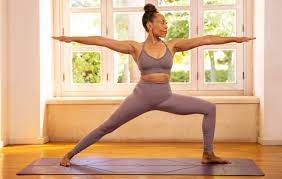
Virabhadrasana II, also known as Warrior Pose II, is a powerful standing yoga pose that increases attention, strength, and stability. This posture creates a powerful, grounded Pose by spreading the legs wide, bending one knee, and extending the arms parallel to the floor.
It increases endurance and balance while strengthening the shoulders, hips, and legs. Warrior Pose II is a key pose in many yoga practices, helping build mental stability and physical strength by promoting focus and body awareness.
How to Do Warrior Pose II:
Here is a step-by-step method for practicing this pose:
- Following a few Surya Namaskar rounds (about six rounds for three pairs), place your feet together, face the longer side of the yoga mat, and begin with Samasthiti. Close your eyes, join your hands at the chest in Namaste, and inhale several times deeply, expanding your abdomen and chest as you do so. Breathe to calm your body and thoughts.
- Make sure your hips are in the center and not pulled to one side as you spread your feet wide apart from one another or more than hip width apart.
- As you stand in Utthita Tadasana, extend your arms to shoulder level, take a few deep breaths, lift your spine, and relax your knees and feet.
- To start, turn the left foot to the left and position it at a 90-degree angle. Turn the right foot to the left and position it inside at a 30-degree angle.
- Here, make sure the hips are comfy. Bend the left knee so that it is slightly above the left ankle while slowly rotating the body to face the left foot. It would be deemed improper to extend the left knee past the left ankle.
- Bring the chest up and out, and extend the arms deeply outward at shoulder distance, stretching from the shoulder blades, while the hips are turned to the left, facing the left foot. making sure the palms are pointing down and the elbows are not bent.
- The deep stretch is coordinated with the right and left thigh movements, firmly planting the right foot in the mat to improve grip with body weight.
- Turn your head and look at the left fingers that are extended in front of you after turning your hips and positioning them in the middle between your two inner thighs.
- Start slow, deep breathing as soon as the body is at ease and properly aligned. As you exhale, observe how the body expands. As you exhale, extend the pose into a deeper stretch by softly lowering your hips without jerking.
- Virabhadrasana II is difficult to hold, so adjust the posture to your body’s comfort level and stay there based on your hip and knee strength and flexibility.
- Stretching your arms is crucial since they will enable you to comfortably balance your body. As a result, ensure that the arm above the bent knee is marginally higher than the arms behind you.
- The hips must align with the ankles, feet, thighs, and knees. This will ensure that neither the ankle nor the kneecap is injured. The energy gained when the body is in this Warrior II posture is something to feel, and this is only possible if the body is properly aligned.
- Here, the shoulders and chest are crucial because they maintain the body’s equilibrium. This position tests shoulder strength, and strengthening the shoulders will help with many other advanced poses.
- Keep the facial muscles totally relaxed and try to keep the body in this position for roughly six breaths.
- First, relax the left knee and stand upright to release the position. Return to Utthita Tadasana after slowly bringing the body to the center while rotating the hips and feet. While keeping the feet hip-distance apart, lower the arms to relax them.
- Here, take a few breaths and let your hips and feet relax. Now, turn the hips and face the right foot while extending the arms to shoulder level. Turn the right foot to the right, positioning it at a 90-degree angle, and the left foot inward at a 30-degree angle.
- Stretch the shoulders from the shoulder blades, open the chest, extend the arms, and look at the right fingers while bending the right knee and positioning it slightly above the right foot.
- Start the slow, deep breathing while maintaining proper body alignment, then extend into the posture as the exhalation occurs. Make sure the body weight is evenly distributed and not solely on the knees and feet.
- Stay in this position for six breaths or as long as you feel comfortable, making sure that no part of your body—especially your knees and feet—is stretched.
- Release by letting go of the bent knee, then swivel to face the center and put your feet back inside. Return to Utthita Tadasana, take a few deep breaths, lower your arms, fully relax your legs, and lift your spine as you do so.
- After taking a few deep breaths and relaxing, one could return to the Warrior II exercise.
Benefits of Warrior Pose II:
It is claimed that one should feel like a warrior with strength, confidence, and power to reap the greatest advantages from practicing this pose. The primary advantages of practicing Virabhadrasana II are listed below.
- Virabhadrasana II, like all previous Virabhadrasanas, focuses on the legs, particularly the hamstrings, which are stretched and expanded to their fullest. In this instance, the deep stretch achieved in the hamstring muscles by bending the knee and firmly planting the foot on the ground creates a great opening for the upper thighs, which causes the hamstrings to expand to their maximum length as well.
- Athletes benefit from the stretching and expansion of their hamstrings, which makes them stronger. In general, athletes would find this posture quite beneficial if they did it frequently prior to their run or event. Because it strengthens the hamstrings, they are less likely to get hurt, and even if they do, they heal quickly.
- Hip flexion: Although it’s crucial to avoid putting all of your upper body weight on your hips, you can increase your flexibility with practice by aligning your hips with your shoulders and feet. The hips allow the lower body to expand deeply into the legs, which strengthens the hips and increases their flexibility.
- Stretches the knees, ankles, and foot: The knees, ankles, and foot are greatly stretched by bending the hips and stretching the thighs. However, one must ensure that the knee and foot do not bear the entire weight of the body. One of the most important skills when performing yoga poses is the ability to balance the body and distribute the weight evenly. Among them is Virabhadrasana II. Strong legs eventually result from the pose’s stretching of the knees, ankles, and feet.
- Tones the leg muscles: By stretching the thighs, knees, calves, and feet, all of the leg muscles are strengthened.
- Internal organ stimulation: When the blood flow is slightly obstructed at the knees, more blood flows to the upper body. The stomach, liver, and intestines all benefit from this blood supply. Consequently, the entire abdominal region and its internal organs are stimulated.
- Relieves lower back pain: This position is thought to be an excellent approach to reduce stiffness near the hips in the lower back. Expanding the muscles surrounding the lower back by flexing the hips is an excellent approach to relieve back pain and stiffness.
- Lung and chest expansion: This lovely pose, which involves raising the upper body and extending the arms to shoulder level, opens the chest and allows for deep breathing by filling the lungs to their fullest capacity. Expanding the chest, this helps to increase lung capacity. The upper abdomen is likewise toned by this extension.
- Boosts concentration and stamina: Virabhadrasana II, also known as Warrior Pose II, increases concentration and stamina through repeated practice, which makes the practice of this pose more and more lovely and effortless. This is because stability and strength are the most crucial aspects of this pose.
- Expands and strengthens the arms and shoulders: This posture provides a fantastic opening for the shoulders with the maximal extension of the arms when the arms are spread out at shoulder level. This expansion increases flexibility while strengthening the arms and shoulder blades.
- It provides an excellent means of using alignment to mold the body. This pose provides a fantastic form to the body and tones the entire body, but it only works when the feet, thighs, hips, and shoulders are perfectly aligned. The practitioner also gains attractiveness from the overall toning of the body.
- Body awareness to maintain balance: If breathing is regulated and rhythmic, Virabhadrasana II, like most positions, gives awareness of the body. This awareness aids in posture improvement and the eventual progressive mastery of the pose.
Contraindications of Warrior Pose II:
When performing Warrior II Pose, there are a few things to consider to prevent injuries.
- Virabhadrasana II requires excellent body stability and balance, which calls for rather flexible and powerful knees. Therefore, one should definitely avoid this position if they have a knee problem.
Because the body’s weight partially rests on the feet and ankles, someone who has a foot or ankle injury should avoid performing this posture to prevent further harm. - This position requires a lot of hip flexion; if you have a hip injury or weak hips, stay away from it.
- People with weak hearts or those who have recently had heart surgery should avoid standing for extended periods of time since it strains the heart.
- When performing Virabhadrasana II, supervision becomes crucial because the pose demands a high level of strength and stability. In addition to making the posture challenging, applying excessive pressure to the knees and hips may have negative effects on the body.
- Avoid this position if you are just recovering from a disease, since general weakness of the body following a specific disease will not support balancing the body in this pose. If you are working with an experienced teacher, take your time expanding and extending.
Modifications of Warrior Pose II:
Those who are new to yoga can practice Virabhadrasana II with a few modifications and adaptations, some of which are listed below.
- To learn this pose, you can start by decreasing the distance between your legs and then progressively increasing it.
- Placing the back foot close to the wall helps balance the body and enhance control. As confidence grows, one can move away from the wall.
- Practicing the pose can be aided by positioning a chair beneath the bent thighs for deeper alignment and more support. While doing this, make sure you have assistance because the chair can shift, and you might lose your equilibrium.
- Beginners can use the wall support by stretching out one arm behind them and placing the palms in front of the wall. With assistance, this pose will be flawless.
- Look toward the center if turning your head and facing your fingers causes your body to become unbalanced.
Warrior Pose II Breath Awareness:
- Bring the body to Samasthiti by inhaling and exhaling.
- Breathe in and out, extend your arms to their fullest length at shoulder level, and spread your legs wider than hip distance apart.
- Take a breath, move your feet to the left, and position your left foot at a 90-degree angle.
- Breathe out, turn your right foot 30 degrees, and turn your torso to face your left foot.
- Breathe in and out, bend your left knee, press your left thigh and hips down as you exhale, and extend your right leg far behind you.
- Breathe in and out, extend your arms fully, look at the arms in front of you, deepen the Pose, and find a comfortable position.
- Breathe out and lower your body while bending your knees and extending your rear leg.
- Breathe in and out slowly, deeply, and mindfully while keeping an eye out for muscular stretches and making sure your body weight is distributed evenly.
- Breathe in and let go of the bent knee.
- Breathe out, turn to face the center, and bring your feet in that direction as well.
- Inhale and exhale, taking a few breaths in the middle to ease the hips and lower back.
- Breathe in and out, then repeat the process with the right leg using the previously described method.
- Breathe in and out, relax, and bring your body to Samasthiti.
Conclusion:
A powerful standing yoga pose, Warrior Pose II (Virabhadrasana II) opens the hips, strengthens the legs, and enhances balance and concentration. Regular practice of this pose promotes inner strength and confidence while enhancing endurance, stability, and body awareness.
Warrior Pose II can be a useful addition to any yoga practice for improving both physical strength and mental focus as long as appropriate alignment and steady breathing are maintained.
FAQs:
What safety measures are in place for Warrior 2?
A person with a misaligned or dislocated knee cap (patellar) must avoid bending their knee past the ankle or 90 degrees. To prevent knee and hip compression, keep your foot and knee pointing in the same direction.
Is Warrior 2 a position for beginners?
Most beginners can perform Warrior 2, but not everyone can execute the entire position right away. It can be altered in several ways to reach the entire asana. For example, you can make the front leg more angled. The knee doesn’t need to be 90 degrees.
Which chakra does the Warrior 2 pose belong to?
The body’s chakras are opened by Warrior II. The Sacral Chakra (Svadistahana) is stimulated by this Pose. We bring ideas to life from this bodily center of pleasure, emotions, and creativity. By striking this Pose, we can connect to our most authentic frequency, which is also present in this energy area.
Why is Warrior 2 so challenging?
Warrior II loads your body in a really significant way, so it’s more than just a stretch. Strong adductor (inner thigh) activation is shown in both legs, not just the front, according to biomechanics studies. Your quadriceps, particularly the vastus lateralis, are working hard.
The warrior position is associated with which Hindu deity?
The warrior positions known as Virabhadrasana are named after Virabhadra, a manifestation of the Hindu deity Shiva. Bhadra means friend or blessing, while vira means hero in Sanskrit.
What does Warrior 2 mean in Sanskrit?
How to Perform Warrior II (Virabhadrasana II) The Sanskrit name for Warrior 2 pose is Virabhadrasana II (veer-ah-bah-DRAHS-anna-II). Named after Virabhadra, a powerful warrior manifestation of Shiva, it is a fundamental standing position that represents strength and concentration. It is frequently used to increase stamina, strengthen legs, and open hips.
What does the Sanskrit Warrior 2 Pose mean?
Warrior II Pose, also known as Virabhadrasana II in Sanskrit, is a standing pose that calls for full body integration to attain both stability and lightness. Combining the outward rotation of the front thigh with the extension of the back leg is the main action in Warrior II.
What is the purpose of the Warrior 2 pose?
As many of us do, spending all day at a computer causes the hips to tighten, the shoulders to round, and the chest to constrict. For opening and stretching all of these regions, Warrior 2 is an ideal pose.
References:
- Warrior Pose II Yoga(Virabhadrasana II)| Yoga sequences, benefits, variations, and Sanskrit Pronunciation | Tummee.com. (n.d.). Tummee.com. https://www.tummee.com/yoga-poses/warrior-pose-ii
- Yoga Journal. (2026, March 10). Warrior 2 Pose. https://www.yogajournal.com/poses/warrior-ii-pose/
- Warrior II – Virabhadrasana II – The Yoga Collective. (2020, April 11). The Yoga Collective. https://www.theyogacollective.com/poses/warrior-2-virabhadrasana-2/
- Admin. (2025, July 16). Virabhadrasana 2 (Warrior Pose): 10 Powerful Benefits, Procedure & Key Tips. Rishikul Yogshala, Rishikesh. https://www.rishikulyogshalarishikesh.com/blog/virabhadrasana-2/
- Yoga Poses Dictionary | Pocket Yoga. (n.d.). https://www.pocketyoga.com/pose/WarriorII