Physical Therapy for Sciatica: Exercises & Treatment
Physical therapy for sciatica can help reduce pain, improve mobility, and restore normal function. A personalized treatment program may include gentle stretching, strengthening exercises, posture training, manual therapy, and education on safe movement.
Regular physical therapy can facilitate a gradual return to everyday activities while addressing underlying muscle weakness or movement issues.
What Is Sciatica?
Sciatica is nerve pain resulting from a sciatic nerve injury or inflammation. It can cause pain as well as tingling or numbness in your butt or back that may spread down your leg. Additionally, you can get sensations in your toes or feet.
Sciatica is a common condition. At some point in their life, a lot of individuals will experience it. In medical treatment, it’s one of the most frequent causes of leg pain.
Types of sciatica:
There are mostly two kinds. The symptoms are usually the same regardless of the type. Among them are
- True sciatica: This kind occurs when the sciatic nerve is directly impacted by an illness or injury.
- Conditions that resemble sciatica but have different origins are known as sciatica-like conditions. They have to do with nearby nerves or the sciatic nerve’s nerve roots.
Where is the sciatic nerve?
The sciatic nerve begins in your lower back, close to the base of your spine. It travels through your butt and pelvis. After that, it travels into your lower leg and down the back of each thigh.
Your lower back is where the nerve starts to constrict, and as it moves down your leg, it becomes gradually broader. It is around the size of a coin at its widest point.
Symptoms and Causes:
Sciatica symptoms:
Sciatica may cause pain in your legs, butt, or lower back. The following symptoms can be moderate to severe:
- Pain
- numbness
- A tingling sensation
The following are serious symptoms to look out for:
- Muscle weakness
- Loss of bladder control
- Loss of bowel control
Sciatica Causes:
When your sciatic nerve or its nerve root is pinched, compressed, or irritated, sciatica results. Conditions affecting the sciatic nerve, a collection of nerves in your lower back, may also cause it.
Sciatic nerve pain can be caused by the following conditions:
- Cauda equina
- Degenerative disk disease
- Foraminal stenosis
- Herniated disks
- Osteoarthritis
- Pregnancy
- Spinal stenosis
- Spondylolisthesis
- Tumors, cysts, or other growths
How is sciatica diagnosed?
Your physiotherapist will diagnose sciatica based on a number of findings from your medical history and physical examination. To identify the cause of your sciatic pain, your therapist will do a number of physical tests, such as lumbar range of motion, nerve mobility, and muscle strength testing.
In addition, we will want to know whether you have experienced any injuries, fevers, bowel or bladder control issues, prior malignancies, or unexpected weight loss. The answers to these questions are crucial since sciatica may be caused by a serious illness, such as cancer, an infection, or a fractured bone. But these are uncommon.
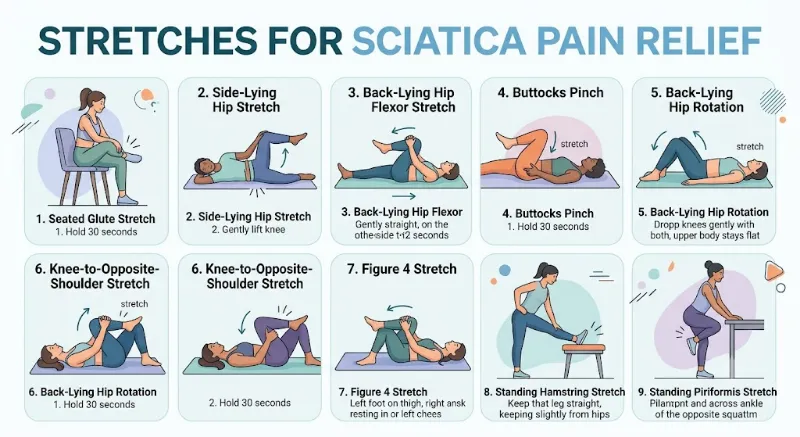
Stretches for Sciatica Pain Relief:
Seated glute stretch:
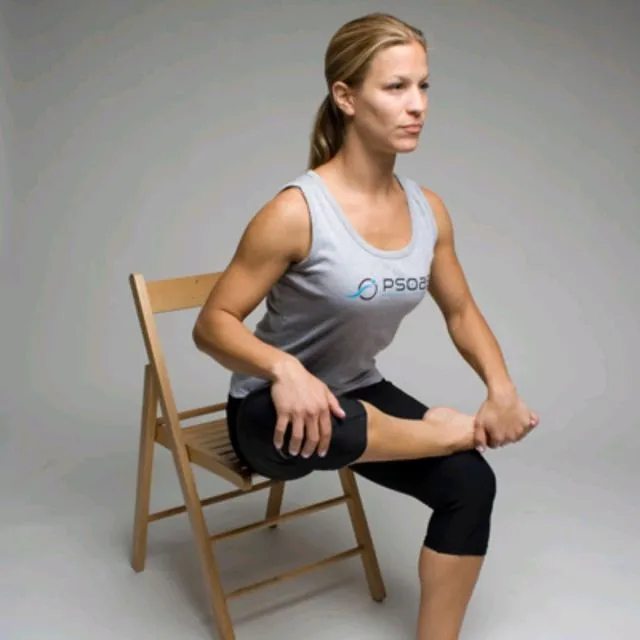
- With your legs out in front of you, take a seat on the floor or in a chair.
- Put your right ankle on top of your left knee while bending your right leg.
- Allow your upper body to reach your thigh as you bend forward.
- Hold for 15 to 30 seconds. This stretches the lower back and glutes.
- On the opposite side, repeat.
Side-lying hip stretch:
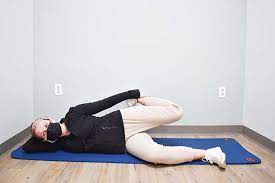
- With your legs slightly bent, lie on your right side on the floor. Put a pillow under your head.
- Lower that knee to the floor and slowly move your left leg toward your chest.
- Lower your left leg to the floor after gently straightening it so that the hip and knee line up with your lower leg.
- Do this three times.
- Repeat with the right leg on top after alternating sides.
Back-lying hip flexor stretch:
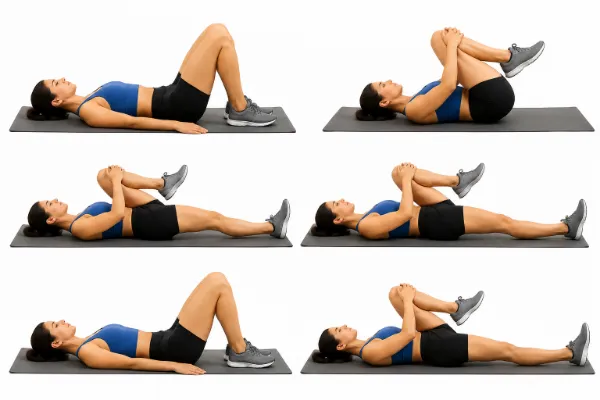
- With your feet flat on the ground and your knees bent, lie on your back on the floor.
- Bring both knees up to your chest.
- Clasp your arms around your right knee and pull it toward your chest.
- Try to contact the floor with the back of your knee as you slide your left leg down, straightening it as far as you can.
- Maintain the posture for five seconds.
- Return to the starting position slowly, then take four seconds to rest.
- Continue with the other leg.
- Repeat three repetitions, changing legs.
Buttocks pinch:
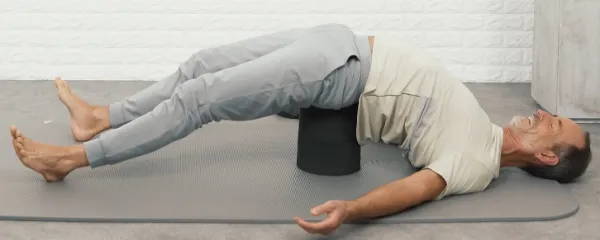
- Place a small pillow under your abdomen while lying on your stomach on the floor.
- Hold your buttocks firmly together for five seconds.
- Relax.
- Work your way up to six repetitions by repeating three times.
Back-lying hip rotation:
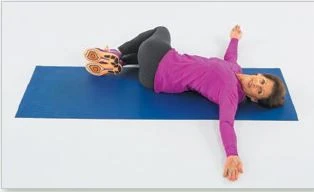
- With your legs together, knees bent, and feet flat on the ground, lie on your back on the floor.
- Maintaining your shoulders fixed to the ground, slowly bring your knees down toward the floor on your right side.
- Avoid straining your knees or using your muscles to push them to the ground.
- Hold for fifteen seconds.
- Go back to your starting position and unwind.
- On the left side, repeat.
- Work up to six repetitions by starting with three and changing sides.
Knee-to-opposite-shoulder stretch:
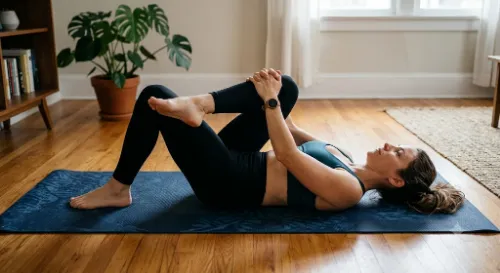
- Lie down on your back on the ground.
- Flex your feet upward and extend your legs.
- Put your right ankle on your left knee and bend your right leg over your left.
- Pull your right leg toward your left shoulder while placing your hand on your right knee.
- Hold for thirty to forty-five seconds.
- Do this three or four times.
- Change your legs.
Figure 4 stretch:
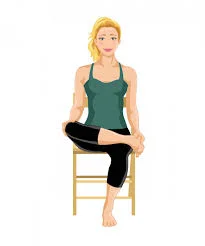
You may expand your hips by performing the figure-4 stretch. There are several variations of this stretch; however, the following instructions can be used to ease sciatic nerve pain:
- Lying flat on your back, bend both knees.
- As you raise your legs toward your body, cross your right foot over your left thigh.
- Repeat on the opposite side after holding the posture for a brief period of time.
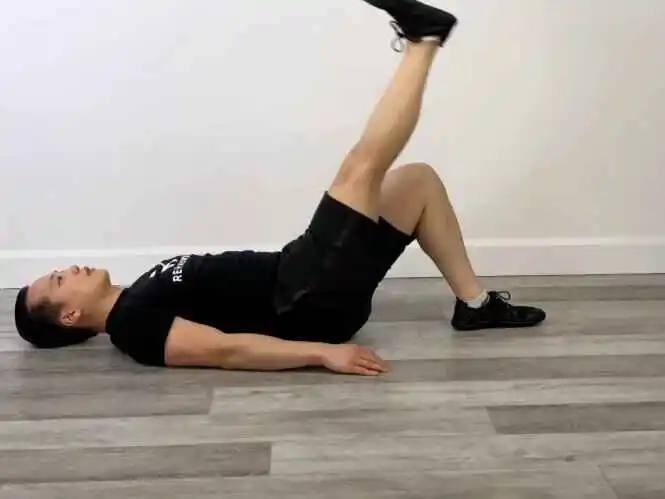
Standing hamstring stretch:
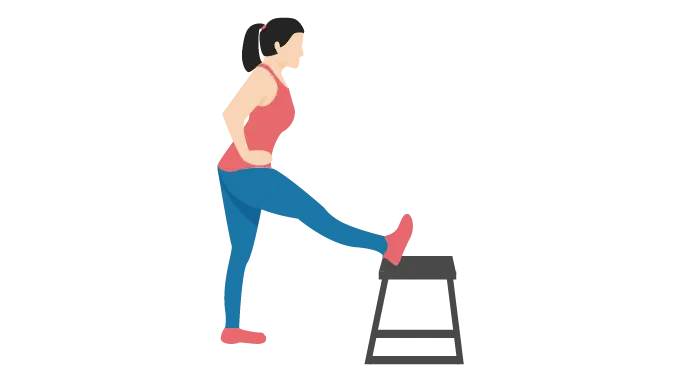
Sciatica-related hamstring stiffness and pain may be reduced with this stretch.
- Put your right foot at or below hip level on a raised surface. This might be a chair, a side table, or steps on the stairs. Make your leg and toes straight by flexing your foot. Keep your knee slightly bent if it has a tendency to hyperextend.
- Slightly bend your body in the direction of your foot. The stretch becomes deeper the farther you go. Don’t exert yourself to the point of pain.
- Instead of raising your lifted leg, release its hip downward. Tie a long workout band or yoga strap around your right thigh and under your left foot if you need help lowering your hips.
- Repeat on the opposite side after holding for at least 30 seconds.
Standing piriformis stretch:
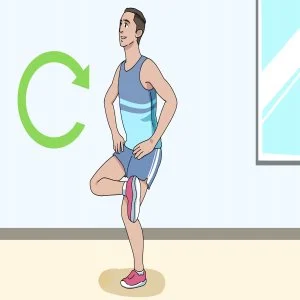
- To maintain your proper balance, stand straight and grasp a chair or wall.
- Make a figure-4 by crossing one ankle over the opposite thigh.
- Maintain a small bend in your standing knee.
- Lower your body into a soft squat by slowly pushing your hips back.
- Maintain a straight back and an elevated chest.
- The piriformis and buttocks of the crossed leg should feel stretched.
- Breathe normally while holding for 20 to 30 seconds.
- On each side, repeat two to three times.
- Don’t force the stretch or bounce.
- If you experience severe pain, numbness, or increasing symptoms, stop.
Risk factors:
Several things might make you less secure. Among them are
- Past or present injuries: You may be at greater risk if you have a lower back or spine injury.
- Aging and strain on the spine: As you age, your spinal joints and discs can become weaker. Pinched nerves or other issues with the spine may result from this. Before the age of 20, it seldom occurs unless an accident is involved.
- Additional body weight: Your lower back and spine may be more stressed if you carry additional weight.
- Weak core muscles: Your spine may receive less support from weak back and abdominal muscles.
- Your work or everyday activities: Your lower back may be strained by heavy lifting, frequent bending, or extended sitting.
- Poor lifting technique or posture: You run a higher risk if you use poor body mechanics when working out or lifting.
- Diabetes: Nerve damage may result from type 2 diabetes.
- Low physical activity: The health of the spine may be impacted by excessive sitting and insufficient movement.
- Use of tobacco: Nicotine can lower blood flow and raise the risk of chronic pain.
Complications:
Most persons who get therapy make a full recovery. In certain situations, symptoms can continue and cause continuous pain and suffering.
Muscle weakness may result from severe nerve injury. Foot drop is one instance. Lifting the front of your foot when walking becomes challenging as a result.
Rarely, nerve injury might be irreversible. Your injured leg may have permanent numbness or loss of sensation as a result.
How to prevent sciatica:
You may avoid sciatica or stop it from occurring again by doing the following steps:
- Work out frequently. Building up your back and core muscles is the key to maintaining a healthy back.
- Check your posture. Use your armrests, put your feet on the floor while seated, and make sure your seat provides sufficient back support.
- Pay attention to how you move. Bend at the knees and maintain a straight back while lifting large goods.
Precautions during sciatica pain:
- Stay away from stretches and movements that increase or spread leg pain.
- Avoid overstretching your lower back, piriformis, or hamstrings.
- Avoid bad posture when carrying large things or bending or twisting.
- Stay away from extended sitting, shift positions often, and, if comfortable, go for quick walks.
- Exercises should be performed comfortably and gently.
- During an acute flare-up, stay away from high-impact activities like jogging or leaping.
- When exercising and going about your regular business, keep your spine neutral.
- If you experience increased numbness, tingling, weakness, or excruciating pain, stop exercising.
- If you have new or increasing limb weakness, be evaluated by a doctor.
- Loss of bladder/bowel control, numbness in the pelvis/saddle area, or extreme weakness in both legs require immediate medical treatment.
FAQs:
Can sciatica be healed with physical therapy?
Physical therapy is one of the best strategies to reduce pain and symptoms, but it does not provide a medical “cure” for the underlying anatomical alterations that cause sciatica.
What is the fastest way to heal sciatica?
Applying an ice pack for fifteen minutes, performing mild nerve glides or stretches, and taking over-the-counter anti-inflammatory drugs are the quickest ways to get instant relief from sciatica.
How long does physical therapy take to cure sciatica?
Although more regimented or severe programs can last up to 12 weeks, physical therapy for sciatica usually takes 4 to 6 weeks for acute patients to show noticeable relief.
What to drink for sciatica pain?
Sciatica-related nerve inflammation can be lessened by consuming anti-inflammatory drinks, including green tea, turmeric golden milk, and ginger tea.
How many days of physiotherapy for sciatica?
To heal from sciatica, most patients require six to twelve physical therapy sessions spaced over six to eight weeks.
What is the number one best exercise for sciatica?
Because sciatica recovery depends on the underlying cause, such as a bulging disc or a tight piriformis muscle, there is no single ideal exercise. However, because it targets the piriformis muscle in the buttock, which frequently squeezes the sciatic nerve, the Figure-4 stretch is generally regarded as one of the most beneficial exercises.
Can walking heal sciatica?
Walking is one of the best low-impact exercises to ease pain, reduce inflammation, and support long-term healing, but it cannot treat sciatica on its own.
References:
- J. W. Frymoyer. (1988). Back pain and sciatica. N Engl J Med. https://pubmed.ncbi.nlm.nih.gov/2961994/
- Foster, N. E., Anema, J. R., Cherkin, D., Chou, R., Cohen, S. P., Gross, D. P., Ferreira, P. H., Fritz, J. M., Koes, B. W., Peul, W., Turner, J. A., Maher, C. G., Buchbinder, R., Hartvigsen, J., Cherkin, D., Foster, N.E., Maher, C. G., Underwood, M., Van Tulder, M., . . . Woolf, A. (2018). Prevention and treatment of low back pain: evidence, challenges, and promising directions. The Lancet, 391(10137), 2368–2383.https://doi.org/10.1016/s0140-6736(18)30489-6
- Hofstede, S. N., De Mheen, P. J. M., Wentink, M. M., Stiggelbout, A. M., La Vleggeert-Lankamp, C., Vlieland, T. P. V., Van Bodegom-Vos, L., & Group, F. T. D. S. (2013). Barriers and facilitators to implementing shared decision-making in multidisciplinary sciatica care: a qualitative study. Implementation Science, 8(1), 95.https://doi.org/10.1186/1748-5908-8-95
- Airaksinen, O., Brox, J. I., Cedraschi, C., Hildebrandt, J., Klaber-Moffett, J., Kovacs, F., Mannion, A. F., Reis, S., Staal, J. B., Ursin, H., Zanoli, G., & Pain, O. B. O. T. C. B. W. G. O. G. F. C. L. B. (2006c). Chapter 4: European guidelines for the management of chronic nonspecific low back pain. European Spine Journal, 15(S2), s192–s300.https://doi.org/10.1007/s00586-006-1072-1