Top 10 Exercises For Sacroiliac Joint Dysfunction
Introduction
Sacroiliac joint(SI) dysfunction can cause pain in the lower back, buttocks, pelvis, or sometimes the hip and thigh. The sacroiliac joints connect the spine to the pelvis and help transfer loads between the upper and lower body. When the joint or surrounding muscles become irritated, or movement becomes altered, everyday activities such as walking, standing, bending, or climbing stairs may become uncomfortable.
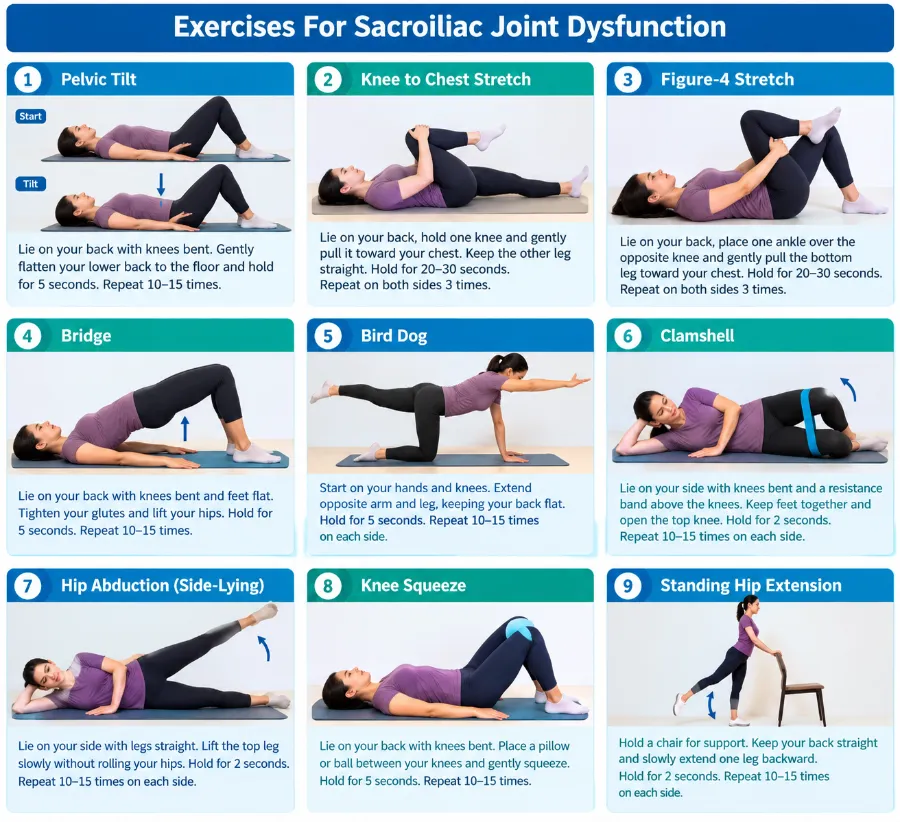
Appropriate exercises can help improve pelvic stability, strengthen the core and hip muscles, maintain mobility, and reduce stress around the SI joint. A gentle, progressive exercise program may include pelvic tilts, bridges, clamshells, hip stretches, core stabilization exercises, and controlled lower-body movements.
Exercises should be performed with proper technique and within a comfortable range of motion. If an exercise increases pain significantly, it should be stopped and assessed by a healthcare professional.
Exercises
Glute Bridge
One of the best exercises for strengthening many muscle groups involved in SI joint stabilisation is the glute bridge. It mostly affects the Gluteus Maximus, a strong muscle that aids with SI joint stabilisation. Your hamstrings, pelvic floor muscles, and deep stabilisers of the spine and pelvis are additional muscles.
How to Do It
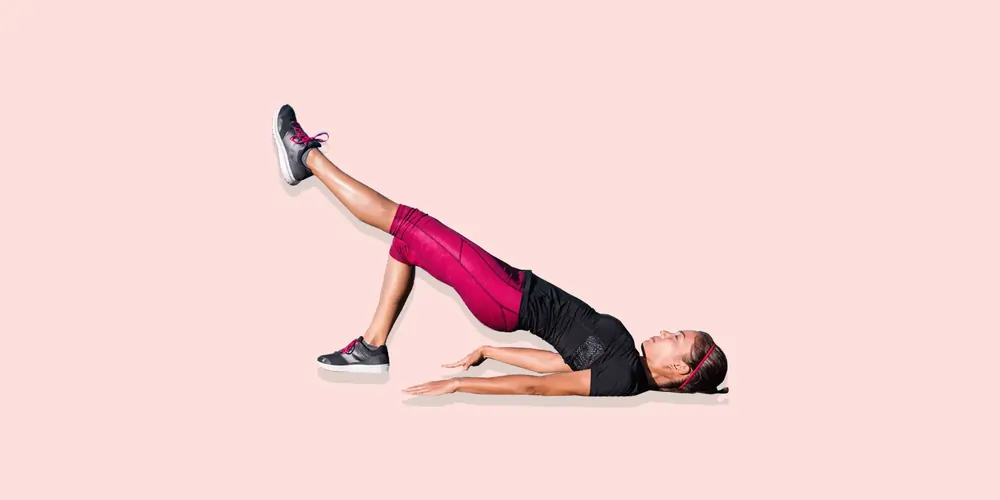
- Place both feet on a medium-sized exercise ball while lying down on an exercise mat.
- Another strong platform that has been raised to a similar height is a bench.
- To give extra support, extend your arms to the side.
- For a maximum of ten seconds, raise your waist to the top.
- Return to the beginning position and repeat for a second repetition.
Start with the simplest version if you don’t have access to an elevated platform or if the workout is too challenging.
- On an exercise mat, lie down.
- With both feet firmly planted on the ground, bend both legs.
- Raise your pelvis and waist to the highest position by extending your hips.
- Return to the beginning position after holding for ten seconds.
- Simply altering the posture in a way that reduces total support can increase the load.
For example, it takes greater effort from the affected muscle groups to elevate one leg or fold your arms over your chest.
Bird Dog
Another regular exercise routine that tests the core without the need for any equipment is this one. A workout mat or anything that provides floor comfort is all you need.
How to Do It
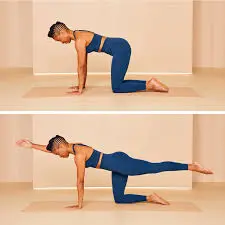
- Get into a quadruped, or all-fours, position.
- Keep your knees below your hips, and your wrists directly below your shoulders.
- This confirms good exercise form and balance.
- Lift your left arm and extend it to shoulder height in front of you. Raise and extend your right leg to hip level equally.
- To return to the beginning position, repeat the movement.
- On the opposite side, repeat the process.
Hip Thurst
This workout strongly supports glute growth. It’s still one of the best techniques to focus on your glute muscles, especially the Gluteus Maximus, according to comparative studies.
How to Do It
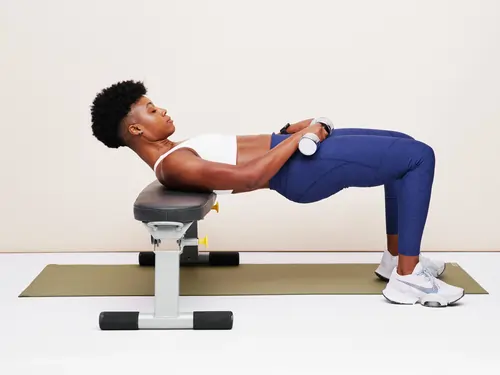
- Take a seat next to a bench. Keep your feet stable on the floor, and rest your upper back on the bench platform.
- Raise your hip and pelvis forward until your waist or pelvis is level with your upper body, much like you would with the Glute Bridge.
- After two seconds of holding, carefully return to the starting position.
- For a second repetition, repeat the exercise. Three to four sets of ten repetitions should be your goal.
Side Plank
This exercise is also very beneficial for your core and glutes, particularly the Gluteus Medius and Minimus, which are the side glutes.
How to Do It
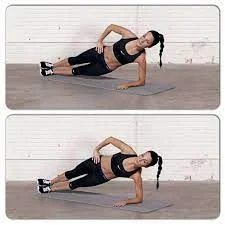
- On your left side, lie down.
- Raise yourself on your left elbow. With the forearm on the ground, the elbow should be bent to a 90-degree angle.
- Raise your pelvis off the ground until it is level and in line with your body.
- For ten seconds, maintain the posture.
- Go back to where you were.
- If this is too heavy or difficult, finish the exercise with both knees bent at a 90-degree angle.
- This reduces the stress and improves the movement.
Plank
This is a common classic exercise. Its effectiveness comes from its capacity to significantly activate deep and global stabilizers of the pelvic and spinal muscles.
How to Do It

- On a mat, lie down on your stomach.
- Lift your entire body by supporting yourself with your feet and elbows.
- To get the most out of the targeted muscle groups, make sure your pelvis is level with the rest of your body.
- Hold for ten seconds.
- Go back to where you were.
- Repeat three to four times.
Monster Walk
The gluteus medius, which is essential for maintaining your pelvis and strengthening the outside of your hip, may be strengthened with this helpful thigh strengthener and balancing exercise.
How to do it:
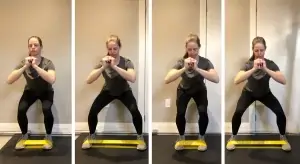
- With your feet hip-width apart, stand with a stretched resistance band around your knees.
- Lower yourself into a mini-squat by bending your knees.
- Stretch the band by stepping one foot straight out to your side while maintaining the squat stance.
- Step your foot back slowly, then switch to the other leg.
Dead Bug
Your deep abdominal muscles, which provide substantial support throughout your core, including the SI joint, are worked by the dead bug. Strengthening your core muscles might help relieve strain on your back, as core weakness may be a contributing factor to SI joint pain.
How to do it:
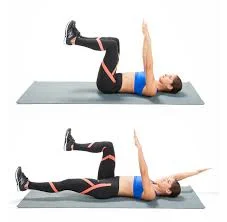
- With your feet extended off the ground and your knees bent at a 90-degree angle, lie on your back with your arms reaching toward the ceiling.
- As you stretch the other leg toward the floor, reach one arm straight back by your ear.
- Instead of touching the ground, your outstretched arm and leg should rise a few inches above it.
- Repeat on the other side after slowly returning your arm and leg to the beginning position.
PT Tip: As you stretch your arms, pay focus on maintaining a flat back on the floor (don’t let it arch up) and strong core muscles.
Quadruped Lateral Flexion
The low back muscles that connect to your pelvis and SI joint will benefit greatly from this stretch. If you spend too much time sitting down or in one posture, such as bending forward to look at a computer screen, these muscles may get tight.
How to do it:
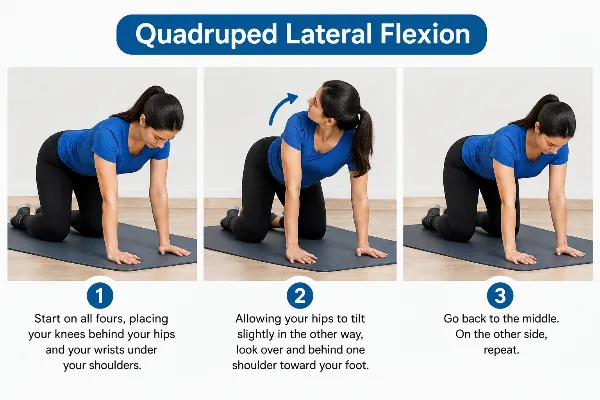
- Start on all fours, placing your knees behind your hips and your wrists under your shoulders.
- Allowing your hips to tilt slightly in the other direction, look over and behind one shoulder toward your foot.
- Go back to the middle.
- On the other side, repeat.
Seated Glute Stretch
This affects the piriformis muscle, which is attached to the femur (thigh bone) and sacrum (triangle-shaped bone at the base of your spine). The sciatic nerve passes through or below this muscle. One typical cause of back pain is tightness in this area. In order to avoid and treat low back pain, it is very beneficial to keep this muscle flexible and stretched.
How to do it:
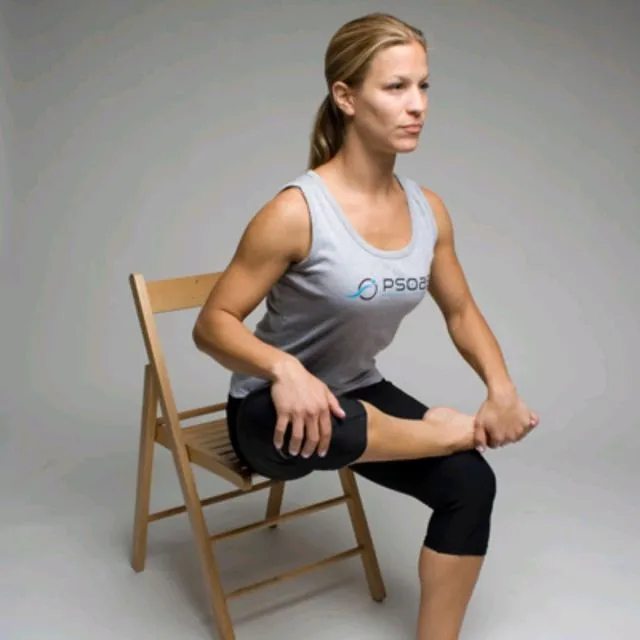
- One foot should be resting on the thigh across from you while you sit on a chair.
- You should have your other foot flat on the ground.
- Move your chest toward the floor until you feel a stretch in your leg or hip to open at your hips.
- Go back to where you were.
Seated Hamstring Stretch
The muscles on the back of your thigh are called hamstrings, and this exercise targets them. Excessive pressure in your hamstrings can result in SI joint pain, which affects your range of motion.
How to do
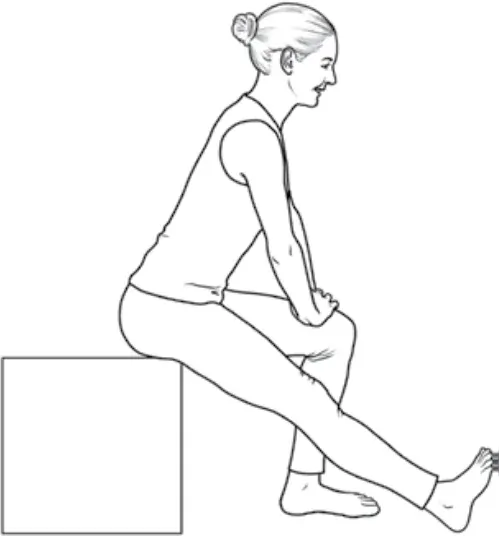
- With your heel placed on the ground, extend one leg out in front of you while sitting on the side of a chair.
- Bend your chest toward the floor and hold by bending at your hips.
- Go back to where you were.
PT Tip: You can change the stretch by performing it while resting on your back.
Benefits oF SI Joint Dysfunction Pain Exercises
SI joint pain can be effectively managed and reduced with proper exercises. By increasing strength, flexibility, and stability, they not only improve your immediate well-being but also support long-term joint health. More about the advantages of performing exercises for SI joint pain may be found here.
Increased stability of the pelvis. The sacroiliac joint is supported by strengthening the muscles surrounding your pelvis, such as your core and glutes. This reduces joint strain and excessive movement, which may relieve pain.
Increased strength in the core. A stronger core helps prevent pain flare-ups and pain by supporting your pelvis and spine and stabilizing the SI joint during activity.
Improved postural stability. Core and pelvic muscles are the focus of many SI joint workouts. Although there is no such thing as perfect posture, you may identify postures that work for you and change positions regularly by strengthening these regions. This improves the general health of your spine and relieves pressure on your SI joint.
Increased flexibility. Stretching exercises for the lower back, hamstrings, and hip flexors help increase flexibility and release stiffness in the pelvic muscles that may be affecting SI joint pain.
Reducing injuries. By supporting proper movement patterns and reducing pressure on the SI joint, strengthening the muscles that support it reduces the chance of injury.
Reduced risk of muscular imbalances. In order to address muscle imbalances that may be causing joint pain, SI joint workouts frequently include strengthening both sides of the body equally.
Conclusion
Exercises for sacroiliac joint dysfunction can help improve pelvic stability, strengthen the core and hip muscles, reduce stiffness, and support better movement. Gentle exercises such as pelvic tilts, bridges, clamshells, hip stretches, and core stabilization exercises may be beneficial when performed with proper technique. However, choose exercises based on the individual’s symptoms and physical condition. Avoid movements that increase pain, and consult a physiotherapist or healthcare professional if symptoms are severe, persistent, or worsening.
Consistency matters, but always perform exercises with proper form and within a comfortable range of motion. Avoid exercises or positions that significantly increase pain, especially pain that spreads into the leg. The appropriate exercise program may vary depending on the underlying cause and severity of sacroiliac joint dysfunction.
If pain continues despite exercise, becomes severe, or interferes with walking, sitting, sleeping, or daily activities, professional evaluation by a physiotherapist or healthcare provider is recommended. A personalized rehabilitation program can help address muscle weakness, mobility limitations, posture, and movement patterns while supporting a safe return to normal activities.
FAQs
What is the best exercise for sacroiliac joint pain?
Because it strengthens the gluteus maximus alongside the pelvic muscles to support the joint, the glute bridge is known as one of the most effective overall exercises for sacroiliac (SI) joint pain.
What is the main cause of sacroiliitis?
Ankylosing spondylitis and cervical spondyloarthritis are the most common specific triggers for sacroiliitis, which is mostly caused by inflammatory types of arthritis that affect the spine.
What is the fastest way to heal SI joint pain?
Combining relative rest, ice or heat therapy, and mild targeted movements to reduce acute inflammation and muscle spasms is the fastest treatment to relieve sacroiliac (SI) joint pain.
What are the long-term symptoms of sacroiliac joint pain?
Chronic pain in the lower back and hips caused by irritation, inflammation, or instability where your spine joins your pelvis is known as long-term sacroiliac (SI) joint pain.
References
- Yetman, D. (2025, October 21). Stretches and exercises to help ease SI (Sacroiliac) joint pain. Healthline. https://www.healthline.com/health/si-joint-stretches#7-stretches-to-try
- Hip thrust. (n.d.). [Video]. Hingehealth. https://www.hingehealth.com/gb/en/resources/articles/si-joint-pain-exercises/
- Cpt, D. R. M. C. (2023, June 23). Strengthening exercises for sacroiliac joint pain relief. Spine-health. https://www.spine-health.com/wellness/exercise/strengthening-exercises-sacroiliac-joint-pain-relief