Benefits of Clean and Press for Strength and Fitness
Introduction:
All of that and more can be found in the clean and press workout. When done correctly, this amazing exercise may help you increase your strength, power, and cardiovascular and muscular endurance.
The clean and press are two distinct movements combined into one. The first is the clean, a combination of a high pull and a deadlift, where you do an overhead press or push after “catching” the barbell in the front rack position with a small dip in your knees. The clean and press may significantly improve your overall strength and power because it is a lower- and upper-body exercise.
To help you get the most out of this fantastic weightlifting exercise, we will break down the clean and press because it involves a lot of steps.
What Is A Clean And Press?
The deltoids are the focus of the clean and press, an advanced full-body exercise that also works the hamstrings, quadriceps, glutes, trapezius, rhomboids, and triceps.
The clean and press, an Olympic lift, is a difficult exercise to learn. But it is well worth it since it increases power, strength, stability, coordination, and endurance.
It’s crucial to divide the action into two parts—the “clean” and the “press”—to perfect the clean and press method. Lifting a barbell from the floor to above the head while performing a shoulder press is the exercise’s primary goal. The first half of the exercise is referred to as “clean” until the barbell is resting on the shoulders and prepared to be pushed over the head; this is referred to as the “press” part.
Clean and Press Exercise Video
Muscles Trained By The Clean and Press:
If I were to list every muscle that the clean and press strengthened, it would turn into a novel. Rather, I’m concentrating on the main muscle groups in the upper and lower body that are enhanced by the clean and press.
- Quadriceps: This exercise’s push press and first lift off the floor both use the quadriceps.
- Glutes: To provide power for the exercise’s high pull and clean movements, a strong hip extension is required after the draw off the floor.
- Hamstrings: The hamstrings help the glutes with hip extension and are engaged in the exercise’s initial tugging.
- Lats, Traps, and Upper Back: To maintain a neutral spine, the three upper-body muscles are used isometrically. The pull, catch, squat, and overhead press then require the lats, traps, and upper back to work together once again.
- Shoulders, Chest, and Triceps: The rigorous press/push press phase of this exercise strengthens the shoulders, triceps, and chest muscles.
How To Do A Clean And Press:
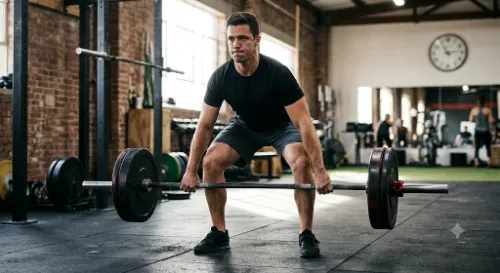
- Take a shoulder-width stance and point your toes slightly outward as you approach the barbell. Push your hips back and use a pronated grip to hold the barbell slightly outside shoulder-width apart. Pin your shoulder blades back, press your feet into the ground, and let your hips rest between your shoulders; this will help you pull the slack out of the bar.
- To start the lift, push through your feet and extend your knees and hips at the same time as you deadlift the bar until it reaches your knees.
- Explosively press your legs into the ground while extending your hips and knees to land on the balls of your feet once the bar is just above your knees. Shrug your shoulders as forcefully as you can at the same time.
- Swing your elbows under the bar so they face straight forward, and the barbell rests on your front delts as your shoulders reach their greatest position.
- Flex your knees to take a little dip while the barbell is resting on your front delts. Then, drive your hips forward and press the weight above your head.
- Lowering the barbell till it rests on the front delts, then lowering it to hip height and deadlifting it back onto the floor will accomplish this.
Personal Trainer Form Tips:
Deadlift, high pull, catch, and overhead press are all components of the clean and press. For a clean and press to be successful, there is a lot going on, and switching between these tasks smoothly is essential.
Pay Attention to Your Set Up:
I’ll begin by stating that, in my professional opinion, if you are uncomfortable with the barbell deadlift, you probably shouldn’t be doing the clean and press. The initial setup for the clean and press is quite similar to that of the deadlift. To master this movement, you must maintain a neutral spine, a solid hip hinge, and a firm grasp on the barbell above your midfoot.
Snap Those Hips:
The deadlift and the first pull are similar, but that’s where these two workouts diverge. To create adequate momentum for the high pull component of the exercise, you must forcefully thrust your hips forward after the barbell passes your knees.
Dip and Catch:
A dip and catch is basically what’s meant by the lifting expression “pulling yourself underneath the bar,” which I see and use frequently. To prepare for the overhead press, you squat or dip beneath the bar to catch it on your shoulders and upper chest in the front rack position. Then, you raise your elbows.
The Press:
The push press exercise is comparable to the overhead press portion of the clean and press. The barbell is driven up and into the lockout position by the strength of your quadriceps. You should start pushing with a single, smooth movement as you get up from the squat position.
Benefits of the Clean and Press Workout:
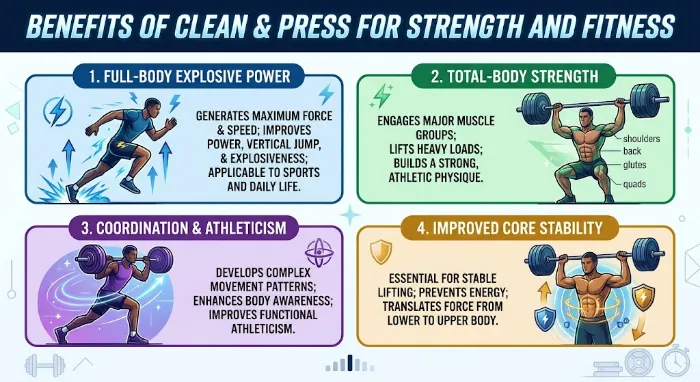
Similar to the clean and jerk, the clean and press is not your typical workout. By transferring momentum from the lower to the upper body, this detailed movement combines strength and power. However, there are great advantages to adding this exercise to your training regimen once you’ve mastered the fundamentals.
Total Body Strength and Power :
The clean and press exercises work the upper and lower bodies at the same time and quickly. It’s a fantastic workout for developing full-body power and strength. It affects nearly all of the body’s muscles and, if learned, permits great levels of resistance. Additionally, it’s a fantastic way to get started with Olympic lifting.
Increased Athleticism and Coordination:
For athletes who must generate force rapidly to run faster and leap higher in their chosen activity, strengthening their muscles with workouts like the clean and press is essential. Additionally, if general population lifters don’t regularly train for it, they will lose power.
It increases calorie burn and improves potential fat burn by raising the heart rate to anaerobic levels. Last but not least, because it combines two movement patterns into one, repeating it fluidly between the upper and lower body will also enhance your coordination and balance.
Direct Carry-Over to Sports and Life:
Running, jumping, sprinting, and collisions are examples of explosive exercises that need strong hip extension, which is the foundation of the clean and press. Additionally, many everyday tasks, like picking up a heavy object (like a kid) from the floor and moving it to your shoulder, require the clean and press movements.
3 Clean and Press Variations:
Try these variants of clean and press once you’ve mastered the fundamental technique.
- Dumbbell clean and press: If you’re a beginner lifter, you might want to practice your clean and press movement pattern using a set of lighter-weight dumbbells. Try a single-arm variant if you want to concentrate on your lifting form.
- Kettlebell clean and press: To practice this variant, raise one kettlebell to shoulder height between your knees and press it above.
- Power clean and press: Instead of using the complete squat posture associated with the traditional clean and press, do power clean and presses by receiving the barbell in a half squat position.
FAQs:
How does a clean and press work?
A weight (such as a barbell, dumbbell, or kettlebell) is lifted from the floor to the shoulders in a single explosive move (the clean) and then pressed straight above in the clean and press, a complex, full-body workout.
Does clean and press build muscle?
The clean and press does indeed develop muscle. It is a full-body complex exercise that works more than 20 muscles simultaneously, which makes it very beneficial for strength, power, and hypertrophy.
Why was the clean and press removed?
After the Munich Games on August 25, 1972, the clean and press was formally eliminated from Olympic weightlifting, changing the sport from a traditional triathlon to the modern biathlon (snatch and clean and jerk).
Are cleans better than deadlifts?
Deadlifts and cleans are not “better” since they target various physical features and have entirely different training objectives.
What is a good weight for clean and press?
Generally speaking, a “good” one-rep maximum (1RM) clean and press weight is at the Intermediate strength level, which is around 0.65 to 0.9 times your body weight for women and 1.0 to 1.25 times your body weight for men.
Is the clean and press harder than the clean and jerk?
Although the clean and jerk is heavier and allows you to lift more weight, the clean and press is more demanding on your upper body strength.
What are the benefits of doing the clean and press exercise?
A full-body compound weight training exercise, the clean and press involves lifting a weight from the floor to the shoulders and then pushing it overhead.
What muscles are used in a clean and press?
A complex, full-body workout, the clean and press engages the anterior (front) and posterior (back) chains in several main muscle groups.
References:
- How to do a clean and press. (n.d.). PureGym. https://www.puregym.com/exercises/arms-and-shoulders/shoulder-press/clean-and-press/
- Ronai, P. (2018). The bench press exercise. ACSMʼs Health & Fitness Journal, 22(6), 52–57. https://doi.org/10.1249/fit.0000000000000432
- THE HERBAL PRE-WORKOUT (POWDER). (2023). International Research Journal of Modernization in Engineering Technology and Science. https://doi.org/10.56726/irjmets33387