How Often Should You Move When Sitting At A Desk?
Introduction:
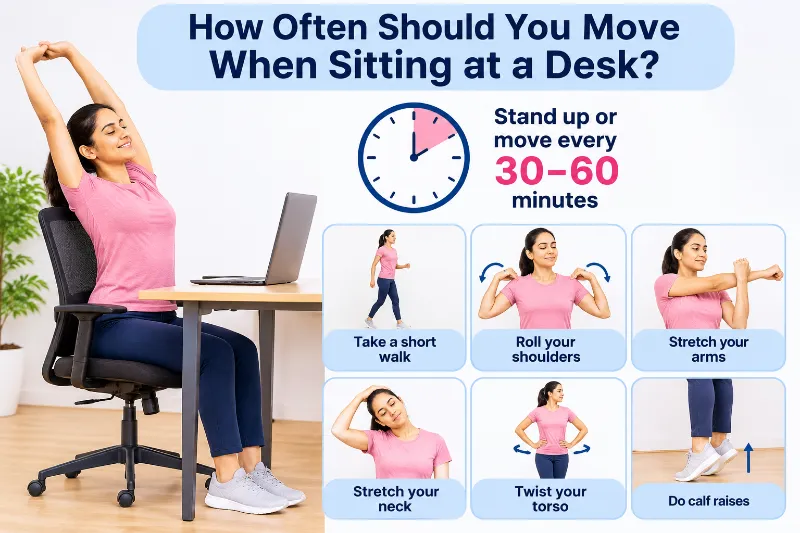
Rather than sitting or standing for extended periods, most specialists recommend switching between sitting and standing every 30 to 60 minutes.
Moving frequently during the day is more crucial than standing for a certain amount of time.
In an office setting, sitting for extended periods of time is typically the norm. However, developing this practice on a regular basis carries a number of health hazards. These health concerns have the potential to lower your quality of life and worsen illnesses that could cause you to die young. We tell you this to let you know what will happen if nothing is done.
What Is the Impact of Prolonged Sitting?
It’s crucial to understand why getting up and moving is necessary before we examine how often you should do so. Numerous health problems have been connected to prolonged sitting, many of which can be avoided with regular, easy movement.
Some of the primary risks associated with prolonged sitting are as follows:
Increased Health Risks:
Daily prolonged sitting has been associated with an increased risk of long-term health problems. Your body’s metabolic activity slows down when you sit for long periods of time, which can lead to high blood pressure, insulin resistance, and elevated cholesterol.
Poor Posture:
Sitting at a desk for extended periods of time can cause bad posture, which can lead to musculoskeletal problems like neck strain and back pain. Slouching and folded sitting can also lead to chronic pain over time, making it more difficult to maintain good posture going forward.
Decreased Circulation:
Long durations of sitting can also lower blood flow, particularly to your legs. In certain situations, this may result in edema. Frequent movement throughout the day improves circulation and keeps these problems from occurring.
Mental Fatigue and Decreased Productivity:
Sitting for extended periods of time damages not just your body but also your intellect.
Sitting for extended periods of time can cause mental fatigue, diminished concentration, and decreased productivity. You can get the clarity you need to concentrate better on your work by taking regular breaks to stretch and move.
How Often Should You Move?
Now that you are aware of the adverse impacts of extended sitting, let’s discuss how often you should get up to exercise.
Movement should be a regular part of your day, according to experts, but how often?
The 30-Minute Rule:
It’s often advised to get up and move every half an hour. This is getting up, moving about, or stretching lightly for a minimum of one to two minutes before going back to your work. Long stretches of sitting should be interspersed with brief bursts of motion to keep your body active and your blood moving.
Your health may start to suffer if you sit for longer than thirty minutes at a time. You may reduce the hazards of sedentary behavior, such as poor circulation and metabolic problems, by getting up every thirty minutes.
The Pomodoro Technique: Productivity and Movement
The Pomodoro Technique is a useful method for striking a balance between work and movement. With this approach, you work in 25-minute blocks and then take a five-minute break to stand, stretch, or walk around. You take a lengthier 15- to 30-minute break after finishing four work intervals, or “pomodoros.”
The Pomodoro Technique promotes frequent movement and helps sustain productivity and focus. You can improve your productivity and mental clarity while lowering the hazards associated with extended sitting by implementing brief breaks every 25 minutes.
The 20-8-2 Rule:
The 20-8-2 rule, which calls for sitting for 20 minutes, standing for 8 minutes, and then moving for 2 minutes, is another beneficial strategy for workplace breaks. This method helps avoid both physical and mental fatigue by promoting more frequent standing and minimal activity.
For example, you might stand at your desk for eight minutes to finish a different task after sitting for twenty minutes. After that, you could stretch your legs or take a short two-minute stroll around your office before going back to your desk. This easy regimen keeps your body active without causing major problems with your work.
What if You Don’t Stand Up Enough?
It’s critical to understand that there is a standing duration that is deemed insufficient. However, there are several downsides if you don’t stand up enough, such as:
- Increased Obesity Risk: Did you know that standing up burns a lot more calories than sitting down? It is accurate. Compared to standing, sitting down will burn half as many calories.
- Your Muscles Get Weaker: Your muscles may get stiff or even atrophy as a result of the lack of movement. This implies that they may weaken and eventually impair your movement.
- Weak Circulation: Your blood flow will be less rapid than normal. As a result, blood clots could form. Even worse, it can set the stage for cardiovascular disease, one of the leading causes of mortality in the US.
- Decreased Life Expectancy: Sitting too much can raise your death rate. This relates to what we said about cardiovascular disease and other potential health problems.
- Spinal Problems: Chronic back pain and spinal misalignment can be largely caused by poor posture. This may result in additional back conditions that impact your mobility.
Therefore, it is crucial to ensure that you are able to stand up on a frequent basis. It’s also advised to balance standing and sitting. Long-term standing has its own disadvantages and health problems, like varicose veins and foot pain. Achieving this balance will therefore be crucial.
How Frequently Should You Get Up from a Desk?
It is essential that you think about getting up at least once every thirty to sixty minutes. This will ensure that the adverse effects of prolonged sitting are lessened. Here’s what you need to do, using these general guidelines to further break it down:
- Think about standing for a minute or two every thirty minutes. This will be great for encouraging circulation and avoiding stiffness.
- To correctly engage your muscles and reset your posture, make sure to move around for at least five to ten minutes per hour.
- Take a 15-minute break every two hours. Think about engaging in light physical activity, such as walking or stretching, during this period.
Frequent breaks can improve focus, sustain energy levels, and reduce the risk of back pain. Purchasing a supportive chair can assist in reducing any problems that may occur when you are seated for extended periods of time.
What Are the Best Strategies to Use with Standing Regularly?
Now that you have a solid understanding of the advantages of regular standing, let’s talk about the tactics you can use. To get the most out of standing, you should make sure you do these things on a daily basis. These methods consist of:
Using a Standing Desk:
An electric or hand-cranked standing desk can be a true blessing. Additionally, it will enable you to cultivate a potentially dynamic work posture. It could be among your greatest investments to date.
Set Reminders and Alarms:
You can get regular reminders on when to take a break, get up, and walk about by using a timer or productivity tool. To be able to stand and do your preferred mild exercises for a few minutes, be sure to keep up with these consistently. This will help maintain balance and prevent you from mistakenly sitting or standing for extended periods of time.
Leverage Walking Meetings:
Why not think about having phone conversations or strolling discussions instead of sitting through meetings? You might even go so far as to recommend using Zoom for meetings. In this manner, you can listen in while taking walks and access the conference on your mobile device. As an alternative, you can concentrate on the meeting itself while walking on a treadmill.
Stretch at Your Desk:
You can stretch at your desk, of course. Use easy exercises like neck stretches, leg extensions, and shoulder rolls. You’ll be able to relax and become more adaptable.
Use Active Seating or a Stability Ball:
In addition to encouraging modest movements throughout the day, the concept of active seating can help activate core muscles. This can be accomplished with a stability ball or a BOBA chair, both of which are useful for any sitting position.
Make Your Breaks More Active:
During their break, a lot of people would browse through their phones. You can, however, decide to be unique. Alternatively, you can take a short stroll around or near your workstation, stretch, or do some moderate exercise. Setting up some sort of activity will be far preferable to doing nothing at all.
These techniques will enable you to engage in as much physical activity as you can, even on stressful days. Don’t forget to make tiny movements while standing. Even if you only spend a few minutes during each break, engage in some physical activity that could be long-term helpful to your health.
What are the risks of sitting too much?
- Sitting takes less energy than standing or moving.
- Many people spend a lot of time sitting down, whether it’s in front of a screen, behind a vehicle, or at a desk. Excessive sitting may pose health dangers, according to research.
- Obesity has been associated with prolonged sitting. Additionally, it has been connected to a group of disorders known as metabolic syndrome. High blood pressure, high blood sugar, excess body fat around the waist, and dangerous cholesterol levels are some of these disorders.
- Overall, excessive sitting appears to increase the risk of dying from cancer and heart disease.
- Thirteen studies, including over a million people’s sitting and exercise levels, were examined by researchers. They discovered that the risk of dying was comparable to that of smoking and obesity for those who sat for more than eight hours a day without engaging in any physical activity. However, moderate cardiovascular exercise for 60 to 75 minutes a day counteracts the negative consequences of excessive sitting.
- According to other research, sitting time has little bearing on the risk of death among the most active individuals.
- In general, improved health can be achieved by exercising more and sitting less. You may begin by just switching from sitting to standing every half an hour. Or figure out how to go for walks while working. Here are some further recommendations:
- Watch TV or have a phone conversation while standing.
- If you work at a desk, consider at some point switching to a standing desk. Standing at a high table or counter allows you to improvise. However, it’s unclear if standing alone can reduce the risk of excessive sitting.
- Instead of meeting in a conference room, have a strolling meeting with your colleagues.
- When you need to utilize the computer, position your work surface over a treadmill so that you may move. This can be accomplished by setting the keyboard and screen of your computer on a stand. Or get a dedicated vertical workstation that comes with a treadmill.
Common Mistakes To Avoid:
5 Standing Desk Mistakes (And How To Fix Them):
Standing for 2+ hours straight:
- Problems: include lower back strain, varicose veins, swollen feet, and leg tiredness.
- Fix: Set a maximum timer of sixty minutes. To encourage switching, use the desk’s alarm feature.
Not using memory presets:
- Problem: Position change is avoided when height is manually adjusted every time. A lot of individuals give up.
- Fix: On the first day, maintain your standing and sitting heights. Simplify switching with a single button press.
Ignoring the sedentary alarm:
- Problem: It’s simple to ignore the alarm without taking any action. Defeats the goal.
- Fix: Make a two-week commitment to the alarm. Before rejecting habits, make switching automatic.
Standing in bad posture:
- Problems: include rounded shoulders, locked knees, weight on one leg, and leaning on a desk. Negates every advantage.
- Fix: Place the display at eye level, stand with your feet hip-width apart, and bend your knees slightly. Every fifteen minutes, check posture.
Skipping breaks entirely:
- Problem: Although standing is preferable to sitting, muscles can still get tired.
- Fix: Every two to three hours, go for a two-minute stroll. Walking is a more restorative activity than sitting stationary.
FAQs:
What is the 90-90-90 rule for sitting?
The 90-90-90 rule is a fundamental ergonomic sitting guideline that supports the spine and lessens strain on the muscles and joints when sitting by placing the three primary body joints at 90-degree angles.
What is the most unhealthy sitting position?
The most harmful sitting position is generally seen as slouching or hunching forward with a rounded back. Your muscles, ligaments, and spinal discs are severely strained when it is held for extended periods of time.
How do I know if my sitting posture is correct?
Your feet should be flat on the floor with your knees bent at a 90-degree angle, your shoulders should sit over your hips with a natural curvature in your lower back, and your ears should line up over your shoulders.
What muscles get tight from a desk job?
Your hamstrings, upper trapezius, neck muscles, hip flexors, and chest (pectorals) are frequently tightened by a desk job. Sitting for extended periods of time causes these muscles to contract or shorten.
Is standing for 7 hours healthy?
It is typically not seen to be healthy to stand for seven hours, especially if there are no intervals for resting or walking. Even though standing uses a little more energy than sitting, standing for extended periods of time—typically more than four hours a day or more than an hour straight—can lead to health issues and physical strain.
How Many Hours of Continuous Desk Sitting Is Considered Excessive?
While total daily sitting usually becomes dangerous after 7 to 8 hours, continuous sitting becomes too lengthy after 20 to 30 minutes without activity.
Is Spending Eight Hours Standing Healthier Than Sitting for the Same Duration?
In general, sitting for eight hours a day is preferable to standing for eight hours a day. It is healthier to switch between sitting, standing, and moving throughout the day rather than being in one static posture for an extended period of time.
References:
- Team, B. (2024, December 4). How often should you get up from your desk and move? https://www.branchfurniture.com/blogs/turn-key/how-often-should-you-stand-up-from-your-desk?srsltid=AYCX9vKvesEZKmk3e8oLbVzr1O6T1-p76JxzXeyMrC6LNm8ETIuCVYAB
- Advisor, B. (2026, March 15). How long should you stand at a standing desk? Science-Backed Guide | Green Soul. Green Soul Ergonomics. https://www.greensoul.online/blogs/blog/sitting-vs-standing-how-long-to-stand?srsltid=AYCX9vLzdwWihVpOzbfJFYRNwW7hksKn1TgN7oVN4G2ZWRDLFNVyObzB
- Rezende, L. F. M., Sá, T. H., Mielke, G. I., Viscondi, J. Y. K., Rey-López, J. P., & Garcia, L. M. T. (2016). All-Cause mortality attributable to sitting time. American Journal of Preventive Medicine, 51(2), 253–263. https://doi.org/10.1016/j.amepre.2016.01.022
- Job, T. (2025, April 22). How Often Should You Stand Up from Your Desk? TopJob. https://www.topjob.co/blogs/news/how-often-should-you-stand-up-from-your-desk?srsltid=AYCX9vL5oFhFTosRAVybBXXFwlkkLL-DJ_Jalftu1OCo8ZEtRX2m97vr