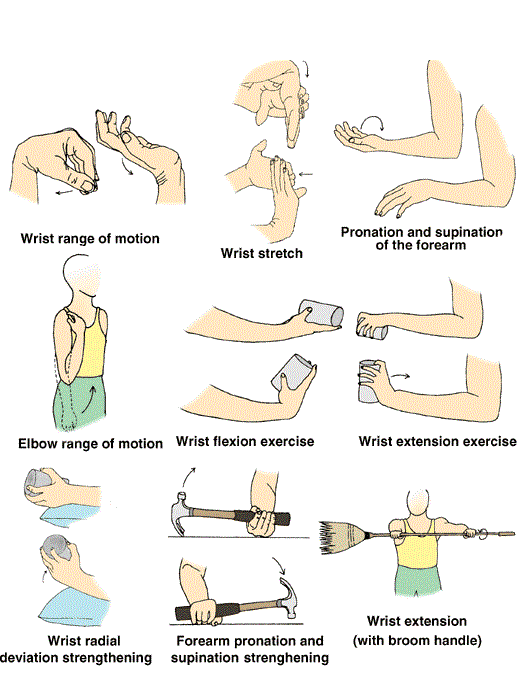
Top Exercise for Tennis Elbow Recovery
Introduction:
Tennis elbow (lateral epicondylitis) is a common condition caused by overuse of the forearm muscles and tendons that attach to the outside of the elbow. It often leads to pain, tenderness, and reduced grip strength, making everyday activities such as lifting, typing, or holding objects uncomfortable.
Recovery exercises play an important role in relieving pain, restoring flexibility, and gradually rebuilding strength in the wrist and forearm. Gentle stretching and strengthening exercises can improve blood flow to the injured tendon, promote healing, and help prevent the problem from returning. For best results, exercises should be performed regularly and progressed gradually without causing sharp or severe pain.
In this guide, you will learn safe and effective exercises designed to support tennis elbow recovery and help you return to normal activities with better strength and function.
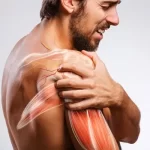
is a painful elbow condition caused by overuse of the joint. Other sports and hobbies can put you in danger, but playing tennis and other racquet sports can lead to this problem. Tennis elbow is caused by inflammation or degeneration of the tendons that connect the forearm muscles along the outside of the elbow. Overuse of the joint causes adverse reactions in the tendons and muscles of the forearm. Tendon insertions can get irritated by repeatedly using the same muscles, resulting in stiffness and soreness on the outside of the elbow.
A structured exercise program is one of the most effective non-surgical treatments for tennis elbow recovery. The right combination of stretching, mobility, and strengthening exercises helps reduce pain, improve flexibility, restore grip strength, and encourage proper tendon healing. As symptoms improve, these exercises also help rebuild endurance and prepare the arm for daily tasks, work, and sports without increasing the risk of re-injury.
Where Does Tennis Elbow Usually Hurt?
Tennis elbow often presents as pain over the elbow’s lateral epicondyle, although it can also radiate up or down the arm.
Treatment options:
The source, intensity, and location of tennis elbow symptoms determine the optimal course of treatment. Nonetheless, a few typical therapies might be:
Pain relief
Doctors frequently prescribe anti-inflammatory drugs like Ibuprofen or Nurofen to treat tennis elbow problems.
Ice therapy
Tennis elbow can be temporarily relieved with ice therapy, which can enhance involvement in other therapies like physical therapy.
Rest
Pain can be temporarily relieved by rest, but it may return as loading resumes. Consequently, the more popular strategy is “relative rest,” which involves progressively reintroducing moderate motions while reducing but not eliminating the burden.
Injections of corticosteroids
A corticosteroid injection administered at the site of pain may be recommended by a physician in certain situations to alleviate any symptoms. In the short term, this can help interrupt the cycle of pain and increase tolerance to other therapies, such as exercise.
Physical therapy:
An essential component of tendon rehabilitation is exercise. To assist in reconditioning the muscles and increase the damaged tendon’s load capacity, a physiotherapist may recommend physical therapy exercises for tennis elbow.
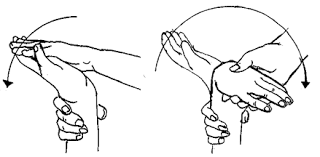
Stretch your wrists
To carry out the exercise:

How to do:
- Put your arm in a supported posture to begin.
- Bend your wrist slowly with the palm pointing down until the back of your forearm starts to stretch.
- With enough break in between each set, repeat the exercise up to three times.
- By applying more pressure with the opposite hand, a physiotherapist can advance the exercise.
Hold/Repetition: Hold for fifteen seconds.
Range of Motion of the Wrist
To carry out the exercise:
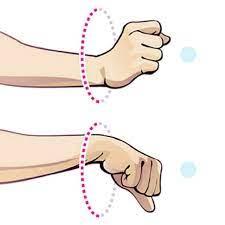
How to do:
- Begin in a position that is comfortable.
- Turn your wrist gently in a single direction.
- Next, in another way
- Steer clear of any sudden movements.
- By extending the range or direction of movement, a physiotherapist can advance the activity.
Hold/Repetition: Repeat in each direction up to ten times, pausing as necessary.
Wrist Extension Isometric (Static)
To carry out the exercise:
How to do:
- Start by using a table to support your forearm.
- Keeping your hand in line with your wrist, position your hand over the edge of the table with your palm facing downwards.
- After positioning, insert a little weight into the hand.
- By increasing the weight or duration of the workout, a physiotherapist can advance the exercise.
Hold/Repetition:
- For fifteen seconds, keep the wrist still.
- Rest between each set as you repeat up to five times.
Progressive Exercise:
A physiotherapist could suggest strengthening activities once the elbow pain has subsided:
Squeezing Your Grip:
To carry out the exercise:
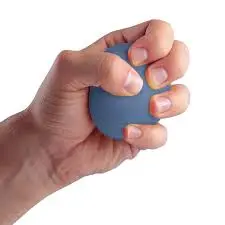
How to do:
- As instructed by your physiotherapist, use a tennis ball, hand grip, and exercise putty.
- Hold the ball in your palm.
- After 15 seconds of holding, release
- The exercise can be advanced by a physiotherapist by making it stronger.
Hold/Repetition:
- After 15 seconds of holding, release
- Up to five times.
Dynamic Isotonic Wrist Extension:
To carry out the exercise:
How to do:
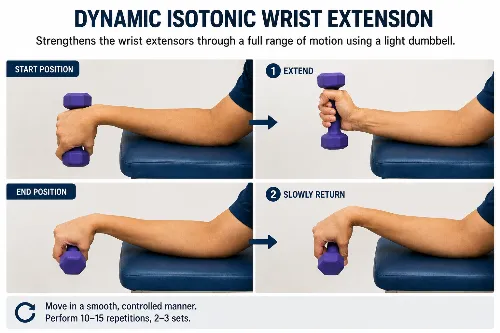
- This is a step toward an isometric wrist extension.
- Begin at the same spot.
- After you’re in place, carefully raise your wrist.
- Next, gently drop the wrist.
- Avoid going beyond the end of the range.
- A physiotherapist can progress by changing the weight or range.
- The exercise can be done without a weight if the symptoms are too agitated.
Hold/Repetition: Repeat five to ten times.
Wrist Turns (Resisted Wrist Supination):
To carry out the exercise:
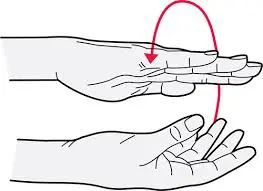
How to do:
- Start by using a table to support your forearm.
- Maintain a neutral forearm position and align your wrist with your hand.
- Put a little weight in your palm.
- Gently turn your palm toward the ceiling.
- Next, turn your palm slightly in the direction of the floor.
- Avoid going to the end of the range.
- The exercise can be done without a weight in the first place if the symptoms are too agitated.
Hold/Repetition: Repeat five to ten times.
Twisting towels:
To carry out the exercise:
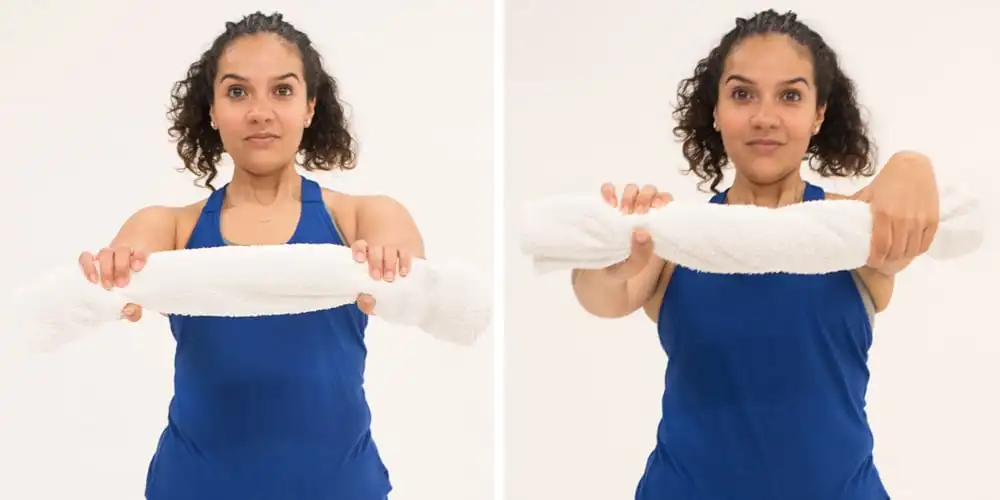
How to do:
- In your hands, hold a loosely rolled towel (lengthwise).
- Twist the towel gently in one direction, as if you were wringing water, while keeping your shoulders and arms relaxed.
- Next, turn in the opposite direction.
- A Theraband bar may be prescribed by a physiotherapist to advance this workout.
- The physiotherapist should keep a careful eye on exercise technique and intensity.
- Adjustments to intensity or duration might be made based on symptom irritability and pain levels. T
- Tennis elbow may be effectively treated with the appropriate exercises.
Hold/Repetition: Repeat five to ten times.
Advanced Exercises for Strengthening:
Your grip strength, forearm muscular strength, and general function may all be further enhanced with advanced strengthening workouts. These are two efficient advanced tennis elbow strengthening exercises:
Eccentric Wrist Extension:
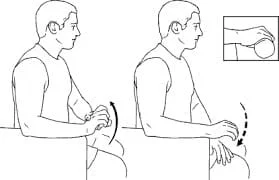
This workout strengthens and improves muscular function by using controlled motions to eccentrically stress your wrist extensor muscles.
The eccentric loading of your wrist extensor muscles is the main goal of the eccentric wrist extension workout. To execute eccentric wrist extensions:
How to do:
- With your forearm resting on a table or your thigh, take a seat.
- In your affected hand, hold a dumbbell with the palm facing down.
- Extend your wrist to slowly descend the dumbbell, using controlled eccentric contractions to oppose the downward motion.
- Repeat the exercise eight to twelve times after returning to the beginning position.
- By extending your muscles under strain, eccentric workouts can strengthen your muscles, improve your grip, and speed up your recuperation.
Hold/Repetition: Repeat the exercise eight to twelve times after returning to the beginning position.
Supination and Pronation of the Forearms:
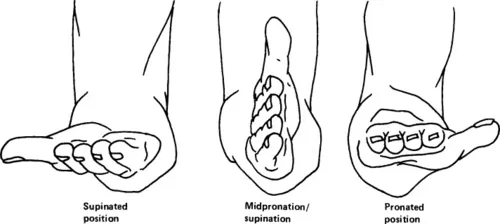
Your supinator muscles, which are in the position of rotating your forearms, are the focus of the forearm supination and pronation exercise.
Forearm Supination and Pronation: This exercise improves the strength and coordination of your forearm muscles by rotating your forearm between supination (palm up) and pronation (palm down).
Advanced wrist strengthening exercises can boost forearm muscular strength and aid long-term rehabilitation from tennis elbow. To guarantee correct technique and avoid putting undue tension on the affected muscles, they should be carried out under the supervision of a physiotherapist or physical therapist.
How to do:
- With your forearm resting on a table or your thigh, take a seat.
- With your palm facing down, grasp a dumbbell or other weighted item in your affected hand.
- Feel the muscles in your forearm as you rotate it from a pronated (palm down) to a supinated (palm up) position.
- Go from a supinated to a pronated posture by reversing the rotation.
- Your forearm muscles’ strength, coordination, and functionality may all be enhanced by this workout. It may be difficult, though, and it needs to be done with careful skill and deliberate motions.
Hold/Repetition: Perform the circular motion eight to twelve times in total.
Changing Your Daily Routine to Recuperate More Rapidly:
A quicker recovery from tennis elbow and the avoidance of further strain can be achieved by modifying specific everyday routines. This includes making ergonomic changes, getting enough sleep, and refraining from activities that aggravate the condition.
Ergonomic Changes at Home and at Work:
You may lessen the tension on your elbow and forearm muscles and speed up your recovery from tennis elbow by making ergonomic changes to your everyday activities at home and at work. Among the ergonomic modifications to take into account are:
- Adjusting the height and angle of workstations to ensure that your wrists and forearms are properly aligned when doing tasks.
- Utilizing ergonomic keyboards, mouse pads, or wrist rests as supporting devices to provide the affected muscles more support and lessen tension.
- Keeping your shoulders relaxed, your elbows at a comfortable angle, and your wrists in a neutral position are all examples of good posture.
- Making the appropriate ergonomic changes based on your activity and condition might be greatly aided by an occupational therapist or ergonomics professional.
The Importance of Rest and Proper Techniques:
For you to heal from tennis elbow, getting enough sleep and utilizing the right technique are essential. A quicker recovery and less strain may be achieved by allowing your injured muscles and tendons enough time to rest and mend. Reducing inflammation and promoting tissue repair can be achieved by resting your affected arm and avoiding activities that worsen your symptoms. Reintroducing activities and exercises gradually is also crucial to prevent your condition from getting worse.
Preventing tension on the muscles during activities requires not only resting but also adopting optimal technique. This might entail changing the way you move, employing good body mechanics, and making sure you’re utilizing the right form when working out or playing sports. You may improve your quality of life, encourage recovery, and stop symptoms from returning by combining rest with appropriate technique.
Conclusion:
Tennis elbow, also known as lateral epicondylitis, is a common pain and potentially crippling ailment that can be successfully treated with a mix of focused exercises and physical therapy. To ensure a complete recovery, it is essential to comprehend the origins, symptoms, and available treatments.
Stretching and specialized exercises are essential when working with a physiotherapist or physical therapist to reduce pain and promote recovery. Of course, you may encourage and even speed up your recovery by making particular changes to your everyday routine.
FAQs
How quickly can one heal from tennis elbow?
Five Tips for Handling Tennis Elbow
Rest: Allow your elbow to recover.
Heat: Reduce stiffness and manage pain.
Massage: Reduce stress and encourage recovery.
Stretch to increase range of motion and lessen tension in your muscles.
Strengthen: Increase resiliency and guard against further harm.
Which type of exercise is most effective for relieving tennis elbow?
Eccentric wrist extension is the greatest exercise for treating lateral epicondylitis, or tennis elbow. By strengthening the muscles that govern wrist mobility, it particularly targets the injured tendons in the forearm, encouraging healing as opposed to merely providing short-term comfort.
What causes tennis elbow to worsen?
Tennis elbow (lateral epicondylitis) is made worse by activities that strain the tendons and muscles in your forearm. Gripping, twisting the forearm, carrying heavy things with extended arms, and repeated activities like typing, playing racquet sports, or using hand tools are examples of common triggers.
What is tennis elbow’s main cause?
Tennis elbow (lateral epicondylitis) is mostly caused by overuse of the forearm muscles, which results in tears and degeneration of the tendon (the extensor carpi radialis brevis) connecting the forearm muscles to the bony lump on the outside of the elbow.
What are tennis elbow’s initial symptoms?
The outer elbow aches when gripping or lifting.
The outer elbow aches when opening jars or twisting the hand.
Localized pain on the outside of the elbow.
Stiffness, particularly in the morning, when the elbow joint is bent or straightened.
Which workouts are best avoided if you have tennis elbow?
If you have lateral epicondylitis, or tennis elbow, avoid doing anything that hurts sharply or right away. Avoid workouts like pull-ups, push-ups, straight-arm cable exercises, heavy wrist curls, holding stress balls for extended periods of time, and heavy barbell bicep curls that put undue strain on your forearm extensors and grip.
References:
- Freutel, N. (2025, February 13). 5 exercises for Tennis elbow rehab. Healthline. https://www.healthline.com/health/fitness-exercise/tennis-elbow-rehab#tStiffness
- Cadman, B. (2025, October 3). Eight exercises for tennis elbow. https://www.medicalnewstoday.com/articles/322746
- NHS Inform. (2026b, March 13). Exercises to help with tennis elbow | NHS Inform. NHS Inform. https://www.nhsinform.scot/illnesses-and-conditions/muscle-bone-and-joints/arm-shoulder-and-hand-problems-and-conditions/exercises-for-tennis-elbow
- SportsMed, Y. (2022, October 24). The 7 best tennis elbow Exercises for Pain relief | Physiotherapists in Toronto | Yorkville Sports Medicine Clinic. Physiotherapists in Toronto | Yorkville Sports Medicine Clinic. https://www.yorkvillesportsmed.com/blog/the-7-best-tennis-elbow-exercises-for-pain-relief