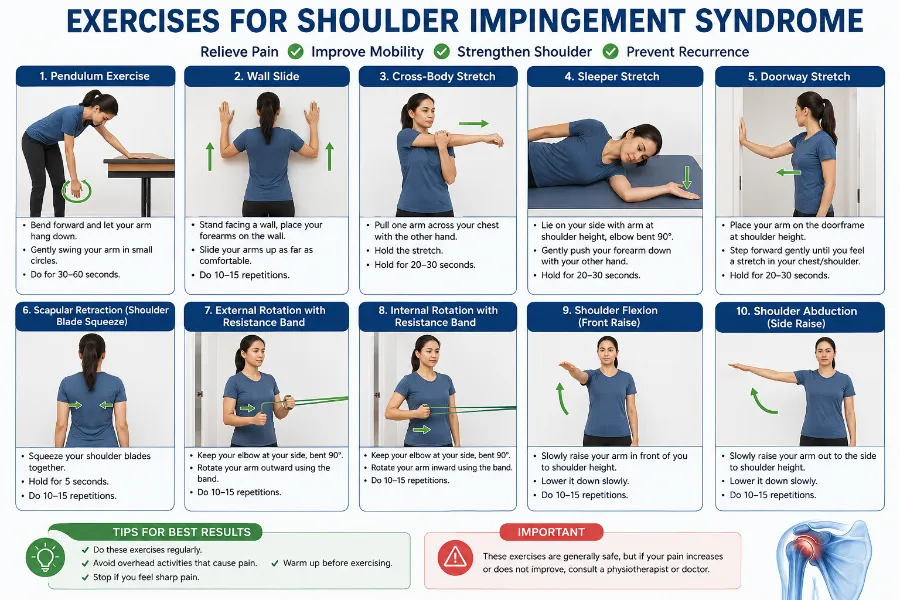
11 Best Exercises for Shoulder Impingement Syndrome
Introduction
Shoulder pain is a cause of shoulder impingement, particularly when lifting your arm above your head.
People who perform repeated overhead tasks are more prone to this overuse condition.
This illness is frequently treated conservatively with rest, nonsteroidal anti-inflammatory medications (NSAIDs), and physical therapy. Stretches and strengthening of the scapula and rotator cuff are suggested exercises.
Up to 65% of people with shoulder pain have shoulder impingement, one of the most common shoulder disorders. From young athletes to elderly persons who participate in a lot of overhead activities, it can impact a wide range of people.
The good news is that the most effective type of therapy is usually conservative, involving activity moderation and exercise. Indeed, an in-depth investigation showed modest evidence that exercise was more helpful than surgery.
What is shoulder impingement?
The rotator cuff may be familiar to you. The head of your humerus, or upper arm bone, is where these four tendons are attached. The subacromial space is a small area that these tendons go through.
The fluid-filled sac known as the bursa and the rotator cuff tendons often have adequate space. However, impingement results from these structures being crushed and irritated by arm movement. This appears as shoulder ache, particularly when you raise your arm.
Anything that alters the shoulder’s restricted range of motion might irritate and hurt it.
This may consist of:
- Overuse or repetitive overhead movements
- Rotator cuff muscle weakness
- Weakness in the scapula, the muscles supporting the shoulder blade
- An abnormal form of the acromion, the bone at the top of the space
What are the best exercises for shoulder impingement?
Exercises include stretches to preserve range of motion and strengthening of the scapula and rotator cuff. Additionally, these workouts avoid muscular imbalances that may cause impingement.
Resistance bands rows
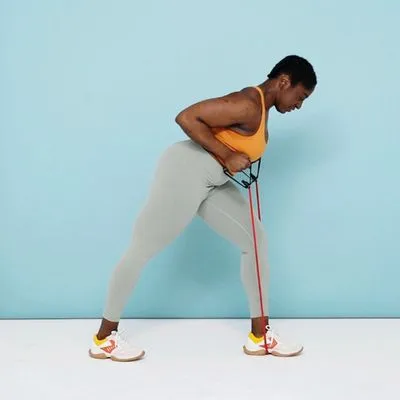
When treating shoulder impingement, exercises that strengthen the muscles that regulate your scapula are essential. You may use the cable pulley equipment at the gym or a resistance band for this banded row exercise.
- Step 1: Loop a resistance band around a beam or close it in a door to secure it around a solid structure. To hold, leave two ends free.
- Step 2: Face the band while standing with your feet shoulder-width apart. With each hand, grasp one end of the band.
- Step 3: Stretch your arms parallel to the floor in front of you. To eliminate any breathing room in the band, back up if necessary.
- Step 4: Pull back on the band while rowing with your elbows directly behind you. When the exercise is finished, squeeze your shoulder blades together.
- Step 5: Relax and go back to where you were.
- Step 6: Perform two to three sets of twelve to fifteen repetitions.
Internal rotation
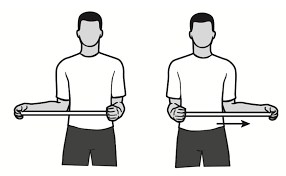
One of your rotator cuff muscles is strengthened by this banded internal rotation workout. Once more, you can utilize the cable pulley machine at your gym or a resistance band.
- Step 1: Tie a resistance band around a sturdy support at waist height or fasten one end of the band to the door.
- Step 2: Make a 90-degree turn so that you are not facing the band. Place your affected arm closest to the band while standing.
- Step 3: Bend your elbow to a 90-degree angle while holding onto the band. Throughout the exercise, keep your elbow tucked at your side.
- Step 4: Rotate your hand toward your stomach while pulling the band in with your palm facing up.
- Step 5: Go back to where you were.
- Step 6: Perform two to three sets of ten to twelve repetitions on each arm.
External rotation
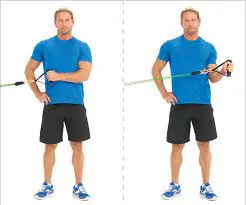
This banded external rotation exercise strengthens several rotator cuff muscles. A resistance band or the gym’s cable pulley machine is required.
- Step 1: Tie a resistance band around a sturdy support at waist height or fasten one end to a door.
- Step 2: Keep your affected arm away from the band when standing.
- Step 3: Bend your elbow to a 90-degree angle while holding the band with your affected side. Throughout the exercise, keep your elbow bent at your side.
- Step 4: Rotate your hand away from your body while pulling the band out, palm up.
- Step 5: Go back to where you were.
- Step 6: Perform two to three sets of ten to twelve repetitions on each arm
Shoulder extension
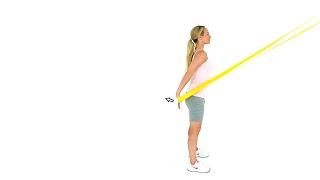
This shoulder extension exercise strengthens the muscles supporting your scapula and your rotator cuff.
- Step 1: Loop a resistance band around a beam or close it in a door to secure it around a sturdy structure. Two ends should be left free for you to grasp.
- Step 2: Grasp the band with each hand while maintaining straight elbows. Start with your hands a little ahead of your torso.
- Step 3: Squeeze your shoulder blades together as you pull your arms straight back against the band’s resistance.
- Step 4: Go back to where you were.
- Step 5: Perform two to three sets of ten to twelve repetitions.
Wall slide
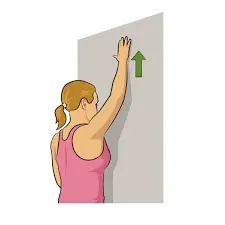
Your shoulder’s range of motion is maintained with this wall slide exercise. This is important to prevent stiffness, which can occur if shoulder pain prevents you from moving your shoulder.
- Step 1: Put a small towel or washcloth in the hand of your affected arm while standing in front of a wall.
- Step 2: With your arm extended over your head, begin at waist height and gently glide your hand up the wall.
- Step 3: Only travel as far as is comfortable for you. There could be a stretch, but if you experience intense pain, stop. You can advance as your mobility increases.
- Step 4: Spend ten to fifteen seconds at the peak.
- Step 5: Do this two to five times.
Pendulum
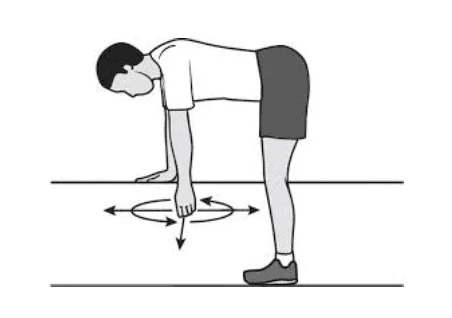
How to do:
- To allow your arm to hang freely, bend forward at the hips.
- Rock from your rear foot to your front foot.
- Allow your arm to rotate in a circle, first in a clockwise direction and then in a counterclockwise direction.
- Spend a minute doing this.
Hold/Repetiton: To relieve pain, repeat this three to five times a day, or more frequently if necessary.
Doorway chest stretch
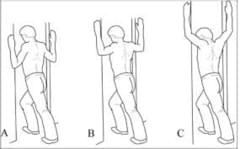
Your shoulders may be pulled forward by tight chest muscles, which may be released with this stretch.
How to do a doorway chest stretch:
- Place your forearm on the doorframe and bend your arm at a 90-degree angle while standing in a doorway.
- Step forward with one foot until your shoulder and chest start to extend.
- Your shoulders may be pulled forward by tight chest muscles, which may be released with this stretch.
Hold/Repetition: Hold for 10 to 15 seconds, then switch sides.
Shoulder blade squeeze
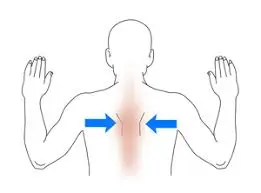
How to do:
- When you stand, keep your arms loose at your sides.
- Turn your thumbs away from you by rotating your hands outward. Squeeze your shoulder blades downward and together. Hold for five to ten seconds.
Hold/Repetition:
- Do this two or three times.
- To relieve pain, repeat this five times a day or more frequently if necessary.
Scaption raise
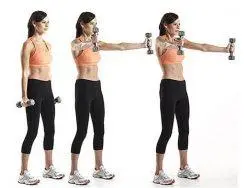
Target shoulder stability muscles are raised by description.
How to do:
- Holding a small weight, keep your front and side at a 45-degree angle.
- Raise your arm to shoulder height, then lower it gradually.
Hold/Repetiton: Perform ten to fifteen repetitions.
Prone horizontal abduction
How to do:
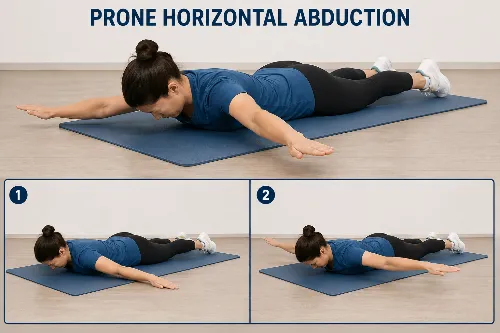
- Place your forehead on a towel while lying on your stomach (prone posture).
- Allow your affected arm to extend over the bed’s edge.
- Start with your palm facing forward and your thumb out.
- Raise your arm as far out to the side as is comfortable while squeezing your shoulder blade.
- Return to the starting position slowly.
Hold/Repetition: Twice a day, repeat 10–20 times.
Scaption elevation
How to do:
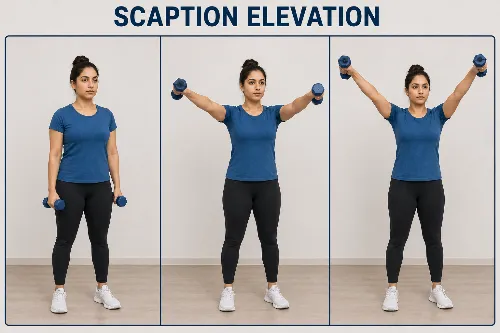
- With your thumbs pointing outward, stand with your arms by your sides.
- Tighten your shoulder blades.
- Lift your arms gently to the side and forward.
- When your arm reaches shoulder level, or you are about to experience pain, stop the action.
Hold/Repetition: Twice a day, repeat 10–20 times.
What’s the fastest way to treat shoulder impingement?
Conservative (nonsurgical) therapy is what experts advise beginning with. The good news is that after two weeks, the majority of people will begin to notice improvements. Your efforts will thus be worthwhile. Among the treatments are:
Rest/activity modification: Steer clear of activities that aggravate your pain, particularly repetitive overhead tasks, during the first one to two weeks.
Prevent immobilization: Don’t completely stop using your arm. Avoid using a sling since it might cause your arm to become stiff. As tolerated, perform the mentioned exercises while moving gently within your pain-free range.
Heat or ice therapy: Heat and ice may reduce pain. For the first few weeks, apply an ice pack to your painful shoulder twice a day for 15 to 20 minutes. Inflammation and pain will be lessened as a result. You can then use a hot pack to improve movement and circulation.
OTC pain relievers: Aspirin, ibuprofen, and naproxen are examples of nonsteroidal anti-inflammatory medicines (NSAIDs) that can reduce pain and inflammation. Pain may also be relieved by acetaminophen. These drugs should only be used for a week or two at a time.
Physical therapy: A physical therapist can assist in identifying and guiding you through the most effective exercises. If necessary, they could also use additional techniques, such as manual treatment.
Although there is little data on shoulder impingement, acupuncture may be a safe and efficient technique to reduce pain.
Corticosteroid injection: A subacromial injection can help reduce pain and increase range of motion when paired with physical activity. However, due to the possibility of adverse consequences, this may not be for everyone.
How do you prevent shoulder impingement?
An overuse condition that develops gradually is shoulder impingement. You can take the following actions to stop this injury from happening:
Warm-up and cool-down: Before engaging in any sport or activity, warm up your muscles. For five to ten minutes, gradually strengthen the muscles that will be active. Additionally, you may use dynamic stretches such as arm circles. Spend some time stretching and cooling off afterward.
Activity correctly: Stop and see a trainer if you are experiencing pain during any activity or if you are unclear about how to do a particular exercise. Injuries can be avoided with proper form.
Stretch and strengthen shoulder muscles: Maintain a consistent regimen for stretching and strengthening your shoulders. The previously mentioned exercises are a wonderful place to start.
Keep your posture correct: Slouching can put your shoulder joint in a position that increases the risk of injury, particularly while performing overhead tasks. Include easy posture-improving activities in your regimen.
Cross-train: To prevent overuse and repetition, you can cross-train by combining various workouts and activities.
Schedule time for recovery and rest: Incorporate a few days off each week into your workout or training routine.
Conclusion:
Shoulder impingement syndrome exercises can be an effective way to reduce pain, improve shoulder mobility, and restore strength when performed consistently and with proper technique. Gentle stretching, range-of-motion exercises, and strengthening the rotator cuff and shoulder blade muscles help reduce pressure on the tendons and improve overall shoulder function. Progress gradually, avoid movements that cause sharp pain, and focus on maintaining good posture throughout the day.
See a physiotherapist or other healthcare provider for a thorough evaluation if your symptoms intensify, last more than a few weeks, or are accompanied by noticeable weakness or loss of mobility. With patience, regular exercise, and proper guidance, most people can recover from shoulder impingement and return to their normal daily activities with less pain and better shoulder function.
FAQs
What exercises should not be done with shoulder impingement?
Overhead presses, upright rows, and lateral lifts with palms down should be avoided if you have shoulder impingement since they squeeze your joint’s tendons.
Will a shoulder impingement ever heal?
Yes, with the right treatment, a shoulder impingement may recover entirely. Rest, physical therapy, and activity modifications often take six weeks to six months.
What sleeping position is best for shoulder impingement?
Using another pillow to keep your arm in a secure, neutral posture while resting on your back or non-painful side is the ideal sleeping position for shoulder impingement. Sleeping straight on your injured shoulder or flat on your stomach will compress the tendons and cause pressure.
What are two signs of shoulder impingement?
Pain when raising the arm above and pain at night, particularly when lying on the affected side, are the two main indicators of shoulder impingement.
Typical Symptoms and Signs
When you reach, lift, or throw something over your shoulder height, you may experience sharp or painful pain.
Night pain: Pain that keeps you awake when you roll onto the injured shoulder or prevents you from falling asleep.
Weakness or stiffness: A slight loss of strength while pushing or pulling, or difficulty moving the arm
What are the two tests for shoulder impingement?
The Hawkins-Kennedy test and the Neer test are the two most commonly used physical examinations used to detect shoulder impingement.
The Hawkins-Kennedy Test
The doctor or physical therapist will extend your arm straight forward to a 90-degree angle and then bend your elbow to a 90-degree angle as you sit or stand. They then quickly and gently move your arm downward.
What it signifies: The test is positive if there is pain in the front or top of the shoulder. The movement pinches your tendon beneath the bone, which causes this pain.
Neer Test
How it’s done: The expert uses one hand to grip and stabilize your shoulder blade while you sit. They elevate your straightened arm in a forward motion near your ear with their other hand.
What it signifies: If you experience pain during this upward pull, the test is successful. Your shoulder blade is being rubbed by your soft tissues, as seen by the soreness.
References
- 10 Shoulder impingement exercises to reduce pain and improve mobility. (2025, May 10). https://www.cfaortho.com/media/news/2025/05/10-shoulder-impingement-exercises-to-reduce-pain
- Farotech. (2025, November 26). 3 Shoulder impingement exercises to relieve pain. EmergeOrtho. https://emergeortho.com/news/shoulder-impingement-exercises/