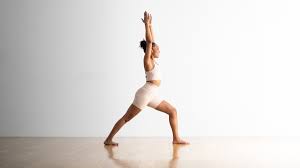
Warrior Pose I (Virabhadrasana I)
Introduction:
Warrior Pose I (Virabhadrasana I) is a powerful standing yoga posture that helps build strength, stability, and focus.
One of the three Warrior Poses, Warrior Pose I is a beginner-level stance that masterfully blends the standing and balancing movements of the body. Despite being fundamental in nature, the fact that pupils must balance simultaneous motions in several directions is what makes it special, potent, and somewhat complex all at once. By immediately promoting mental calm and strengthening stability, power, and focus, this balancing exercise enhances overall health.
Increasing hip flexibility and strengthening the legs, core, back, ankles, and feet are the main goals of this basic pose. Additionally, it helps pupils become more conscious of their body positions and cultivate a sense of balance.
“Vira” means “Hero,” “Warrior,” “Vigorous,” or “Courageous” in Sanskrit, whereas “Bhadra” means “good” or “auspicious.” According to Indian Classic stories, the warrior “Virabhadra,” who was created by Lord Shiva, is named after the ferocious warrior who represents our inner capacity to triumph over ignorance and ego.
Frequent practice of this pose promotes proper posture and spinal alignment and enhances all standing yoga postures and hip openers. Deeper breathing is made possible by the great stretch to the chest and both sides of the torso.
Strong shoulders are encouraged by extending the arms overhead. When the shoulders are opened, the spine twists, making it appropriate for backbend practice. It’s interesting to note that martial arts are also known to use this position.
Warrior Pose I (Virabhadrasana I) Video
How to Do Warrior Pose I:
Only after thoroughly warming up the body—either by performing a few rounds of Sun Salutations A (Surya Namaskar A) or some simple hip-opening exercises—should the posture be tried. A list of warm-up yoga routines might be taken into consideration. The following are the steps to enter the Warrior I Pose:
- Start by performing the Mountain Pose (Tadasana) while standing on the mat. Keep the feet three to four feet apart. [See Five Star Pointed Pose] Students might stand with their heels touching the mat’s edge to make sure they are in the same line.
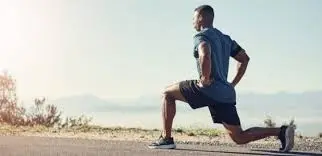
- Take a breath and point your right toes in the direction of your left foot. Breathe out and position your left thigh parallel to the ground. The left ankle and knee are perpendicular to one another.
- Place your right foot on the mat with a slight inclination of around 30 to 45 degrees. Lift your arms till they align with your shoulders. Place your arms parallel to the ground. The floor is in front of the palms. The Warrior 2 Pose is achieved by focusing on the left palm.
- Take a breath now, then lift your arms above your head. The arms have to line up with one another. In Anjali Mudra, align the palms. For stability, place your weight evenly on both feet and push the floor through the outer border of your rear foot. Extend your back and raise your arms so that they are in line with your ears. Hold the position for five to ten breaths.
- Maintain a long neck and relaxed shoulders. Adjust to the Five Star Pose. On the opposite side, repeat these instructions.
- Finally, realign to Mountain Pose (Tadasana) after exercising on both sides. In the Three Part Mountain Pose, relax.
Benefits of Warrior Pose I:
The following are some advantages of Warrior Pose I, a fundamental and potent yoga pose:
- Stretches, Strengthens, Lengthens: In Warrior Pose I (Virabhadrasana I), the deep stretch of the lower body, including the adductors of the inner thighs, the quadriceps, the hamstrings, and the gluteus maximus, helps to maintain a toned, attractive muscle. Stretching the upper body maintains the health of the obliques, or side abdominal muscles, as well as the muscles around the entire spine.
- Range of Motion and Flexibility: Frequent Warrior Pose practice. In addition to strengthening and toning the legs, ankles, and feet, I also improve hip flexibility. The body’s flexibility gradually increases with the deep stretch of the complete body, which makes it necessary for the practice of numerous other advanced-level postures.
- Chest, Diaphragm, and Breath: To stay stable in Virabhadrasana I, also known as Warrior Pose I, the arms are extended over the head, extending the chest and diaphragm. The muscles that activate the respiratory system’s organs contract when the arms are extended, and the diaphragm and chest are deeply stretched. In Warrior Pose I, the exchange of gases through the lungs, which would be deep and gradual with awareness of the body, serves to increase fresh air circulation. Additionally, the fresh air prevents allergies by keeping the nasal passages free.
- Awareness and Focus: Since Virabhadrasana I is likened to a warrior, practicing this position with complete awareness will help develop stability, endurance, and self-confidence.
- Alignment and Posture: Warrior Pose I is a great way to learn about the alignment of the knee and ankle. The stability and forward motion of the pelvis are affected by how the back foot is maintained. Feeling stable in the posture depends on the lengthening upward movement of the arms and the breath-led spine. To preserve the knee and ankle joint, make sure the knee points in the same direction as the second and third toes.
- Energizing, De-stressing, and Relaxing: In Virabhadrasana I, also known as Warrior Pose I, the deep stretch of the arms over the head gives the neck and shoulders an equivalent amount of stretch, which lessens stiffness. The body feels completely lighter as a result of this decrease in stiffness, which also raises energy levels.
- Organs and Stimulation: The digestive and reproductive systems perform better when the muscles, notably the abdominal muscles, are engaged. This lessens indigestion and reproductive issues.
- Therapeutic, Healing, and Ailments: Patients with asthma benefit from the diaphragm’s expansion, which enhances the respiratory system. The sciatic nerve and other nerves are better able to move when the hips and entire leg flex from the base of the spine. Fresh energy is brought in to assist in lessening sleeplessness symptoms as stamina and stability are increased with awareness of the body.
- Balance and Emotions: Because maintaining the posture necessitates shifting concentration to the breath and various body muscles utilized to enter the stance, regular practice of this pose helps quiet the mind. The student’s capacity for mental control is sharpened by this deliberate movement of awareness, which can aid in emotional regulation. Dealing with challenging circumstances in life can be improved.
- Circulation and Systems: Patients with asthma benefit from the diaphragm’s expansion, which enhances the respiratory system. Better nerve mobility, including the sciatic nerve, is produced by flexing the hips and the entire leg from the base of the spine. Fresh energy is brought in to assist in lessening insomnia symptoms as stamina and stability are developed with knowledge of the body.
- Others: Teens may find Warrior I (Virabhadrasana I) and other warrior-related poses to be thrilling. A fun-focused kids’ yoga session can be created by combining the different arm variations of the foundation posture with humorous and engaging stories.
Contraindications of Warrior Pose I:
The first stance in the list of variations of the Warrior series poses, Warrior stance I, is regarded as a highly powerful standing balance pose under the Hatha Yoga practice. However, there are some things to keep in mind when performing this pose. Below is an explanation of these:
Injury and Surgery:
- If a student has trouble balancing or has a hip, knee, back, or shoulder ailment, they should avoid this position. Until their doctors give the all-clear, people who have recently had surgery in these regions should likewise refrain from adopting this posture.
- Gaining flexibility is just as important as understanding the body through Virabhadrasana I practice. If one is not conscious of their body, they have a propensity to constrict their respiration while stretching their arms above their head and looking up.
Ailment and Physical Strength:
- It takes practice to look up while maintaining awareness of the body with feet apart in Warrior Pose I. Anyone with headaches or poor body balance should go slowly. Additionally, one could begin by doing this with assistance or begin by gazing forward rather than upward while still maintaining body balance. Other variations include adding a block, like in Warrior Pose I Block Between Knee and Wall, or using the wall as illustrated in Warrior I Variation Wall.
- For students who are just starting, it is recommended that they practice the Warrior I Pose with their hands either at the waist, as seen in Warrior I Hands On Hips Heels On Floor, or at their hearts rather than lifting their arms for stability.
- Students may be instructed to remain on the rolled mat until they develop the required strength around the knee muscles if they experience pain in their rear leg’s knee. Additionally, the stance can be broadened if maintaining the right heel in line with the left heel seems challenging and strains the knee. This keeps the joints from being strained and enables your knees and ankles to point in the same direction as your hips. The Warrior I pose’s variations, such as Warrior I Variation Straight Leg and Warrior I Straight Legs hands on hips (where the front knee is kept straight), can also be attempted by someone with weak knees.
- Additionally, students may be instructed to lift the heel of their back foot off the mat and ascend onto the ball while performing the High Lunge Pose if they experience pressure in their lower back and pelvis while maintaining the back foot on the mat.
- Arm Position: Some students may find it difficult to maintain the arms overhead because of shoulder tightness or weak upper arms. In these cases, it may be suggested that they try different arm poses, such as Warrior Pose I Eagle Arms, Warrior I Airplane Pose, Warrior I Hands On Hips Heels On Floor, or just keep the palms in Anjali Mudra close to the chest.
- Curving your lower back is one mistake. Rather, pull your ribs in and scoop your tailbone forward.
Lack of Body-Breath Connections:
- Several bodily motions are involved in this position. Without awareness of the body and breath, maintaining the posture is almost impossible. For instance, excessive hip lowering can strain the knees, excessive pushing of the back foot into the mat can throw off balance, and excessive lower back pain can strain the spine. Only when the effects of breath on the body are understood can these alignments be assessed and adjusted.
Others: Although this stance is suitable for pregnant people, the center of gravity may change. As a result, they should be very careful when entering and exiting the position and maintain stability by looking forward rather than at their palms.
Warrior Pose I Breath Awareness:
Warrior Pose I is a standing-balancing yoga pose. To get the most out of this technique, follow the breathing guidelines listed below:
- Breathe in and out while aligning yourself in Mountain Pose, Tadasana.
- Inhale: Spread your feet three to four feet wide in Five-Pointed Star Pose (Utthita Tadasana) by walking or jumping.
- When you exhale, shift your torso to the left, point the toes of your left foot, and turn your right foot toward your left foot (about 30 to 40 degrees inward).
- Breathe in and out while bending the left leg to a 90-degree angle. The right leg is strong, straight, and stretched.
- Take a breath and raise your arms parallel to the ceiling.
- Exhale: When you feel balanced, join the palms in Anjali Mudra.
- Inhale: Lastly, raise your chin to look up.
- Inhale-Exhale: In Warrior Pose I (Virabhadrasana I), establish a connection with your breath and remain in the pose. Maintain stability and balance by distributing your weight equally between both feet and using the muscles in both legs.
- Exhale: Lower your arms and chin. In Utthita Tadasana, return your torso and feet to the center.
- Inhale-Exhale: Return to alignment in Tadasana by walking or jumping. Unwind for a little.
- Inhale-Exhale: Using the breath awareness mentioned above, repeat the process on the opposite side once you feel comfortable. Continue elevating your back thigh (right) toward the ceiling while firmly planting your back foot (right) on the ground.
Conclusion:
Virabhadrasana I, also known as Warrior Pose I, is a potent standing yoga pose that increases focus, strength, and stability. It strengthens the legs and core while stretching the hip flexors, shoulders, and chest.
Regular practice of this pose helps enhance posture, balance, and general body awareness. Warrior Pose I is a crucial component of many yoga routines because it fosters both physical endurance and mental confidence by maintaining steady breathing and good posture.
FAQs:
How much time should you spend in the warrior 1 pose?
For stability, place your weight equally on both feet and push the floor through the outer border of your back foot. Extend your back and raise your arms so they are in line with your ears. For five to ten breaths, maintain the position. Maintain a long neck and loose shoulders.
Does Warrior 1 reduce tension?
Try warrior posture if you want to specifically increase your strength, concentration, and willpower. You will feel refreshed and reenergized by this well-liked yoga progression and its modifications, which will also help you reduce stress. Your practice will be more varied thanks to the movements, which will help you both intellectually and physically.
Who ought to stay out of Warrior Pose?
Similar to other yoga poses, Warrior Poses have particular precautions and contraindications that must be followed for a safe practice. This posture should not be attempted by people with balance problems or injuries to their knees, hips, shoulders, or backs.
How long should I keep Warrior One?
For stability, place your weight equally on both feet and push the floor through the outer border of your back foot. Extend your back and raise your arms so they are in line with your ears. For five to ten breaths, maintain the position. Maintain a long neck and loose shoulders.
What situations make the Warrior 1 position inappropriate?
If a student has trouble balancing or has a hip, knee, back, or shoulder ailment, they should avoid this position. Until their doctors give the all-clear, people who have recently had surgery in these regions should likewise refrain from adopting this posture.
What are the advantages of the Warrior 1 position for the mind?
In order to silence distracting thoughts, practitioners learn to concentrate on breath, body alignment, and muscle engagement. By encouraging a serene, centered state of mind, this meditative component of the pose helps lower stress and anxiety.
Is Warrior 1 a pose of balance?
Warrior 1 is a presence-based pose that calls for breath awareness, balance, and concentration. Maintaining this position teaches you to remain composed and grounded in the face of difficulties.
Who shouldn’t strike the Warrior Pose?
Similar to other yoga poses, Warrior Poses have particular precautions and contraindications that must be followed for a safe practice. This posture should not be attempted by people with balance problems or injuries to their knees, hips, shoulders, or backs.
What is the recommended duration for holding Warrior 1?
As you extend your spine, keep your shoulders loose and your ribs drawn in. If it feels comfortable, look ahead or slightly upward. Step forward and repeat on the other side after holding for five to ten breaths.
Is Warrior 1 suitable for beginners?
In addition to lengthening and shaping the legs, the Warrior I yoga stance increases strength. It strengthens the back muscles and expands the shoulders and chest. This video, which is a part of our Foundations of Yoga series, is ideal for beginners and anyone looking to resume or improve their current practice.
What advantages does Warrior 1 offer?
Your entire body benefits from doing Warrior 1, whether you do it alone or as part of a series. Your chest, hip flexors, and entire front half of your body can all be opened in this pose. strengthening your shoulders, core, thighs, and glutes.
Is Warrior 1 a stance for yoga?
A fundamental yoga pose that strikes a balance between strength and flexibility in true warrior style is Virabhadrasana 1. Perhaps one of the more popular yoga stances is Virabhadrasana 1. It might also be the most difficult.
Why will Warrior 1 help you become more balanced?
It establishes fundamental equilibrium. The feet must ground, the legs must stabilize, the hips must align, and the torso must raise to perform Warrior 1. Functional equilibrium is defined as “many parts of the body syncing and working together,” according to Woodford.
References:
- Warrior Pose I Yoga(Virabhadrasana I)| Yoga sequences, benefits, variations, and Sanskrit Pronunciation | Tummee.com. (n.d.). Tummee.com. https://www.tummee.com/yoga-poses/warrior-pose-i
- Yoga Journal. (2025a, February 25). Warrior 1 Pose. https://www.yogajournal.com/poses/warrior-i-pose/
- Rakshak, & Rakshak. (2025, February 26). Virabhadrasana or Veerbhadrasana (Warrior Pose) | How to do | Benefits – The Art Of Living. The Art of Living – Making Life A Celebration. https://www.artofliving.org/in-en/yoga/yoga-poses/veerabhadrasana-warrior-pose
- Jain, K. H. (2025, March 17). Yoga’s 5 Warrior Poses: Benefits & Tips For Perfect Form. Arhanta Yoga Ashrams. https://www.arhantayoga.org/blog/yoga-warrior-pose-guide/