13 Best Exercises For Knee Effusion
Introduction:
Knee effusion, or “water on the knee,” often causes swelling, stiffness, and discomfort. Targeted exercises can help reduce fluid buildup, improve joint mobility, and strengthen the surrounding muscles to support faster recovery and long-term knee health.
The knee is a complex joint that allows humans to move in a variety of ways through the cooperation of bones, muscles, tendons, and ligaments. Unfortunately, this joint is also subject to several traumas, accidents, and other problems that can result in inflammation, which can cause swelling and pain.
Your ability to move and function during the day may be impacted by knee effusion, or swelling. At some point, everyone will probably have a swollen knee. Although they might not be able to treat the underlying illness, Exercises For Knee Effusion can help you feel better, speed up the healing process, and regain your mobility.
Speaking with a physical therapist can be especially beneficial. Based on your unique needs and the underlying cause of your knee swelling, they can customize an exercise regimen. Additionally, a physical therapist can guarantee that the exercises are safe and beneficial for your particular condition.
Causes:
Knee effusion can result from a variety of underlying reasons, some of the more prevalent ones being:
Injuries
- One of the most frequent causes of knee fluid accumulation, or knee effusion, is injury.
- The body produces extra synovial fluid as a protective mechanism when the knee joint suffers trauma, such as sprains, ligament tears, soft tissue injuries, or fractures.
- Swelling, pain, and limited mobility are the effects of this fluid buildup.
- Damage to the knee, whether from a sports injury or a simple slip, can cause inflammation and fluid buildup around the joint.
An infection
- Anywhere around the knee, a bacterial infection may cause swelling.
- A physician should be consulted as soon as possible if a knee joint infection is suspected because this could be a medical emergency.
Arthritis
- Knee effusion is often caused by osteoarthritis and rheumatoid arthritis.
- Osteoarthritis is a condition in which the knee’s cartilage gradually deteriorates, leading the body to overproduce fluid in reaction to the joint damage.
- On the other hand, rheumatoid arthritis is an autoimmune condition that causes persistent fluid accumulation in the knee by causing chronic inflammation.
- In both situations, the knee may appear painful, swollen, and stiff, particularly after periods of activity or rest, which frequently results in a stiff knee.
Overuse
- Knee bursitis and tendinitis (tendonitis) are common overuse injuries.
- Inflammation of the tendons connecting the kneecap to the shin bone is known as tendinitis, and it can occasionally be brought on by repeated jumping motions.
- Repetitive crouching or kneeling on hard surfaces can cause bursitis, which is inflammation of the fluid-filled sacs that help in knee cushioning.
Cysts
- Nodules in the back of the knee, known as Baker’s cysts, can cause persistent swelling or arise from swelling caused by additional conditions like arthritis.
A bursitis
- Bursae are sacs filled with fluid that are placed in strategic locations around the knee joint.
- By acting as cushions, these sacs lessen movement-related friction between muscles, tendons, and bones.
- Inflammation of a bursa is called bursitis, and it can be caused by injury, overuse, or even underlying diseases like rheumatoid arthritis.
Post-Surgical Recovery
- Fluid accumulation is a common part of the healing process following knee surgery, such as a meniscus repair or knee replacement.
- The body creates synovial fluid to shield the knee and promote healing, but too much of it can be uncomfortable and impede recovery.
- To ensure a full recovery and avoid complications, it is essential to manage this fluid accumulation with appropriate care, rest, and recommended exercises.
Signs and symptoms:
Swelling
- Noticeable fluid buildup that causes swelling around the knee joint.
- One knee may appear noticeably bigger than the other.
Limited Range of Motion
- Difficulty climbing stairs or carrying out other typical knee motions.
Sensitivity
- When pressed or touched, the knee joint may become sensitive.
Stiffness
- Inability to fully extend or bend the knee.
- The knee may feel heavy or constricted.
Aches
- Pain can vary from mild pain to terrible pain.
- Movement and weight-bearing activities often make it worse.
Redness and Warmth
- Touching the skin over the knee may make it feel warm.
- Mild redness can occasionally be seen, particularly if there is an infection or inflammation.
Sensation of Fluid
- In certain situations, applying pressure to the knee may cause a soft, squishy feeling.
Exercise’s benefits:
Decreases Swelling
- Mild movement enhances blood circulation and promotes lymphatic drainage, which can accumulate in the knee joint.
Restores Range of Motion
- Exercises improve or increase the knee joint’s flexibility and help avoid stiffness.
Enhances Functionality
- Frequent exercise facilitates easier and less painful daily activities like walking by promoting smoother joint movement.
Avoids Recurrence
- By maintaining the joint’s health and flexibility, strengthening and mobility exercises can help stop fluid buildup in the future.
Builds Up Supporting Muscles
- The affected knee experiences less joint stress when the quadriceps, hamstrings, and calf muscles are strengthened.
Improves Joint Stability
- Enhanced coordination and tone of muscles.
- Assist in preventing additional damage and instability to the knee.
Before beginning an exercise program, it is crucial to take into account the following safety precautions:
- It’s important to maximize the benefits and consider a few safety precautions before beginning any health program.
- Consult your doctor or physical therapist for guidance on which exercises are most suitable to treat your specific issue.
- It’s crucial to listen to your body’s needs and refrain from pushing yourself when it’s uncomfortable.
- Exercise frequently causes pain, but persistent or severe pain may indicate overwork.
- Start with low-impact exercises and work your way up to more difficult ones until you can tolerate further pain.
- Repetitive injuries can be avoided with good form and posture.
- Consult your physician if you are unclear about how to start exercising properly.
- You should warm up your joints and muscles before beginning an exercise session to prepare them.
Exercises For Knee Effusion:
You can greatly reduce knee swelling and increase mobility by including mild yet efficient exercises in your recovery regimen. Without putting undue strain on the knee joint, these exercises are intended to improve flexibility, strengthen surrounding muscles, and help in the healing process.
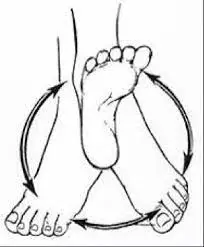
Ankle circle
- Start with the seating position on the chair.
- Put your affected foot up on a chair.
- Keep your leg firm and only move your ankle.
- Rotate your foot clockwise in gentle, thoughtful circles.
- After ten to fifteen rounds, turn counterclockwise.
- Then return to your neutral position.
- Then relax.
- Repeat these exercises 5 to 10 times.
Ankle pump
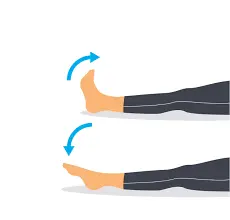
- Sit or lie down with your back flat against a chair.
- The legs are spread out and slightly apart.
- To make the soles flat, the toes should point up.
- Point your feet as close to your knees as you can.
- After that, make every effort to guide them away from you.
- Bend your feet in each direction alternately to finish the task.
- Hold your toes in this stretched position for only a moment, just a few seconds.
- After that, gradually return your foot to a straight position on the ground.
- Then return to your neutral position.
- Then relax.
- Repeat these exercises 5 to 10 times.
Heel slide
- Start on the bed in the supine position.
- Make sure your heel stays on the bed or floor throughout the exercise.
- Slide your heel as far up toward your buttocks as you can comfortably, while bending the knee of the leg you wish to work.
- Hold this position for a few seconds.
- Keeping your heel on the bed or floor, slowly slide your heel back down to the beginning position.
- When performing the exercise, avoid holding your breath.
- Then return to your neutral position.
- Then relax.
- Repeat these exercises 5 to 10 times.
- Use the other leg to complete the motion.
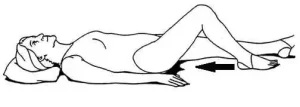
Static quadriceps strengthening
- Sit or lie down on a level surface with your legs extended in front of you.
- If you’re seated, make sure your knees are straight and not bent.
- When lying down, make sure your legs are fully extended and your feet are flat on the ground.
- You can tighten your quadriceps muscles by pressing the back of your leg down toward the floor or the surface you are sleeping or sitting on.
- Consider attempting to extend your leg without actually moving your knee.
- You aim to contract your quadriceps while keeping your knee stable.
- Hold the contraction for a few seconds while keeping the muscle taut.
- Keep your breathing consistent throughout the exercise.
- You should not hold your breath.
- Then return to your neutral position.
- Then relax.
- Repeat these exercises 5 to 10 times.
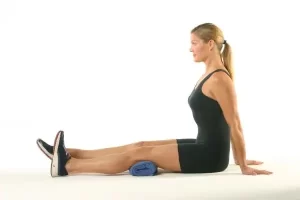
Straight leg raise
- With your legs comfortably spread out on the ground and your hips square, lie on your back.
- Make a 90-degree bend in your non-injured leg’s knee.
- Place the foot flat on the ground.
- Contract your quadriceps, a group of muscles on the front of your thigh, to stabilize the muscles on your straight leg.
- Raise the straight leg a few inches off the ground while taking a slow breath.
- Hold this position for a few seconds.
- Breathe out slowly, then carefully lower the leg to the ground.
- Then return to your neutral position.
- Then relax.
- Repeat these exercises 5 to 10 times.
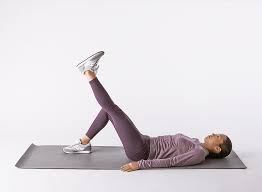
Seated chair slide
- With your feet flat on a smooth floor, take a seat in a sturdy chair.
- Maintain a straight back while placing your hands on the chair’s sides.
- Slide your affected foot as far back under the chair as you can comfortably.
- For a short while, maintain the bent-knee position.
- To get back to where you started, slide your foot forward.
- Slide the foot back and take a breath.
- Then return to your neutral position.
- Then relax.
- Repeat these exercises 5 to 10 times.
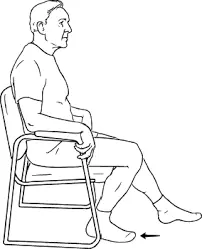
Seated knee extensions
- Sit in a chair or bench with your feet flat on the ground and your knees bent at a 90-degree angle.
- Maintain a straight back and loose shoulders.
- Keep your hands on your thighs or the chair’s sides for balance and support.
- Slowly extend one leg straight out in front of you while keeping your knee in line with your hip.
- Contract your quadriceps, the muscles at the front of your thigh, as you straighten your leg.
- You aim to fully extend the leg without locking the knee joint.
- Hold the extended position for one or two seconds.
- Then return to your neutral position.
- Then relax.
- Repeat these exercises 5 to 10 times.
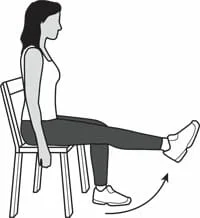
Standing quadriceps stretch
- For balance, place your feet together and hold onto a chair, wall, or countertop.
- Bend your knee to get your heel closer to your buttocks as you raise one leg behind you.
- Grab the top of your foot or ankle with the hand that is on the same side as the bent leg.
- Pull your foot gently toward your buttocks until the front of your thigh starts to stretch.
- Make sure your hips are straight and your knees remain close together without bending forward too much.
- The front of your thigh should be stretched.
- Hold this position for a few seconds.
- Then return to your neutral position.
- Then relax.
- Repeat these exercises 5 to 10 times.
- Repeat the stretch on the other leg after gradually releasing your foot.
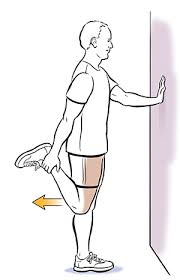
Standing hamstring curl
- As you stand, ensure that your feet are hip-width apart.
- Place your hands on your hips or a chair for balance.
- Your left leg should now be the only form of support.
- The heel of your right knee should be approaching your butt as you slowly bend it.
- Maintain a neutral posture with your thighs.
- Hold this position for a few seconds.
- Gently place your foot down.
- Then return to your neutral position.
- Then relax.
- Repeat these exercises 5 to 10 times.
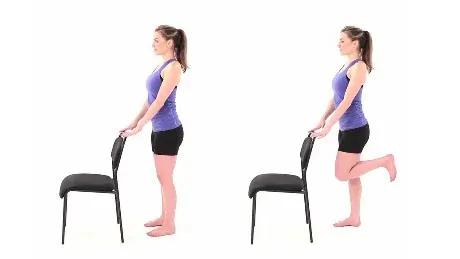
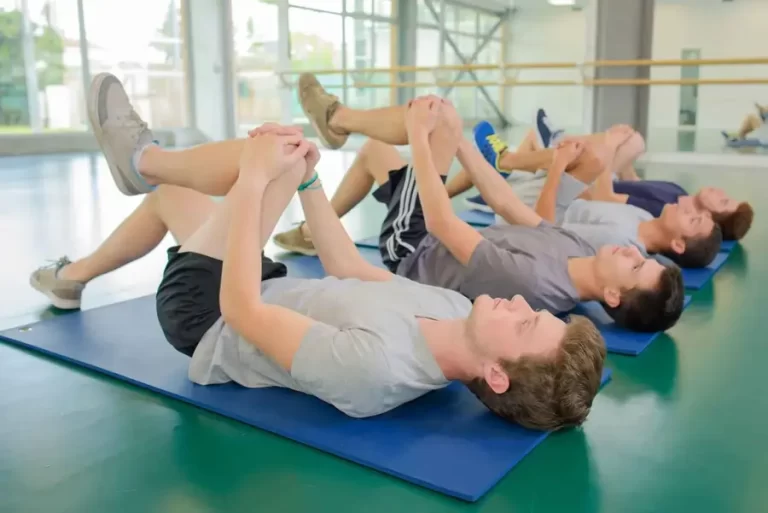
Supine hamstring stretch
- Put yourself on your back on a yoga mat.
- You should stretch and relax both legs.
- Have a resistance band, yoga strap, or towel handy.
- Bending your right knee, loop the strap around the back of your right foot.
- Hold the ends of the strap securely with both hands.
- Raise your right leg gradually while keeping your left leg flat on the ground.
- Your hamstrings will stretch significantly when you gently pull your leg toward you with the strap.
- Maintain a slight bend in your knee if your hamstrings are extremely tight.
- Maintain this posture for a short while.
- On the mat, keep your lower back flat.
- Then return to your neutral position.
- Then relax.
- Repeat these exercises 5 to 10 times.
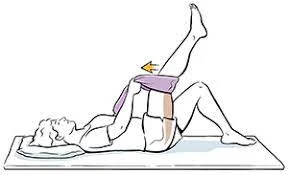
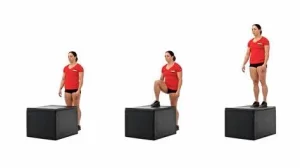
Step up
- Get to your feet. Next, set up a step box or lower platform in front of you.
- Use one foot to step onto the step.
- By straightening your knees and hips and applying pressure to your heel, you can raise your body.
- Control your muscles rather than applying force.
- Hold this position for a few seconds.
- Take a slow step back down.
- Then return to your neutral position.
- Then relax.
- Repeat these exercises 5 to 10 times.
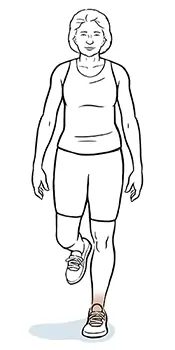
Single-leg balance
- Stand on the ground to begin.
- You should keep your arms at your sides.
- To lift your foot back, flex one leg at the knee.
- Use your other foot for balance as you stand up.
- Hold this position for a few seconds.
- Lower the elevated foot.
- Then return to your neutral position.
- Then relax.
- Repeat these exercises 5 to 10 times.
Prone extension stretch
- Find a bed that has enough space surrounding it, at least on one side.
- Lie on your stomach on the bed.
- Place your lower leg over the edge of the bed and your thigh on the bed.
- On the affected leg, place a small rolled towel beneath your thigh just above the kneecap.
- To straighten your lower leg, relax and let gravity pull it toward the floor.
- Hold this position for a few seconds.
- Then return to your neutral position.
- Then relax.
- Repeat these exercises 5 to 10 times.

What safety measures should be followed when working out?
Warm up and cool down.
- Warm up your muscles with gentle, dynamic movements before working out.
- Afterward, do some light stretches to maintain flexibility.
Increase Intensity Gradually After Starting Slowly
- Start with easy exercises that aim to keep your range of motion pain-free.
- As your pain and swelling go down, gradually increase the exercises’ complexity and intensity.
Slow Down and Take Frequent Breaks
- Stretching too much or performing repetitions too quickly can lead to issues.
- Hold each stretch gently and take a break in between repetitions.
- Because speed increases risk, workouts should be done cautiously and slowly.
Pay Attention to Controlled Motions
- Exercises should be done carefully and under control.
- Stay away from forceful or jerky motions that might worsen the injury.
Pay Attention to Your Body
- Your body uses pain as a signal.
- If you feel any pain while exercising, stop right away and seek advice from a medical professional or physical therapist.
Make Use of the Correct Method
- It’s crucial to finish each exercise carefully and slowly.
- Get your form checked by a therapist or use a mirror.
When did you quit working out?
Pain that is sudden or severe
- Severe, stabbing, or worsening pain indicates that the joint is being overstressed, even though mild to moderate pain is normal.
Take a break or change the exercise if needed.
- Minimal fatigue or stiffness
- Slight pain from a previous workout; minimal form breakdown because of bad posture
- Pain only in specific movements
Chronic Pain Following Exercise
- You’ve probably overworked yourself if you experience pain, stiffness, or swelling after a session that lasts longer than a day or two.
- Go back to a safer setting or lessen the intensity.
If You’re Overly Exhausted or Confused
- Chronic pain and nerve dysfunction can cause fatigue and difficulty focusing.
- Excessive exercise may make these systemic issues worse.
- Prioritize relaxation and healing.
If symptoms worsen over time instead of improving
- Exercise should gradually alleviate symptoms.
- If you’re keeping to the proper protocol and your symptoms worsen over several days, you could stress the nerve even more.
- Postpone your routine.
When you have a knee effusion, which exercises should you avoid?
Activities with a high impact
- Jogging or running
- Exercises involving plyometrics
- Running up stairs
Extended periods of standing or walking
- Particularly on hard surfaces
- Walking or hiking a long distance
Deep lunges and squats
- These put a lot of strain on the knee joint and can cause inflammation and cartilage strain.
Rotating or twisting motions
- The knee experiences rotational stress when playing sports or exercising, like basketball or tennis, that require quick turns.
High-impact jump techniques
- Due to the forceful impact during landing, exercises like box jumps, jump squats, and burpees may worsen pre-existing pain.
Excessive weightlifting
- Deadlifts or weighted squats
- Extensions of the legs with strong resistance
- Any strength training that results in increased pain or swelling
Knee Effusion Prevention:
Since knee swelling is frequently your body’s normal reaction to an injury or other medical condition, it is not always possible to prevent it. However, there are things you can do to lessen the chance of developing a knee effusion, like:
Continuing to be active.
- Regular movement is one of the healthy habits that can help prevent swelling, including in the knees.
Paying attention to your body
- When exercising or participating in sports, try not to overdo it because injuries can lead to inflammation and swelling.
- To give your knees time to adjust to the increased load, increase your intensity gradually.
Keeping a Healthy Weight
- Being overweight puts a lot of strain on your joints, especially your knees.
- If necessary, losing weight can greatly enhance knee health and lower the risk of knee effusion.
Workouts for Strengthening
- The knee joint is stabilized and supported by strong quadriceps, hamstrings, and calves.
- Exercises that focus on these muscle groups on a regular basis can enhance knee function and lower the chance of further injuries.
- You can design a secure and effective strengthening program that suits your needs by speaking with a personal trainer or physical therapist.
Frequently switching positions
- To avoid an overuse injury, change up your posture and movement if your job or hobby requires you to jump or be on your knees.
- Regularly engaging in short periods of activity is one way to prevent becoming stuck in one position for an extended period of time.
Keep Your Posture Correct
- By keeping your posture straight, you can properly align your joints and lessen the strain on your knees.
- With your shoulders back and your core active, concentrate on maintaining a tall posture.
- Stay away from slouching, as this can lead to poor posture and excessive joint strain.
Understanding When Medical Intervention Is Necessary:
Even though at-home treatments are frequently successful in treating knee effusion, there are some circumstances requiring medical treatment.
The following are important warning indicators to arrange for a consultation with a medical professional:
- A comprehensive assessment by a physician is essential if the pain is severe, persistent, or gets worse with little activity.
- A visit to the doctor is necessary to figure out the cause and receive the necessary treatment when the injured leg is unable to support weight.
- If your knee feels like it’s locking or catching when you move, it may indicate a meniscus tear or a damaged ligament, requiring medical attention.
- An infection may be indicated by a fever and knee swelling, requiring immediate medical attention.
- Any obvious abnormality or misalignment of the knee joint could be a sign of a serious injury that needs to be treated right away.
- Severe inflammation or an infection may be indicated by significant redness or warmth around the knee joint.
- If you’ve had a major knee injury in the past, such as a fracture or tear in a ligament, any swelling afterwards may be a sign of additional damage that requires medical attention.
Summary:
Knee swelling, also known as knee effusion, is a common issue that affects people of all ages. Everyone will probably have some degree of knee pain and swelling at some point in their lives. A painful or swollen knee can be effectively treated with knee effusion exercises. These exercises can increase mobility but will not solve the underlying issue.
A tiny amount of synovial fluid usually surrounds the knee to improve smooth joint movement and lessen friction. When too much fluid builds up around the knee joint as a result of an injury, infection, or medical condition, it’s referred to as water in the knee or knee effusion. Usually affecting just one knee, knee effusion causes one knee to appear more swollen than the other.
Managing knee effusion, or fluid accumulation in the knee, can be painful and restrictive to day-to-day activities. Excess fluid in the knee, whether from an injury, arthritis, or overuse, frequently results in swelling, stiffness, and pain. Incorporating certain exercises into your routine can help reduce swelling, improve mobility, and support the healing process, even though medical treatment may occasionally be required.
FAQ:
Is exercise beneficial for knee effusion?
Any workout that uses your leg muscles can help minimize knee effusion because your muscles have a “pump function” that allows them to pump out swelling in your joints. Waiting and sleeping won’t reduce edema as much as using your body’s natural pump actively.
How can knee effusion be decreased?
Self-care.
Take a break. Try to stay away from weight-bearing exercises.
Elevation and ice. Every two to four hours, apply ice to your knee for 15 to 20 minutes to reduce pain and swelling.
Compression. Applying an elastic bandage to your knee can help reduce swelling.
Painkillers.
What is the healing time of a knee effusion?
While more serious injuries like ligament tears or arthritis may take weeks to months to heal, simple episodes of knee effusions might heal in a few days with rest and ice. The underlying reason, the severity of the illness, and the particular course of treatment, which could involve medicine, physical therapy, or surgery, all affect how long it takes to heal.
If I have a knee effusion, should I still walk?
Walking can help with knee effusion because it strengthens the surrounding muscles and increases circulation, particularly for disorders like osteoarthritis. Walking, however, could put too much strain on your joints and should be avoided or replaced with more moderate activities like swimming if you have severe pain. Always pay attention to your body; if walking makes you feel worse, stop, take a break, and think about doing something less strenuous.
Does cycling help with knee fluid?
The circulation of synovial fluid, which lubricates the knee joint, is enhanced by cycling. Improved lubrication prevents wear and tear and eases arthritis-related pain by lowering friction between the joint surfaces.
When you have a knee effusion, what should you avoid?
Stay away from rough running surfaces and sudden, jarring movements. Avoid repetitive motions whenever you can. Keeping a healthy weight. Receiving treatment for long-term conditions like arthritis.
When you have a knee effusion, how should you sleep?
Try sleeping on your back with the affected leg slightly raised on a pillow to relieve knee pain. In addition to giving your knee an additional layer of comfort, the elevation will lessen any swelling as you sleep.
How does knee pain go away?
Rest, physical therapy, focused exercise, and working with a physician to address the underlying cause are some possible treatments.
Does effusion in the knee joint go away?
Yes, once the cause of the effusion is treated, the swelling usually disappears. But not every cause of water on the knee can be cured. Treatment for a number of causes entails controlling the symptoms rather than getting rid of them.
For knee effusion, which exercises work best?
Quadriceps sets
Straight leg raises
Hamstring stretches
Heel slides
Calf pumps
Short arc quads
How frequently should I perform exercises for knee effusion?
Usually once or twice a day, with a focus on careful, slow movement. Decrease frequency or intensity if swelling worsens afterward.
Will knee swelling be lessened by exercise?
Exercise increases muscle activation, joint mobility, and circulation, all of which can progressively lessen swelling. Results are enhanced when exercises are combined with compression, elevation, and ice.
References:
- S. Physio (n.d.-a). Surrey Physio offers the top five exercises for reducing knee swelling. Physio in Surrey. https://www.surreyphysio.co.uk/top-5/5-best-exercises-to-reduce-knee-swelling/
- Quad set. (n.d.). [Video]. Hingehealth. https://www.hingehealth.com/gb/en/resources/articles/knee-effusion/
- August 4, 2025; Seidenburg, M. How Exercise Can Reduce Knee Swelling. Physical therapy at BenchMark. Exercises to reduce knee swelling: https://www.benchmarkpt.com/blog/
- Exercises to decrease knee fluid. 30 September 2024. Georgia Orthopaedics and Spine. Exercises to lower fluid in the knee: https://www.gaspineortho.com/
- Exercises that reduce water on the knee are the best. (n.d.). HexaHealth. https://www.hexahealth.com/blog/knee-effusion-exercises-to-reduce-fluid
- On January 18, 2025, Patil, S. Causes, Treatments, and Natural Solutions for Quick Relief from Swollen Knees. Polarishealthcare. https://www.polarishealthcare.in/post/swollen-knee
- Image 6, Knee flexion in a chair. (n.d.). https://iris.hattiesburgclinic.com/patadv/exkit/Geriatric%20Resource%20Library/English/0300000304tnee8m_English.html
- Image 13, B. S. Pt (October 19, 2025). To increase the knee extension range of motion, perform a prone hang exercise. Excellent Health. https://www.verywellhealth.com/the-prone-hang-exercise-2696511 to enhance the knee range of motion