V-Ups Exercise: Benefits, Proper Form, and Technique Guide
What Are V-Ups?
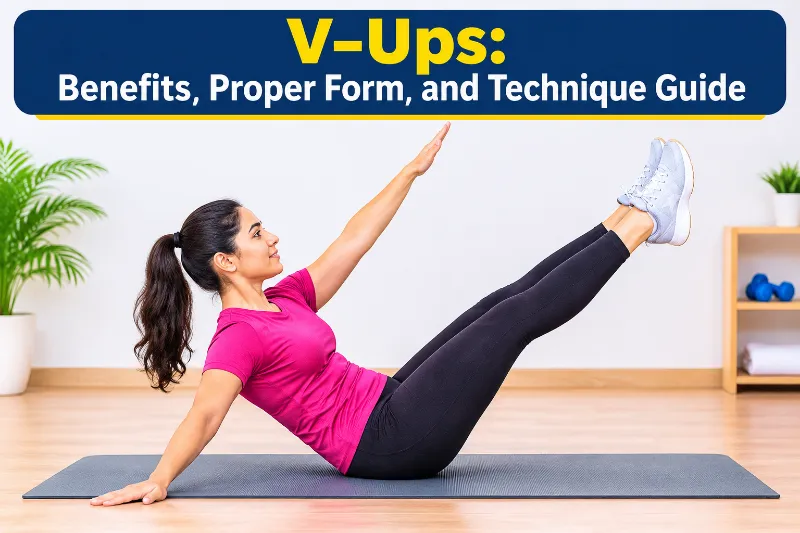
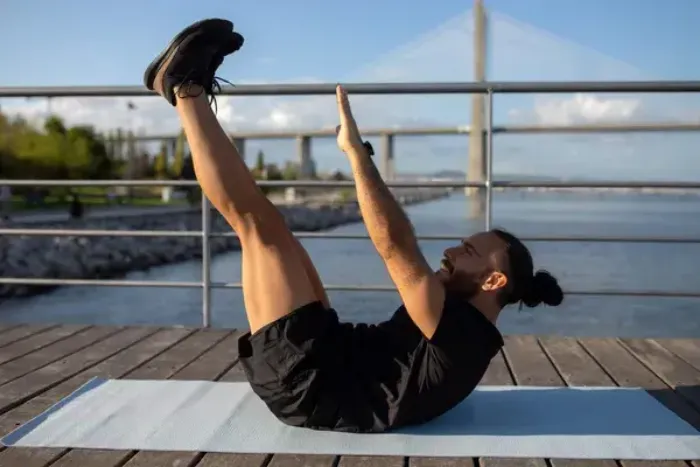
The V-up, often referred to as the jackknife sit-up, is a core exercise that works your hip flexors, glutes, and abdominal muscles. V-ups help you strengthen your core by engaging your rectus abdominis. Lying flat on your back, perform V-ups by simultaneously elevating your upper and lower bodies into the shape of a V.
Your back and legs should be at a 45-degree angle to the floor when you are using perfect form. V-up variations include executing the exercise while holding a free weight, such as a medicine ball or dumbbell.
V-Ups Exercise Video
How do you do a V-up?
To do a V-up with proper form, sit up straight at the peak of the exercise, being careful not to round your shoulders or back. After that, return to the earth with control.
Remember to breathe and avoid using your arms for motor control when performing the V-up. When you sit up, exhale, and when you sit back down, inhale.
V-up exercises to try:
Rees created the following program, which includes three different versions in addition to traditional V-ups. Include these exercises in your regimen to strengthen and stabilize your core and increase the power of your training runs and races.
Perform each exercise eight to twelve times, with ten to thirty seconds of rest between. Do the entire circuit twice to increase the difficulty.
If you need assistance learning the proper form, watch the video above where Rees demonstrates each step. Although an exercise mat is optional, no equipment is needed to do this workout.
V-up:
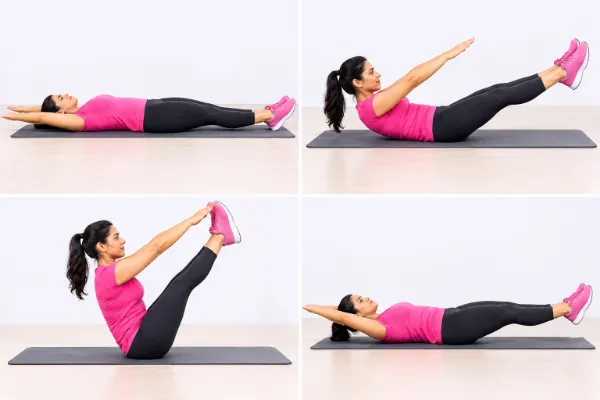
- In the hollow-hold posture, lie face up. With your biceps close to your ears, extend your legs and raise your arms above your head.
- Raise your legs, head, and shoulders off the ground to form a V. At the peak, bring your hands and feet as close together as possible.
- Return to the floor slowly.
- Continue.
V-up with bent legs:
- In a hollow-hold posture, lie face up. With your biceps at your ears, extend your legs and raise your arms above your head.
- For a raised tuck crunch, immediately tuck your knees and chest together.
- Return to a hollow-hold posture by extending your arms and legs.
- Do it again.
Alternating single-leg V-up:
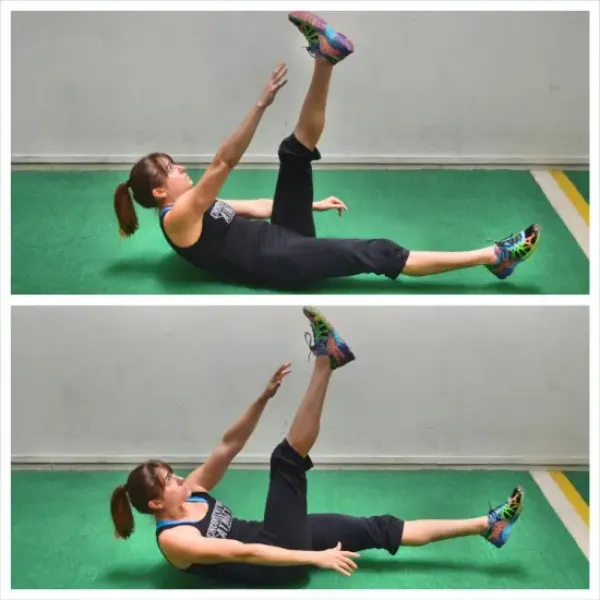
- In a hollow-hold posture, lie face up. With your biceps at your ears, extend your legs and raise your arms above your head.
- Raise your left leg and right arm off the ground in a V shape so that they touch as closely as possible at the top.
- Lower yourself back down slowly.
- Next, raise your right leg and left arm off the ground into a V shape so that they touch as closely as possible at the top.
- Lower yourself back down slowly.
- Do it again.
Side-lying V-up:
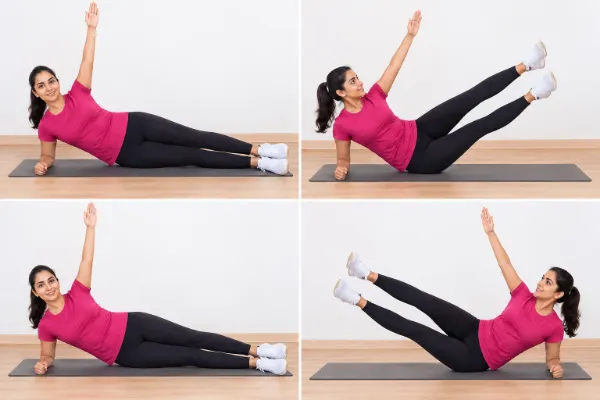
- With your legs straight, lie on your left side at a 45-degree angle.
- For balance, place your left forearm on the ground and shift your weight to your left hip. You should extend your right arm toward the ceiling.
- Make a V shape with your legs and right arm facing each other while keeping both legs straight.
- Lower yourself back down slowly.
- Do it again.
- Next, turn to the sides.
Benefits of V-Up Exercises:
Trains the Entire Rectus Abdominis in One Movement:
The majority of ab workouts only target one part of the abdominal wall; leg lifts target the lower abs, while crunches target the upper abs. V-ups use a simultaneous upper- and lower-body lift to train both at the same time.
V-ups are one of the highest-yielding single ab exercises available since research on abdominal workouts reveals that compound ab motions result in much more overall abdominal activation than partial-range crunches.
Builds Core Power and Athletic Explosiveness:
V-ups teach the kind of explosive core power employed in sports, such as jumping, sprint starts, and throwing actions, because of their simultaneous contraction nature, which involves the upper body and legs firing simultaneously.
Compared to slow-tempo isolation ab work, this has a greater direct impact on athletic performance. Stat: Adding compound core exercises to current programs across 8-week protocols results in significant gains in vertical leap and trunk rotation, according to athletic research on core training and explosive performance.
Strengthens Hip Flexors and Pelvic Control:
During v-ups, the deep hip flexors and pelvic stabilizers fire continually, creating the trunk-to-leg link needed for running, walking, and standing up.
Ab strength is translated into practical performance through this functional synergy. Especially helpful for office workers whose hip flexors weaken due to extended sitting.
Highly Time-Efficient — One Move for Full Abdominal Demand:
Because each rep loads the entire abdominal wall, performing five minutes of v-ups every day results in quantifiable full-ab strength gains within four weeks. Because a single exercise meets the majority of the demand, v-ups are especially beneficial for time-pressed people who cannot afford to perform separate crunches, leg raises, and oblique exercises every day.
How to Incorporate V-Ups into Your Workout Routine:
Because of their adaptability, V-Ups may be made to fit any program.
For Beginners:
- Twice a week, perform 2–3 sets of 10–15 repetitions.
- Put form above speed.
For Intermediate to Advanced:
Include workouts like these in a circuit with V-Ups:
- Planks
- Russian Twists
- Raising Your Legs
Use intervals of 30 to 60 seconds, with little to no break in between.
Full-Body Training Integration:
- Warm-Up Activation: To strengthen your core before lifting, perform V-Ups.
- Finisher: To fatigue the core, complete two rounds of 15–20 repetitions at the end of your workout.
Best V-Up Variations:
Exercise 1: Standard V-Up: Complete Rectus Abdominis + Hip Flexors; 3 sets × 10–12 repetitions
Lie flat on your back with your arms extended overhead and your legs straight, resting on the ground. Raise your legs and upper body simultaneously, reaching your hands all the way to your toes.
The body creates a V shape with the tailbone serving as the pivot. To begin, lower with control. 10–12 reps in three sets. The basic version. Modification: If a straight-leg version compromises form, bend your knees slightly throughout the lift to make it easier; lower the range by meeting at half-height until you can achieve complete V form.
Exercise 2: Tuck Up (V Up for Novices): 3 sets × 10 repetitions for Entry-Level Full Abs
Same initial position. Raise your upper body while simultaneously pulling your bent knees closer to your chest; your hands should reach your knees or shins, not your toes. Lower while maintaining control. 10 reps in three sets. The how-to-do-v-ups-for-beginners variant is intended for people who are starting from scratch with their ab strength.
Anyone who can perform simple crunches can perform the exercise because of the reduced range and bent knees, which reduce hip-flexor strain. Once the tuck-up form is locked, it will take three to four weeks to build to standard V-ups. Modification: If even the tuck-up version results in a breakdown in form, further decrease range by bringing knees only halfway to the chest.
Exercise 3: 3-Way V-Up: Rectus Abdominis + Obliques; 3 sets × 6 repetitions per direction
Same initial position.
Rep 1: Perform a conventional V-up by reaching your hands straight forward toward your toes. Rep 2: V-up while turning your upper body slightly to the right and reaching your hands to the right side of your toes.
Rep 3: V-up to the left. That cycle consists of one round, three sets, and six rounds (a total of eighteen reps). The only exercise that works all three abdominal muscle groups in a single session is the 3-way V-up, which adds rotational activation and targets the rectus abdominis and obliques. Once the regular V-up form is locked, save for week 4+. Reduce the range of rotation until oblique strength catches up by doing a small body turn instead of a full reach to the side.
Common V-up Mistakes To Avoid:
A few common mistakes are the main cause of V-up irritation. Before getting further repetitions, tidy these up:
- Instead of using your abs, use momentum. You may fake the procedure by tossing your arms and swinging your legs. Let your core do the lifting as you slow down.
- Your lower back should be rounded. Because rounding puts tension on your spine and relieves the load on your core, maintain a long spine and braced abs.
- Not just making it to the summit. Results are limited by half-reps. At the peak, extend your hands to your toes, then manage the drop.
- Dropping your legs too quickly. Lower under control: A large portion of the core work is done during the lowering phase.
- Holding your breath. Bracing differs from holding your breath in that you exhale as you crunch up and inhale as you drop.
- Let your lower back rise above the floor. Apply pressure all the way through. Avoid lowering your legs too much if it rises at the bottom.
Tips for Progressing Your V-Up Skills Over Time:
Consistency and smart growth are necessary for improvement. Here’s how to improve your V-Up skills:
Start With Bent-Knee V-Ups:
- Excellent for novices looking to reduce strain and leverage.
- As strength increases, switch to straight-leg V-Ups.
Add Static Holds:
- Pause for two to five seconds at the peak of the V position.
- increases core endurance and isometric strength.
Include Complementary Core Movements:
Increase the strength of your V-Up with:
- Hollow holds: teach stability and core tension
- Lower ab strength is developed with hanging leg lifts.
Conclusion: Embrace V-Ups for a Stronger, Sculpted Core
A tried-and-true method for developing a defined, functioning, and resilient core is to add V-Ups into your exercise regimen. This whole-body movement:
- Focuses on several abdominal muscles.
- Improves control and stability
- Scales according to your degree of fitness
V-Ups can improve your complete fitness journey with regular practice, increasingly difficult tasks, and astute recovery. This one movement offers significant benefits whether your goals are performance, aesthetics, or injury prevention.
FAQs:
Are V-ups better than sit-ups?
Compared to sit-ups, V-ups are a more difficult ab workout that puts more strain on the lower abs and hip flexors. They can develop the core more effectively than sit-ups, but doing them correctly requires a strong core.
How long should I do V-ups for?
For five to ten seconds, hold this raised position. Then, slowly return to your starting position and repeat the exercise with the other leg.
Are V-ups difficult?
How to Reach a V-Up. Although V-ups may appear simple at first, performing them successfully calls for a considerable bit of strength and stability. The rectus abdominis is the main muscle used in V-ups; therefore, strengthening it will enhance your performance.
Do V-ups get you abs?
V-ups work the hip flexors, obliques, and rectus abdominis. You’ll strengthen these muscles and begin to notice definition in your abs if you perform exercises regularly and correctly.
How to get a V-shape quickly?
Example of a 4-Day V-Shaped Workout
Straight-Arm Lat Pulldown: 15–20 repetitions per set.
Strict pull-up with machine assistance: two sets of five to ten repetitions.
Wide-Grip Lat Pulldown: 10–15 repetitions in two sets.
Snatch Grip Deadlift: 10–15 repetitions in two sets.
Two sets of ten to fifteen repetitions of the cable lateral raise.
What causes V-cut abs?
The transversus abdominis and obliques meet at V lines. Only when your body fat percentage is really low—11% or less for men and 14% or less for women—can you see them.
What is a V-shaped body type?
The V-shaped figure, sometimes known as an inverted triangle or inverted pyramid, can be identified by long legs, a less defined waist, and shoulders that are wider than the hips. You most likely have this shape if your shoulder line is substantially wider than your hips. Measure your hips, waist, and shoulders to be certain.
How to get the V shape at home?
Pull-ups and lat pulldowns are examples of exercises that directly target these muscles and help develop the width that forms the top of the V. From a physique standpoint, the lats shape the upper lines that taper down toward the waist and are the main source of upper-body width.
What is the best V-line exercise for abs?
Workouts that focus on your lower abs will help you achieve a V-line. Try lower stomach workouts including reverse crunches, hanging leg raises, and leg lifts. To reduce body fat and reach your fitness objectives more quickly, combine these exercises with cardio and a healthy diet.
References:
- Minzner, C. F. (2009). Riots and Cover-Ups: Counterproductive control of local agents in China. FLASH – Fordham Law Archive of Scholarship & History (Fordham University), 31(1), 53. https://ir.lawnet.fordham.edu/faculty_scholarship/6
- Zickl, D., & Boswell, R. (2025, April 11). V-up variations to build core strength and stability. Runner’s World UK. https://www.runnersworld.com/uk/training/cross-training/a64433617/v-ups/
- Chadwick, P. (2026, July 23). V-Ups exercise tutorial: Explosive core Strength. Gymless. https://gymless.org/v-ups/
- Bothra, T. (2026, October 30). 5 Variations of V-Ups exercises. Habuild. https://habuild.in/strength-training/v-ups-exercises
- Swolverine Inc. (2025, April 25). Mastering V-Ups: the ultimate guide to sculpting your core and achieving perfect form. Swolverine. https://swolverine.com/blogs/blog/mastering-v-ups-the-ultimate-guide-to-sculpting-your-core-and-achieving-perfect-form-2?srsltid=AYCX9vK6y1ZDWBh2C3p9o-5DCfAvTv5oIVlRKL1MWjirRQvLil_z9Ndz