8 Best Scapular Stabilization Exercises
Introduction
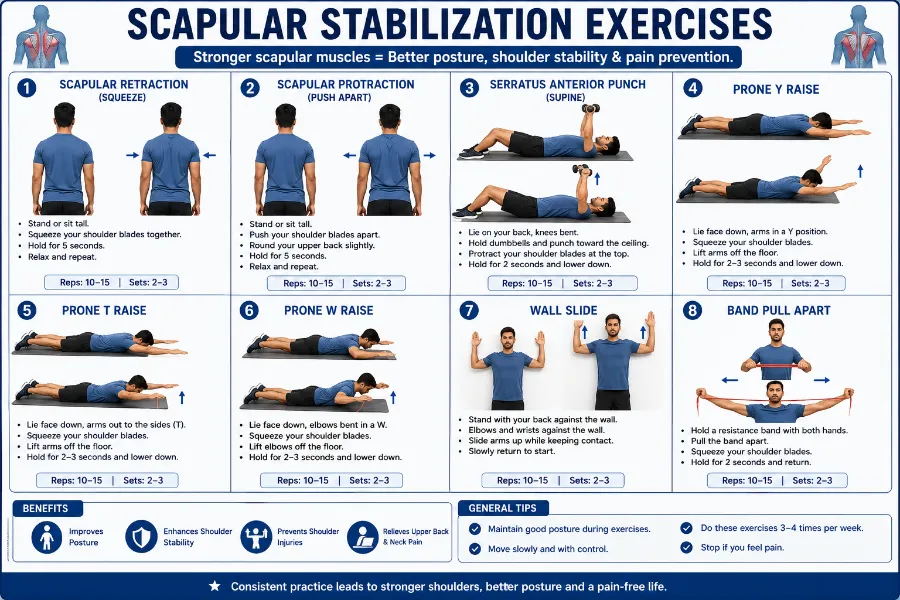
Scapular stabilization exercises are designed to strengthen and improve the control of the muscles that support the shoulder blade. The scapula plays an important role in maintaining proper shoulder movement, posture, and upper-body function. Weakness or poor coordination of the scapular muscles can contribute to shoulder pain, stiffness, impingement, and reduced movement efficiency.
These exercises focus on muscles such as the serratus anterior, trapezius, and rhomboids to improve scapular stability and coordination. Regular practice can help improve shoulder mechanics, posture, and functional strength. They are commonly included in physiotherapy programs for people with shoulder pain, rounded shoulders, and other movement-related problems.
Scapular stabilization exercises help the shoulder blade remain in a controlled and stable position during arm and upper-body movements. Because the shoulder joint depends heavily on the proper movement of the scapula, good scapular control is essential for efficient and pain-free shoulder function.
These exercises can improve scapular strength, mobility, coordination, posture, and shoulder stability. They are particularly useful for people who experience shoulder weakness, poor posture, shoulder impingement, or difficulty performing overhead activities.
Top Scapular Stabilization Exercises
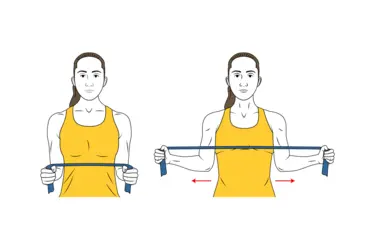
Banded Pull-Apart
The muscles in your upper back that support your shoulder blades during upper body movements are strengthened by this workout. By bringing the shoulder blades closer to the spine, these muscles can increase pulling strength, release shoulder tightness, and open up the chest.
How to do it:
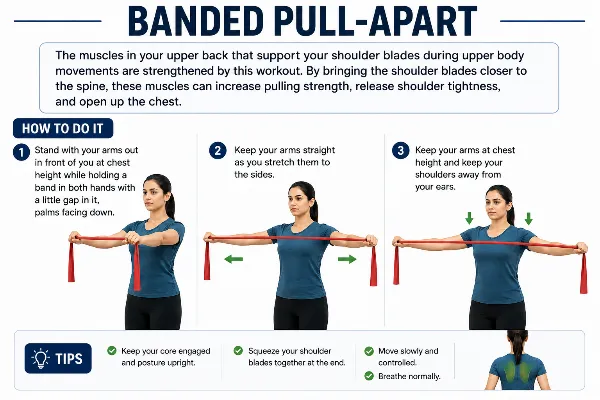
- Stand with your arms out in front of you at chest height while holding a band in both hands with a little gap in it, palms facing down.
- Keep your arms straight as you stretch them to the sides.
- Keep your arms at chest height and keep your shoulders away from your ears.
Bent-Over IYT
This exercise looks like a common overhead movement by targeting the major muscles that support your shoulder blades in various postures. This is an excellent workout for anyone with shoulder or neck pain from overhead exercise since it makes it easier for your arms and shoulder blades to operate together.
How to do it:
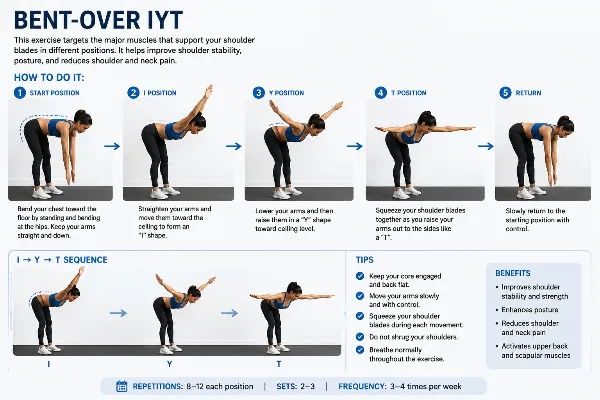
- Bend your chest toward the floor by standing and bending at the hips.
- You should have your arms down toward the floor and straight.
- Now, straighten your arms and move them toward the ceiling to form an “I” shape.
- After letting your arms down again, raise them in a “Y” form toward ceiling level.
- Squeeze your shoulder blades together as you lower your arms and raise them out to the sides like a “T.”
- Return to the starting position with confidence.
Resisted Serratus Hug Movement
In order to keep your shoulder blades securely in place against your rib cage, this exercise works the muscles along your ribs. It helps in maintaining the stability of your shoulder blade during movement. Imagine that your shoulder blades are moving from your rib cage to your armpits as you perform this movement.
How to do it:
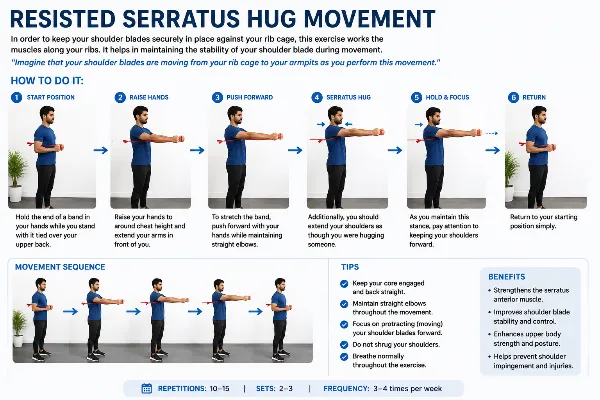
- Hold the end of a band in your hands while you stand with it tied over your upper back.
- Raise your hands to around chest height and extend your arms in front of you.
- To stretch the band, push forward with your hands while maintaining straight elbows.
- Additionally, you should extend your shoulders as though you were hugging someone.
- As you maintain this stance, pay attention to keeping your shoulders forward.
- Return to your starting position simply.
Push-Up Plus
Similar to the resisted serratus hug movement, this exercise requires you to hold your body weight. For people who suffer shoulder pain when moving large objects, it can be quite helpful.
How to do it:
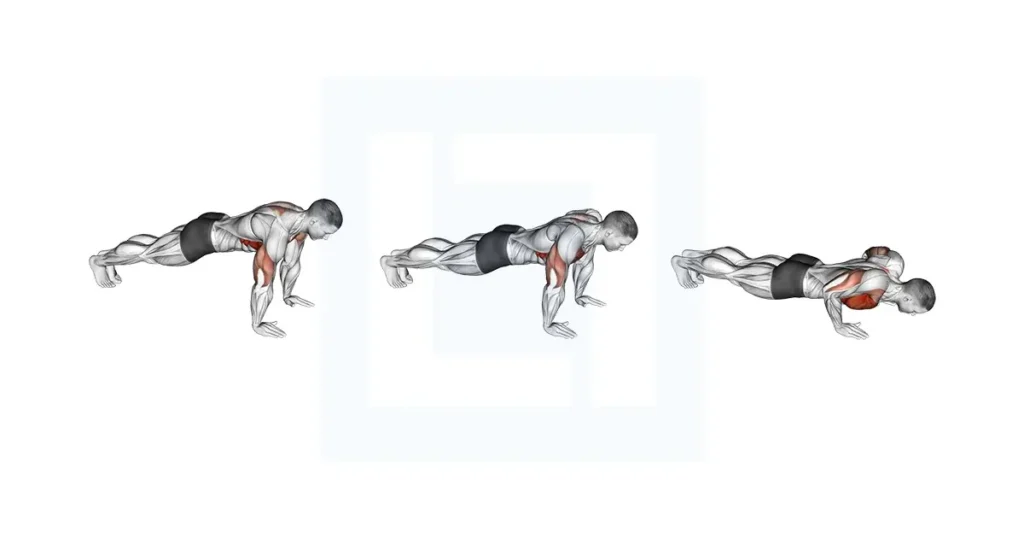
- Start on all fours, then go to a plank posture by stepping one foot back and then the other.
- To round your upper back into the top of your head, press into your hands while maintaining straight elbows.
- As your shoulder blades move apart, your upper back will rise.
- To unround your upper back and get back to the beginning posture, relax your shoulder blades.
Shoulder Rows
Your mid-back muscles are the main focus of this traditional workout. Remember to keep your shoulders relaxed and away from your ears while you pull. This makes it easier for you to feel the strain in your mid-back instead of your shoulders.
Remember to keep your shoulders relaxed and away from your ears while you pull.
How to do it:
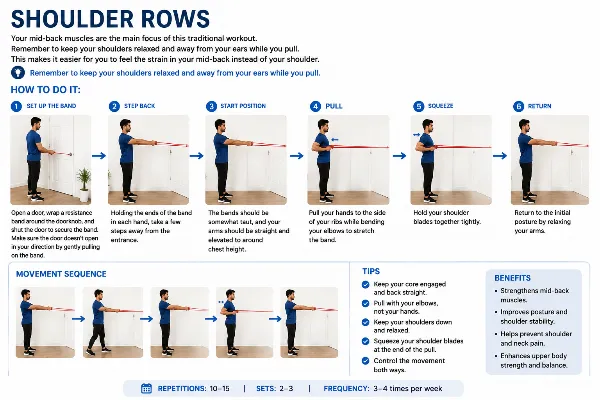
- Open a door, wrap a resistance band around the doorknob, and shut the door to secure the band. Make sure the door doesn’t open in your direction by gently pulling on the band.
- Holding the ends of the band in each hand, take a few steps away from the entrance.
- The bands should be somewhat taut, and your arms should be straight and elevated to around chest height.
- Pull your hands to the side of your ribs while bending your elbows to stretch the band.
- Hold your shoulder blades together tightly.
- Return to the initial posture by relaxing your arms.
Resisted Y
The muscles in the bottom portion of your upper back, which support the stability of your shoulder when reaching up, are the focus of this difficult exercise. As you fold the band into the Y form, it might be useful to picture your shoulder blades slipping into your rear pocket.
How to do it:
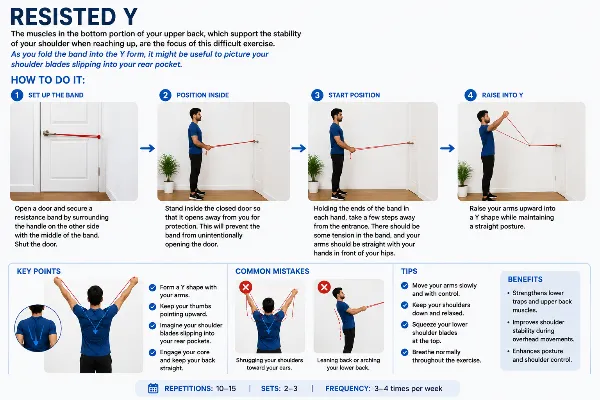
- After opening a door, tie a resistance band by surrounding the handle on the other side with the middle of the band. Shut the door.
- Stand inside the closed door so that it opens away from you for protection.
- Holding the ends of the band in each hand, take a few steps away from the entrance.
- Raise your arms upward into a Y shape while maintaining a straight posture.
Resisted Shoulder Internal Rotation
This exercise focuses on the muscles that allow your arm to bend inward. Additionally, it facilitates arm and shoulder blade coordination. This strengthens the shoulder during pushing and pulling exercises.
How to do it:
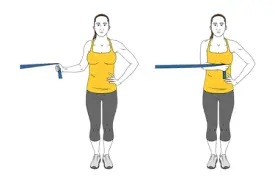
- To secure a resistance band, open a door, wrap it around the opposite handle, and then close the door.
- Stand inside the closed door so that it opens away from you for your safety. This will prevent the band from unintentionally opening the door.
- Your forearm is directed in the direction of the door, and your elbow is bent 90 degrees.
- Take a few side steps away from the entrance since the band is under some pressure.
- Rotate your arm and move your hand to the far side of your rib cage to stretch the band.
- Your elbow stays folded to your side and bent at a 90-degree angle for the whole exercise.
- Before you relax your hand, return it to its original position.
- On the opposite side, repeat.
Resisted Shoulder External Rotation
This exercise routine focuses on the rotator cuff muscles, which rotate your arm outward. Where your shoulder blade joins your upper arm, it provides stability. In order to support the shoulder during overhead movements, this exercise increases strength and endurance.
How to do it
- One way to fasten a resistance band is to open a door and wrap one end of the band around the handle on the other side. After that, shut the door.
- To verify that the band does not unintentionally pull the door open, stand on the side of the door that is closing.
- Wrap the other end of the band around your extended hand once the door is at your side.
- Rest your forearm across your abdomen, with your elbow bent to a 90-degree angle.
- To create tension for the band, take several side steps away from the entrance.
- Throughout the movement, your elbow stays bent and at your side.
- Before you relax your hand, return it to its original position.
- On the opposite side, repeat.
Benefits of Scapular Stabilization Exercises
One of the best ways to strengthen your upper body and promote healthy mobility is to add scapular stability exercises to your program. The previously mentioned exercises can help your muscles grow stronger and more coordinated so you move with comfort, whether you’re managing shoulder pain or instability from sports, everyday tasks, or job responsibilities, or you just want more confidence in your regular activities. Among the main advantages of performing these workouts are:
Release of stress in the neck and shoulders. Your neck is supported at the base of your shoulder blades. Your shoulders and neck might feel less strain if you have strong, well-coordinated shoulder blade muscles. For some people, this may also help reduce the frequency or severity of tension headaches.
Improved base for mobility. Consider your shoulder blades to be your arms’ launchpad. Building a strong foundation enables your arms to be stronger and more effective when you push, pull, lift, or throw. Whether you’re an athlete serving a ball or have a physically demanding profession requiring lifting, this is particularly helpful if you perform repetitive overhead exercises.
Increase your reach above the ground. Your shoulder blade must rotate effectively in order to raise your arm all the way up without raising your shoulder toward your ear. You can reach high shelves or put on a coat more easily if you strengthen the muscles in your upper back and around your shoulder.
Less difficulty when doing regular duties. Stronger scapular muscles are stronger. This implies that you could have less fatigue or stiffness when driving for long periods of time, carrying groceries, or sitting at a computer.
Conclusion
Scapular stabilization exercises can help improve shoulder blade control, posture, and upper-body movement by strengthening the muscles that support the scapula. Exercises such as scapular retraction, wall slides, serratus punches, and scapular push-ups can be incorporated into a regular exercise routine based on individual needs and ability.
For best results, perform these exercises with slow, controlled movements and maintain proper posture throughout. Avoid movements that cause sharp or increasing pain. If you have persistent shoulder or neck pain, weakness, or difficulty moving your arm, consult a physiotherapist for an individualized assessment and exercise plan.
FAQs
Which exercise is best for scapular stabilization?
Since the shoulder blade may move in many different directions, there is no one “best” exercise; nonetheless, the scapular push-up is often regarded as the best fundamental exercise. The main muscles that maintain your shoulder blade securely against your rib cage and stop “winging” are the serratus anterior and rhomboids.
What is scapular stabilization?
The ability of the muscles around your shoulder blade (scapula) to maintain it smoothly and firmly against your rib cage is known as scapular stability. This establishes a stable base. A strong shoulder blade allows safe and powerful upper body movement whether lifting, pushing, or reaching with your arm.
What causes poor scapular control?
A change in the shoulder blade’s typical resting posture or movement results in poor scapular control, sometimes referred to medically as scapular disorder.
Which muscle controls scapular depression?
The main muscles that support and bring the scapula downward are the primary depressors.
The primary muscle that prevents your shoulders from shrugging is the lower trapezius, which pulls the shoulder blade straight down and back.
Pectoralis Minor: Draws the scapula’s coracoid process forward and downward on the rib cage.
When your hands or arms are fixed, such as during a dip, the latissimus dorsi helps draw the shoulder girdle down.
Serratus Anterior (Lower Fibers): Supports downward rotation by keeping the lower border of the shoulder blade level on the chest wall.
How to strengthen scapular stabilizers?
To regulate shoulder blade movement, improve posture, and prevent injuries to your shoulder joints, strengthen your scapular stabilizers with target exercises like scapular push-ups, resistance band pull-aparts, and wall angels.
References
- Banded pull-aparts. (n.d.). [Video]. Hingehealth. https://www.hingehealth.com/gb/en/resources/articles/scapular-stabilization-exercises/
- White, A. (2023, May 30). 5 Scapular stabilization exercises for strong shoulders. Healthline. https://www.healthline.com/health/fitness-exercise/scapular-stabilization-exercises#ity-ws
- Dodson, J. T. (2026, August 6). 9 best scapular exercises to perform for shoulder impingement (and 4 alternates). Medbridge.