Floor Double Crunches: Benefits, Proper Technique, and Tips
Introduction:
Floor Double Crunches are an effective abdominal exercise that targets the upper and lower abdominal muscles simultaneously. It combines the two crunch variations—the reverse crunch and the classic crunch, both of which are excellent ab workouts in and of themselves.
However, it is more than a core exercise. By combining the two crunches, you can also target the hip flexors and lower abdominal regions.
The double crunch not only helps you get to, or maintain, that most desirable chiseled six-pack abs, but also strengthens the muscles that provide balance and support for sport-specific activities and big lifts, not to mention everyday activities.
Crunches are a bodyweight floor exercise that flexes the lumbar spine to target the rectus abdominis. A crunch, in contrast to a sit-up, merely raises the upper back off the ground, focusing effort on the core and minimizing hip flexor involvement. The most crucial element in achieving genuine results is mastering correct form before increasing loudness.
Muscles Worked By The Double Crunch:
This combo of two crunch exercises will activate your core and lower body, giving the following muscles a good workout:
Rectus Abdominis:
These two muscles are found on the front of your abdomen and are frequently referred to as the abs. It extends to the front of the pelvis from the ribs. Maintaining a slim frame that accentuates the lines and bumps of a six-pack is made possible by working out the rectus abdominis.
The trunk and spine are stabilized and flexed by the rectus abdominis.
Obliques:
The external and internal obliques are your two groups of oblique muscles. They connect to the top of the hip bone, the ribs, the lower back, and the abdominal fascia. They are situated diagonally on either side of your waist.
- The most superficial external obliques wrap around the sides of the waist and go diagonally downward between the pelvis and lower ribs.
- The internal obliques, which run diagonally in the opposite direction between the pelvis and lower ribs, are located beneath the external obliques.
Trunk flexion and rotation are important functions of the obliques. They promote torso rotation, side bending, and lateral flexion of the spine.
Hip flexors:
The hip flexors serve as the link between the pelvis, abdomen, and lower body. As their name implies, their main purpose is to flex the hips. When you are sitting, they flex passively; when you do double crunches, they flex aggressively as your knees approach your chest.
How to Get Started with Crunches:
What You Must Do First:
For comfort, all you need is a yoga mat and a level surface. No gym membership and no equipment. Make sure you have a few feet of empty floor space and dress comfortably so you can move freely.
Realistic Goal Setting:
Start with 2–3 sets of 10–15 repetitions if you’re new to core training, and pay close attention to form over number. Raising the amount too soon causes compensatory movement patterns and neck pain, which compromise the outcomes. Aim for consistent advancement over a period of four to six weeks before increasing the volume or difficulty.
Begin with the Fundamentals:
Your basis is the usual crunch. Before trying full-body crunches, bicycle variants, or reverse crunches, master this. 50 careless repetitions are less beneficial than a well-executed fundamental crunch that is controlled, breath-synchronized, and spine-neutral.
This useful guide to strength training at home complements a devoted ab practice for individuals who are prepared to develop a more comprehensive at-home exercise regimen.
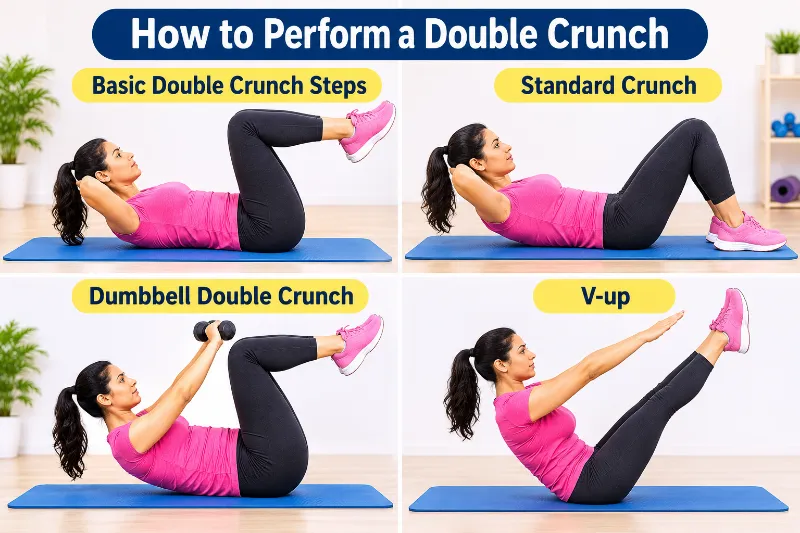
How to perform a double crunch:
Learning the double crunch is quite simple. You may also adjust the difficulty level based on your level of fitness. The V-up and the conventional crunch are two versions that raise or lower the intensity, respectively.
Basic double crunch steps:
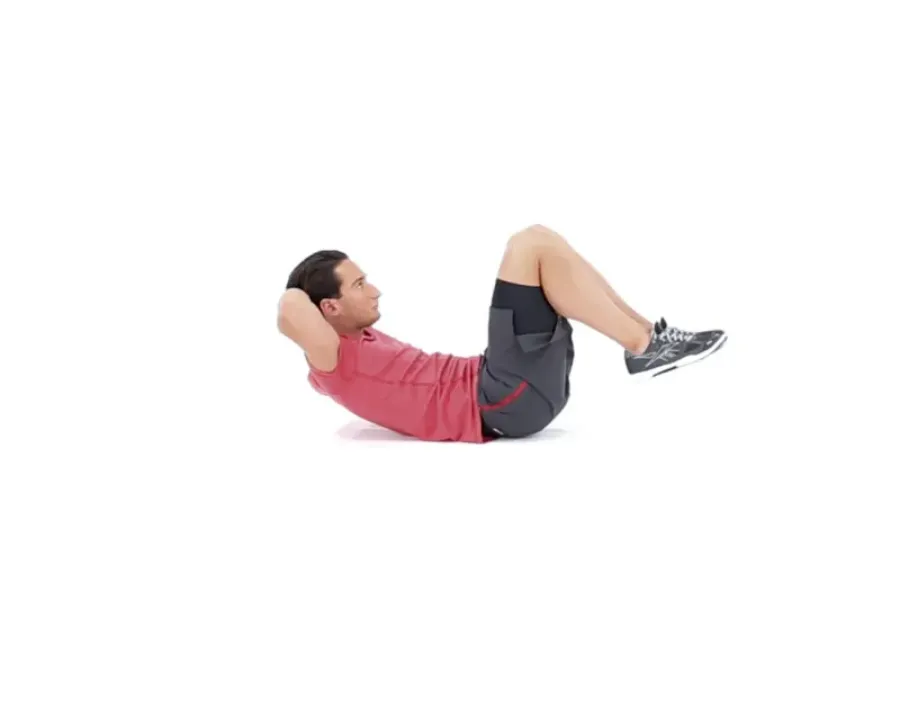
The steps to perform a simple double crunch are as follows:
- Start on your back with your feet flat on the floor, your knees bent, and your hands beside your head, lightly stroking the side of your head with your fingertips. Another option is to fold your arms over your chest.
- Imagine your lower ribs shifting slightly toward your pelvis as you contract your abdominals to brace your core. On the floor, your lower back should softly flatten. This braced point is where each repeat should start.
- Raise your knees gradually until your thighs are slightly above a 90-degree angle to the floor.
- Raise your chest toward your knees while lifting your head and shoulders off the ground. Your forehead should be around 6 inches (15 cm) from your knees at the peak of the repetition.
- Continue in the other direction until your feet are level on the ground and your shoulders and back are on the floor.
- As part of your exercise regimen, do three sets of ten to fifteen repetitions.
Common error: arched low back
One typical mistake made when doing ab workouts is arching the lower back. This pose may cause lower back tension, deactivate the rectus abdominis, and emphasize the hip flexors.
According to research, practically all core exercises require the braced abdominal posture without a lower back arch in order to be performed safely.
Make sure you’re correctly bracing at the start of each rep to prevent this error. Stop the set and take a break before continuing your reps if your back begins to arch and you get too tired to keep the brace in place.
Common error: crunching the neck
Compressing your chin into your chest while resting your hands behind your head is another extremely typical problem with crunch workouts.
This position strains your neck and may even make breathing more challenging, according to a study.
To prevent this frequent mistake, carefully follow the attached recommendations.
Make sure your hands are positioned next to your head so that your fingertips lightly contact your temples. Be careful not to interlace your fingers behind your head or cross your hands.
Standard crunch:
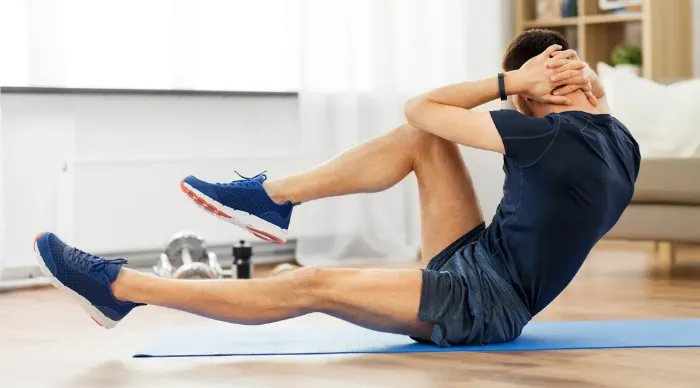
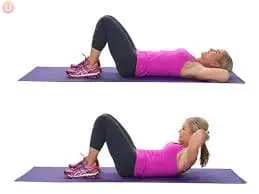
You can switch back to a regular abdominal crunch if you find the double crunch too challenging. You maintain your feet on the floor during this exercise, which is quite similar to the double crunch.
To carry out the typical crunch:
- Start on your back with your feet flat on the ground, your knees bent, and your hands beside your head, lightly stroking the side of your head with your fingertips. As an alternative, you might fold your arms over your chest.
- Engage your abdominal muscles and visualize your lower ribs shifting slightly toward your pelvis to brace your core. The floor should gradually flatten your lower back. This braced position should be the starting point for each repeat.
- Raise your chest toward your knees while lifting your head and shoulders off the ground. Your upper back should be around 8 inches (20 cm) off the ground at the top of the repetition.
- Once your upper back and shoulders are on the ground, reverse the movement.
- As part of your exercise regimen, do three sets of ten to fifteen repetitions.
The same rules that apply to the double crunch also apply to preventing lower back arching and neck compression.
Dumbbell double crunch:
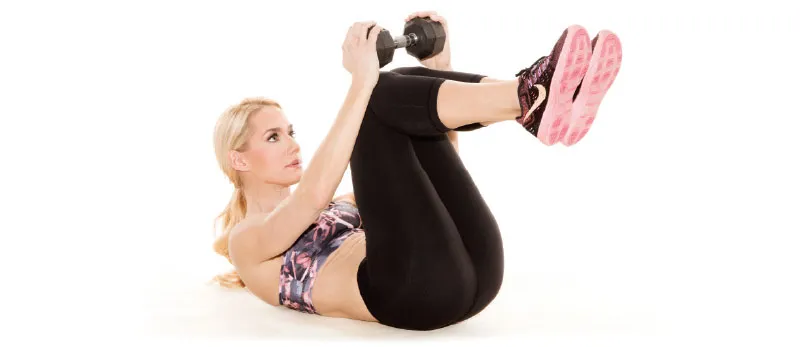
The dumbbell double crunch is a fantastic technique to add external resistance to the exercise if you have access to basic equipment.
With the only difference being holding a dumbbell between your feet while performing the crunch, it’s nearly identical to the regular double crunch.
- Start sitting with your feet on the ground and your knees bent. A dumbbell should be positioned between your feet perpendicular to each foot’s length. The dumbbell’s weighted top side should land on the tops of your feet.
- While lying on your back with your legs elevated, position your hands gently alongside your head, allowing your fingertips to rest near your temples. Another option is to fold your arms over your chest.
- Engage your abdominal muscles and visualize your lower ribs shifting slightly toward your pelvis to brace your core. The floor should gradually flatten your lower back. This braced position should be the starting point for each repeat.
- Raise your chest to your knees while lifting your head and shoulders off the ground.
- Lift your feet and the dumbbell off the ground, pull your knees up to your chest, and elevate your shoulders and upper back off the ground. To keep the dumbbell secure, keep your feet squeezed together.
- Once your upper back and shoulders are on the ground, reverse the motion.
- As part of your exercise regimen, do three sets of ten to fifteen repetitions. To adjust the intensity, use a lighter or heavier dumbbell.
V-up:
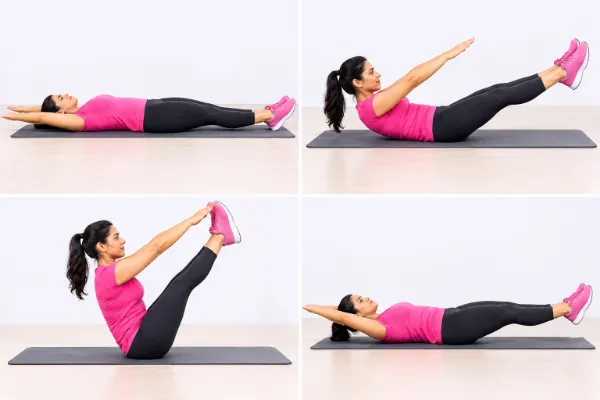
If you can complete three sets of fifteen double crunches with ease, the V-up exercise is a great choice. Although your arms and legs are straight rather than bent throughout the workout, the general mechanics are extremely similar.
To perform a V-up:
- Lie flat on your back with both legs extended and your arms stretched out comfortably at your sides.
- Lift your arms and legs 6 to 12 inches (15 to 30 cm) off the ground, then support your core by moving your ribs slightly closer to your pelvis and contracting your abdominal muscles. The floor should gradually flatten your lower back.
- Tighten your thighs and feet together.
- Raise your torso and legs slowly, then use your hands to grasp your toes. Your legs and torso should form a “V” shape at the peak of the repetition. Don’t worry if you can’t reach your toes; just get as near as you can.
- To go back to the starting position, slowly reverse the movement. Between repetitions, you should ideally keep your feet and shoulders off the ground.
- Do three sets of six to twelve repetitions.
The V-up is subject to the form cues for avoiding a low-back arch.
Since you won’t have your hands on your head, pain in your neck is typically less of a problem. Just be careful not to “reach” with your head or neck and to maintain the same position of your chin in relation to your body.
Benefits of Double Crunches:
- Goals for the Whole Core: Double crunches, in contrast to other types of crunches, ensure balanced core growth by simultaneously activating the upper and lower abs. Over time, this results in a more defined and toned midsection.
- Enhances Toning of Muscles: Double crunches are a fantastic option for people who want a more defined core since they assist in developing lean muscle in the middle. By doing these crunches on a regular basis, you may increase your general strength and tone your muscles.
- Encourages Fat Loss: Double crunches can assist in burning calories and improving weight management, but no activity by itself can ensure fat loss. Results are improved when combined with aerobics and a healthy diet.
- Strengthens and Stabilizes the Core: For general fitness, better posture, and the avoidance of lower back discomfort, a strong core is crucial. Deep core muscles are used in double crunches to assist in stabilizing the body during a variety of movements.
- Provides Flexibility with Crunch Variations: There are numerous methods to modify double crunches to make your workout more difficult. For instance, weighted crunches increase resistance and aid in the development of stronger muscles.
Who Should Try Crunches?
In all of fitness, beginner crunches have one of the lowest barriers. You may begin with very few repetitions and don’t need any equipment or technical expertise at first. For someone starting a program from scratch, the normal crunch is a great place to start.
Women’s crunches are very beneficial for women and don’t increase bulk since most women don’t have the hormonal profile needed for major hypertrophy. Crunches do help with posture, lower back support, and core tone.
Older persons: By promoting spinal health and effective mobility, modified crunches and seated core exercises can help older persons. However, before including crunches in their program, anyone with osteoporosis or pre-existing spinal issues should speak with a physiotherapist or doctor. As part of a more comprehensive regimen, progressive strength-building workouts for the entire body could also be suitable.
Working Professionals: Your postural muscles are frequently overextended, and your core is chronically weak if you spend eight or more hours a day at a desk. At the conclusion of the workday, even a 10-minute crunch practice may significantly improve posture, ease lower back strain, and restore energy.
Crunch Variations to Try:
Try these modifications to change up your abdominal exercises:
- Weighted crunches: Press a dumbbell or a weight plate up against your chest to increase resistance.
- Reverse crunches: Keep your upper body still while raising your legs near your chest to concentrate more on your lower abs.
- Bicycle crunches: Alternate elbow-to-knee motions in a cycling motion to work the obliques.
- Side crunches: Twist your torso to one side while performing the crunch to target your side abs.
- Double crunch hold: To engage the core more fully, hold the crunch position for a few seconds rather than instantly lowering back down.
Build Core Strength with a Routine That Actually Works:
It is not enough to perform hundreds of crunches once a week in the hopes of developing a strong core. Every day, it’s about increasing structure, proper form, and consistency.
- Live-guided strength and core exercises every day
- A built-in progression from beginner to advanced
- Completely home-friendly; no equipment needed
- Professional advice to maintain proper shape
- A community that holds you responsible
Common Mistakes to Avoid When Doing Crunches:
Bad Form: Tugging on Your Neck. Locking fingers behind the head and pulling the neck forward is the most common crunch error. The only purpose of your hands is to provide gentle support. Your abdominal muscles should be the only source of lifting force—neither momentum nor neck strain.
Ignoring the warm-up, lower back pain is more likely to occur if you get right into crunches on a chilly spine. Before starting your core workout, spend three to five minutes doing gentle exercises like cat-cow stretches, pelvic tilts, or a little stroll.
Keeping Your Breath in During the effort phase, a lot of young people hold their breath. This lowers muscular activity and increases intra-abdominal pressure. As you crunch upward, exhale; as you descend, inhale. One essential component of proper crunch technique is controlled breathing.
Excessive Training Without Recovery. Like any other muscle, the abs require time to heal. Crunching hundreds of times a day without taking a break causes a plateau and raises the risk of damage. Daily overload is less effective than three to four focused sessions per week alternated with rest days.
The True Killer of Progress: Inconsistency. Inconsistency is the main barrier to core development, not poor form or few repetitions. Periodic crunch sessions yield very little. Over the course of weeks and months, a consistent, daily approach—even ten minutes—compounds into significant strength.
FAQs:
How to do floor crunches properly?
To do a floor crunch, either position your hands lightly behind your head with broad elbows, or lie on your back with your feet flat on the ground and your knees bent.
How to perform a double crunch?
By combining a conventional crunch and a reverse crunch, the double crunch is a powerful core workout that targets your upper, middle, and lower abdominal muscles simultaneously.
Which crunches are the most effective?
The best crunches work the rectus abdominis (often known as the “six-pack”) and the obliques, among other core muscles. They also protect your spine by using short, controlled movements instead of complete sit-ups.
Are crunches better than planks?
Although each exercise has a distinct role, planks are typically seen to be superior to crunches for total functional strength, spinal stability, and full-body muscle activation.
How many crunches is a good amount?
An acceptable goal for a general exercise regimen is two to three sets of ten to fifteen slow, controlled repetitions, done two to three times a week.
Can I do ab exercises every day?
Only if the workouts are low-intensity and low-load can you train your abs every day. However, as your abdominal muscles require time to recover just like any other muscle group in your body, it is not advised to train them vigorously or with high resistance every day.
Are double crunches effective?
The upper, middle, and lower abdominal muscles may all be worked simultaneously by performing double crunches.
References:
- Colletta, M. (2026, February 24). How to do double crunches (Form & muscles worked). Steel Supplements. https://steelsupplements.com/blogs/steel-blog/how-to-do-double-crunches-form-muscles-worked?srsltid=AYCX9vJmWqxmKv71IFHIPDrZFQ4um9FVqLtZf448L74oPjO3z436jwOt
- Cpt, T. R. B. (2021, February 8). Double crunches: benefits and how to do them. Healthline. https://www.healthline.com/nutrition/double-crunch#instructions
- Bothra, T. (2026, September 19). How to do crunches: Benefits, techniques & mistakes. Habuild. https://habuild.in/habitology/strength-and-fitness/how-to-do-crunches
- Sathe, A. (2025, April 21). Double crunches: benefits and how to do them. NineFit – Shop Fitness Wear and Gear. https://ninefit.com/double-crunches-benefits-and-how-to-do-them/