Balance Exercises for a Weak Ankle
Introduction:
Exercises that strengthen weak ankles will help you become more stable, reduce pain, and avoid additional injuries.
Over time, regular wear and tear and tension can cause injuries to your ankle joints and muscles. Your balance may be affected by weak ankles.
What Causes Weak Ankles?
It’s important to know the causes of weak ankles before beginning the workouts.
- Injury. Ankle weakness can result from a variety of injuries. This might involve a sudden fall or an incident involving a particular activity, such as basketball, volleyball, or soccer.
- Inadequate or poorly fitting shoes. Wearing the incorrect shoes for your activities might also lead to weak ankles.
- Age. Sometimes it’s merely a side effect of aging and joint degeneration.
- Obesity. Your feet and ankles may naturally weaken if you are overweight.
- A variety of other foot issues. Weak ankles are associated with Achilles tendinitis, gout, osteoarthritis, and other foot issues.
Whatever the reason behind your weakening ankles, your main objective is to get them stronger again. After all, your ankles play a critical role in maintaining stability and developing strength.
Symptoms of Weak Ankles:
Look for the following signs if you’re unsure if your ankles are strong enough. These are signs of ankle weakness:
- Twisting or rolling your ankle, depending on the outcome. This usually entails rolling the joint outward. The most typical sign of a weaker ankle joint is this.
- Having aching or sore ankles or feet
- Being prone to sprains and other injuries involving the ankle
- Problems with balancing
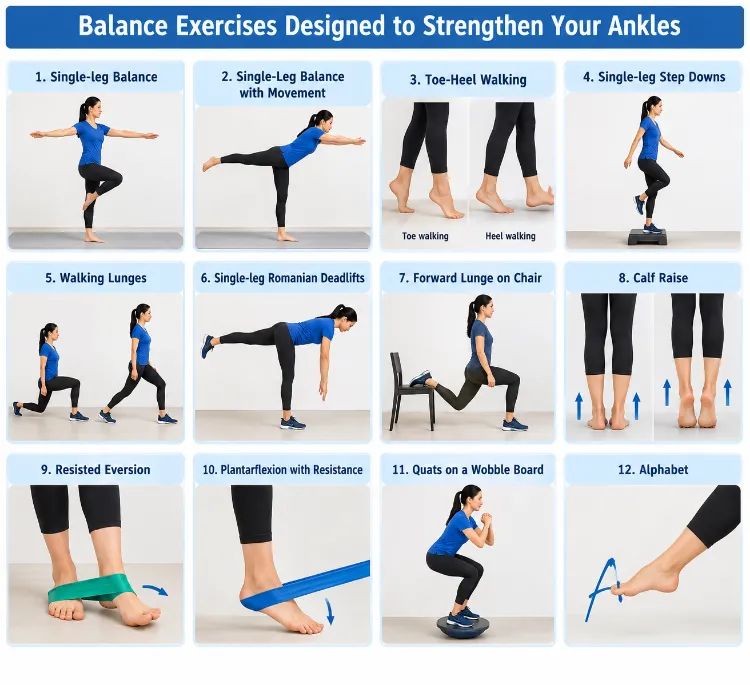
Balance Exercises Designed to Strengthen Your Ankles:
The exercises shown below may help you heal from an injury or strengthen your ankle.
Try these to strengthen your ankles gradually and enhance your body’s balance. Remember that these ankle strengthening exercises may not only increase ankle stability but also build your lower leg, core, and other muscles throughout your body.
You may discover that one ankle is genetically stronger than the other by performing these exercises. It is typical for you to have one dominant side, even if you have not harmed one. In order for them to be equally powerful, it is crucial to attempt to balance them out.
Single-leg Balance:
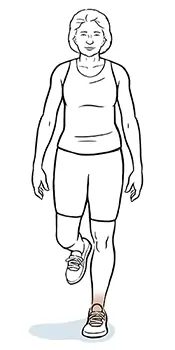
A sprained ankle is one example of an illness or injury that might impair your ability to balance on your feet. You may improve your leg strength and, consequently, your balance by performing this easy single-leg workout. You only need a chair or anything to cling to for additional support.
- When you stand up, your legs should be either exactly behind your torso or positioned as naturally as possible.
- Instead of using both feet, put all of your weight on one.
- Hold for at least a few seconds, and as you improve, extend the time.
- Repeat after switching legs.
- Every set should be repeated.
- Do the workout once per day.
As you get better, you may stand on unstable surfaces, like a BOSU ball, for an extra challenge, or raise your non-weight-bearing leg off the ground more and more. Another option is to just extend the duration of the position.
Single-Leg Balance with Movement:

If this particular workout isn’t challenging enough for you, increase the challenge by including some more movement.
- Standing with your legs straight under your body feels most natural.
- Instead of using both feet, put all of your weight on one.
- Gently raise the leg off the ground without any weight on it.
- Move your elevated leg rather than remaining motionless, as in the previously described single-leg balance.
- Bend your knee and raise it to your waist before lowering it again. Swing it behind your body and in front of you. Alternatively, extend your leg to the side of your body and then bring it back in. Do all three in order, maybe.
As with the original single-leg balance, utilize a chair for additional support if the action is making you shaky. Eventually, you’ll be able to perform this position by yourself.
Toe-Heel Walking:

By moving your weight from your heels to the front pad of your foot, you may improve the strength of your ankle and foot muscles. You only need your own body as a support for this exercise, and it doesn’t demand a lot of balance.
- Get to your feet.
- Transfer your weight to the rear of your feet.
- Ensure that the front portion of your foot is raised off the ground.
- Walk after balancing on your heels.
- At least between breaks, continue this for a few seconds. Sport Injury Clinic advises aiming for eight sets of 15 to 20 seconds with a 20-second break in between.
- As close to your toes as you can, shift your body weight.
- Start moving on your toes.
- At least between breaks, continue this for a few seconds.
Try to do this exercise twice a day, and when your ankles gain strength, try to extend the time.
Single-leg Step Downs :

By doing single step-downs from a secure, raised surface, we will imitate the concept of climbing steps. This controlled movement exercise aims to increase ankle stability.
- Stand on a stable, raised platform, such as a seat, step, or box.
- Keep one foot away from the edge.
- Your supporting leg’s knee should be bent.
- Return the foot to its raised position.
- Put your weight through your heels.
- Do this fifteen times for each side of your body.
Walking Lunges:

Lunges can appear like a straightforward exercise, but those with ankle pain may find them challenging. Take careful to avoid putting additional stress on your lower body.
- Get to your feet.
- Step forward and bend this leg till the angle of your knee is 90 degrees.
- Let the back knee fall to the ground.
- For a few seconds, maintain this posture.
- Step in with the leg in the rear.
- On the opposite leg, repeat.
Single-leg Romanian Deadlifts:

Try adding more weight for individuals who begin to experience gains in their recovery. Follow these guidelines if you think you can manage the added weight:
- Holding a weight in one hand, ideally a kettlebell, stand up.
- Bend at the waist slowly while keeping your body under control.
- Using one hand, lower the weight toward the floor while lifting your leg off the ground on the same side of your body.
- Return to a standing posture slowly.
- On each side of your body, repeat ten times.
Forward Lunge on Chair:
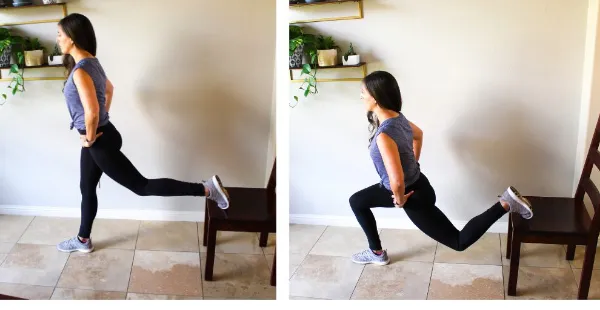
- The goal of this exercise is to improve ankle flexibility.
- Put a chair over your damaged ankle. You need to bend your knee. Put your knee over your toes by shifting your whole weight forward.
- You should be able to feel your ankle’s range of motion.
- If there is no pain, try pushing a little bit further.
- For around 30 seconds, maintain the end range.
- Do it three times.
Calf Raise:

- The muscles at the back of your leg below your knee are strengthened by this workout.
- Grasp the back of a chair and stand.
- Elevate yourself slowly onto your tiptoes and then return to standing.
- Do this twenty times. You can do this exercise on one leg, with modest weights, or on a step with your heels extending off the edge to advance it.
Resisted Eversion:
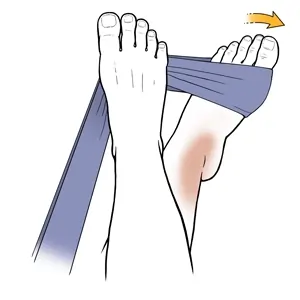
- As resistance, use a popular surface.
- Try turning your foot outward against the resistance.
- After 15 seconds of holding, let go.
- Repeat ten times.
- The ankle’s evertor muscles, which are responsible for turning the foot outward, are strengthened by this exercise.
Plantarflexion with Resistance:
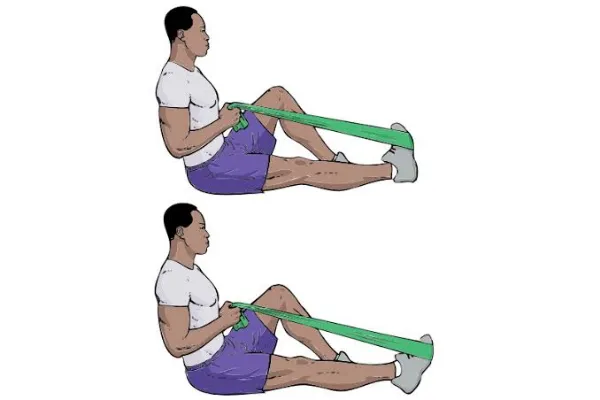
- Under the ball of your wounded foot, place a resistance band.
- Try to point your toe while maintaining the resistance. After that, go back to neutral. Perform three sets of 12 repetitions of this exercise.
- The gastrocnemius and soleus muscles, which are located at the rear of your calf and foot, are the focus of this exercise.
- These muscles are essential for balance, which allows humans to run, jump, walk, and engage in other leg-related tasks.
Squats on a Wobble Board:
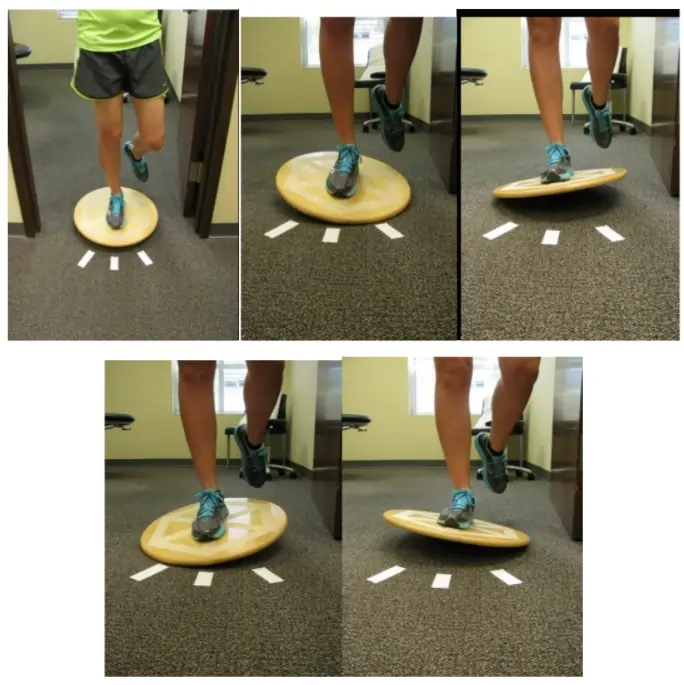
- Squat down carefully and slowly while standing on a wobble board to improve proprioception and balance.
- Next, go back to standing. Do three sets of 10 repetitions of this.
- Try doing the same exercise on one leg or on a pillow if you don’t have access to a wobble board.
Alphabet:
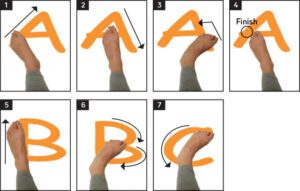
- Try using your injured ankle to write the alphabet.
- You have to use all of your ankle muscles and move your ankle in all directions up and down, side to side, and in a circle—in order to “write” each letter of the alphabet.
- This encourages flexibility and may enhance your ankle’s range of motion.
- Do this many times a day.
The Benefits of Ankle Strengthening Exercises:
You may end up limping around for weeks as a result, making most everyday tasks more difficult, such as driving, grocery shopping, and just going for a stroll.
Ankle sprains are much more prevalent than you may think. According to research, at least two million Americans suffer an ankle sprain every year, whether they roll their ankle while jogging in the morning, stumble on the sidewalk, or slip on the stairs. You are also more likely to sprain your ankle again once you have already done so. Actually, persistent symptoms, including pain, edema, and ankle instability, can result from up to 40% of ankle sprains.
A lot of weight and effort must be supported by your ankles. For instance, they bear the weight of many times your body weight when you run and leap. You face the danger of spraining ankle ligaments or straining a muscle if your ankles aren’t strong enough to support you.
Furthermore, ankle strength has an effect on more than simply your ankles. Your knees, hips, back, and other foot-related tissues are all more stressed when your ankles are weak. For instance, weak ankles are more likely to develop Achilles tendinitis because the surrounding tendons are frequently overused.
FAQs:
What are the best exercises for strengthening my ankles?
Resistance band workouts, standing calf raises, and single-leg balancing exercises are the best ways to strengthen your ankles.
What causes very weak ankles?
Past injuries, such as untreated or recurrent ankle sprains that strain and damage the supporting ligaments, are typically the cause of weak ankles.
How long does it take to strengthen a weak ankle?
For a weak ankle, it usually takes 4 to 6 weeks of regular exercise to see better stability and 6 to 12 weeks of focused training to acquire considerable strength and muscle remodeling.
Will walking strengthen ankles?
Frequent walking increases joint mobility and ankle stability, but it only slightly strengthens the ankle muscles.
When not to wear ankle support?
Whether your injury has completely healed and you can walk painlessly, whether you are sleeping or resting, or when engaging in low-risk, routine indoor activities, avoid using ankle support.
What are some good exercises for healthy ankles using a balance board?
Ankle balancing board exercises use careful, gradual motions to increase lower-leg strength, joint stability, and response time.
Are weak ankles genetic?
While weak ankles are typically a combination of hereditary characteristics and prior traumas, they can be largely genetic.
References:
- Santos-Longhurst, A. (2019, July 23). How to strengthen weak ankles. Healthline. https://www.healthline.com/health/weak-ankles
- Foot and Ankle Group. (2020, June 11). 6 Balance exercises to strengthen weak ankles – Foot and ankle group. https://www.footandanklegroup.com/6-balance-exercises-to-strengthen-weak-ankles/
- Alpha Health Services. (2023, October 23). Top 10 exercises to strengthen weak ankles – Ask a physiotherapist | Alpha Health Services. Alpha Health Services – Toronto Physiotherapy, massage, dry needling, acupuncture, pelvic floor pregnancy, physical therapy, shockwave, concussion treatment & more. https://www.alphahealthservices.ca/top-10-exercises-to-strengthen-weak-ankles/
- Calf raise. (n.d.). [Video]. Hingehealth. https://www.hingehealth.com/gb/en/resources/articles/ankle-strengthening-exercises/