ACL Rehabilitation Exercise
Introduction:
The anterior cruciate ligament (ACL) is the most often damaged ligament in the knee that requires surgical repair. Throughout the year, we treat a lot of patients who carefully enter the clinic to start their rehabilitation process following an ACL reconstruction after getting a diagnosis from their surgeon.
What does the ACL do?
The anterior cruciate ligament (ACL) is a ligament, a strong, fibrous tissue structure that limits a joint’s range of motion to prevent abnormal movement. It occurs inside the knee joint’s capsule.
ACL injuries are common in all football codes, basketball, netball, skiing, and any other sport where running requires position changes.
The primary barrier to the tibia’s or shin bone’s forward movement is the ACL. It prevents the tibia from moving too far forward or the femur from moving backward when the foot is planted. Also, the ACL helps maintain the knee joint’s degree of rotation and angulation. It is referred to as longitudinal because it physically intersects with the knee’s posterior cruciate ligament.
Goals of early ACL rehab:
The first two weeks following ACL restoration are typically referred to as early rehabilitation. During these initial two weeks, it is crucial to achieve a few objectives, which are typically the following:
- Reducing post-operative pain and edema.
- Walk in a comparatively typical manner.
- Achieving complete knee extension.
- Have a knee flexion of about 120 degrees.
- Develop some strong control over your quadriceps and hamstrings.
Keep in mind that these goals are for a basic ACL replacement; alternative restrictions could be applied if the knee requires additional procedures, including a simultaneous meniscus repair.
Reducing pain and edema:
The knee will be swollen and painful after surgery. Continuous pain relief is necessary to help with rehabilitation because, in general, pain is a protective mechanism and the body can only function with a certain amount of pain. Controlling pain is crucial to enable early rehabilitation and to support quicker and better results at the end of the physical process.
When the knee pain is severe and the muscles cannot function properly, crutches are useful for moving around. When you use crutches properly, your walking pattern can return to normal, which can ultimately help you get off the crutches more quickly.
Regular compression and ice therapy are also helpful; to help reduce post-operative edema, apply compression bandages or bracing and ice twice an hour to begin.
Physiotherapist manual therapy is quite helpful during the early phases of recovery. Leg massages can also help reduce pain and promote lymphatic drainage, which helps reduce edema. In the process of helping to restore knee mobility, hands-on patella and knee mobilization treatments can reduce pain.
ACL Rehab: Gain early full extension.
One of the most important goals of early rehabilitation following surgery is to achieve full knee extension as soon as possible. Later in the rehabilitation process, failure to get a full extension now could have severe consequences. Stretching is crucial at this point.
Since most ACL grafts are made from hamstring tendon strands from the same leg, which also require some healing time, I usually avoid stretching the hamstrings too much too soon.
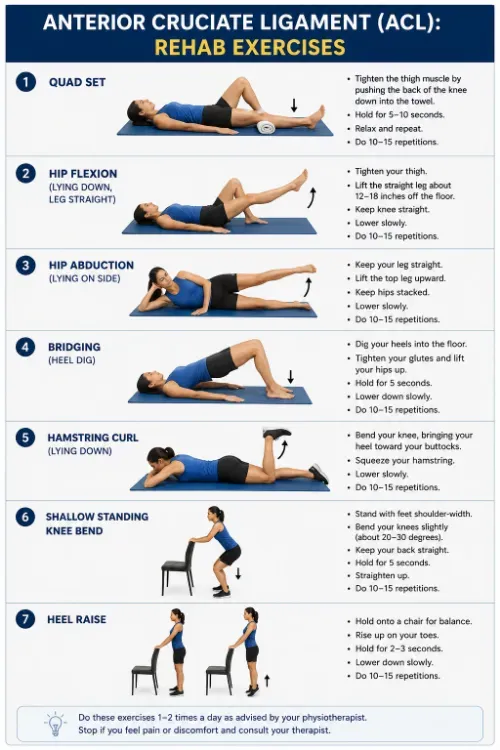
Anterior Cruciate Ligament (ACL): Rehab Exercises
These are the following exercises for ACL rehabilitation:
Quad set:
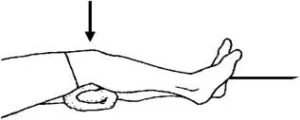
- With your injured leg straight, sit or lie down on the floor or a stable surface. Under your knee, place a little towel that has been rolled up.
- To strengthen your straight leg’s thigh muscles, press the back of your knee against the towel.
- After holding for about six seconds, take a break.
- Do this eight or twelve times.
- Repeating these exercises with your other leg is a beneficial option.
Hip flexion (lying down, leg straight):
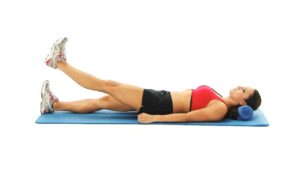
- With your injured leg straight, lie on your back. If it seems more comfortable, you can bend your other leg.
- Press the back of your knee down to tighten the thigh muscles of the injured leg. Maintain a straight knee.
- Keeping your leg straight and your thigh muscles tight, raise your injured leg until your heel is around 12 inches off the ground. After holding for around six seconds, gradually lower.
- Do this eight or twelve times.
- Repeating these exercises with your other leg is a beneficial option.
Hip abduction (lying on side):

- Keep your injured leg on top of you while lying on your side. You can support your head with a pillow or your hand.
- Maintain a straight knee and a leg that is parallel to your body.
- Lift the injured leg straight up toward the ceiling, 12 inches off the ground. After holding for around six seconds, lower your leg gradually.
- Do this eight or twelve times.
- It’s beneficial to repeat these moves on your other side.
Bridging:
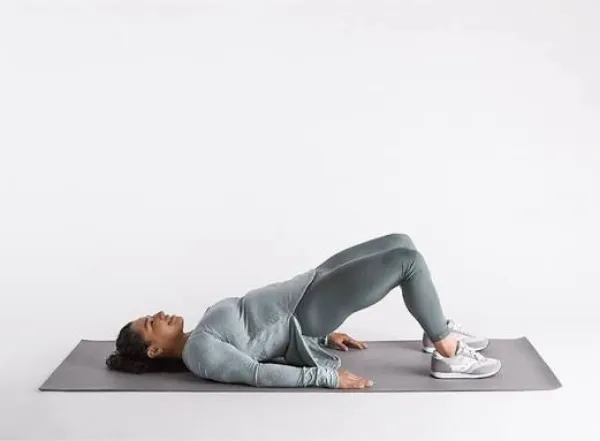
- Only your heels should be pushing into the ground as you lie on your back with both knees and ankles bent. You should bend your knees to a 90-degree angle.
- Pull your abdomen in toward your spine to strengthen your abdominal muscles. Don’t hold your breath; instead, continue breathing normally.
- Squeeze your buttocks, push your heels into the ground, and raise your hips off the ground until your knees, hips, and shoulders are all in a straight line. Maintain a level hip position.
- Hold for about six seconds.
- Return your hips to the floor slowly.
- Do this eight or twelve times.
Hamstring curl (lying down):
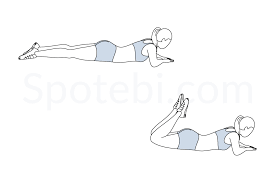
- With your legs straight, lie on your abdomen.
- Bend your knee to raise the foot of the injured leg toward your pelvis. Do this movement without bending your knee as much if it is painful. You might be able to avoid any uncomfortable movements by doing this.
- Return your foot to the ground slowly.
- Do this eight or twelve times.
- Repeating these exercises with your second leg is a beneficial option.
Increase the resistance once you can perform this exercise painlessly. To achieve this:
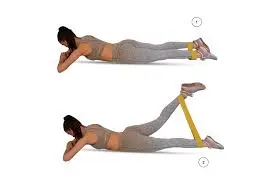
- Create a loop by tying the ends of an exercise band together. To secure the band, either attach one end of the loop to a strong item or close a door on the band so it is on the opposite side of the door.
- The lower portion of your injured leg should be crossed with the opposite end of the exercise band.
- Repeat movements 1-5 while gradually using your leg to stretch back on the workout band.
Shallow standing knee bend:
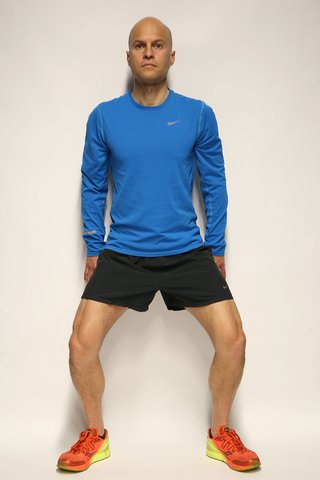
- Place your hands gently on a chair or table in front of you as you stand. Place your feet shoulder-width apart.
- Bend your knees slowly, as though you were going to sit on a chair. Avoid putting your knees in front of your toes.
- Take a 6-inch step down. You should always keep your heels on the ground.
- Gently get up to a standing posture.
- Do this eight or twelve times.
Heel raise:
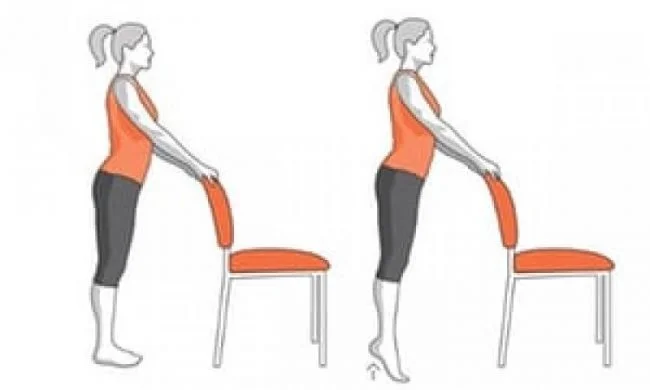
- Place your feet a few inches apart and place your hands lightly on a chair or table in front of you.
- Maintaining a straight knee, slowly lift your heels one to two inches off the ground. After holding for around six seconds, gradually bring your heels down to the ground.
- Do this eight or twelve times.
Advice for ACL Prehabilitation:
It’s common to have pain, swelling, and scars after an ACL tear. Here are some methods of controlling the pain and swelling to get your knee ready for surgery.
Crutch Use:
- You may need to use two crutches to walk. You can move about securely and support your knee with the aid of crutches.
- When walking on crutches, try to put as much of your body weight on your leg as you can without making your knees hurt worse. This may be referred to as weight-bearing as tolerated.
- Your doctor or physical therapist will teach you how to use crutches both before and after surgery.
Ice, Elevate, and Rest:
If you have injured your ACL, you should freeze, elevate, and rest your knee to minimize pain, swelling, and inflammation.
- For at least the first 24 hours after your injury, or until severe inflammation is under control, lie down with an elevated leg over your heart and apply ice.
- Raise and hold up your whole leg. Never put pillows or other support above your knee by itself.
- Please ask your doctors for precise advice on how to utilize compression during your rehabilitation if they recommend it.
Regain Mobility and Strength:
Exercises to increase strength and mobility are among the suggested ones. For rehabilitation to be successful, at least the basic activities in both areas must be performed.
Maintaining a Healthy Routine:
Maintaining a healthy lifestyle is a must for a successful recovery following ACL surgery. This is your chance to give up smoking. Healing is slowed considerably by smoking. Keep an eye on your alcohol intake as well, particularly if you are taking medications that may not interact well with alcohol. Maintain a healthy weight. Gaining too much weight might affect your knee. As you concentrate on these beneficial adjustments, keep in mind to avoid anything that can delay your progress.
Important Factors to Avoid Following ACL Surgery:
Following ACL surgery, it’s just as crucial to understand what not to do as what to do.
Avoid These Activities While Recovering:
- Skipping Therapy: Although it may be tempting, avoid missing your rehabilitation appointments.
- Non-Rehabilitation Activities: Follow your doctor’s instructions and avoid certain activities.
- Allowing Stiffness: Keep your knee from becoming stiff. As instructed, keep it going.
- Unstable Movements: Steer clear of activities that might lead to knee instability.
Keeping these things in mind is essential to the recovery of your knee. For a successful recovery, adhere to these recommendations. Next, it’s critical to recognize warning indicators and know when to get assistance.
Recognizing Post-Surgery Complications After ACL:
After ACL surgery, keep a watchful eye out for any indications of problems. Keep a watch out for:
- Swelling
- Pain
- Instability
Long-Term Recovery and Lifestyle Changes After ACL:
After ACL surgery, you will need to make significant adjustments and adopt new routines.
- Include rehabilitation activities daily.
- Work on your knees’ strength and stability.
- Do your best to prevent more injuries.
You may move toward a healthier, more active life by adhering to these healing techniques.
FAQs:
What is Stage 4 of ACL rehab?
Stage 4 of ACL rehabilitation, which usually begins three to six months after surgery, concentrates on physical activity, advanced running technique, and sport-specific movements. The main objective is to provide safe, symmetrical landing methods while preparing the knee for high-intensity, unexpected activities like running, bending, and jumps.
What is Phase 2 of ACL rehab?
Developing strength, regaining a normal gait, and improving balance are the main goals of phase 2 of ACL rehabilitation, which usually lasts from weeks two to six after surgery. Before moving on to agility training, the main objectives are to reduce edema, restore a complete range of motion, and develop strong quadriceps control.
Can ACL recovery take 2 years?
It can take up to two years for a person to fully recover biologically and functionally after an ACL repair, even though they frequently resume modest activities much sooner. Basic everyday activities and mild sports can be resumed in 9 to 12 months, but it takes longer to reach peak strength and 100% joint health.
What helps ACL heal faster?
Strict attention to early physical therapy (prehab and post-op), active edema control, and appropriate diet are necessary to speed up ACL rehabilitation. Although healing cannot be pushed, adhering to an ideal routine effectively recovers mobility, preserves the graft, and avoids muscle atrophy.
Is ACL surgery high risk?
It is a minimally invasive, highly standardized treatment with an 80–90% success rate. Serious problems are rare, although, like any procedure, there are some minor possible concerns (such as infection, blood clots, and stiffness).
References:
- Anterior Cruciate Ligament (ACL): Rehab exercises | Kaiser Permanente. (n.d.). Kaiser Permanente. https://healthy.kaiserpermanente.org/health-wellness/health-encyclopedia/he.anterior-cruciate-ligament-acl-rehab-exercises.ad1473
- Eckenrode, B. J., Carey, J. L., Sennett, B. J., & Zgonis, M. H. (2017). Prevention and management of post-operative complications following ACL reconstruction. Current Reviews in Musculoskeletal Medicine, 10(3), 315–321. https://doi.org/10.1007/s12178-017-9427-2
- Cavanaugh, J. T., & Powers, M. (2017). ACL rehabilitation progression: Where are we now? Current Reviews in Musculoskeletal Medicine, 10(3), 289–296. https://doi.org/10.1007/s12178-017-9426-3
- Larson, D., Vu, V., Ness, B. M., Wellsandt, E., & Morrison, S. (2021). A Multi-Systems Approach to Human Movement after ACL Reconstruction: The Musculoskeletal System. International Journal of Sports Physical Therapy, 17(1), 27–46. https://doi.org/10.26603/001c.29456