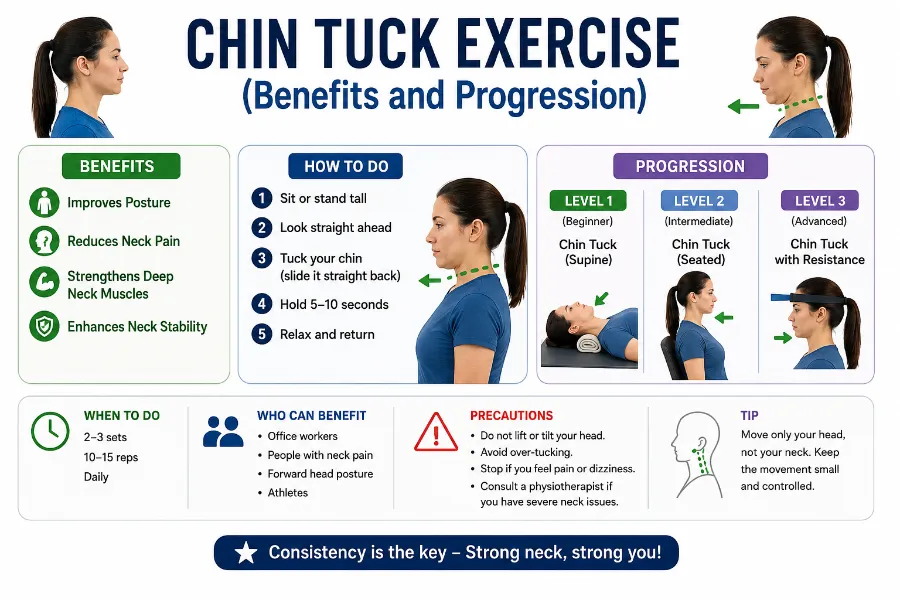
Chin Tuck Exercise (Benefits and Progression)
Introduction
The chin tuck exercise is one of the most effective and common posture exercises, reducing neck pain and improving neck posture. By stretching tense muscles at the back of the neck and strengthening the deep cervical flexor muscles at the front, it aids in the restoration of proper head and neck alignment.
Modern lifestyles often involve prolonged use of computers, smartphones, and tablets, causing the head to drift forward and placing excessive stress on the cervical spine. Over time, this poor posture can lead to neck stiffness, headaches, shoulder tension, and reduced mobility. Performing chin tuck exercises regularly can help counteract these effects by retraining your neck muscles to maintain a neutral posture.
This simple exercise requires no equipment and can be performed at home, in the office, or anywhere you can sit or stand comfortably. It is frequently recommended by physiotherapists as part of rehabilitation programs for neck pain, cervical spondylosis, tech neck, and postural dysfunction. When practiced consistently with proper technique, chin tuck exercises can improve posture, decrease muscle strain, and support long-term neck health.
Muscles:
- Deep neck flexors
- Sternocleidomastoid
- Scalenes
Indications
The chin tuck exercise is indicated for individuals who need to improve cervical spine alignment, strengthen the deep neck flexor muscles, and reduce neck strain.
It is commonly recommended by physiotherapists in the following situations:
Forward Head Posture
Helps correct the position of the head and promotes proper neck alignment.
Neck Pain (Cervicalgia)
Beneficial for mild to moderate mechanical neck pain associated with poor posture.
Tech Neck (Text Neck Syndrome)
Reduces strain caused by prolonged smartphone, tablet, or computer use.
Cervical Spondylosis: may help improve posture, decrease muscle tension, and support neck function when performed as part of a rehabilitation program.
Chronic Neck Muscle Weakness: strengthens the deep cervical flexor muscles that stabilize the neck.
Postural Dysfunction
It is advised for those with rounded shoulders and bad posture, whether sitting or standing.
Tension-Type Headaches:
May help reduce headaches associated with neck muscle tightness and poor posture.
Shoulder and Upper Back Muscle Tightness: Helps relieve excessive tension in the upper trapezius and surrounding muscles.
Office Workers and Students are ideal for individuals who spend long hours sitting at a desk or using digital devices.
Reduced Cervical Stability helps improve neuromuscular control and stability of the cervical spine.
Rehabilitation programs are often included in physiotherapy programs for cervical spine rehabilitation, posture correction, and neck pain.
Related Conditions:
- Headaches
- Forward Head Posture
- Upper Cross Syndrome
- Text Neck
- Cervical Disc Herniation
- TMJ Syndrome
- Thoracic outlet syndrome
Benefits
- Reduces the forward head position, which improves posture.
- Strengthens the neck’s stabilizing muscles.
- Reduces pain in the upper back and neck.
- Simplifies daily activities like using a phone, driving, and reading.
- Promotes proper neck alignment
- Reduces neck stiffness and muscle tension
- Improves postural awareness
- Supports cervical spine stability
- Helps improve neck muscle endurance
- May reduce strain caused by prolonged screen use
- Encourages better sitting and standing posture
- Easy to perform at home or at work
- Supports a more neutral cervical spine position
- May help decrease excessive strain on the neck muscles
- Improves postural alignment during sitting and standing
- Can help counteract poor posture from prolonged computer use
- Improves neck muscle coordination
- Helps develop better posture habits
- May improve comfort during prolonged sitting
- Supports functional neck movement
- Can be included in a neck rehabilitation program
- Helps improve awareness of head positioning during daily activities
- Easy to perform without any equipment
Exercises
Chin Tuck In Sitting Position
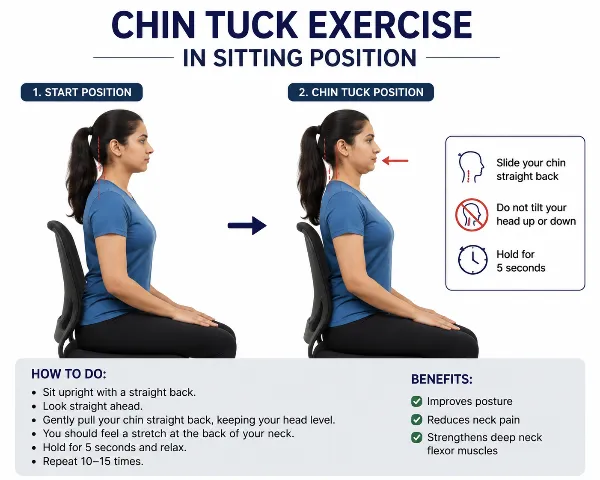
Whether you’re sitting or standing, you can perform chin tucks almost anywhere. It makes your neck muscles stronger.
- Keep your chin parallel to the floor
- Straighten your head.
- Tilt your chin back toward your chest to form a double chin.
- Keep your chin tucked in; move the back of your head away from the base of your neck.
- Take three deep breaths while maintaining this position.
- Repeat with your chin in its typical posture.
Chin Tucked In Supine Position
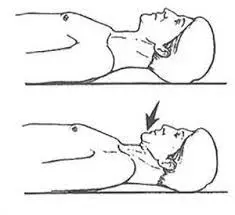
It’s a great idea to stretch just before getting out of bed in the morning.
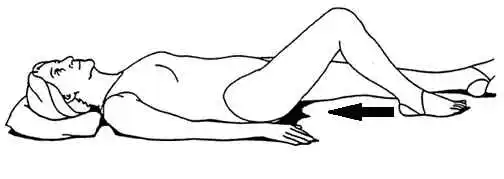
Rest on your back with a small towel roll under your neck.
- Put your chin in.
- Repeat with your chin in its typical posture.
Standing With Your Chin Tucked Against a Wall
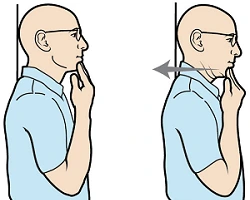
- This exercise will help you with your posture.
- Put your shoulders, back, and head flat against a wall.
- Put your chin in.
- Hold for a short while.
- Repeat with your chin in its typical posture.
- Place both arms, palms out, on the wall while maintaining the same starting position.
- You should raise and lower your arms in reference to the wall.
- Whether you’re seated or standing, tuck the two fingers of one hand into your chin.
- Bring your head closer to your chest after applying light pressure with your other hand on top of your head until you feel a stretch.
- Hold the stretch for 20 seconds.
Chin Tuck Against Resistance
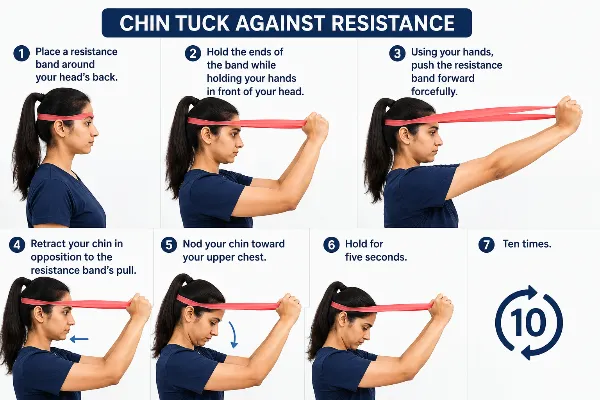
- Place a resistance band around your head’s back.
- Hold the ends of the band while holding your hands in front of your head.
- Using your hands, push the resistance band forward forcefully.
- Retract your chin in opposition to the resistance band’s pull.
- Nod your chin toward your upper chest.
- Hold for five seconds.
- Ten times.
Progression of Exercise:
- Stage 1 – Basic Chin Tuck: Perform the exercise lying down or sitting with gentle chin retraction.
- Stage 2 – Seated Chin Tuck: Perform chin tucks while maintaining an upright sitting posture.
- Stage 3 – Standing Chin Tuck: Practice the movement while standing and maintaining good overall posture.
- Stage 4 – Chin Tuck With Hold: Hold the retracted position for 5–10 seconds before relaxing.
- Stage 5 – Repetitive Chin Tucks: Perform controlled repetitions to improve neck muscle endurance.
- Stage 6 – Chin Tuck Against Resistance: Use gentle resistance with your hand or an appropriate resistance device, if advised by a physiotherapist.
- Stage 7 – Functional Chin Tuck: Maintain the corrected head position during activities such as walking, computer work, or other daily tasks.
Tips
- Avoid nodding or staring at the ground; instead, go back straight.
- Keep your shoulders relaxed and your chest up.
- Imagine yourself resting your head back against a wall.
- During the exercise, take regular breaths.
Contraindications
Although the chin tuck exercise is generally safe, it may not be appropriate for everyone. In the following circumstances, it should be avoided or only carried out under a medical professional’s supervision:
Recent Neck Fracture or Acute Trauma
Do not perform the exercise after a recent cervical spine injury unless cleared by a physician.
Cervical Spine Instability
Individuals with significant ligament injury or cervical instability should avoid this exercise until evaluated by a specialist.
Severe Cervical Disc Herniation with Neurological Symptoms
If accompanied by severe arm pain, numbness, weakness, or loss of function, medical evaluation is necessary before exercising.
Acute Neck Pain with Severe Inflammation
Rest and medical assessment may be more appropriate until the acute phase settles.
Recent Cervical Spine Surgery
Perform only if specifically approved by the surgeon or physiotherapist.
Cervical Myelopathy :
People with spinal cord compression should avoid unsupervised neck exercises and seek specialist guidance.
Conclusion:
The chin tuck exercise is a straightforward yet extremely effective method to strengthen the deep cervical flexor muscles, improve neck posture, and lessen the pressure caused by forward head position. and prolonged screen use. When performed correctly and consistently, it can help relieve neck pain, decrease muscle tension, improve cervical alignment, and support better overall posture.
For the best results, incorporate chin tuck exercises into your daily routine along with ergonomic workstation adjustments, regular stretching, and strengthening exercises for the neck, shoulders, and upper back. Remember to perform the movement slowly and with proper technique, avoiding excessive force or discomfort.
If you experience severe pain, dizziness, numbness, or worsening symptoms during the exercise, stop immediately and consult a healthcare professional or physiotherapist. With consistency and proper guidance, the chin tuck exercise can be an important part of maintaining a healthy, strong, and pain-free neck.
FAQs
How to do chin tuck exercises?
Chin tucks improve forward head posture and reduce neck strain. With your eyes level, take a tall seat or stand. Make a double chin by gently pulling your head straight back. Feel a stretch at the base of your head as you hold for three to five seconds, then let go. Ten times.
How long to hold a chin tuck?
For three to five seconds, hold each chin tuck.
To complete the exercise:
With your shoulders relaxed and your head fixed forward, choose a tall seat or stand.
Make a “double chin” by pulling your chin straight back without lifting your head up or down.
After three to five seconds of holding, let go.
Try to complete two to three sets of ten repetitions; ideally, you should do this many times a day.
Can chin tucks help with a neck hump?
Yes, chin tucks work really well to reduce a neck hump, particularly if the hump is caused by rounded shoulders and forward head position. They relieve tension and lessen the appearance of the hump by pulling your head back into alignment over your shoulders through the strengthening of the deep cervical flexors.
Does chin tuck hurt?
If tucking your chin hurts, stop right away. Although the movement is intended to ease “tech neck,” pushing it might pinch nerves or strain joints. Additionally, overusing superficial muscles rather than deep flexors might cause pain.
References:
- chin tucks exercise | neck and posture strength for older adults — More Life Health – Seniors Health & Fitness. (n.d.). More Life Health – Seniors Health & Fitness. https://morelifehealth.com/chin-tucks
- Chin Tucks ET. (n.d.). [Video]. Hinge Health. https://www.hingehealth.com/gb/en/resources/articles/chin-tucks/