Low-Impact Exercises for Knee Arthritis
Introduction:
Osteoarthritis is the most common type, though other forms exist. This degenerative disorder wears away the cartilage in joints and the surrounding bones. It frequently affects the knees, causing inflammation, stiffness, and joint pain.
It may be challenging to move around and carry out your everyday tasks as a result of these symptoms. You may believe that knee arthritis gets worse with exercise. However, specific strengthening and stretching activities can help relieve your problems. To begin, all you need is your healthcare provider’s approval and practical advice.
What makes an exercise low impact for the knee?
Easy does not necessarily equate to little effect. It indicates that the exercise prevents the knee from being repeatedly pounded. Running, leaping, and court sports have a greater impact on the muscles surrounding the hip, thigh, and calf than cycling, swimming, and regulated strength workouts.
The cause of your symptoms will determine the best option. While a person with a locked knee, an unstable kneecap, or a recent injury may require an evaluation before beginning, a knee with osteoarthritis may tolerate regular cycling quite well. Your surgeon’s or physiotherapist’s rehabilitation plan should always take precedence over general exercise recommendations following knee replacement or arthroscopy.
The 24-hour reaction is helpful guidance. It may be appropriate to expect mild muscle soreness or experience brief, mild pain. Exercise should be reduced, though, if it results in severe pain, substantial swelling, stiffness, pain at night, or symptoms that increase the next day significantly.
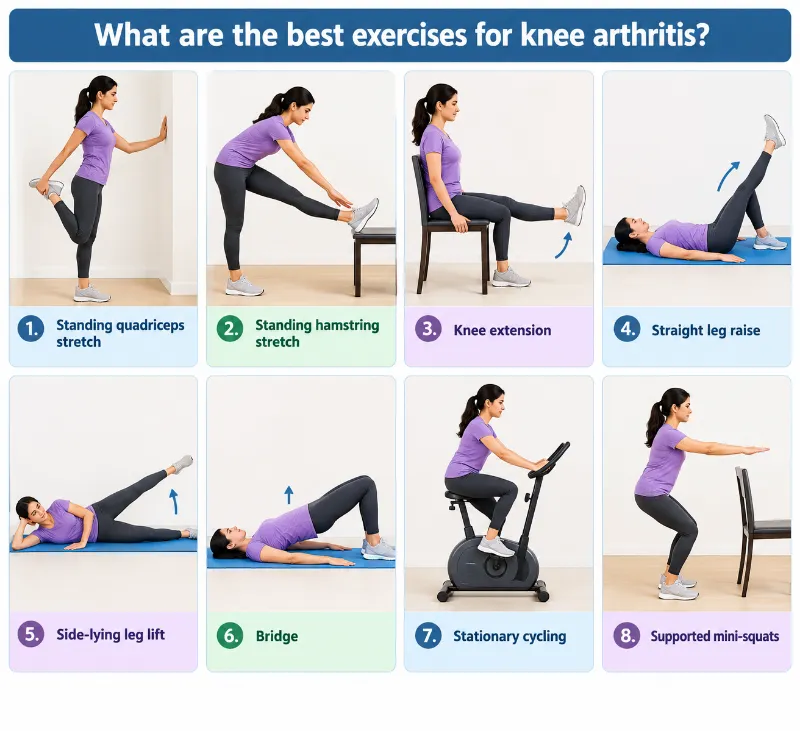
What are the best exercises for knee arthritis?
With knee arthritis, exercising may be the last thing on your mind. However, knee arthritis exercises might help reduce pain if done properly. For knee osteoarthritis, a comprehensive regimen should consist of:
Stretches: Your knees may become rigid due to joint inflammation. Stretches can improve flexibility and release tense muscles, enabling more fluid movement.
Strengthening exercises: Knee joint pain, particularly when standing, walking, or bending, can also be caused by inflammation. Your knees can be supported and stabilized with certain strengthening workouts. Stronger muscles could ease the strain on sore joints and facilitate daily tasks.
Here are 8 stretches and exercises to help you get started:
Standing quadriceps stretch:
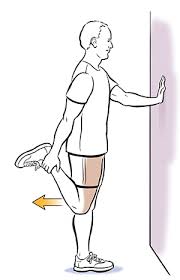
The quadriceps muscles, a set of four muscles on the front of your thighs, are worked by the standing quadriceps stretch, as the name implies. You can bend your knee more painlessly if your quadriceps are more flexible.
- Step 1: Maintain a straight back and stand tall. For balance, grab the back of a sturdy chair.
- Step 2: Bend one knee so that your heel is in line with your butt.
- Step 3: Feel the stretch along the front of your thigh as you slowly slide your foot closer to your butt while holding your ankle. You can deepen the stretch by pushing your hip forward with a gluteal squeeze.
- Step 4: Wait 30 seconds. On the opposite side, repeat.
- Step 5: Repeat the stretch three to five times on each side.
Standing hamstring stretch:
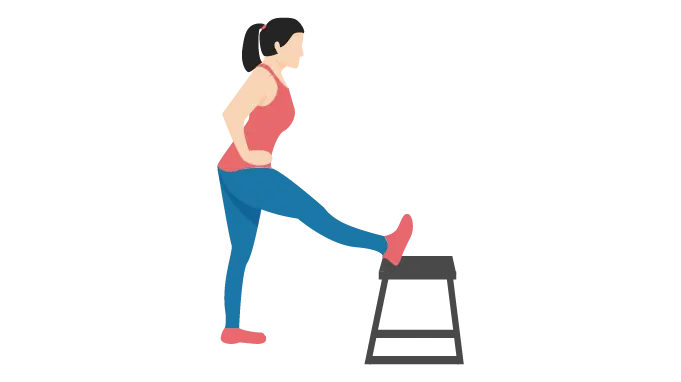
The muscles on the back of your thighs are lengthened by the standing hamstring stretch. Stretching the hamstrings may improve range of motion and flexibility for more comfortable, pain-free mobility.
- Step 1: Take a straight stance in front of an exercise block. Point your toes toward the ceiling while placing your heel on the block. Maintain an extended knee and a straight leg.
- Step 2: Lean forward by hinging at the hips and gradually moving your chest closer to one leg. As you bend forward, maintain a straight back and an extended leg.
- Step 3: Feel the stretch at the rear of your extended leg behind your knee as you hold for 30 seconds.
- Step 4: Continue on the opposite side.
- Step 5: Stretch three to five times on each side.
Knee extension:
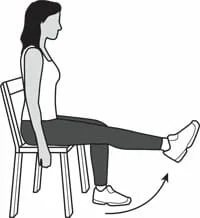
Using the sitting knee extension, you may isolate your quadriceps muscles. The knee is stabilized and extended by this set of muscles. Strong quadriceps have been demonstrated to reduce joint pressure and relieve knee pain.
- Step 1: Take a seat with your feet flat on the ground and your back straight.
- Step 2: Point your toes toward the ceiling while extending one leg in front of you. To maintain a straight and locked knee, contract the quadriceps muscles at the front of your thigh.
- Step 3: After five to ten seconds of holding this position, let go.
- Step 4: Perform 20 reps on each side.
Straight leg raise:
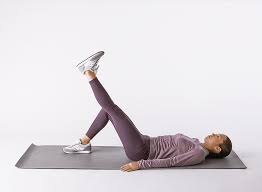
Straight leg raises improve the strength and control of your quadriceps, which improves your knee’s stability during movement.
- Step 1: Lie down on your back. With your foot flat on the ground, bend one leg. With your toes pointing toward the ceiling and your foot contracted, keep the opposite leg outstretched.
- Step 2: To maintain a straight and locked knee, contract or squeeze the quadriceps muscle in your extended leg.
- Step 3: Lift your extended leg slowly while keeping your knee locked. Slowly return your leg to the beginning position after raising it until your knee is level with your bent knee.
- Step 4: Perform 20 reps on each side.
Side-lying leg lift:
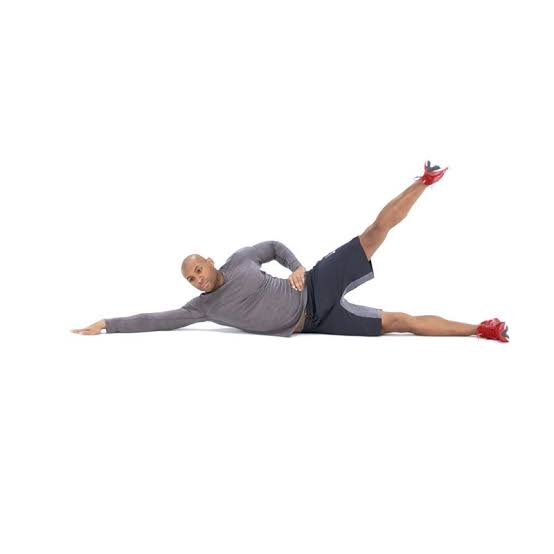
The side-lying leg raise has two purposes: it targets the outer glutes at the sides of the hips and aids with quadriceps control. These muscles maintain the normal position of your joints and support your hips and knees.
- Step 1: Extend your legs and flex your feet while lying on one side. Make sure your feet, knees, ankles, and hips are stacked.
- Step 2: Bend your arm and place your head in your hand, or place your forearm flat on the ground.
- Step 3: With your hips in alignment and your foot flexed, elevate your upper leg while using your core.
- Step 4: Lower your leg gradually to the starting position after pausing for three to five seconds.
- Step 5: Perform 20 reps on each side.
Bridge:
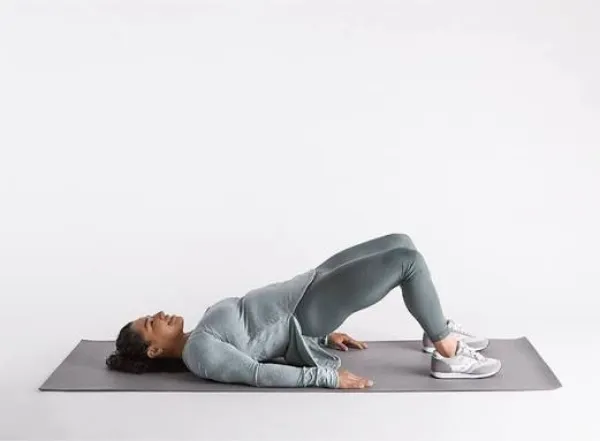
The bridge works the glutes, hamstrings, and hip adductors, among other lower-body and core muscles. Strong hip muscles called the glutes help ease knee strain and enable your leg muscles to bear a larger portion of your total weight.
- Step 1: With your feet on the ground and your knees bent, lie flat on your back.
- Step 2: To activate your abs, gently press your lower back toward the floor.
- Step 3: Raise your hips without creating a back arch.
- Step 4: Squeeze your glutes and pull your belly button in the direction of your spine to maintain an active core.
- Step 5: Lower your hips gradually to the beginning position after holding the bridge for five to ten seconds.
- Step 6: Finish 20 repetitions.
Stationary cycling:
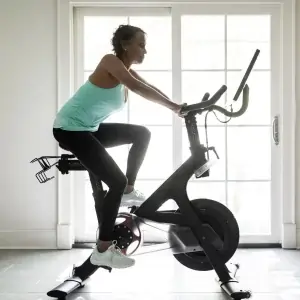
- One of the most comfortable methods to preserve knee mobility and increase fitness is to use an exercise bike.
- At the bottom of each pedal stroke, raise the saddle so that your knee is not significantly bent.
- Instead of attempting to accomplish a hard workout right away, start with extremely little resistance and a brief duration, even five to ten minutes.
- If you find a complete revolution difficult, rock the pedals back and forth as much as you can. Advance to full rotations as stiffness decreases. Although it’s not the best option for every issue, those with mild to moderate arthritis typically tolerate cycling well.
Supported mini-squats:
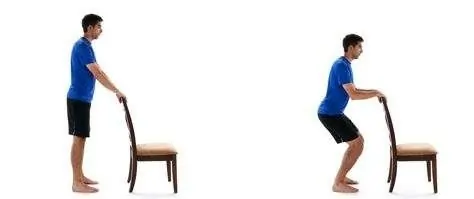
- Grab the back of a solid chair or a kitchen countertop.
- As if you were starting to sit down, slightly bend at the hips and knees, then push through your feet to stand back up.
- Make sure that your knees and toes are pointed in the same direction.
- A deep squat has no rewards.
- While putting less strain on an uncomfortable knee, a shallow, controlled movement may efficiently strengthen the hips and thighs. If bending itself causes significant pain, avoid this activity during a difficult flare.
How many and how often:
To help relieve your knee pain, you should gradually include activities in your regimen. You can choose to perform all of the exercises at once, or you can begin with only one or two and add more as you get more at ease.
Movement and strengthening exercises:
The frequency of a single movement is called a repetition. It might be beneficial to perform two to three repetitions at a time while beginning new workouts. Smaller doses throughout the day are preferable. Practice your repetitions, for instance, every hour. Add one or two repetitions to your movements every few days as this becomes simpler and if you feel capable of doing so.
It might be beneficial to divide the exercises into sets as you get more repetitions. This implies that while you may perform more repetitions at once, you will perform them less often over the day. This type of exercise promotes strength. As an example:
- Do 8 repetitions.
- Rest for a minute.
- Repeat another set of 8 repetitions.
- Repeat this 2 to 3 times a day.
You might try increasing the number of repetitions you perform over time. Aim for no more than two sets of fifteen.
Stretching exercises may be found in several of the videos on this website. We would advise you to maintain the posture for a longer period of time as a stretch once you can do it with ease. Your range of motion may gradually increase as a result.
You should experience a little stretch when performing the workout. There shouldn’t be any pain or irritation. Stretches should ideally be held for 20 to 30 seconds.
Aim to concentrate on performing the workout sets. Do two to three sets of stretches, for instance. Try to do this two or three times a day. Your range of motion should increase as you stretch more, allowing you to extend farther.
When to stop:
- If you get new or increasing pain from these workouts, stop doing them.
- It’s a good idea to discuss your knee pain with a healthcare provider if it gets severe while you’re doing this.
What exercises should you avoid with knee arthritis?
It is typically advised, safe, and advantageous to exercise if you have knee arthritis. However, some forms of exercise should be avoided. Knee joint pain and irritation can be increased by high-impact exercises that place a lot of strain on your knees. When exercising with knee osteoarthritis, steer clear of or restrict exercises like these to help protect your joints:
- Running
- Jumping
- Stair climbing
- Deep squatting and lunging
Once your exercise regimen has strengthened your surrounding leg muscles and improved their ability to support your knee joints, you might be able to return to these activities. To design an exercise regimen that works for you, think about working with a physical therapist or personal trainer.
Tips to protect your knees during exercise:
Stay away from overstressing your joints when exercising if you have knee arthritis. When beginning an exercise regimen, pay attention to useful advice to protect your joints and maintain the health and comfort of your knees.
- Take it gradually. Any portion of your body might be stressed by too much movement too quickly, especially if you have arthritis. Take your time starting any fitness regimen. Ease into additional exercise after that. Your body will have time to adapt to the increased exercise as a result.
- Minimize carrying weight. The strain on arthritic knees can be increased by standing and using your legs to support your weight. Pressure and pain can be reduced by beginning with non-weight-bearing activities, such as those that let you sit in a chair or lie down.
- Begin with low-impact workouts. Joint-friendly, low-impact workouts are an excellent approach to maintain an active lifestyle. You can get a wonderful workout without placing too much strain or friction on your joints by doing things like walking, swimming, riding a stationary bike, and doing yoga or tai chi. You can discuss engaging in higher-impact activities, like jogging, with your healthcare physician when your symptoms improve.
- Put your form first. In order to lower the chance of injury, it is essential to learn good workout form. To optimize your strength and balance, practice doing exercises slowly and carefully.
- If needed, modify your regimen. Keep an eye on how various activities impact the symptoms of osteoarthritis in your knee. Modify your schedule as necessary. For instance, choose power walking if jogging makes your knee discomfort worse. To aid with stiffness and pain in joints, think about doing workouts in the pool.
FAQs:
How to live with arthritic knees?
To minimize pain and maintain mobility, living with arthritic knees necessitates a combination of low-impact exercise, focused strengthening, and regular joint preservation.
Is walking good for knee pain?
By lubricating the joint and strengthening surrounding muscles, walking can help reduce knee pain and stiffness, particularly from mild osteoarthritis. However, it must be done carefully and gradually to prevent irritation from getting severe.
How to heal a knee faster?
Start the RICE treatment for the first 48 to 72 hours after a knee injury, then do mild mobility exercises. If pain or swelling doesn’t go away, see a doctor.
What is the best position to sleep in if I have knee pain?
Sleeping on your back with a cushion under your knees or on your side with a firm pillow between your knees are the ideal sleeping positions if you have knee pain.
What are some natural remedies for knee pain in old age?
Reducing inflammation, alleviating stiffness, and strengthening the surrounding muscles are the main goals of effective natural treatments for knee pain in older individuals, which frequently comes on due to osteoarthritis and joint degradation.
How long does knee pain take to heal?
The origin and degree of knee pain determine how well a patient recovers. While significant structural damage or surgery requires several months, minor problems can resolve in a matter of days or weeks.
Can you live with severe arthritis in the knee?
It is possible to live with severe (Stage 4) knee arthritis, and many individuals manage it for years without surgery by combining conservative therapy with lifestyle changes.
How to get inflammation out of the knee?
Depending on the underlying reason (such as arthritis, an accident, or overuse), treating knee inflammation may need a combination of urgent home care, medicinal therapies, and physical therapy.
References:
- NHS Inform. (2026, July 28). Exercises to help with osteoarthritis of the knee | NHS Inform. NHS Inform. https://www.nhsinform.scot/illnesses-and-conditions/muscle-bone-and-joints/leg-and-foot-problems-and-conditions/exercises-for-osteoarthritis-of-the-knee/
- Cheema, K. (2026, October 18). 8 Best low impact knee exercises for mobility. Mr Kam Cheema | Consultant Hip & Knee Surgeon | London & Kent. https://kamcheema.com/best-low-impact-knee-exercises/
- Kolasinski, S. L., Neogi, T., Hochberg, M. C., Oatis, C., Guyatt, G., Block, J., Callahan, L., Copenhaver, C., Dodge, C., Felson, D., Gellar, K., Harvey, W. F., Hawker, G., Herzig, E., Kwoh, C. K., Nelson, A. E., Samuels, J., Scanzello, C., White, D., . . . Reston, J. (2020). 2019 American College of Rheumatology/Arthritis Foundation Guideline for the Management of Osteoarthritis of the hand, hip, and knee. Arthritis Care & Research, 72(2), 149–162. https://doi.org/10.1002/acr.24131