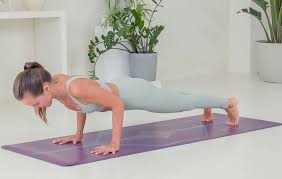
Chaturanga Dandasana (Four-Limbed Staff Pose)
Introduction:
Chaturanga Dandasana (Four-Limbed Staff Pose) is a foundational yoga pose that builds upper body and core strength while improving stability and control.
Asana means posture, danda means staff of support, and chatur means four limbs in Sanskrit. The spinal cord, which serves as the body’s primary support system, is referred to as the staff in Four-Limbed Staff Pose (Chaturanga Dandasana). In a horizontal position, the spine is neutral and looks like a straight stick. This prone pose was introduced by the Iyengar yoga school, yet it was not included in the Hatha Pradipika Yogic literature.
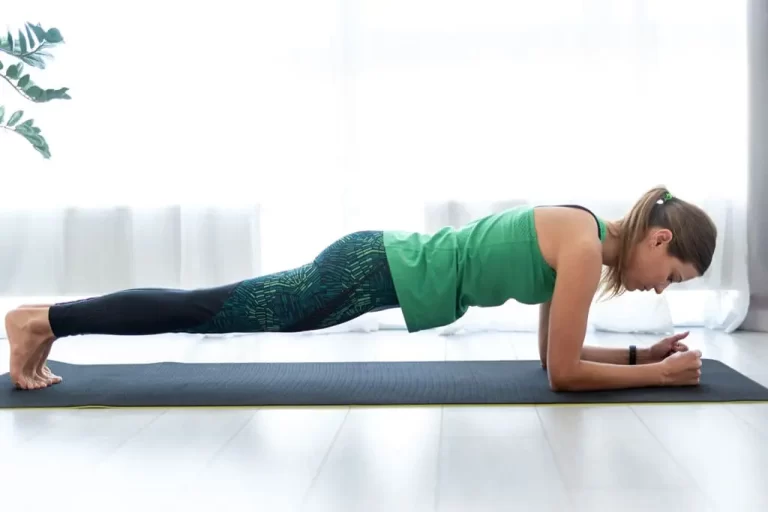
This pose is similar to the Plank Pose (Phalakasana). In Chaturanga Dandasana, students focus on their arms and core while lowering their bodies with their arms bent at the elbows. With just four points of support—two feet and two palms—the entire body alignment in both positions resembles a rod or a plank. Four body parts are represented by the word Chaturanga. Another name for this position is the Low Plank Pose.
The short flow, Surya Namaskar (Sun Salutation), includes Four-Limbed Staff Pose, which is thought to strengthen the arms, shoulders, and core. Numerous fitness schools, including gym, Pilates, free floor exercises, Power Yoga, Vinyasa, and Ashtanga Yoga, use this adaptable transit pose.
Because they strengthen the arms and core, Catur Svanasana (Dolphin Pose), Utthan Pristhasana (Lizard Pose), and Phalakasana are excellent poses to prepare for Chaturanga Dandasana. Because it may be modified, the Four-Limbed Staff Pose is a symmetrical base pose. Four-Limbed Staff Pose can be used in flow yoga sequences since it increases the body’s energy.
Because it may be used to create variations of four-limbed staff posture, the four-limbed staff pose is regarded as a base pose. Four-Limbed Staff Pose can be incorporated into flow yoga sequences since it increases the body’s energy.
How to Do Chaturanga Dandasana?
The stages to Four Limbed Staff Pose (Chaturanga Dandasana) are as follows:
- First, position your body in Bharmanasana, or Table Top Pose. Place the legs beneath the hips and the hands beneath the shoulders. In Bharmanasana, establish yourself. Breathe evenly and easily through your nose.
- Take a breath, raise your knees off the mat, and straighten your back. Spread your fingers and apply pressure simultaneously with your hands and forearms. Keep your chest from collapsing. Firmly place your feet on the mat and keep your toes curled in. Only the feet and palms should be in contact with the earth.
- Here, keep your back neutral and be careful not to raise your hips too high. Tucking the stomach in and developing a small amount of core strength is the trick to support this. Continue breathing. Avoid letting your hips drop too low and maintain an elevated thigh position. Adjust your body so that your shoulders are exactly over your wrists if your buttocks protrude.
- Lengthen the back of your neck and pull your abdominal muscles toward your spine as you look down between your hands. Make sure your head and spine are in alignment. Extend your collarbones away from your ears and across your shoulder blades.
- The pupil should avoid locking their elbows even if their arms are straight. It puts strain on the wrists. Here, pay attention to evenly distributing the weight across your hands’ palms. Phalakasana is this.
- Now inhale deeply. Breathe out gently, lowering your entire upper and lower body while bending at the elbows and firmly planting your palms on the ground. Stretch your upper torso forward and bring your body parallel to the mat, gazing down at the bottom underneath you. Make sure the weight is in the center of the body rather than the wrists and shoulders. The hands are level on the ground, and the toes are completely grounded.
- You should work on this alignment by pulling your stomach in, keeping your elbows close to your body, and bringing your chest closer to the floor while keeping your forehead and chin in line with your shoulders.
- For the first four breaths, stay in this position once the body is in alignment and comfortable. Increase your endurance gradually until you can take eight breaths. Breathe in and relax your body. As you release the breath, maintain the posture, making sure your body is nearly parallel to the ground. Maintain core focus with each exhale.
- To exit this pose, press back into Child Pose (Balasana) and relax after placing your knees on the ground.
Benefits of Chaturanga Dandasana:
The advantages of Four-Limbed Staff Pose (Chaturanga Dandasana) are as follows:
- Stretches, Strengthens, Lengthens: To become comfortable in this pose, one must have strength in the forearms and upper arms. The muscles surrounding the upper arms are encouraged to expand and contract with breathing and gain strength via repeated practice of balancing the body on the arms. By using the shoulder blades to support the arms, the alignment strengthens the shoulders. Because the alignment works the core, this position strengthens the core. The body is held nearly parallel to the floor by the strength of the abdominal muscles.
- Flexibility and Range of Motion: One of the most important aspects of this position is the elbow bending. In addition to strengthening the arm muscles, it also improves the elbows’ and wrists’ flexibility. As the pupil engages the hips to hold the pose, it strengthens the hips. Students advance to challenging arm balancing poses such as Headstand Pose (Sirsasana), Forearm Side Plank, Feathered Peacock Pose (Pincha Mayurasana), Headstand Pose Wide Legs (Salamba Sirsasana Konasana), and more with consistent practice.
- Awareness and Focus (Concentration): The learner maintains focus on the alignment and core during this yoga pose. Essential components of this pose are supporting the arms with bent elbows, supporting the foot with curled toes, and correctly aligning the spine without raising the hips high. The pose lasts longer because of the conscious core strength that the little stomach tuck maintains. Maintaining this posture with breath awareness requires concentration, which improves both mental and physical stability.
- Alignment and Posture: A strong, self-assured posture is best achieved with toned arms and legs and a strong core. The major branch of the tree, known as the body, the spine, is toned by Chaturanga Dandasana. This toning improves the balance of the body and the health of the spine.
- Energizing, De-stressing, and Relaxing: This posture provides the body with energy and momentum to move into deeper vinyasa flows, making it an energizing position. This pose can be used by yoga instructors to create yoga flows and sequence core strengthening.
- Organs and Stimulation: Because this posture strengthens the abdominal muscles from the core, the digestive system will be at its peak when the abdominal organs start to perform well. It is definitely necessary to practice this pose repeatedly.
- Balance and Emotions: The practitioner’s confidence is increased by this difficult pose. It helps balance an individual’s emotional quotient by activating the Manipura Chakra (Nabhi Chakra). Maintaining the pose requires physical stability, which also strengthens the mind. The energy runs throughout the entire body like fluid, and the prana (vital force) is in equilibrium.
- Others: Only those who are physically fit can perform this pose because it requires strength in the joints and core. Marathon runners, athletes, and teenagers can all benefit from this practice.
Contraindications of Chaturanga Dandasana:
For Four-Limbed Staff Pose (Chaturanga Dandasana), all Phalakasana-related contraindications apply and can be referred to. However, because the body is lowered more in this pose, the extra safety measure to be aware of is described below:
- Lack of Body-Breath Connections: The learner should bend their arms at the elbows to lower their body from Phalakasana to Chaturanga Dandasana. The arms should be close to the chest, and the elbows should be directed upward. The student’s wrists, elbows, shoulders, and chest would all be under more stress if they spread their elbows out from their bodies.
- Therefore, this motion should be performed carefully, using all of your awareness—including your breath—to maintain the pose for as long as necessary. They must also take the pose while exhaling. After that, they must maintain breathing and inner awareness. This pose should be avoided by any learner who lacks coordination.
Modifications of Chaturanga Dandasana:
The different ways that beginners and intermediate practitioners can perform this pose are described below.
- One of the most popular variations is the Chaturanga on the forearms, which is generally easier for most students to practice. This pose involves taking the body down, balancing on the toes, and placing the forearms with fingers interlocked to guide the core muscles to work slowly to build strength. The shoulders are supported here.
- At Four-Limbed Staff Pose, one can first place the knees on the floor to gain confidence before working slowly on the stamina and core strength.
- Building confidence with the arms and shoulders can also be done gradually by placing yoga blocks beneath the chest and using this support to descend into Chaturanga Dandasana. To prevent excessive strain on the shoulders and lower back, the chest will rest on the yoga block while the palms stay on the floor, and the elbows are bent. Be careful not to put all of your body weight on the block.
- Another way to achieve this pose is to use the wall to support your toes.
- If your wrists are still weak, another option is to use yoga blocks beneath your palms. Place these blocks near your outer chest, place your palms on them, and slowly lower your body. Verify that the blocks do not slip.
Four-Limbed Staff poses Breath Awareness:
- Inhale and Exhale: Perform Uttanasana with your palms near your feet, then fully exhale.
- Inhale and Exhale: From Uttanasana, take a breath and place your feet close to one another behind you. Then, exhale, bringing your spine upward and your chest downward while balancing on your palms and feet.
- Take a breath, raise your upper body, and extend your arms into a plank pose.
- Exhale: Keep your elbows fully extended, lower your thighs to the floor, and balance your body by looking up onto your palms.
- Inhale: Bend your elbows as you descend from Plank Pose, bringing your entire body close to the floor but not touching it.
- When you exhale, extend your body forward and align it with the floor. Stay in this position, breathe normally, and look down while lowering your body with each exhale without getting too close to the ground.
- Inhale and Exhale: Bring the body into Vajrasana or Crocodile pose by inhaling, slowly releasing the pose, and then relaxing.
Conclusion:
Chaturanga Dandasana is a potent foundational yoga practice that improves alignment, core stability, and upper body strength. It improves endurance and gets the body ready for more difficult poses when done with proper form and control. Regular practice fosters discipline, balance, and body awareness in addition to increasing physical strength.
FAQs:
What gives it the name Chaturanga Dandasana?
The Sanskrit terms “Chatur” (four), “Anga” (limb), “Danda” (staff), and “Asana” (posture) are the sources of the name Chaturanga Dandasana. The 1896 book Vyayama Dipika (Gymnastics Manual) featured this pose for the first time.
What advantages does Chaturanga Dandasana offer?
Chaturanga Dandasana Siddhi Yoga Chaturanga Dandasana (Four-Limbed Staff Pose) is a basic yoga practice that fully engages the back and core muscles while strengthening the arms, shoulders, and wrists. As a vital, strengthening transition in vinyasa yoga, it enhances stability, posture, and body control.
Which muscles are targeted by Chaturanga?
The arms and upper body as a whole are well-worked in this yoga pose. It helps build flexibility and strength in the hands and wrists, in addition to toning the muscles of the upper arm and forearm. Additionally, Chaturanga enables you to tone your abdominal muscles by stabilizing your core muscles.
What are typical errors made by Chaturanga?
Leading by merely bending the elbows is a major error I frequently witness in Chaturanga. It is necessary to move forward on the balls of the feet. Elbows should bend while remaining above the wrist, and shoulders should move ahead of fingers. Elbows may bend 90 degrees. Hips, elbows, and shoulders stay in a straight line.
What is the chaturanga pose in Sanskrit?
Chaturanga Dandasana, also known as Low Plank or Four-Limbed Staff pose, is an asana used in modern yoga as an exercise and in some forms of Surya Namaskar (Salute to the Sun), in which a straight body parallel to the ground is supported by the palms and toes with elbows.
Can you strengthen your core with Chaturanga?
The “High to Mid Plank,” or Chaturanga, is a crucial pose in the majority of CorePower Yoga courses. It strengthens the upper body and core while simultaneously using all of the body’s major muscle groups.
How much time does learning Chaturanga take?
You will begin to accept that learning Chaturanga at its best might take three, four, five, or even 10 months. The wait at the end will be worthwhile if you persevere, one step at a time. I can assist you in getting going right now. Chaturanga while kneeling on the ground.
What makes Chaturanga Dandasana significant?
You must use your arms, wrists, and forearms in Chaturanga Dandasana. Over time, you will develop strong, toned biceps and triceps as well as increased arm strength because it forces you to balance your body on your hands. Dandasana yoga improves your spine and core muscles in addition to your arms.
What differentiates Chaturanga from Chaturanga?
Similar to Chaturanga, Chaturaji was an old Indian four-player game. Although it’s impossible to be certain, the majority of historians today concur that Chaturanga was Chaturaji’s predecessor. A Chaturaji board replica.
Is Chaturanga difficult for beginners?
It’s a strength-building position that’s particularly challenging for beginners since it needs good alignment and coordination.
Does Chaturanga help you gain muscle?
Chaturanga Dandasana is a very powerful exercise for strengthening the upper body, especially the arms, shoulders, and chest. Practitioners work several muscle groups at once by keeping the body parallel to the floor and bending the elbows near the torso.
What advantages does the Chaturanga Dandasana position offer?
Aids in burning fat in the area of your arms and core. strengthens the forearms, wrists, and upper arms. stimulates the Manipura Chakra and the digestive system. increases the flexibility of your spine, allowing you to properly position your body.
Four-Limbed Staff poses: What Is It?
The 2,000-year-old foundational yoga pose known as Chaturanga Dandasana, or Four-Limbed Staff Pose, involves holding the body parallel to the ground while supporting it with the hands and feet, bending the elbows at right angles.
References:
- Wikipedia contributors. (2025a, August 7). Chaturanga Dandasana. Wikipedia. https://en.wikipedia.org/wiki/Chaturanga_Dandasana#:~:text=Chaturanga%20Dandasana%20
- Four-limbed staff poses Yoga(Chaturanga Dandasana)| Yoga sequences, benefits, variations, and Sanskrit Pronunciation | Tummee.com. (n.d.). Tummee.com. https://www.tummee.com/yoga-poses/four-limbed-staff-pose
- Potdar, S., & Potdar, S. (2024, July 23). Chaturanga Dandasana (Four-limbed staff poses) – The Art of Living. The Art of Living – Making Life A Celebration. https://www.artofliving.org/in-en/yoga/yoga-poses/chaturanga-dandasana-four-limbed-staff-pose
- Yoga Vastu. (2021, June 3). Chaturanga Dandasana – Yoga Vastu. https://yogavastu.com/p/chaturanga-dandasana/
- Admin. (2025, September 5). Chaturanga Dandasana (Four-limbed staff poses). Maharishi Yogpeeth Blog. https://maharishiyogapeeth.com/blog/chaturanga-dandasana-four-limbed-staff-pose/