Zaslav Test
What is a Zaslav Test?
The Zaslav Test, also known as the Internal Rotation Resistance Strength Test (IRRST), is a clinical shoulder examination used to assess anterior and subacromial shoulder impingement. It is commonly performed as a follow-up to the Neer test to help differentiate between outlet (subacromial) and intra-articular causes of shoulder pain by comparing internal and external rotation strength under resistance.
- Internal meaning medial rotation resistance strength test [IRRST] is another name for it.
- The doctor’s therapist does this test to assess for shoulder impingement.
- This exam is a follow-up to the Neer test.
- The primary purpose of this test is to assess anterior shoulder impingement.
- The purpose of this impingement is to compress the anterior, excluding the knee.
What is the purpose of the Zaslav test?
- The Zaslav test is used to diagnose subacromial impingement syndrome.
- It is used to assess the shoulder joint’s impingement.
- When the examiner determines that the Neer test is too positive, it also serves to differentiate between an outlet, which indicates subacromial impingement, and an intra-articular, which indicates a non-outlet issue.
How to perform of to Zaslav test?
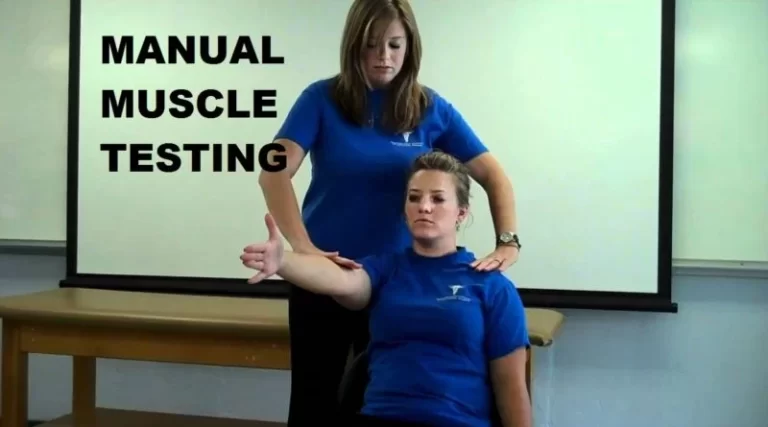
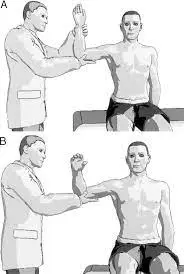
- Standing is the starting position for the exam.
- In this posture, the arm should be abducted to 90 degrees, and the shoulder joint should be externally rotated to 80 to 85 degrees.
- The examiner next applies isometric resistance to lateral rotation, which is followed by isometric resistance to medial rotation, which is the internal rotation of the shoulder.
What is the result of the Zaslav test?
- When a patient has strong lateral rotation strength, which indicates external rotation, but not medial rotation strength, which indicates internal impingement, this test is considered positive.
- Classic external anterior impingement is indicated if the patient shows more weakness during lateral rotation.
Some other thing about the Zaslav test?
- Regardless of the reason for the impingement—rotator cuff pathology, scapular or humeral instability, or labral pathology—it is checked for anterior shoulder impingement.
- As a result, structures are squeezed into the anterior portion of the humerus between the acromion process and the coracoid process.
- This test’s probability is useful for determining whether the shoulder is impinged.
- However, measuring the entire thickness of rotator cuff tears is not the greatest option.
FAQs
What is the internal rotation resistance strength test?
Internal rotation resistance strength test: an original diagnostic method…
With the arm at 90° ER and 85° IR, the individual is instructed to maximally oppose both external and internal rotation. The IRRST result is deemed positive if a patient with a positive impingement sign has strong external rotation in this position and apparent weakness in internal rotation.
What does a positive O Brien’s test indicate?
If the O’Brien test is positive, you have difficulty in the first position but less pain in the second. For the O’Brien test to be positive, you must experience fewer difficulties in the second position. A labral tear may be the cause of the severe shoulder ache.
What is the special test for the supraspinatus?
During a shoulder examination, a unique test called the empty can test is used to determine whether the supraspinatus tendon is involved. When patients indicate shoulder tenderness, weakness, or restricted range of motion, it is frequently used.
References
Ladva, V. (2022, January 8). Zaslav test for the shoulder joint : – Mobile Physiotherapy Clinic. Mobile Physiotherapy Clinic. https://mobilephysiotherapyclinic.in/zaslav-test-for-to-shoulder-joint/