5 Physio-Approved Exercises to Improve Hip Mobility
Introduction:
The main muscle groups that surround your hips aid in maintaining the range of motion in your hip joints. Activities like walking, standing, and climbing stairs might become easier to do as your physical fitness continues to improve if you stretch and strengthen these regions.
As you extend your hips, gradually increase the range of motion. For five to eight breaths, try holding each stance, and record any pain or unease. See a doctor or physical therapist so they can evaluate the issue if you experience pinpoint, sharp pain, or if it lasts longer than a few hours.
Exercises to Instantly Improve Hip Mobility Video:
Exercises to Instantly Improve Hip Mobility:
Pigeon Pose:
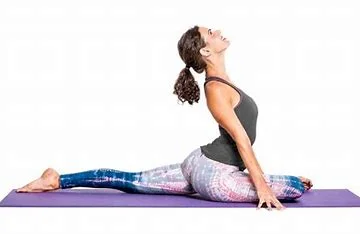
After starting in downward-facing dog, move your weight forward and your right knee closer to your right wrist. Your right foot should go toward the mat’s left edge. With your left leg lowered to the floor, slide your left thigh back. Make sure your left leg is parallel to the mat’s length and your hip bones are parallel and looking forward.
Keep your body upright by resting your fingertips on the mat (or bring the ground closer to you using two yoga blocks). Draw back your shoulder blades. (An additional option for a deeper stretch is to lie your forearms on the floor and fold forward over your right leg.) Push through your palms, tuck your left toes, and return to the downward-facing dog position to exit the posture.
90/90 Hip Rotations:
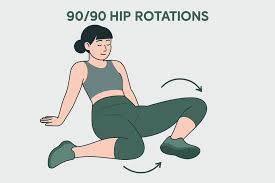
To improve the hips’ internal and external rotation, 90/90 hip rotations are a great mobility exercise. In order to maintain an erect chest and an engaged core, you must sit on the floor with one leg bent at a 90-degree angle in front of you and the other leg bent at the same angle behind you.
Without raising your feet off the ground, carefully rotate both knees to the opposite side from here, then effortlessly switch to the opposing side and repeat the 90/90 position. This deliberate motion improves lower back strain, glute activation, hip flexibility, and lower body mechanics in general. Frequent practice can reduce the chance of injury, support improved posture, ease hip stiffness, and enhance performance in exercises like lunges and squats.
Hip Flexor Stretch:
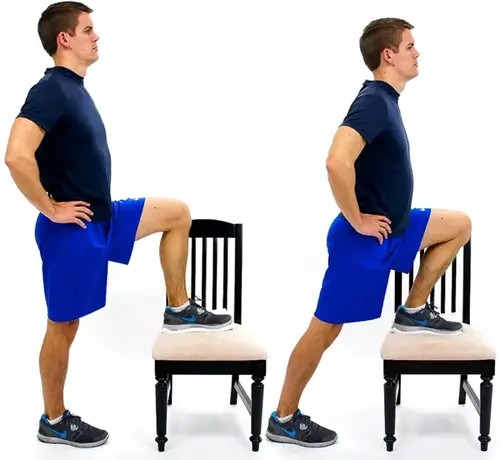
Targeting the muscles at the front of the hip, particularly the rectus femoris and iliopsoas, the hip flexor stretch is a straightforward yet incredibly powerful exercise. Long-term sitting can tighten hip flexors, which can result in lower back pain and bad posture. It is especially helpful for those who sit for extended periods of time. Start in a half-kneeling position, placing one knee on the floor and the other foot forward at a 90-degree angle, to do this stretch.
Gently move your hips forward until you feel a stretch in the front of the kneeling leg’s hip while maintaining an erect chest and an engaged core. Breathe deeply while holding the position for 20 to 30 seconds, then switch sides. Regularly performing the hip flexor stretch can improve posture, decrease hip stiffness, increase flexibility, and support improved performance in exercises like squatting, running, and walking.
Glute Bridge:
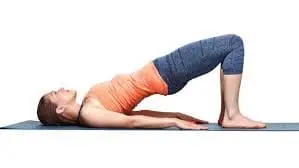
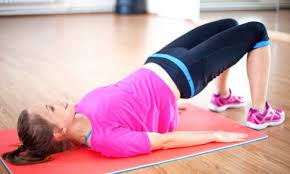
A great lower-body exercise that supports the lower back and tones the glute muscles, hamstrings, and core is the glute bridge. Lift your hips toward the ceiling by pressing through your heels until your body is in a straight line from your shoulders to your knees. At the top, squeeze your glutes for a moment, then controllably descend your hips back down.
In addition to improving posture and reducing lower back strain, this exercise helps increase hip stability and improve performance in exercises like lunges and squats. Additionally, regular practice can assist in activating weak glute muscles and easing prolonged sitting stiffness.
Dynamic Hip Circles:
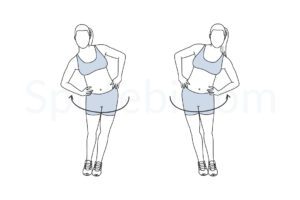
An effective movement exercise that enhances hip flexibility, joint lubrication, and general lower-body movement control is the dynamic hip circle. In order to prepare the hips for exercises like walking, running, squatting, or sports training, this movement is frequently included in warm-up routines. Hold onto a wall or other sturdy surface for balance while standing tall to perform powerful hip circles.
Without arching your lower back, raise one knee to hip height and steadily move it in a broad, controlled circle. Before swapping legs, make 8–10 circles in a single direction and then the opposite motion. In addition to improving range of motion and reducing the chance of injury during physical activity, this exercise helps activate the hip flexors, glutes, and stabilizing muscles.
Conclusion:
Incorporating physio-approved exercises into your daily routine is one of the most effective ways to instantly improve hip mobility and overall movement quality. Simple movements like 90/90 rotations, hip flexor stretches, glute bridges, and dynamic hip circles help release tight muscles, activate weak areas, and restore proper joint function.
Consistency is key—just a few minutes each day can reduce stiffness, ease lower back pain, enhance posture, and improve performance in daily activities and workouts. By prioritizing hip mobility, you not only move better but also lower your risk of injury and support long-term joint health.
FAQs:
Who ought to stay away from these exercises?
Before beginning, people with acute injuries, severe arthritis, labral tears, or recent hip surgery should speak with a doctor or physiotherapist.
Are hip mobility exercises effective for enhancing athletic performance?
Indeed. Squats, lunges, running mechanics, balance, and general lower-body strength are all improved by improved hip mobility.
After performing mobility exercises, is it typical to experience mild soreness?
Yes, it’s natural to feel a little sore, especially if your hips were really tight. Sharp or ongoing pain, however, is abnormal and needs to be assessed.
What differentiates hip flexibility from hip mobility?
Through a complete range of motion, hip mobility encompasses both strength and flexibility. Mobility guarantees controlled movement, whereas flexibility solely refers to muscle length.
Before performing hip mobility exercises, should I warm up?
It is advised to perform a brief warm-up, such as dynamic leg swings, marching, or walking in place, for three to five minutes to improve blood flow and avoid injury.
Are hip mobility exercises effective for alleviating lower back pain?
Yes, lower back pain is frequently caused by tight hips. Enhancing hip strength and flexibility can help with posture and lessen lower back strain.
Are exercises for hip mobility safe for those who have hip pain?
Yes, but make sure the exercises are pain-free and gentle. Before beginning, speak with a physiotherapist if you have arthritis, significant hip pain, or a history of injury.
How frequently should I do exercises for hip mobility?
Engage in hip mobility exercises four to five times a week for optimal benefits. You can safely perform mild mobility exercises every day if you suffer from stiffness or spend a lot of time sitting down.
References:
- Cronkleton, E. (2025, July 3). 14 Exercises for strengthening and increasing mobility in the hips. Healthline. https://www.healthline.com/health/hip-exercises
- Exercises for the hips. (n.d.). Arthritis UK. https://www.arthritis-uk.org/information-and-support/living-with-arthritis/health-and-wellbeing/exercising-with-arthritis/exercises-for-healthy-joints/exercises-for-the-hips/
- Team, C. P. (2025, November 13). Best hip exercises to ease stiffness and pain. County Physio Ltd. https://countyphysio.co.uk/best-hip-exercises/
- Clinic, C. (2025, December 4). Target your hips, groin, and glutes with these Hip-OPening stretches. Cleveland Clinic. https://health.clevelandclinic.org/hip-opening-stretches
- Gdrummond. (2025, November 15). Rehab exercises to restore smooth hip motion. St Leonard’s Physio. https://stleonardsphysio.com.au/rehab-exercises-to-restore-smooth-hip-motion/