
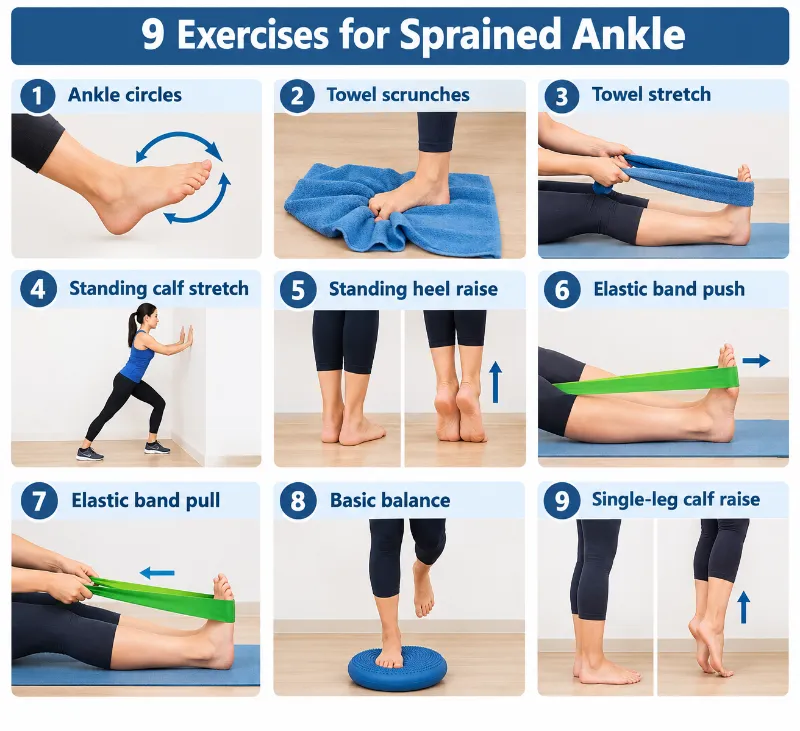
9 Best Exercises for Weak Ankles After an Ankle Sprain
Introduction:
One of the most frequent injuries that athletes and physically active people may have is an ankle sprain. It happens when the foot and ankle joint is twisted, rotated, or pushed beyond its usual range of motion, tearing or stretching the ligaments surrounding the ankle joint. Ankle sprains are more frequently caused by poor balance—more specifically, proprioception—than by a lack of lower limb strength, flexibility, or endurance. The most typical sign of decreased proprioception is poor balance.
All injuries have the potential to impair your balance and proprioception. Proprioception and balance exercises, however, can help you quickly improve both your proprioception and balance.
The knowledge or sense of your joint’s location and motion in space is known as proprioception. A sprained joint might give out, feel unstable, and lose proprioception. In physically active people and athletes, ankle strengthening exercises that incorporate proprioceptive and balance exercises assist the body in relearning how to manage joint position and prevent injury.
Types of sprained ankles:
- Grade 1 (mild): There isn’t much tearing, but your ligament is stretched enough to cause harm. You may have some pain and soreness in the ankle area. You shouldn’t experience any instability when walking.
- Grade 2 (moderate): Your wounded ligament is partially or completely torn. However, it is still intact. There will be greater swelling, and movement will be painful. Walking might hurt, and you could feel unstable.
- Grade 3 (severe): Your ligament is entirely torn in two. Another name for this is a ruptured ligament. Because of severe edema, you might not be able to walk or move that ankle.
Symptoms of sprained ankles:
Depending on the severity, ankle sprain symptoms might vary, but they often include:
- Pain, particularly while bearing weight on your ankle
- Tenderness to touch
- Swelling
- Stiffness
- Bruising
Sprained ankle causes:
Your ligaments might be sprained by anything that overstretches them. Ankle sprains are also referred to as twisted or rolled ankles. These titles are appropriate since excessive ankle rotation in any one direction might harm your ligaments.
Among the most typical reasons are:
- Slips
- Falls
- Sports injuries
- Landing wrong after a jump
One of the most frequent sports injuries is an ankle sprain, particularly in games involving rapid direction changes or forceful foot twisting. Football, basketball, soccer, and tennis can all raise your risk of sprains.
Additional risk factors may consist of:
- Problems with balance or coordination that increase your risk of slipping or falling
- Feet with a high arch
- Ankles that are rigid or not particularly flexible
- Ankles that are “looser” than normal due to excessive flexibility
Your ankles will be less resistant to slips, trips, and unexpected additional force if they are less flexible. However, if your ankles are exceptionally flexible, you may be at greater danger. Joints that are looser may be more prone to overstretch.
9 Exercises for Sprained Ankle :
Ankle circles:
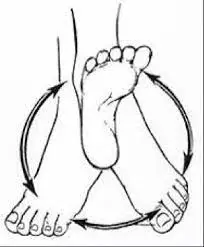
You can maintain your ankle’s complete range of motion and increase blood flow with range-of-motion workouts. One of the first mild exercises you should do is ankle circles, which assist your ankle in moving in all directions.
- Use a foam roller, rolled-up towel, or pool tube to support your leg as you sit on the floor to keep your heel off the ground.
- Move your ankle slowly in a clockwise circle. Move the ankle in the other direction for the same number of repetitions after completing 10 of them.
- You can do this two or three times if there is no pain.
Towel scrunches:
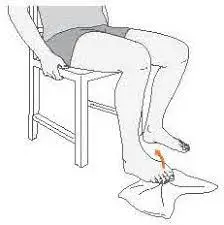
A mild workout that can assist in increasing your feet’ and ankles’ strength, flexibility, and range of motion is towel scrunches. This exercise may be done standing or sitting.
- Place a small towel on the ground in front of you.
- Gently grasp the towel with your toes and twist it up. Do this twice.
- Keeping the same stance, release the towel and push it back out with the outside of your toes.
- Do this eight or ten times.
Towel stretch:

The Achilles tendon, which runs behind your ankle and connects your calf muscles to your heel bone, can be gently stretched using a towel.
You can do this exercise with a hip belt, a towel, or a light resistance band.
- Take a seat on the floor with your leg out in front of you.
- Cover your foot’s ball with a cloth. Pull back on the towel gently to bring your toes closer to you.
- Hold the stretch for 15 to 30 seconds.
- Avoid stretching too much. Your calf muscle should only be slightly to moderately stretched.
Standing calf stretch:

The back of the leg can be stretched with this well-liked exercise.
- For support, place your hands on a work table or turn to face a wall.
- Put your healthy foot forward and your damaged ankle roughly one step back.
- With your back heel down on the floor, slowly bend your front knee until the calf on the injured side starts to stretch slightly.
- Repeat this three times, holding each stretch for thirty seconds.
Standing heel raise:
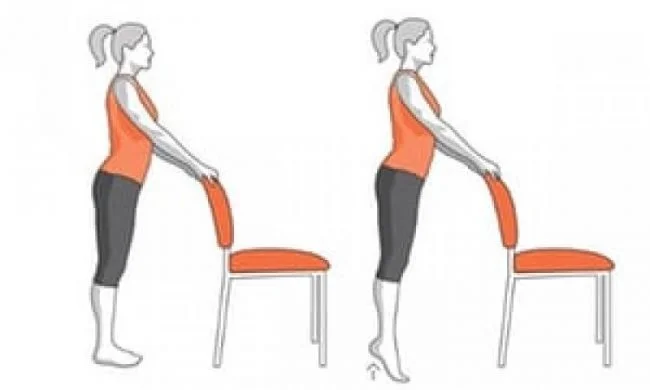
You can stand or sit while doing this workout. If standing is too painful or uncomfortable, take a seat.
- Hold onto a wall, a flat surface, or a chair back to support yourself while keeping your hands in front of you.
- Keeping your feet shoulder-width apart, carefully rise onto your toes. For five seconds, maintain this posture.
- Go back to the floor and rock back on your heels a little while raising your toes.
- Begin with 10 repetitions and work your way up to 20 or more.
Keep in mind that you want no pain and just a mild stretch. As they become easier, you can switch to using only the toes on your injured side.
Elastic band push:

You can add strengthening exercises to your program if your sprained ankle has good range of motion and you can bear weight on it without pain.
This is a variation on the towel stretch, except it uses a resistance band to increase resistance.
- Take a seat on the ground. Put the elastic band over the ball of your foot after extending your affected leg. Grasp both ends.
- Keep the other leg bent at a 90-degree angle.
- Push your ankle forward slowly, as if you were pointing your toe. Then return it gradually.
Do this ten times. If your ankle hurts or feels unstable, don’t use the band.
Elastic band pull:

This exercise can strengthen the ligaments and muscles on the top of your foot and ankle.
- Wrap your resistance band around a hefty item, like the leg of a desk or table.
- Hook your toes and upper foot inside the band while seated on the ground.
- Return your foot to a vertical position by slowly drawing it back toward you. Do this ten times.
You may strengthen your ankle’s muscles and enable it to move through its whole range of motion by doing two variations of this exercise. You should place the band on the outside or inside of the injured ankle rather than dealing with it directly.
- Ankle out: Apply the resistance band to the inside of the damaged ankle first. Slowly slide your foot outside against the resistance band and back after placing it inside the band’s end.
- Ankle in: Apply the resistance band to the outside of the damaged ankle first. Put your foot within the band’s end, move it slowly inside against the resistance band, and then return it.
Basic balance:

Nerve fibers are harmed when you suffer a sprain. Your brain must restore its sense of where your ankle is and how to move it exactly as you develop strength. Proprioception is the term for this sensation.
When you start this exercise, use a countertop or the back of a chair for more support.
- Gently raise the other foot off the ground behind you while standing on the affected foot.
- First, hold this for a few seconds. Then, if you can, increase the duration to 30 seconds and 1 minute.
There are various methods to increase the difficulty of this exercise as your balance improves:
- During the workout,
- stand on a pillow rather than the solid ground,
- close your eyes, and avoid using any additional support.
Single-leg calf raise:

All of these exercises are combined in single-leg calf raises to improve range of motion, stability, and balance while strengthening the muscles that support your ankle.
When you start this exercise, use a countertop or the back of a chair for more support.
- With your hands on a wall, a level surface, or the back of a chair, raise your healthy leg behind you so that your weight is on the leg with the injured ankle.
- Raise your heel and push yourself up until your calf starts to work. After two seconds of holding this position, lower yourself.
- Try doing this exercise with the help of a few fingers as you gain strength. Do this on your own when you’re stronger.
Benefits of Ankle Strengthening Exercises:
The primary advantage of ankle strengthening exercises is that applying weight will put less strain on the ankle joint.
Exercises that protect the joint and reduce the risk of developing osteoarthritis and ankle arthritis will help you enhance your ankle joint. Leg strengthening enhances balance and leg bone density.
Do Sprained Ankles Ever Fully Heal?
The degree and grade of a sprained ankle determine how long it takes to heal. Depending on the force and degree of the injury, there are three categories for ankle sprains. They vary from a minor ligament tear or stretching that results in mild soreness to a total tear that causes severe pain and inflammation. Our experts will choose the finest course of action and recovery exercises for your situation after determining the severity of your sprain.
Ankle sprains usually require a few days to six weeks to heal completely with elevation and icing. In more difficult situations, healing could take many months and need the use of crutches. It will take a few weeks for a patient with mild ankle sprains to recover full comfort. It may take months if the ligaments are torn.
How to Prevent Ankle Sprains & Strengthen Your Ankles:
Both sportsmen and less active people are susceptible to ankle sprains. Avoiding an ankle sprain requires maintaining the ankle’s strength and flexibility. This can be done by strengthening your core, increasing your balance, and being aware of any ankle pain you may be experiencing. In certain cases, surgery may be necessary to fix torn tissues and maintain the strength and stability of your ankle during walking.
Risks of Exercising Injured or Weakened Ankles:
Ankle strengthening activities are generally safe. If you are feeling any negative indications of inflammation or pain, it is crucial to avoid exercising and stretching your ankle.
If you have bruises or a sprain, avoid undertaking ankle strengthening activities. Before attempting to begin ankle workouts, it is recommended to apply ice to minimize inflammation and rest for a week or two. Exercises that involve slow, controlled movements should reduce the incidence of pain.
If you experience pain, stop working out and treat your ankle using the RICE (Rest, Ice, Compression, and Elevation) technique. Avoid performing really difficult workouts too soon after an accident, since this may aggravate your symptoms or put you at risk for another injury.
FAQs:
Why is my ankle so weak after a sprain?
Therefore, a severe ankle sprain causes the lateral ligaments (ATFL and CFL) to tear or rupture. These ligaments will repair, but they will do so while stretched. This makes the ankle joint feel clumsy and raises the possibility that the patient will trip over their ankle in the future.
How do I tell if my ankle sprain is grade 2 or 3?
Grade 2: An incomplete tear with substantial swelling, pain, and bruising; a more serious sprain. Walking hurts, and the damaged parts are sensitive to the touch, but the fact that it feels strong. Grade 3: The affected ligament or ligaments are completely torn, and there is significant bruising and swelling.
Do sprained ankles ever fully heal?
A key to recovering from an ankle sprain is to give it time to heal. Ankle sprains can take anywhere from two weeks to several weeks to heal, depending on how severe they are. One year after the accident, 10–30% of individuals may still have some chronic pain.
What are two danger signs for ankle ligament instability?
Chronic ankle instability sufferers frequently report ankle rotation that occurs frequently, particularly when doing sports or on uneven surfaces. Chronic pain and swelling. Tenderness or pain.
Can weak ankles be strengthened?
Ten easy exercises might help strengthen weak ankles, which can be caused by past injuries or other health problems. You’re not alone if you’ve sprained or fractured an ankle; it’s an injury you don’t quickly forget.
Can ankle ligaments be permanently damaged?
Unfortunately, the ankle can occasionally sustain irreversible damage. Ankle instability may result from poor healing and weakening, or ankle pain and swelling may result from damage to the joint or another surrounding structure.
Can I walk on my sprained ankle after 3 days?
While Grade 2 and Grade 3 sprains usually require further protected rest before bearing full weight, Grade 1 sprains may allow safe walking at three days with minimal pain.
How many days should I rest with a sprained ankle?
By lessening the strain on the injured ligaments, resting your ankle as much as possible during the first 48 hours after a sprain will reduce your risk of aggravating the injury. While severe sprains could need several months of healing, mild sprains might only need a few days.
References:
- Ankle Strengthening Exercises Including Balance and Proprioception Exercises | Kansas City Bone & Joint Clinic | Orthopedic Care Overland Park. (n.d.). https://www.kcbj.com/ankle-strengthening-exercises-including-balance-proprioception-exercises-orthopedic-musculoskeletal-care-overland-park-kansas-city/
- Sprained ankle. (n.d.). Cleveland Clinic. https://my.clevelandclinic.org/health/diseases/22048-sprained-ankle
- Hecht, M. (2025, October 30). 9 exercises for your sprained ankle and when to see a doctor. Healthline. https://www.healthline.com/health/sprained-ankle-exercises#single-leg-calf-raise
- Surgeons, E. V. F. A. A. (n.d.). Tips to strengthen your ankles & Avoid a sprain | EVFAS. Blue Compass, Des Moines, Iowa, www.bluecompass.com. https://www.eastvillagefootandankle.com/services/ankle/ankle-sprain
- Sundstrom, J., & Mijailovic, J. (2025, August 29). 12 Ankle strengthening exercises to prevent and avoid further injury. Upstep. https://www.upstep.com/a/blog/ankle-strengthening-exercises-to-prevent-and-avoid-further-injury?srsltid=AU7gw4XSM2CT8nPyoPmkYqsqPiDQVxsaSazY0B_nkzC7-Vec_LxDfUKv