Crouch Gait
Introduction
Crouch gait is an abnormal walking pattern commonly seen in individuals with cerebral palsy, where the hips and knees remain excessively bent during standing and walking. This posture increases strain on the muscles and joints, often leading to fatigue, pain, and reduced mobility over time. Early identification and proper rehabilitation can help improve walking efficiency and quality of life.
To clarify what crouch gait is, this article will go over:
- What makes people with cerebral palsy crouch?
- Dangers of a poorly controlled crouch gait
- Is it possible to cure crouch gait?
- How to help people with cerebral palsy who have a crouch gait
Growth spurts (when muscles cannot keep up with quickly growing weight), physical abnormalities, weight increase, muscular weakness, poor motor control, and contractures are some of the reasons for crouch gait. It is a vicious cycle since having a crouched gait can result in a variety of problems, including increased crouching.
Crouch Gait Causes in People with Cerebral Palsy
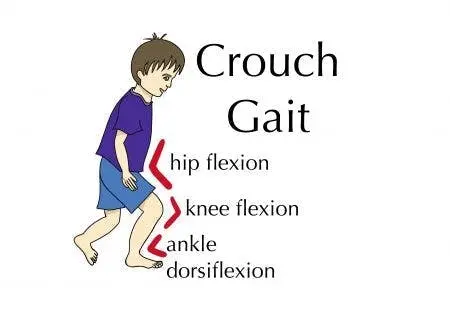
Crouch gait is a different gait that can be identified by:
- Ankle dorsiflexion is the upward twisting of both ankles.
- Knee flexion, or bent knees
- Hip flexion, or bent hips
The way this position gives the impression that the individual is walking somewhat crouching is known as “crouch gait.”
Spasticity, an involuntary contraction of the muscles, is the primary cause of crouch gait. Spasticity results from poor brain-muscle connection. The result is that the muscles remain tight for long periods of time.
Spastic cerebral palsy is caused by a brain injury that happens during development. Depending on the location of the brain wound, the child may have stiffness in various body areas. The resulting stiffness can get worse over time, although the resulting cerebral palsy does not. Because the brain doesn’t have a signal for the affected muscles to relax, they remain tight.
As a result, when they begin to walk, kids with stiff legs might develop abnormal gait patterns like the crouch gait.
Risks Associated with Poorly Managed Crouch Gait
Compared to unaffected walking patterns, walking with a crouch gait demands more energy, which frequently results in pain in the joints and fatigue.
The body has to use more effort to maintain equilibrium due to the extra pressure on the bones, joints, and muscles. Additionally, some muscles are always under strain due to the ankles, knees, and hips, while others are left underdeveloped. Chronic pain is frequently the result of this muscular imbalance, which raises joint pressure.
If leg spasticity is not properly managed, people may experience further issues such as:
- Weakening of the ankle plantar flexors and hip and knee extensors due to unequal or distorted development
- displaced or subluxed joints, poor posture and stability, and difficulty walking
The Effects of Crouch Gait on Children with Cerebral Palsy
One of the most difficult effects of the crouch gait for kids with cerebral palsy is hypertonia, commonly referred to as excessive muscular tone or spasticity. Due to the child’s involuntary muscular spasms, this disease results in tight muscles, stiff, jerky movements, and occasionally joint dislocation and pain. This makes it very challenging to sit, stand, and move, as well as for relaxation.
Spasticity results from a child’s brain being injured by cerebral palsy in a way that prevents the brain from asking its affected muscles to relax and instead overstimulates them in an effort to provide stability. Spasticity, or involuntary muscular contractions, results from this misunderstanding and grows worse as the kid gets older. This stiffness frequently results in crouching and can impede the development of a normal walking pattern.
As a child’s body develops, high muscular tone may also force it inward, causing abnormalities. Additionally, low muscle tone (hypotonia), which frequently affects the abdominal muscles in children with cerebral palsy, can result in poor posture, balance issues, and instabilities in the trunk and torso. If left untreated, spasticity puts excessive strain on a child’s musculoskeletal system, which includes their bones, joints, and muscles.
Flexion and Range of Motion
The term “crouch gait” comes from the way a person appears when walking. They appear to be going forward while squatting. Their ankles bend while their knees and hips excessively bend (in flexion), causing them to crouch. It is particularly prevalent in children with spastic cerebral palsy and pediatric cerebral palsy.
Walking, sitting, and standing—or rising from a seated position—all depend on flexion. Range of Motion (ROM) is also related to flexion. A person’s knee range of motion is a combination of their knee’s flexion and extension. Flexion is the capacity to bend the leg, whereas extension is the capacity to straighten it. The majority of children’s legs are fully straightened at 1.6-5º extension and fully flexed at 142-152º. Numerous other issues might arise from the inability to properly extend or from appearing to be locked in flexion
The Wear and Tear of Crouch Gait
One of the most prevalent problematic walking patterns in children with cerebral palsy is crouch gait, which is significantly impacted by excessive knee flexion. Once more, those who have trouble with a crouch gait are unable to walk with their knees completely extended. Their knee joints and quadriceps—the muscles at the front and sides of the thigh—are severely strained by their inability to fully extend their legs. They are always in use, which explains why.
Children’s ability to walk for longer periods of time and farther is limited as a result of this continual bending, which wears them out more rapidly. They get tired. Their knees ached. Not to mention the damage it does to their confidence. Additionally, Flint Rehab said that “the body must work harder to maintain balance because of the additional strain on the muscles, joints, and bones.” Furthermore, “The continual contraction of the ankles, knees, and hips results in constant strain on some muscles while others remain underused,” they continued. Chronic pain is frequently caused by this muscular imbalance, which raises joint pressure.
Additionally, degenerative arthritis, skeletal abnormalities, and pain in the joints can result from crouching. It seems sense that a large number of kids with crouch gait eventually need wheelchairs or assistance walking devices.
How to Treat Crouch Gait
Orthotic Equipment
- Even if it means your kid may walk more slowly or in pain while learning to improve crouch gait, it is essential to correct poor form and placement.
- Braces and splints are examples of orthotic devices that offer structural support to encourage appropriate musculoskeletal alignment and gently stretch spastic muscles. and stop further contractions.
- Ideally, people may progressively wean themselves off their orthotic devices until they are no longer required as their bodies and brains adjust to walking with a corrected gait pattern.
Physical Therapy
Finally, and perhaps most crucially, addressing aberrant gait patterns, such as crouch gait, requires intensive physical therapy.
Your child must engage in rigorous physical training to improve their gait, no matter whether they receive spasticity treatment with a brace, Botox, or surgery.
For one to replace the current walking pattern and stimulate neuroplasticity in the brain, physical therapy activities must be difficult and frequent. It’s also crucial to keep doing exercises at home to further develop and transfer abilities acquired in treatment.
Botox
- To temporarily reduce spasticity, a drug called Botox is injected into spastic muscles. The excessive nerve impulses that trigger muscular contractions are blocked by it.
- The effects of Botox provide people a window of time to practice walking correctly. The benefits of regularly walking with proper form may persist long after the drug has worn off, ignoring the fact that its effects do wear off with time.
Intrathecal Baclofen Pump
- A continuous dose of baclofen can enter the fluid around the spinal cord by surgery to implant a baclofen pump beneath the skin of the abdomen.
- Baclofen is a muscle inhibitor that reduces excessive muscle tone, similar to Botox. You don’t need to take as much of the medication as you would if you took it orally since it is injected straight into the cerebrospinal fluid. But since the pump requires frequent refills, baclofen pumps might not be the best course of action for kids.
Selective Dorsal Rhizotomy
- A surgical technique called selective dorsal rhizotomy involves severing hyperactive sensory nerve fibers alone. Spasticity can be considerably reduced by restricting the brain’s ability to communicate with the muscles.
Single-Event Multi-Level Surgery (SEMLS)
- It involves a surgical treatment that addresses each muscle imbalance and bone abnormality one at a time, beginning at the hips and ending at the feet.
- Tendons can extend, muscles can move, and bones can change as a result of SEMLs. Without directly affecting the central nervous system, spasticity can be considerably reduced by adjusting the musculoskeletal system.
Summary
When ambulatory diplegic and quadriplegic patients reach the pubertal spurt, their weak muscles are unable to sustain a toe walking pattern due to the quickly increasing weight, resulting in a frequent gait deviation known as crouch gait. This type of gait is very inefficient and may eventually impair one’s ability to walk.
Overloading the anterior knee may result in arthritis, discomfort, and failure of the extensor mechanism. Because of its progressive nature, surgery is frequently necessary. Because crouch gait has several causes, surgery should be customized to address each patient’s unique anatomical and physiological problems.
FAQs
What muscles are weak in the crouch gait?
The decreased strength needed from the ankle plantarflexors and hip abductors during crouch gait implies that these muscle groups might be targets for strength training and that their deficiency may be a factor in crouch gait.
What is crouch walking called?
The term “crouch gait” comes from the way a person walks. They appear to be going forward while squatting. Their ankles bend while their knees and hips excessively bend (in flexion), causing them to crouch. It is particularly prevalent in children with spastic CP and pediatric cerebral palsy.
What is a crouch gait in adults?
People with cerebral palsy often have crouch gait (CG), one of the most common gait abnormalities. The main unique advantages are severe flexion of the hip, knee, and ankle.
References
- Crouch Gait: Causes, issues, Treatments – Bionic Power Inc. (n.d.). https://bionic-power.com/crouch-gait-causes-issues-treatments/
- Otr/L, E. D. (2022, October 25). Crouch gait and cerebral palsy: What it looks like & How to treat it. Flint Rehab. https://www.flintrehab.com/crouch-gait-cerebral-palsy/?srsltid=AfmBOoqE72GiGuUIVQdBVPde4riQcgQ3m5qYRdqBfZMBJ5xKxmY4sgOE