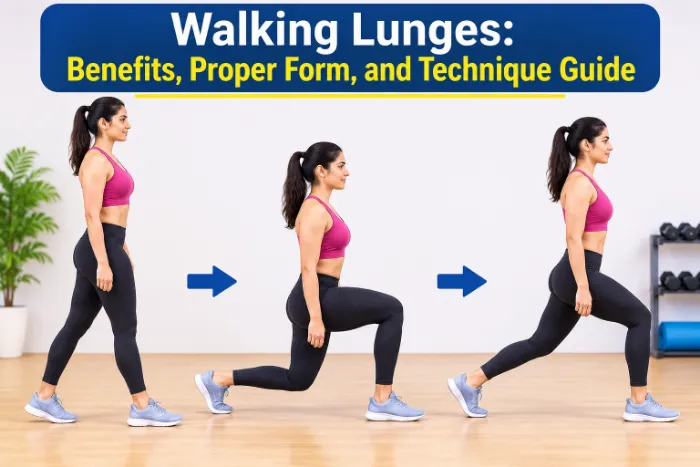
Walking Lunges: Benefits, Proper Form, and Technique Guide
Introduction:
Walking lunges are an effective lower-body exercise that helps strengthen the quadriceps, hamstrings, glutes, and calves.
Because they enable you to raise a significant amount of weight, certain workouts appear impressive. Others are remarkable because they reveal every flaw you were unaware of. Walking lunges are clearly in the second group.
They seem straightforward at first—just take a step forward and drop yourself to the ground. In actuality, each repetition concurrently tests your strength, balance, coordination, mobility, posture, and body awareness.
They should be included in almost all well-designed training programs because of this. We’re far more interested in workouts that enhance your body’s performance both inside and outside of the gym than we are in ones that just leave you tired. That’s what walking lunges do.
They help in the development of single-leg strength, stability, and control that is useful for jogging, trekking, climbing stairs, lifting kids, participating in outdoor sports, and just going about daily activities with assurance.
What Is A Walking Lunge?
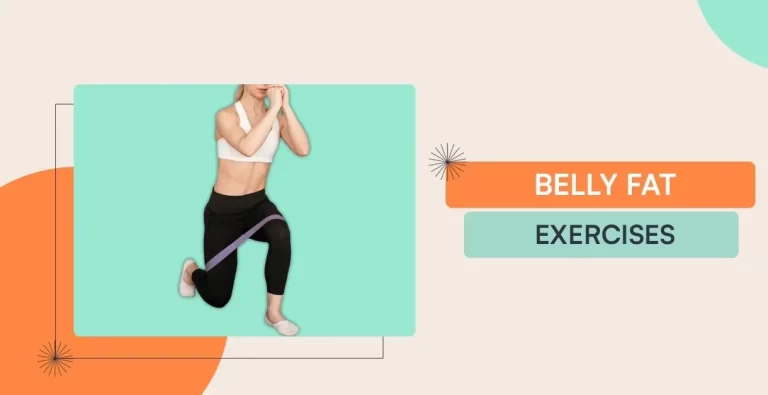
A version of the forward lunge, the walking lunge uses the rear leg to move the body forward rather than the front leg to return to standing. Walking lunges and other unilateral exercises are excellent for finding and fixing imbalances between the two limbs.
Similar to stationary lunges, walking lunges are a complex exercise that works the calves and core in addition to strengthening the quadriceps, hamstrings, and glutes. The walking lunge version requires you to shift your weight while standing on one leg, which increases the difficulty of balance and stability.
Walking lunges raise heart rate and can be used as part of a high-intensity interval training (HIIT) circuit with bodyweight or light weights, or as part of a strength training regimen with heavier weights.
Why Walking Lunges Matter:
Both legs are used in a lot of common lower-body workouts.
These bilateral movements are really beneficial, but they can also help your stronger leg make up for your weaker one.
Walking lunges take away that chance.
Every leg needs to independently:
- Produce force
- Control body weight
- Stabilize the hip
- Maintain knee alignment
- Absorb impact
- Generate forward movement
This highlights weaknesses that leg presses and squats can avoid.
Increasing one’s strength in one leg often results in:
- Better movement efficiency
- Improved athletic performance
- Fewer compensations
- Better balance
- Increased confidence during everyday activities
Muscles Worked in Walking Lunges:
Walking lunges are a complex, unilateral lower-body exercise that works many muscle groups and requires core stability and coordination. The major and secondary muscles used are broken down as follows:
Primary Muscles:
Gluteus Maximus.
The main force behind the hip extension stage. Walking lunges are one of the best workouts for developing the glutes since a long stride further engages the muscles.
Quadriceps.
The quadriceps regulate the descent into the lunge and stretch the knee during the upward phase. More strain is placed on the quadriceps with a shorter stride.
Semitendinosus, Semimembranosus, and Biceps Femoris are the hamstrings.
These help slow down the process during the lowering phase and support the glutes in extending the hip.
Secondary Muscles:
Adductors
The inner thighs aid in maintaining alignment throughout the gait cycle and stabilizing the leg as you stride.
Calves (Soleus and Gastrocnemius)
During each step, engage them to help push off the ground and preserve ankle stability.
Rectus Abdominis, Obliques, and Transverse Abdominis are the core muscles.
For each step, stabilize the pelvis and spine by working isometrically. Postural strength is enhanced, and anti-rotational control is forced due to the unilateral character.
Walking Lunges Video
Who should avoid walking lunges?
Walking lunges should be avoided if you have a hip or knee injury or if you have severe pain in the joints. Additionally, to avoid falls, you should either avoid doing this activity or do it under close supervision if you are pregnant.
How to do a walking lunge?
- Place your feet shoulder-width apart and stand upright. Rest your hands gently on your waist or let your arms relax alongside your body.
- Put your weight on your heel and take a step forward with your right leg.
- In a lunge position, bend your right knee and drop it until it is parallel to the floor. Take a moment to pause.
- Move your left foot forward while keeping your right leg still, then repeat the movement with your left leg. When your left leg is parallel to the floor in a lunge, pause.
- As you lunge, repeat this movement, “walking” forward while switching legs.
- Perform 10–12 repetitions on each leg. Do two or three sets.
Variations to try:
Walking lunge with torso twist:
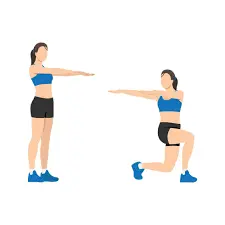
Equipment required: One free weight or a medicine ball
- Place your feet hip-width apart and stand upright. Hold a medicine ball or weight in front of your core with both hands while bending your elbows at a 90-degree angle to activate your abs.
- Put your weight on your heel as you take a step forward with your right leg.
- Bend your right knee and lower yourself to a lunge stance with your knee parallel to the floor as your right foot hits the ground and stabilizes. Take a moment.
- Holding the weight with both hands, rotate your upper body to the right once you are steady in the lunge posture. Your torso should be the source of the movement.
- Lunge forward with your left leg after twisting back to the center. As you lunge and turn to the left, repeat the same motion with your left leg, “walking” ahead.
- Do ten to twelve repetitions on each side.
Walking lunge with weights:
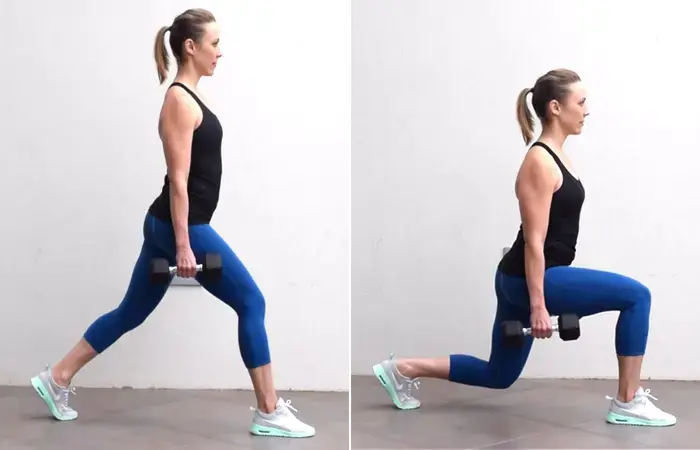
Two dumbbells are required equipment.
- Maintain a straight posture with your shoulders back. Maintain a straight body while holding one dumbbell in each hand and maintaining your arms at your sides.
- Throughout the entire exercise, keep your arms at your sides in a relaxed position. Put your weight on your heel as you take a step forward with your right leg.
- Bend your right knee and descend parallel to the floor into a lunge stance as your right foot hits the ground and stabilizes.
- Move your left foot forward while keeping your right leg still, then repeat the movement with your left leg. When your left leg is parallel to the floor in a lunge, pause.
- As you lunge, repeat this movement, “walking” forward while changing legs.
- Perform 10–12 repetitions on each leg. Do two or three sets.
How to Program Walking Lunges into Your Workout Routine:
Walking lunges are very flexible. They may be included in your warm-up, primary lift, or accessory training, depending on your objective—muscle development, strength, endurance, or mobility.
For Hypertrophy (Muscle Growth)
- Frequency: 2–3x per week
- Volume: 3–4 sets of 8–12 reps per leg
- Rest: 60–90 seconds between sets
- Load: Moderate to heavy dumbbells or barbell
When combined with Bulgarian split squats or barbell back squats, walking lunges can function as a finisher that emphasizes the quadriceps or glutes.
For Strength and Stability
- Frequency: 1–2x per week
- Volume: 4–5 sets of 6–8 steps per leg
- Rest: 90–120 seconds between sets
- Load: Heavy dumbbells or barbell across the back
On lower-body days, use walking lunges as an additional strength exercise to strengthen joint stability under load and develop unilateral control.
For Endurance and conditioning
- Frequency: 2–4x per week
- Volume: 3–5 sets of 20+ steps total
- Rest: Minimal (30–60 seconds) or superset with cardio
- Load: Bodyweight or light load
To increase cardiovascular capacity and muscle endurance, try combining walking lunges with rowing intervals, kettlebell swings, or sled pushes.
Benefits of Walking Lunges:
Build Functional Lower-Body Strength:
The muscles involved in almost all lower-body movements are strengthened by walking lunges.
Each stage progresses:
- Quadriceps
- Gluteus maximus
- Hamstrings
- Hip stabilizers
- Calves
Rather than just lifting greater weights, you’re building usable strength since each side functions independently.
Improve Balance and Coordination:
Your nervous system must continuously make little modifications for each step.
This trains:
- Balance
- Proprioception
- Foot control
- Hip stability
- Body awareness
These abilities become increasingly important as we progress through the ageing process.
Enhancing balance is beneficial for more than simply sports performance; it can lower the chance of falls and improve self-assurance when moving around in daily life.
Reduce Strength Imbalances:
Few people have perfect symmetry.
Most people have an instinctive preference for one leg.
Over time, this may lead to:
- Uneven strength
- Altered movement patterns
- Compensations
- Poor exercise mechanics
Walking lunges reveal these variations while providing every leg with an equal chance to get better.
Develop Core Stability:
Walking lunges are classified as leg exercises, yet each repetition requires constant effort from your core.
Your obliques, spinal stabilizers, and abdominal muscles must withstand:
- Rotation
- Side bending
- Excessive forward lean
Your core’s principal function is to maintain stability rather than to move.
Your core works precisely like this throughout a lot of everyday tasks.
Improve Everyday Movement:
Walking lunges are very similar to everyday movements.
Examples include:
- Climbing stairs
- Stepping over obstacles
- Hiking
- Getting off the floor
- Carrying groceries
- Playing with children
- Recreational sports
For this reason, walking lunges are frequently regarded as one of the greatest functional strength workouts out there.
They teach movement rather than muscles alone.
Safety tips:
Compared to static lunges, walking lunges need greater balance and coordination. One of the biggest concerns is getting hurt when you fall because you can’t keep your equilibrium. You run a higher chance of pulling a muscle if you use incorrect form.
For most people, walking lunges are thought to be safe. If you’re just starting, you might want to start with a static lunge until your form is perfect. Walking lunges can help avoid injuries; therefore, it’s crucial to have proper technique.
To keep safe, follow these suggestions:
- Throughout the exercise, keep your body erect. Try not to bend forward too much.
- Throughout the whole lunge, keep your core active.
- Avoid arching your back by not extending your leg too much when you lunge forward.
- Aim to take enough steps such that your torso and hips are straight down and your body is comfortable in a vertical position. In addition to being dangerous for your knees, not going far enough might result in injury.
Working with a trainer or a friend or relative who has experience with walking lunges might be beneficial if you’re new to working out. They may provide advice on how to make the most of this move and assist in ensuring that your form is proper.
FAQs:
What is the best technique for walking lunges?
Walking lunges are a dynamic compound exercise that improves balance, core stability, and lower body strength.
How to do a lunge correctly for beginners?
An effective lower-body workout that strengthens your glutes, quadriceps, and hamstrings and enhances your balance is the forward lunge.
How many lunges should a beginner start with?
A total beginner should begin with two to three sets of five to ten lunges each leg (about twenty to forty total lunges) per session, done two to three times a week.
How long should you do walking lunges?
It takes five to ten minutes to do a typical walking lunge workout. This often entails two to three sets of eight to twelve repetitions each leg, or about twenty to thirty total reps per set at a regulated pace.
Which is better, squats or walking lunges?
Walking lunges and squats are not always “better” since they have distinct training objectives. Whether you desire to develop athletic balance and single-leg stability or gain sheer bulk and heavy strength will determine which one is best for you.
Why is it so hard for me to do walking lunges?
Walking lunges are challenging because they are a unilateral (single-leg) exercise in which your center of gravity moves across space as your body continually absorbs, stabilizes, and produces force through one leg at a time.
What is the easiest type of lunge to do?
Most people agree that the reverse lunge is the most straightforward and knee-friendly variant of the typical lunge.
Are walking lunges worth doing?
Walking lunges are worthwhile because they increase single-leg strength, correct muscular imbalances, and enhance core stability and balance.
References:
- Wilson, S. (2026, August 2). Walking lunges: benefits, proper form, muscles worked & coaching tips. PuncHIIT Fitness Inc. https://www.punchiit.ca/post/walking-lunges-benefits-proper-form
- Chertoff, J. (2019, June 24). How to Step Up Your Workout with Walking Lunges. Healthline. https://www.healthline.com/health/exercise-fitness/walking-lunges#frequency
- Swolverine Inc. (2025, June 16). Walking lunges: Benefits, form, variations, and programming tips. Swolverine. https://swolverine.com/blogs/blog/walking-lunges-benefits-form-variations-and-programming-tips?srsltid=AYCX9vK4PWxDjkf11-fEWVS1LAdvMsMv94gKJbq5IZimd21piyTpMRFn
- How to do walking lunges. (n.d.). PureGym. https://www.puregym.com/exercises/legs/quad-exercises/lunges/walking-lunges/