Top Exercises for Tech Neck From Looking Down at a Phone
Introduction:
For many of us, cellphones are an essential part of our lives.
We use them to stay in contact with our loved ones, get information in a matter of seconds, and browse websites that offer our favorite music, news, social media, sports data, and recipes. They assist us in managing our professional and personal routines.
All of our everyday encounters with technology, however, come with a very real and unpleasant side consequence.
Studies have shown that tech neck, sometimes referred to as “text neck,” is caused by spending too much time hunched over our devices.
What is tech neck?
The term “Text Neck Syndrome” describes the neck pain that has become more common as a result of our overuse of technology. Staring down at our phones and tablets for long periods of time causes neck stress, which is what causes it.
This strain can cause pain, stiffness, and possibly limited range of motion. It’s becoming increasingly common since younger people use their cellphones so often.
Your neck muscles are only used to support the 4.5–5.5 kg weight of your head while it is erect and facing straight ahead. When tilted 15 degrees, this increases to 12 kilograms. Your neck muscles have to work hard to sustain more than 18 kg at a 30-degree angle. The weight that must be supported at a 45-degree angle is more than 22 kg. Lastly, gazing down at a 60-degree angle puts more than 27 kg of stress on your neck muscles.
What Are “Text Neck” Symptoms And Indications?
“Text neck” symptoms could consist of:
- Severe or painful shoulder or neck ache at the end of the day
- Having trouble maintaining good posture is known as postural fatigue.
- Neck Pain or Upper Back Pain
- Constantly holding the head and neck forward, as well as stiffness and overall shoulder pain
- Headaches that get worse when using a computer or looking down.
Risks of using your phone excessively:
In 2024, the annual increase in the amount of time that American adults and children spend on their smartphones, tablets, and feature phones will reach four hours and thirty-nine minutes.
Overusing your phone can have a variety of negative impacts, from slight aches to severe pain and stiffness.
The most typical adverse effects consist of:
- Neck Pain
- Shoulder pain
- Headaches
- Poor posture
Blurred vision, numbness, and tingling in the hands and arms are other adverse effects.
The weight of a human skull is similar to that of a bowling ball—between 10 and 12 pounds. This is something we rarely consider. The angle decreases with increasing pressure and strain on your head as you tilt it down. It may seem like ten bowling balls.
Physical therapy might be helpful if you have any significant neck issues.
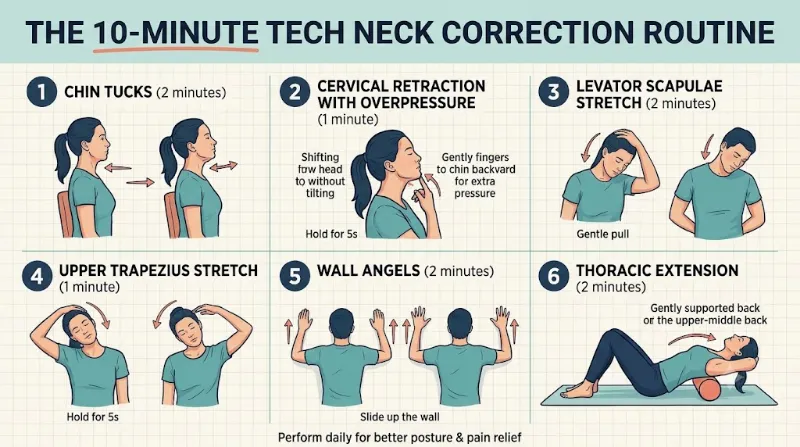
The 10-Minute Tech Neck Correction Routine:
Once a day, ideally in the morning before settling into your desk, carry out this routine. Exercises easily flow into one another. When done at an even pace, the full workout takes 8 to 10 minutes.
Chin Tucks (2 minutes):
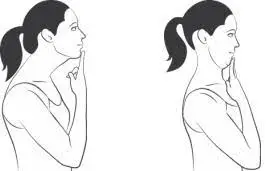
- The chin tuck is the most important exercise for tech neck correction. In addition to extending the suboccipital muscles, which are pinched in forward head position, it directly engages the deep cervical flexors.
- Whether you’re sitting or standing, keep your shoulders relaxed and your back upright.
- Slide your head back straight, as though creating a double chin, without dropping your chin up or down.
- There should be a small stretch at the base of your skull and a minor restriction at the front of your neck. After three seconds of holding, go back to neutral.
- Do fifteen repetitions. It is not a nod; it is just a horizontal movement.
- Limit your range of motion if you experience pain or dizziness.
Cervical Retraction with Overpressure (1 minute):
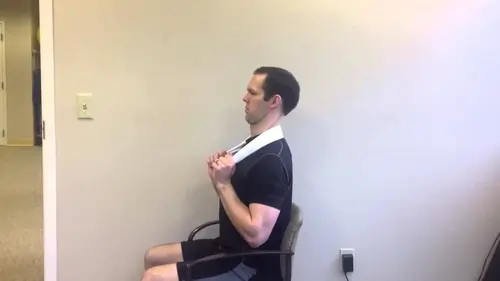
- This advanced version of the chin tuck increases activation of the deep flexors and deepens the stretch by applying light palm pressure.
- Once you’ve completed a chin tuck, place two fingers on your chin and gently press back while keeping it retracted.
- For each repetition, hold for five seconds.
- Do eight repetitions.
- For those who have experienced severe neck issues for longer than six months, this exercise is very beneficial.
Levator Scapulae Stretch (2 minutes):

- The top four cervical vertebrae are connected to the upper corner of your shoulder blade via the levator scapulae.
- It gets sensitive and permanently shortened in tech neck.
- Stretching it every day stops the muscle from forcing your cervical spine into forward flexion and offers instant relief.
- Take a chair and sit up straight.
- Place your right hand on the rear left side of your skull by reaching it above your head.
- Pull your head gently to the right and forward at a 45-degree angle until you feel a stretch in your left shoulder blade and along the left side of your neck.
- Hold for thirty seconds. Change sides.
- Do two reps on each side.
Upper Trapezius Stretch (1 minute):
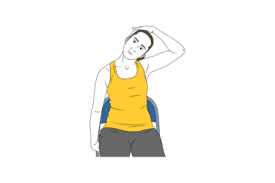
- Drop your right ear toward your right shoulder while sitting up straight. Put your right hand over your head and gently press it down.
- Your upper trapezius and the left side of your neck should both feel stretched.
- Hold each side for 20 seconds.
- Do two reps on each side.
Wall Angels (2 minutes):
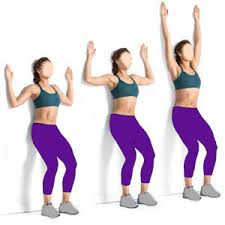
- The thoracic spine and shoulder posture that supports the majority of tech neck presentations are addressed by wall angels.
- The cervical spine extends in response to the thoracic spine rounding forward, pushing the head forward.
- For long-lasting tech neck relief, thoracic posture correction is crucial.
- Place your feet about 4 inches away from the baseboard while keeping your back flat against a wall.
- Place your lower back, upper back, and back of your head on the wall. With your elbows bent, raise your arms to a 90-degree angle, resembling a goalpost.
- Keeping your elbows and wrists in touch with the wall, slowly glide your arms up the wall until they are almost straight overhead. Go back to where you were.
- Do 12 repetitions.
- Start with a limited range of motion and progressively increase it if you are unable to maintain your head and lower back against the wall at the same time.
Thoracic Extension Over a Foam Roller (2 minutes):

- This exercise instantly relieves the thoracic tightness that causes forward head posture if you use a foam roller.
- At the level of your shoulder blades, position the roller perpendicular to your spine.
- Your thoracic spine will open up as you gradually extend backward over the roller while supporting your head with your hands.
- After ten seconds of holding, raise the roller one inch away from your back and repeat.
- Start at the mid-back and work your way down to the base of your neck.
- Make two passes.
- If you don’t have a foam roller, you may do a second set of wall angels or do ten prone cobras, which include lying face down with your arms at your sides and lifting your head and chest off the ground by pressing your shoulder blades together for three seconds each time.
Why These Exercises Work:
The aforementioned regimen is based on a certain physiological principle. Tech neck is more than just a stiffness or weakening issue. It is a pattern of reciprocal inhibition in which the muscles that should be at rest (upper trapezius, levator scapulae, suboccipitals) are hyperactive while the muscles that should be functioning (deep cervical flexors, lower trapezius, serratus anterior) are repressed. Both relaxing the hyperactive muscles and stimulating the inhibited muscles are necessary for effective correction.
The deep cervical flexors are engaged during chin tucks. While ignoring the upper trapezius, wall angels activate the serratus anterior and lower trapezius. The levator scapulae and upper trapezius workouts directly target the overactive muscles. The spinal flexibility that permits the head to naturally rest over the shoulders rather than in front of them is restored by thoracic extension.
How Long Until You See Results?
After one to two weeks of regular daily practice, the majority of participants report a decrease in headache frequency and neck strain. It usually takes four to eight weeks to see measurable postural change that may be seen in photos or evaluated by a physical therapist. When the cervical curvature has been severely decreased or reversed, structural alterations may need three to six months of constant labor.
Consistency is the most crucial factor. The results are significantly greater when this exercise is carried out five days a week as opposed to very rarely. Create a non-negotiable time slot in your daily routine, preferably before your first screen time of the day.
Ergonomic Adjustments To Support Your Progress:
If you spend eight or more hours a day in a posture that increases tech neck, exercise alone won’t be sufficient to treat the condition. By making the following ergonomic changes, you may lessen the postural strain on your cervical spine while working and prevent your daily exercise benefits from being reversed.
Make sure the top of your monitor is at or just below eye level. By doing this, the downward stare that causes chin-forward posture is avoided. Invest in an additional keyboard and laptop stand if you use a laptop so you can lift the screen without stooping. Instead of staring down at your phone in your lap while using it, hold it at eye level. To reset your posture and reduce progressive spinal strain, take a 2-minute movement break every 45 to 60 minutes.
Prevent text neck from taking over:
It’s possible that tech neck cannot be completely avoided. Holding your neck up all day, even with excellent posture, puts stress on the surrounding muscles and joints. Just by being healthy, you experience occasional flare-ups of neck pain. There are ways to reduce periods and prevent chronic pain.
Change positions frequently:
When it comes to causing pain, sitting still is definitely the most harmful. If held for an extended period of time, even an ergonomic position might cause neck problems. Long-term immobility of a tissue structure, such as a muscle or joint, reduces synovial fluid exchange and may result in reduced blood flow. Synovial fluid lubricates and reduces resistance in joints such as the shoulders, hips, and knees.
Try to switch positions roughly every 20 minutes. Simple movements like turning your neck, stretching your shoulders, or strolling around the room will help release tense muscles and improve blood flow. It may be easy to lose track of time whether working or watching TV. You may set a timer to remind you to get moving.
Change how you hold your phone:
To avoid having your head too high or slouched forward, bring the screen to eye level. Instead, maintain a neutral spine so that your shoulders and ears line up. This will prevent you from maintaining a forward-looking posture for extended periods of time.
Take phone breaks:
Even if it’s only for two or three minutes per hour, taking frequent breaks from the computer might be beneficial. My first recommendation for avoiding and treating tech neck is to break the habit of looking down, but most individuals are unlikely to be able to do so.
Therefore, I advise individuals to make an effort to actively take breaks from their phones. Use a sticky note or set reminders on your computer or phone. These relatively small cues can have a significant impact.
Manage stress:
The key to neck health is stress management. Your shoulders and neck naturally get more tense when you’re under stress at work or in your personal life. Regular muscular relaxation assists in preventing stress from turning into physical pain. A daily 10- to 20-minute mindfulness meditation practice can help relax tense muscles brought on by stress. During mindfulness meditation, you look for tense regions in your body and concentrate on your breath.
Make it a habit to practice brief focused meditations prior to stressful events. I can already feel myself becoming tense as I head into a meeting that I don’t want to attend. Breathe deeply three times, pause, feel the breathing, and quickly scan your body. Recognize your areas of tension and accept that you are about to embark on a difficult task.
Improve sleep:
Sleep is essential for both pain management and muscle rehabilitation. People’s daily muscle tension doesn’t have an opportunity to relax when they don’t get enough sleep. Tension raises the likelihood of neck pain over time.
The brain’s chemicals that regulate how we perceive pain are similarly impacted by insufficient sleep. The pain pathways may suffer if we don’t receive enough restorative sleep since we aren’t resetting our neurotransmitters.
Concentrating on sleep hygiene can enhance the quality of your sleep. You can obtain a good night’s sleep through the use of these healthy habits:
- Set a regular bedtime and wake-up time each day.
- Keep your sleeping surroundings comfortable.
- 30 to 60 minutes before bed, turn off electronics and keep away from too stimulating activities.
Try the Text Neck app:
Text Neck is an Android app that gives you “immediate real-time feedback” on your posture (a green or red light). Additionally, there is an optional alarm or vibration alert to let you know when you’ve returned to negative habits.
Do 10 minutes of yoga:
Yoga is the greatest technique to prevent and treat neck and back problems since it combines breath exercises, improves movement patterns, and raises body awareness.
Neck pain is mostly caused by tight rhomboids and other muscular imbalances, which may be addressed with regular yoga practice. Doing the exercises mentioned above or spending 10 minutes a day in yoga might be helpful.
When To See A Physio:
Make an appointment with a physiotherapist if you’re experiencing neck pain from using your computer or smartphone. They can help you create a customized treatment plan that will help you reduce pain and avoid repeat episodes.
In order to treat text neck and protect the general health of your neck, back, and spine, your physiotherapist will do a thorough evaluation, treat any underlying issues, and develop a focused and thorough therapy plan.
When you have a physiotherapist on your team, they can help you with specific manual therapies like soft tissue massage to improve your results, provide you with the best care to improve your overall neck, back, and musculoskeletal health, and respond to any questions you may have about your pain.
FAQs:
How to fix neck from looking down at phone?
Raising your phone up to eye level, tucking your chin in, and resting your elbows on a table or pillow to support your arms will all help relieve neck pain caused by staring down at your phone (commonly referred to as “tech neck”).
How do I reverse a tech neck?
You must modify your everyday ergonomics, strengthen weak neck and upper back muscles, and often stretch tight front tissues to reverse “tech neck” (forward head position and strain from displays).
Why does looking down make my neck hurt?
The most prevalent cause of neck pain when looking down is “tech neck,” or strained muscles from tilting your head in the direction of phones and computers. Herniated discs, pinched nerves, and worn cervical joints (osteoarthritis) are further reasons.
How much time does a tech neck take to heal?
With regular self-care and posture adjustments, mild instances of tech neck get better in two to four weeks, while severe or chronic cases may take many months to completely heal.
Is the phone neck reversible?
In general, “tech neck”—a strain or changed curvature caused by staring down at a phone—is reversible, especially if detected early. Stretching your neck, elevating your phone to eye level, and improving your posture will all help relieve tense muscles and bring your posture back to normal.
What are the common symptoms of tech neck?
Common physical symptoms of tech neck include stiffness, tension headaches from extended forward head positions when using screens, dull or acute neck pain, and muscular tiredness.
References:
- Garos, S. (2020). Goodbye is Just the Beginning. Journal of Loss and Trauma, 26(3), 303–308. https://doi.org/10.1080/15325024.2020.1721726
- Kassel, G. (2020, May 30). 6 Chiropractor-Approved exercises to fight text neck. Healthline. https://www.healthline.com/health/fitness-exercise/text-neck-treatment#does-text-neck-really-cause-pain
- Allsports Physiotherapy & Sports Medicine. (2023, May 19). How to avoid text neck: Five physio-recommended exercises. Allsports Physiotherapy & Sports Medicine. https://www.allsportsphysio.com.au/2022/09/how-to-avoid-text-neck-five-physio-recommended-exercises/
- Prevent Tech Neck | Mass General Brigham. (n.d.). https://www.massgeneralbrigham.org/en/health-wellness/prevent-tech-neck
- Tech Neck Exercises: 7 moves to Fix forward head Posture in 2026. (2026, July 30). Iron Neck. https://www.iron-neck.com/blogs/articles/tech-neck-exercises?srsltid=AYCX9vIfQ-ARYF0NILOYdFJPLk1HvJDU7–f4MLZKjBkm8PImj-U2ix0