Donkey Kick Exercise
Introduction:
The Donkey Kick exercise is a simple yet effective move that targets the glutes, hips, and core. It helps strengthen the lower body, improve stability, and support proper hip alignment, making it beneficial for building strength and preventing injuries.
It targets the lower body without the need for equipment by simulating a kicking action while on all fours. This exercise enhances hip stability, balance, and general lower-body strength in addition to helping to develop stronger, more developed glutes. Donkey kicks are a fantastic exercise that is simple to practice at home or at the gym.
What is the Donkey Kick Exercise?
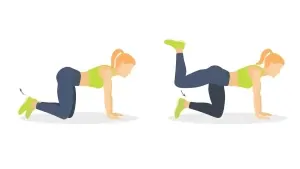
The gluteus maximus, the biggest muscle in your buttocks, is the primary focus of the bodyweight Donkey Kick exercise. Then, as though you were “kicking” toward the sky, you raise one leg backward and upward while maintaining a 90-degree bend in your knee. Before swapping sides, you repeat by lowering the leg back to the beginning position.
This exercise improves hip mobility and stability while strengthening the core, hamstrings, and glutes. Though resistance bands or ankle weights can be used for increased intensity, it is particularly well-liked for sculpting the glutes and can be performed without any specific equipment.
How to do the Donkey Kick exercise?
Raise your leg toward the sky while bending your right knee to a 90-degree angle, pressing through your heel to avoid any arch in your lower back and maintaining a level hip position. Return to the beginning position by slowly lowering the leg without allowing the knee to fully contact the floor. Do this as many times as you like, then switch to the opposite side.
Common Mistakes to Avoid in Donkey Kick Exercise:
- Hip rotation: Turning your hips outward puts strain on your lower back and decreases glute engagement.
- Swinging the leg: It is less effective to use momentum rather than deliberate action.
- Not using the core: During a workout, a slack core can lead to instability and bad posture.
Benefits of Donkey Kick Exercise:
With its many advantages, the Donkey Kick exercise is a fantastic complement to core and lower body exercises. It helps to develop hip form, power, and stability by mainly toning and strengthening the glute muscles. It also enhances posture, balance, and general lower-body strength by working the hamstrings and core.
This exercise is particularly beneficial for improving hip stability and mobility, which helps with everyday activities like lifting, walking, and climbing stairs. Being a bodyweight exercise, it may be performed anywhere without the need for any equipment, and its efficacy can be further increased by using resistance bands or ankle weights.
Variations of the Donkey Kick exercise:
The following are some efficient methods to modify the Donkey Kick exercise to work the core and glutes:
- Resistance Band Donkey Kick: To increase tension and force your glutes to work harder, wrap a resistance band around your ankles or thighs.
- Weighted Donkey Kick: For further resistance and muscle activation, place a dumbbell behind your knee or utilize weights at your ankles.
- Straight-Leg Donkey Kick: For a more intense hamstring workout, stretch your leg straight back and raise it toward the sky rather than keeping it bent.
- Pulse Donkey Kick: To maintain continuous stress in the glutes, pulse up and down at the peak of the exercise.
- Cross-Over Donkey Kick (Rainbow Kick): To work your obliques and glutes, raise your leg and move it in an arc over your torso, contacting the floor on each side.
- Elevated Donkey Kick: To improve range of motion and core engagement, execute the kick with your hands on a step, bench, or stability ball.
Conclusion:
To sum up, the Donkey Kick exercise is a straightforward yet efficient movement that works the hamstrings and core in addition to strengthening and toning the glutes. It benefits both novices and exercise enthusiasts by enhancing hip stability, posture, and balance.
Donkey kicks may be easily modified and varied to match a variety of fitness levels and objectives, including strengthening, improving mobility, and shaping the lower body. Including this exercise in your regimen is a terrific approach to increasing your functional mobility and overall lower-body strength.
FAQs
What advantages does performing donkey kicks offer?
The main advantages of donkey kicks are that they build and tone the glutes, improve hip mobility and posture, and increase core stability—all of which lessen the risk of knee and lower back ailments. In addition to strengthening the hamstrings and using the shoulder muscles for stability, this equipment-free workout helps enhance balance and metabolism by building lean muscle.
Are donkey kicks inferior to squats?
Although the glutes are worked in both workouts, squats work more lower-body muscles than a classic donkey kick.
What made the donkey kick illegal?
Given that the “donkey” move needed Carr to make continuous contact with the ball rather than a simple touch to flip it up, it is now clear why FIFA decided to ban it.
Do you run faster when you donkey kick?
Donkey kicks are an excellent method to expand the hip and engage the glute muscles, which are essential for fast running and injury-free running.
Is abdominal fat reduced by the donkey kick?
Similar to crunches, it is quite good at burning fat and toning the whole body. This pose works the hands, aids in the rapid reduction of stomach fat, and dissolves the entire abdominal region.
Will I get a larger bum from donkey kicks?
Certain specialized workouts can help you improve your butt’s form, hardness, or volume. Squats, donkey kickbacks, clamshells, lunges, and glute bridges are a few examples of these exercises.
Is a donkey kick strong?
Donkey kicks are a great way to activate the gluteus maximus, which is the body’s strongest muscle. They are useful for running warm-ups and for prehab or rehabilitation muscle isolation. Using tension bands and performing fewer sets and repetitions can also make donkey kicks more difficult.
Is the waist slimmed by donkey kicks?
Exercises like squats, lunges, and motions like donkey kicks or fire hydrants can help you acquire larger buttocks and a smaller waist.
Can I kick a donkey in bed?
For additional support, place a cushion beneath your knees. Push your foot toward the ceiling using your glutes, then squeeze when you get to the peak of the exercise.
What is Donkey Kicks’ true name?
A quadruped bent-knee hip extension is the scientific term for the donkey kick. However, the action itself, which resembles the animal’s infamous kick, is what gives it its namesake. This activity may be done in several different ways.
Do donkey kicks make your hips bigger?
Additionally, they are highly helpful in increasing hip stability, which lowers the risk of hip injuries and improves movement efficiency in general.
What would happen if I kicked 100 donkeys every day?
Your body may benefit greatly from performing 100 donkey kicks daily for 30 days. These benefits include improved posture, increased hip mobility, improved core stability, and strengthened glutes. Additionally, you could have less lower back pain, have better muscle endurance, and burn a few more calories.
How frequently should I perform donkey kicks?
Avoid allowing your leg to flare out and move with control, maintaining a neutral neck and spine. Do it again. Depending on the remainder of your exercise, aim for three to five sets and 15 to 20 repetitions each leg.
Are squats inferior to donkey kicks?
Although the glutes are worked in both workouts, squats work more lower body muscles than a classic donkey kick. A donkey kick is a superior motion for isolating the glute muscles, so choose it if your goal is to target only your core and glutes.
What differentiates kickbacks from donkey kicks?
Donkey kicks and glute kickbacks are minor variants of one another. A glute kickback involves extending the knee. You can select your favorite exercise or perform both because they target the same muscles from slightly different perspectives.
What are the benefits of the donkey kick exercise?
The main advantages of donkey kicks are that they build and tone the glutes, improve hip mobility and posture, and increase core stability—all of which lessen the risk of knee and lower back ailments. In addition to strengthening the hamstrings and using the shoulder muscles for stability, this equipment-free workout helps enhance balance and metabolism by building lean muscle.
References:
- Donkey kicks. (n.d.). [Video]. Hingehealth. https://en-gb.hingehealth.com/resources/articles/donkey-kicks/
- Cpt, N. B. (2016, December 19). 5 donkey kick exercises to get your booty in gear. Healthline. https://www.healthline.com/health/fitness-exercise/donkey-kick#half-circle
- How to do donkey kicks | Step-by-Step | The Gym Group. (n.d.). https://www.thegymgroup.com/exercises/legs-and-glutes-exercises/how-to-do-donkey-kicks/
- A Step-By-Step Guide to donkey kick exercise: variations, benefits, and more! (2024, May 13). Healthy Foods for Weight Loss to Add in Your Diet | ToneOpFit. https://toneopfit.com/blogs/guide-to-donkey-kick-exercise
- Konstantinovsky, M. (1970, January 1). Here’s why you should add donkey kicks to your workout routine. https://www.onepeloton.com/blog/donkey-kicks
- Fit, C. (2022, August 22). Donkey Kick: Benefits, Variations & How To Do It. blog.cult.fit. https://blog.cult.fit/articles/donkey-kick-benefits-variations-how-to-do-it
- H, T. (2025, August 5). What is the Donkey Kick Exercise? ASFA. https://www.americansportandfitness.com/blogs/fitness-blog/what-is-the-donkey-kick-exercise?srsltid=AfmBOorfkqQqh1QXPOO1YmhJrY5IecsbH5GZMnmXochJB2I4W6vLx-he