Physical Therapy for Neck Pain: Exercises, Treatment, and Recovery
Introduction:
One of the most popular methods for treating chronic neck pain is physical therapy. In order to start an exercise regimen that strengthens and stretches the neck, most physical therapy programs for neck pain consist of giving treatments to reduce pain and/or stiffness.
Physical therapy techniques and exercises might differ from person to person, as does the length of the treatment regimen.
What Is Neck Pain?
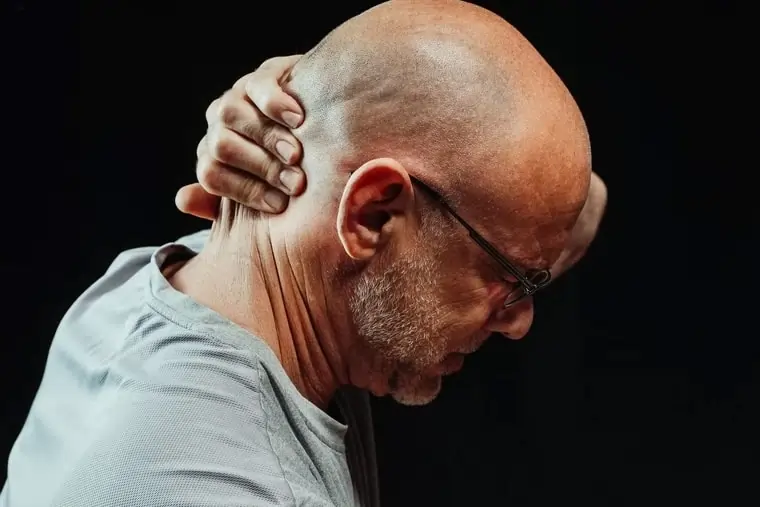
Pain in the upper spine, often behind the head and above the shoulders, is referred to as neck pain. The neck may be affected on one or both sides. Other parts of the body, such as the hands, elbows, arms, shoulder blades, head, and face, may also experience pain.
An estimated 3% of Americans suffer from neck pain annually. Additionally, it is believed that a person has a 20% chance of developing normal neck pain during the next year. Adults between the ages of 40 and 70 are most commonly affected by neck pain. Additionally, research indicates that women are more prone than men to experience neck pain. Risk factors for neck problems include being older, being female, having a demanding job, smoking, having little social or professional support, and having a history of back pain.
Numerous factors, such as muscular strains, inactivity, degenerative and inflammatory changes, or traumatic experiences, can result in neck pain. After a neck pain episode, most people recover in six to twelve weeks; however, certain problems may take longer. Older age, high degrees of discomfort, high levels of psychological distress, and poor physical health have all been linked to chronic neck pain.
How Does It Feel?
Individuals who suffer from neck pain may describe the stiffness in their neck as:
- Sharp.
- Stabbing.
- Dull.
- Aching.
- Throbbing.
- Tingling.
Irritated nerves can cause neck pain that radiates to the upper back, shoulder blades, shoulders, arms, or hands. This condition is known as radiculopathy. It can also be accompanied by arm or hand weakness. Your physical therapist will work closely with your doctor and surgeon to determine the appropriate course of treatment.
Signs and Symptoms:
The tissue or structure that is impacted and the extent of the injury determine the kind and location of your symptoms.
Any of the following symptoms might be caused by neck pain:
- Unable to rotate or bend the neck.
- Having trouble seeing up.
- Looking over one’s shoulder is difficult.
- Weak shoulder and arm muscles.
- Muscle Spasms.
Neck pain may be the cause of any of the following symptoms:
- Neck, upper back, shoulder, arm, or hand pain.
- Numbness or tingling in the neck, shoulders, hands, or arms.
- Weakness in the arms.
- Greater pain when sitting, reaching, sneezing, or coughing.
- Unable to sit or stand upright.
- Stiffness when attempting to move or the sensation of being fixed in a posture such as bent over or with the head tilted to one side.
- Tight muscles.
- Pain prevents one from sitting or standing for extended periods of time.
- Severe pain in the morning or at night.
- Pain-related difficulty falling asleep.
Goals of Physical Therapy for Neck Pain:
The following objectives are commonly included in physical therapy for neck pain:
- Reduce stiffness and pain
- Increase head and neck range of motion
- Build up the neck and its supporting muscles’ dynamic strength.
- Create plans to stop pain from coming back.
Physical treatment may be important in enhancing neck posture and function for everyday movements, even if pain cannot be totally removed.
How Is It Diagnosed?
During a full assessment, your physical therapist will take your medical history. Additionally, he or she will ask you in-depth about your pain or injury, including:
- When and how did the pain begin?
- Where and what kind of pain are you experiencing?
- What time of day is the most difficult?
- What aspects of your everyday life are you currently unable to do because of the pain?
To diagnose physical issues, a physical therapist will test your body for things like:
- Difficulty moving.
- Weakness or tightness in the muscles.
- Loss of skin sensation in some areas.
- Loss of reflexes.
- Joint stiffness.
- Poor posture.
- Difficulty walking.
Physical therapy treatment may start immediately to help you get well and continue your regular activities if your physical therapist discovers any of the above problems.
Your physical therapist may work with a doctor or surgeon to have specialized diagnostic tests, such as an MRI, if more serious issues are discovered with any of the tests. To ensure that you receive an accurate diagnosis as well as the necessary care and treatment, your physical therapist will collaborate closely with doctors and other medical professionals.
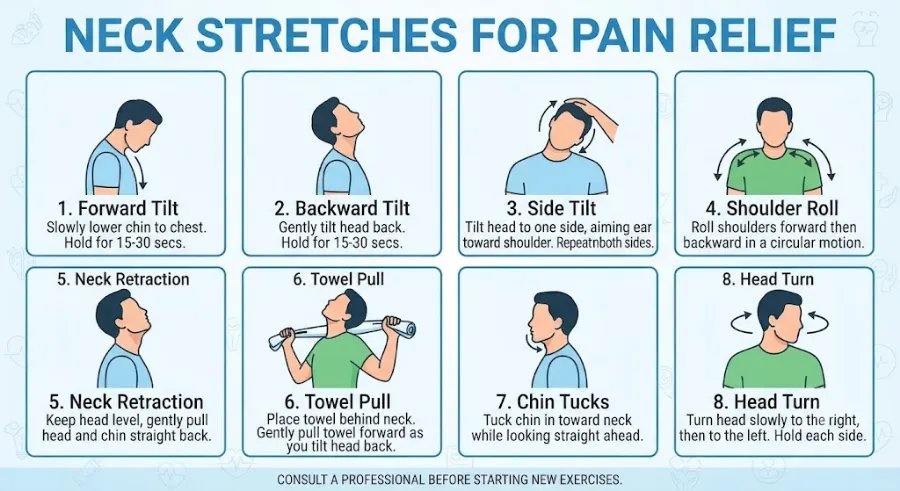
Neck Stretches for Pain Relief:
These are the following exercises for relieving neck pain:
Forward and Backward Tilt:
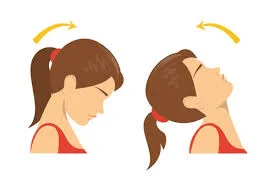
You can work on your feet or while seated. Make sure your movements are smooth and slow.
- Start with your back straight and your head directly above your shoulders.
- Hold the position for 15 to 30 seconds after lowering your chin toward your chest. Calm down and slowly raise your head again.
- Move the base of your skull toward your back and lift your chin toward the ceiling. Return to the starting position after holding for five to ten seconds.
- Do the set one to three times. Do it every day.
Side Tilt:
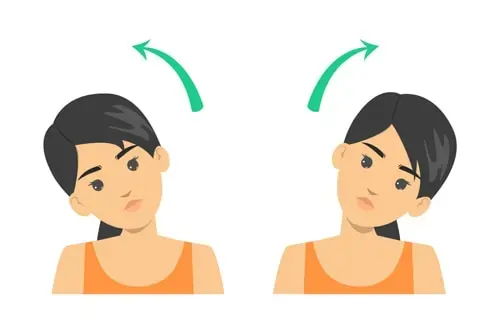
Stand with your arms at your sides and your feet hip-width apart.
- Try to contact your right shoulder with your ear while you gently bend your head in that direction. When you sense a stretch, stop. Avoid lifting your shoulder.
- Hold the stretch for five to ten seconds, then return to the beginning position. Repeat the set one to three times.
- On your left side, repeat.
- Put your palm on the side of your head that is prone over your head and gently pull with your fingertips for further stretch.
Shoulder Roll:
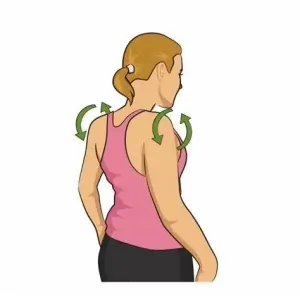
The easiest way to achieve this is to stand.
- Make a circle with your shoulders as you straighten them. Repeat six times.
- Make six more circles, this time in the other direction, after returning to the starting point.
Neck Retraction:
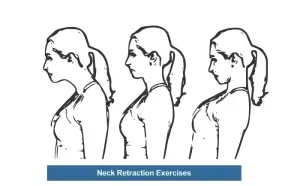
Retracting, or drawing back, your head and neck is part of this stretch. This may be done either standing or sitting.
- Keep your chin slightly tucked down and look straight ahead.
- As though attempting to create a double chin, carefully pull your head and chin backward. Without exerting yourself, pull back as far as you can.
- Avoid tilting your head in either direction.
- For three to five seconds, maintain this posture.
- Return your head to its initial position.
- Repeat ten to fifteen times.
Forward head posture occurs when your head hangs forward, in front of your shoulders. This can help correct it.
Towel Pull:
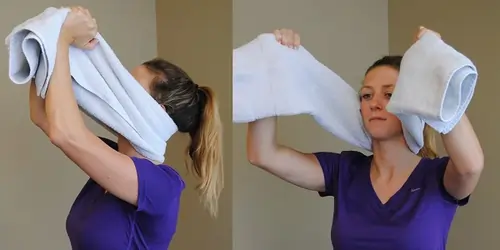
A rolled-up towel is necessary for this stretch. Get to your feet and stare straight ahead.
- Holding both ends of the rolled-up towel tightly with your hands, wrap it over the back of your neck.
- Look up as far as you can while tilting your head back.
- To keep the towel supporting your head and neck, raise your hands in time with your concentration.
- Pull the cloth gently.
- Return your head to its initial position after raising it.
- Repeat ten times over, repeat.
Chin Tucks:
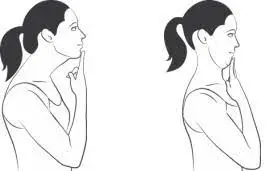
You perform this exercise while lying down, which is comparable to neck retraction.
- On your back, lie down.
- Try to smooth your neck back on the surface you are lying on by pulling your chin as far down and back as you can.
- Hold it for three to five seconds, then let go.
Head turn:
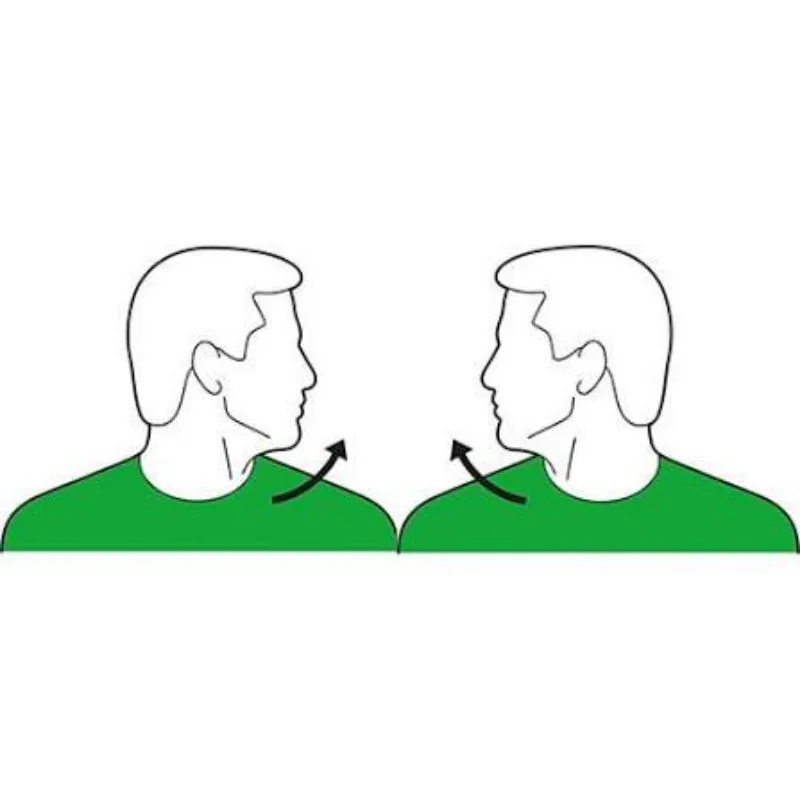
- To improve your balance, it’s recommended to perform this exercise while seated.
- Keeping your chin at the same height, turn your head to one side.
- Gently stretch your neck muscles for five seconds.
- Repeat on the other side after bringing your head back to the center.
- On each side, repeat five times.
If this is uncomfortable to do while you’re standing or sitting, try it while lying down, so that your head is supported.
How can my neck pain be relieved at home?
In addition to taking painkillers, you can perform the following at-home exercises to reduce neck pain:
- Hot therapy: Every few hours, take a hot shower or apply a hot towel or heating pad to the painful area for fifteen minutes. The heat relaxes your muscles and improves blood flow.
- Cold therapy: The cold reduces inflammation and swelling by narrowing your blood vessels. Use cold instead of heat as soon as possible following an accident.
- Exercise: Follow your healthcare provider’s recommendations for neck exercises to improve range of motion and reduce neck pain. Avoid exercising if you have a serious neck injury or a pinched nerve.
- Stress-reduction strategies: Breathing exercises, yoga, mindfulness, and meditation can all help release tension in the body that may be the source of neck pain.
- Give up smoking since it weakens bones, hastens degenerative disc disease, and delays recovery.
How can I prevent neck pain?
Although you can’t always prevent neck pain, you can reduce your risk. Your risk of neck pain can be considerably reduced with a few easy lifestyle or postural improvements.
Ergonomic workstations:
One of the most prevalent causes of neck pain is an unergonomic workstation. An ergonomic workplace is one that is both pleasant and effective. People who work from home, have desk jobs, or constantly tilt their heads to gaze at a laptop screen are more likely to have an unpleasant workspace.
To enhance the ergonomics of your workspace, you can:
- When typing, raise your workstation so that your forearms are parallel to the floor.
- Select a chair so that your thighs are parallel to the floor and your feet may plant firmly on the ground.
- Place your eyes at the upper third of the screen while using a laptop or computer display.
Tech neck prevention:
Not only is it unacceptable to constantly look down at your phone, but it can also cause neck strain. Continually straining your neck over time might harm your ligaments, joints, and discs. Because of how frequently this injury occurs, medical professionals have created the term “tech neck” to characterize what happens to your neck when you look down all the time.
To reduce your chance of developing tech neck, you could:
- Maintain eye level with your phone or other device.
- To reduce the angle of your head, place your device on a pillow.
- To help you remember to take breaks from your phone, set timers.
- Cut down on the time you spend texting
Postural changes:
Your posture can cause neck pain whether you’re doing routine tasks, sitting at a desk, or looking at your phone. In reality, your neck muscles experience an additional 10 pounds of strain for every inch your head moves forward. Chronic pain results from bad posture because it stresses and destroys the tissues in your neck over time.
To avoid neck pain and improve your posture:
- Move your shoulders away from your ears.
- Use your abdominal muscles gently.
- Maintain your head in alignment with your body’s core.
- To maintain a straight spine, raise your chest.
Best pillow for neck pain:
You can’t get rid of neck ache with a certain pillow. However, a few crucial pointers might assist in making sure that your neck discomfort isn’t being caused by the incorrect pillow. You could:
- Choose memory foam, which molds to the curvature of your spine.
- Find a travel pillow that supports your neck, so you don’t have to worry about neck pain when you go out of town.
- Look for flatter pillows that maintain your head in close alignment with your spine.
- Replace pillows every one to two years
Your neck pain may also be affected by where you position your pillow. If you sleep on your back, assist the position of your spine by placing a pillow under your thighs.
Do’s and Don’ts for Neck Pain:
Do’s:
- Maintain proper posture when standing, sitting, and using electronics.
- Keep your phone or computer at eye level to prevent prolonged neck bending.
- Take regular breaks while working at a desk—move and stretch your neck every 30 to 60 minutes.
- Do gentle neck stretches and movements within a comfortable range, and strengthen your upper back, neck, and shoulder muscles as advised by a physiotherapist.
- To maintain an even neck posture when you sleep, use a supporting pillow.
- To assist in easing pain and stiffness in your muscles, use heat or ice as needed.
- Avoid extended bed rest and maintain an active lifestyle.
- Safely lift items by keeping them near your body and avoiding sudden twisting.
- Consistently adhere to the workout and therapy regimen recommended by your physiotherapist.
Don’ts:
- Avoid standing still for extended periods of time, especially if your head is tilted forward.
- Avoid strongly bending or repeatedly cracking your neck.
- Avoid doing forceful neck stretches or movements that make your neck pain more severe.
- Avoid spending a lot of time carrying heavy items on one shoulder.
- Avoid using a pillow that forces your neck too high or too low, or sleeping in uncomfortable postures.
- Don’t ignore chronic or increasing pain.
- If you experience severe pain, dizziness, numbness, or weakness during a workout, stop.
- Unless a healthcare provider expressly recommends it, avoid relying on extended bed rest.
- Avoid forcibly manipulating your neck, especially if you have significant neck pain that is unexplained.
FAQs:
How should I go to sleep if I have neck pain?
Sleeping on your back or side with your neck in a neutral, balanced posture supported by the appropriate pillows is the best option if you have neck pain.
How many days of physiotherapy for neck pain?
Depending on how severe the issue is, physiotherapy for neck pain often lasts three to six weeks and requires five to twelve sessions in total.
What are the top 5 reasons for neck pain?
Poor posture, strained muscles, cervical osteoarthritis, whiplash injuries, and pinched nerves from ruptured discs are the top five causes of neck pain.
What vitamins help with neck pain?
To reduce neck stiffness and inflammation, several vitamins and minerals improve bone, nerve, and muscle function.
Can physical therapy cure neck pain?
Nonetheless, physical therapy can help manage and lessen most non-surgical neck pain.
What is a red flag in neck pain?
When it comes to neck pain, a red flag is a warning sign or symptom that points to a significant, possibly dangerous underlying disease that needs to be examined right away.
When you have neck pain, what should you not do?
When you have neck pain, stay away from heavy overhead lifts, complete neck circles, and sleeping on several pillows.
How to fix neck pain permanently?
You need to combine regular posture correction, ergonomic adjustments, and focused strengthening exercises under the supervision of a physical therapist in order to permanently treat neck pain. A long-term regimen is needed rather than a single quick fix because a permanent solution depends on the underlying reason.
References:
- Linton, S. J. (2000). A review of psychological risk factors in back and neck pain. Spine, 25(9), 1148–1156. https://doi.org/10.1097/00007632-200005010-00017
- Chou, R., Fanciullo, G. J., Fine, P. G., Adler, J. A., Ballantyne, J. C., Davies, P., Donovan, M. I., Fishbain, D. A., Foley, K. M., Fudin, J., Gilson, A. M., Kelter, A., Mauskop, A., O’Connor, P. G., Passik, S. D., Pasternak, G. W., Portenoy, R. K., Rich, B. A., Roberts, R. G., . . . Miaskowski, C. (2009). Clinical guidelines for the use of Chronic opioid therapy in chronic noncancer pain. Journal of Pain, 10(2), 113-130.e22. https://doi.org/10.1016/j.jpain.2008.10.008
- Ferris, R. L., Blumenschein, G., Fayette, J., Guigay, J., Colevas, A. D., Licitra, L., Harrington, K., Kasper, S., Vokes, E. E., Even, C., Worden, F., Saba, N. F., Docampo, L. C. I., Haddad, R., Rordorf, T., Kiyota, N., Tahara, M., Monga, M., Lynch, M., . . . Gillison, M. L. (2016). Nivolumab for recurrent Squamous-Cell carcinoma of the head and neck. New England Journal of Medicine, 375(19), 1856–1867. https://doi.org/10.1056/nejmoa1602252
- Kazeminasab, S., Nejadghaderi, S. A., Amiri, P., Pourfathi, H., Araj-Khodaei, M., Sullman, M. J. M., Kolahi, A., & Safiri, S. (2022). Neck pain: global epidemiology, trends and risk factors. BMC Musculoskeletal Disorders, 23(1), 26. https://doi.org/10.1186/s12891-021-04957-4
- Gross, A., Kay, T. M., Paquin, J., Blanchette, S., Lalonde, P., Christie, T., Dupont, G., Graham, N., Burnie, S. J., Gelley, G., Goldsmith, C. H., Forget, M., Hoving, J. L., Brønfort, G., Santaguida, P. L., & Group, C. O. (2015). Exercises for mechanical neck disorders. Cochrane Database of Systematic Reviews, 2015(1), CD004250. https://doi.org/10.1002/14651858.cd004250.pub5
- Coderre, T. J., Katz, J., Vaccarino, A. L., & Melzack, R. (1993). Contribution of central neuroplasticity to pathological pain: review of clinical and experimental evidence. Pain, 52(3), 259–285. https://doi.org/10.1016/0304-3959(93)90161-h