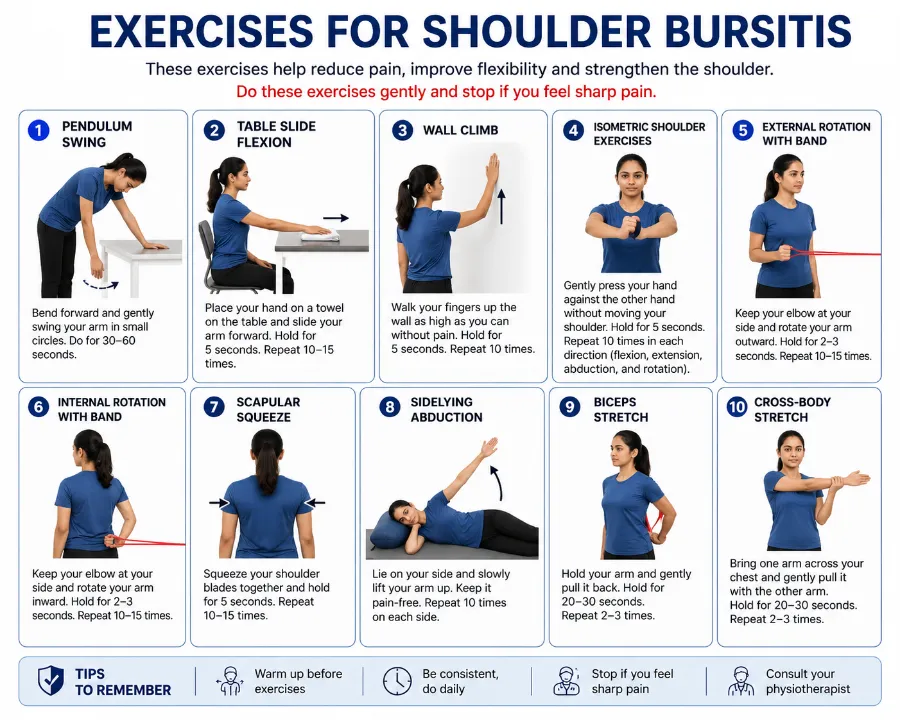
10 Best Exercises for Shoulder Bursitis
Introduction
Shoulder bursitis is a common condition that occurs when the bursa, a small fluid-filled sac that reduces friction around the shoulder joint, becomes irritated and inflamed. It can cause shoulder pain, tenderness, swelling, and difficulty with movements such as lifting the arm overhead or reaching behind the back. Gentle, appropriate exercises can help improve shoulder mobility, reduce stiffness, and gradually strengthen the muscles that support the joint.
Exercise selection should be based on the severity of symptoms. In the early stage, gentle range-of-motion exercises are usually more suitable, while strengthening exercises can be added as pain and inflammation improve. Avoid movements that significantly increase pain, and consult a physiotherapist or healthcare professional if symptoms are severe or persistent.
What are the best exercises for shoulder bursitis?
Maintaining your range of motion is the goal of the first half of the exercises mentioned below. You may not be using your shoulder to its full potential because it pains when you move it. Stiffness may result from this, and it may potentially develop into frozen shoulder, a disorder that severely restricts movement. Make an effort to perform these exercises once or twice daily. Keep it within your pain-free range, but you should feel a stretch. The stretches can be advanced progressively.
Strengthening is the purpose of the other workouts. In particular, they strengthen the shoulder-supporting rotator cuff muscles. To guarantee that your shoulder joint is in the best possible position to prevent injury, posture-focused exercises are also included (see section. You are prepared to go on to strengthening if you can complete the stretching exercises painlessly.
It shouldn’t hurt to perform the workouts. Proceed carefully and as tolerated. With the right exercise program and proper guidance, many people with shoulder bursitis can gradually regain mobility, strength, and confidence in using the affected arm during daily activities.
Exercises for shoulder bursitis
Pendulum
Particularly in the early phases of shoulder bursitis, the pendulum exercise is an excellent method of pain relief. This little passive exercise opens up space in your shoulder to reduce pain, improves blood flow, and helps avoid shoulder stiffness. This is something you can do many times a day. But make sure you do it passively, meaning you shouldn’t swing your arm using your muscles.
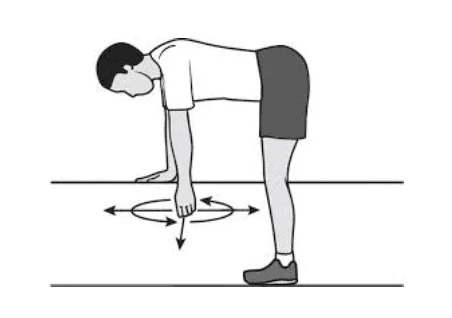
- Step 1: Bend at the waist and let your affected arm hang down while holding onto a chair or table.
- Step 2: To rotate your arm circularly, softly sway your body while relaxing your arm.
- Step 3: Verify that your arm isn’t being moved aggressively. Allow your arm to move while your body sways.
- Step 4: To move your arm in a circular motion in the other direction, reverse the motion of your body.
- Step 5: Swing your arm forward and backward by moving your torso.
- Step 6: Swing your arm from side to side by moving your torso.
- Step 7: Make five to ten movements with your arm in each direction.
Shoulder extension stretch
The range of motion with extension improves with this shoulder extension stretch. This gives you complete range of motion while lifting your arm above your head.
- Step 1: Place a solid chair or countertop arms’ length away from you.
- Step 2: With your elbows straight, place both hands on the surface.
- Step 3: Let your shoulders extend as you bend your knees to lower your trunk.
- Step 4: Compared to your unaffected limb, your affected arm might not be as flexible.
- Your affected side should have the same range of motion as your unaffected side.
- Step 5: Stretch for 30 seconds.
- Step 6: Get up and unwind.
- Step 7: Do this three to five times.
Towel stretch
With internal rotation, this behind-the-back stretch increases range of motion. For this activity, a towel is required.

- Step 1: Place your feet shoulder-width apart.
- Step 2: Cover the unaffected shoulder with a towel, allowing the towel’s end to fall down your back.
- Step 3: Use your affected arm to reach back and grasp the towel’s end.
- Step 4: To draw your affected arm more into the stretch, slowly pull up on the towel with your unaffected arm.
- Step 5: Remain in your pain-free range.
- Step 6: Hold for ten to fifteen seconds.
- Step 7: Return your arm to its initial position with relaxation.
- Step 8: Do this three to five times.
Posterior capsule stretch
Tightness in the posterior shoulder is reduced by this posterior capsule stretch. This is important since it helps guarantee that the shoulder joint is moving in the proper alignment, relieving strain on the bursae. This reduces pain and increases shoulder range of motion.
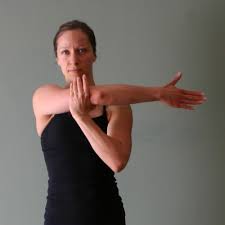
- Step 1: Raise the affected arm in front of you at shoulder height.
- Step 2: Stretch it across your torso at shoulder height while keeping your palm down.
- Step 3: For a deeper stretch, push your arm over your elbow with your other hand.
- Step 4: Hold for 15 to 30 seconds.
- Step 5: Do this three to five times.
Internal rotation
The rotator cuff muscles that support your shoulder are strengthened by this internal rotation workout. For this workout, a resistance band is required.
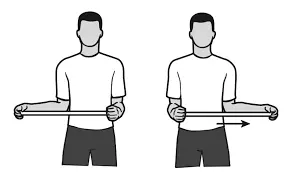
- Step 1: Secure a resistance band to a door at waist height by tying a knot in it.
- Step 2: Bend the affected arm’s elbow. For extra support, put a small rolled-up towel between your torso and elbow. If this process is unpleasant, you can skip it.
- Step 3: Face the door with your affected side.
- Step 4: Use the affected arm to hold onto the resistance band. Turn your forearm toward your body while maintaining a 90-degree elbow bend.
- Step 5: Turn your forearm till it comes into contact with your abdomen. During this movement, your elbow should remain by your side.
- Step 6: Go back to the beginning position slowly.
- Step 7: Perform 12–15 repetitions.
- Step 8: Repeat two to three times. On the opposite arm, repeat.
External rotation
The postural muscles that maintain the proper alignment of your shoulder joint and relieve strain on the bursae are strengthened by the resistance row workout. For this workout, a resistance band is required. You may use cable pulleys to perform this workout in the gym.
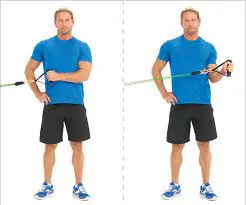
- Step 1: Wrap a resistance band around a bedpost or other strong object. Hold the band’s end in each hand.
- Step 2: The band should be just above the height of the belly button.
- Step 3: Put one foot just ahead of the other. Pull your elbows back in a rowing action with both arms while holding onto the resistance band.
- Step 4: Pull back while squeezing your shoulder blades together.
- Step 5: Keep rowing for 12 to 15 repetitions.
- Step 6: Repeat two to three times.
Doorway stretch
The muscles that run across your chest and attach to your shoulder are called pectorals, and this stretch works them.
How to do:
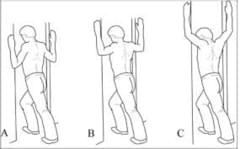
- Take a position in an open doorway.
- On either side of the entryway, place your palms flat. Put your hands at or just below shoulder height while bending your elbows.
- Step forward with one foot until the front of your shoulders and your chest start to tug a little. Avoid bending forward.
Hold/Repetition:
Hold for thirty seconds.
Repeat three times after releasing.
Wall push-ups
The bony ring created by the junction of the clavicle and scapula bones, known as the shoulder girdle, is stabilized by these.
How to do:
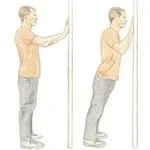
- Take a position facing a wall.
- Stretch your arms out in front of you and place your hands flat against the wall, shoulder-width apart, without shifting your shoulders.
- Get into a plank stance by moving your feet back. From your head to your heels, your body should be in a straight line.
- Lower yourself slowly in the direction of the wall, pausing until your nose nearly touches it.
- Return to the initial position by pressing back up.
Hold/Repetition:
Ten times repeat
Scapular retraction
Try this exercise with your arms raised out to the sides if your shoulders have a decent range of motion. Maintain a 90-degree angle with your elbows. The elastic band should be raised to shoulder level. To bring your shoulder blades closer together, pull the band back. Then return your arms to their initial position.
How to do:
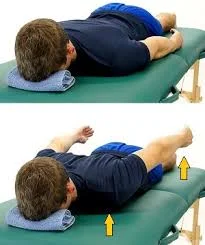
- For this exercise, you’ll need elastic materials like Thera-Band or surgical tubing.
- Wrap the band around a sturdy object, preferably a bedpost, at waist level.
- The band’s end should be held in either hand.
- Bend to a 90-degree angle and pull the band back while keeping your elbows at your sides.
- The direction of your shoulder blades should be the same.
- After that, put your arms back where they started.
Hold/Repetition: Do this eight or twelve times.
Shoulder blade squeeze
The shoulder blade squeeze exercise, also known as scapular retraction, is a simple exercise that helps strengthen and activate the muscles around the shoulder blades. It involves gently pulling the shoulder blades backward and toward each other while keeping the shoulders relaxed. This exercise can help improve posture, shoulder stability, and upper-back muscle strength,
How to do:
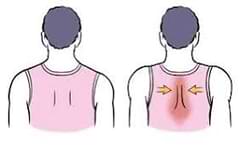
- Stand with your arms at your sides and squeeze your shoulder blades together.
- Avoid raising your shoulders as you squeeze.
Hold/Repetition: Hold for six seconds. Do this eight or twelve times.
What should be avoided with shoulder bursitis?
It’s important to contact a doctor if your shoulder pain persists for more than a few days to receive a precise diagnosis. Mobility and function may be lost if therapy is postponed. Additionally, it’s important to rule out other problems, such as a torn rotator cuff.
Avoid doing anything that will make the pain worse in between. This may consist of:
Painting ceilings, washing windows, throwing, and workouts like pull-ups are examples of repetitive overhead actions.
Exercises that involve lifting weights above, such as the bench press or shoulder press, will overstress your bursae.
- Repetitive movements: Avoid any task that requires repetitive motions, such as cleaning, sweeping, or vacuuming.
- High-impact sports or exercise: The bouncing motion of jogging, jumping, or high-intensity interval training could worsen your shoulder.
- Elbow or arm weight-bearing: Avoid resting on your elbow. Additionally, you should stay away from body weight exercises like planks, burpees, and push-ups.
- Across-body movements: Until the pain goes away, avoid moving your arm across your body when playing sports like baseball, tennis, or golf.
- Sleeping on your shoulder: Avoid sleeping on the side that is affected. With a pillow under your arm and one between your legs, sleep on the opposite side. Sleeping on your back is another option.
Reevaluate the pain after completing the mentioned stretching exercises. If you are in pain, don’t go on to the strengthening exercises. Similarly, it’s appropriate to stop doing strengthening workouts if they cause pain. It indicates that your shoulder isn’t ready; therefore, you should limit your range of motion to stretches. Introduce the resistance band strengthening workouts gradually.
Conclusion:
Exercises for shoulder bursitis can help reduce stiffness, improve shoulder mobility, and gradually restore strength and function. Gentle stretching and strengthening exercises should be performed regularly without causing sharp or worsening pain. Avoid movements that aggravate symptoms, especially during the early stages of recovery.
If pain persists, increases, or limits daily activities, consult a physiotherapist or healthcare professional for an individualized treatment plan. With proper exercise, activity modification, and adequate rest, most people can gradually return to normal shoulder function.
Exercises should always be performed slowly and within a comfortable range. Avoid repetitive overhead movements, heavy lifting, or any exercise that significantly increases pain or swelling. As symptoms improve, strengthening exercises can be progressed gradually to improve shoulder stability and reduce the risk of recurrence.
With the right exercise program and proper guidance, many people with shoulder bursitis can gradually regain mobility, strength, and confidence in using the affected arm during daily activities.
FAQs
What is the best exercise for shoulder bursitis?
The pendulum swing is the ideal initial exercise for shoulder bursitis because it stimulates blood flow and gradually loosens the joint without compressing the inflamed bursa. Wall crawls, shoulder blade squeezes, and pendulum swings are additional powerful movements.
What not to do with shoulder bursitis?
Combining rest and ice with medical therapies like cortisone injections or anti-inflammatory medications is the quickest approach to recovering from shoulder bursitis. The bursa sac heals more quickly when painful motions are stopped, swelling is rapidly reduced, and mild physical therapy is initiated.
Should you exercise with your shoulder if you have bursitis?
Exercising your shoulder is a good idea, but only with mild, painless movements. Exercises that prevent joint freezing and improve blood flow include wall slides and pendulum swings. Stay away from high-impact sports, hard lifting, and other overhead movements that might cause severe pain.
What tests confirm bursitis?
Bursitis cannot be confirmed by a single test. A physical examination and medical history are the main methods used by doctors to diagnose it. If necessary, they employ X-rays or fluid/blood testing to rule out fractures, arthritis, or infection, and ultrasound or MRI to detect an inflamed bursa.
What are the three symptoms of bursitis?
Three typical signs of bursitis are stiffness or restricted range of motion, localized edema surrounding the joint, and joint pain and swelling that gets worse with pressure or movement.
References:
- Mehta, P. (2025, September 9). The 12 best stretches and Exercises for shoulder Bursitis. Resilience Orthopedics. https://www.resilienceorthopedics.com/shoulder/exercises-shoulder-bursitis/
- Rubleva, E. (2025, October 1). The 7 best shoulder Bursitis Exercises. Bauerfeind New Zealand. https://bauerfeind.co.nz/blogs/news/the-7-best-shoulder-bursitis-exercises?srsltid=AfmBOoqUitGrpKCuzfRgJLJaUU_C4EiC02_wvkqoNhSheHf0YphYmvrx
- Trigg, L. (2025, May 25). THE BEST SHOULDER BURSITIS EXERCISES FOR WHEN YOU’RE FEELING SORE – Integrity Physio. Integrity Physio. https://www.integrityphysio.com.au/blog/the-best-shoulder-bursitis-exercises-for-when-youre-feeling-sore/