Physiotherapy Exercises for Flat Back Posture
Introduction:
Physiotherapy exercises for flat back posture focus on restoring the natural curve of the spine, improving flexibility, and strengthening key core and back muscles.
Repeat each exercise a few times when you initially start. As you become more comfortable with an exercise, you can then increase the frequency of your workouts.
Discuss safe exercise options with a physical therapist or other member of your healthcare team if you’re starting an exercise program because of persistent back pain or following a back injury.
Physiotherapy Exercises for Flat Back Posture Video:
Physiotherapy Exercises for Flat Back Posture:
Bridge Pose:
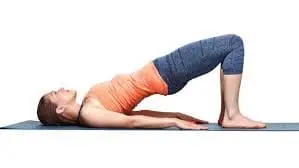
With your knees bent and your feet flat on the ground, lie on your back. While you tense your abdominal and buttock muscles, keep your head and shoulders relaxed on the floor. In order to create a straight line from your knees to your shoulders, elevate your hips next.
Make an effort to remain there long enough to inhale three times. Return to your starting point and repeat. Start with five reps per day and gradually increase to thirty.
Cat-Cow Stretch:
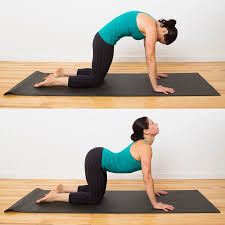
On your hands and knees, kneel. Bring your head down and slowly arch your back as though you were drawing your belly up toward the ceiling. Then raise your head while letting your tummy and back slowly drop toward the floor. Return to the beginning. Do it twice a day, three to five times.
Bird Dog Exercises:
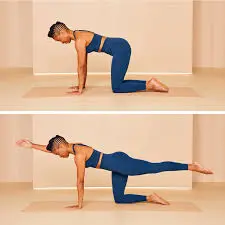
By strengthening the lower back and core muscles during arm and leg movements, this low-impact exercise helps reduce back pain. Start by assuming a tabletop position on your hands and knees.
Next, raise and stretch your right leg behind you and your left arm in front of you while contracting your abdominal muscles. After holding this posture for five seconds, switch to your right arm and left leg.
Child’s Pose:
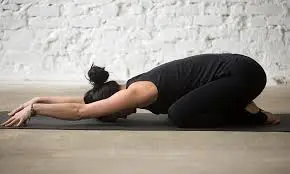
This relaxing stretch lengthens your spine and eases neck and lower back pain. Keeping your arms out in front of you, begin in the tabletop position, then slowly rest your forehead on the floor and sink your hips back towards your feet.
Cobra Pose:
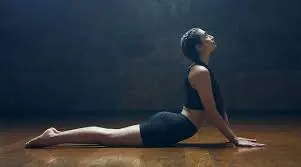
Cobra posture eases spinal tension and strengthens your upper back. Place your hands beneath your shoulders and begin by lying on your stomach. Raise your shoulders off the ground and press onto your hands with your back’s strength.
Dead Bug Exercise:
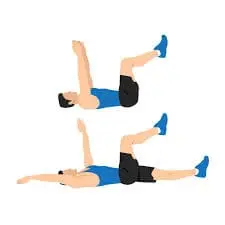
A great core stability exercise, the Dead Bug Exercise improves balance and coordination while strengthening the hip flexors, lower back, and abdominal muscles. Lying on your back, with your legs bent at a 90-degree angle and your arms reaching toward the ceiling, you can perform this exercise like a “dead bug.” From here, you keep your lower back firmly pressed against the floor while you slowly descend your opposing arm and leg toward the floor.
Clamshells:
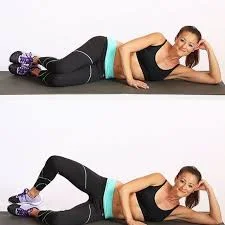
A straightforward yet incredibly powerful exercise, clamshells work the gluteus medius and hip stabilizing muscles. Lying on your side with your feet piled on top of one another and your knees bent at a 90-degree angle is how you do this exercise.
Maintaining your hip stability and preventing backward rolling, you steadily raise your upper knee while keeping your feet together and your core active.
Standing Hip Extension:
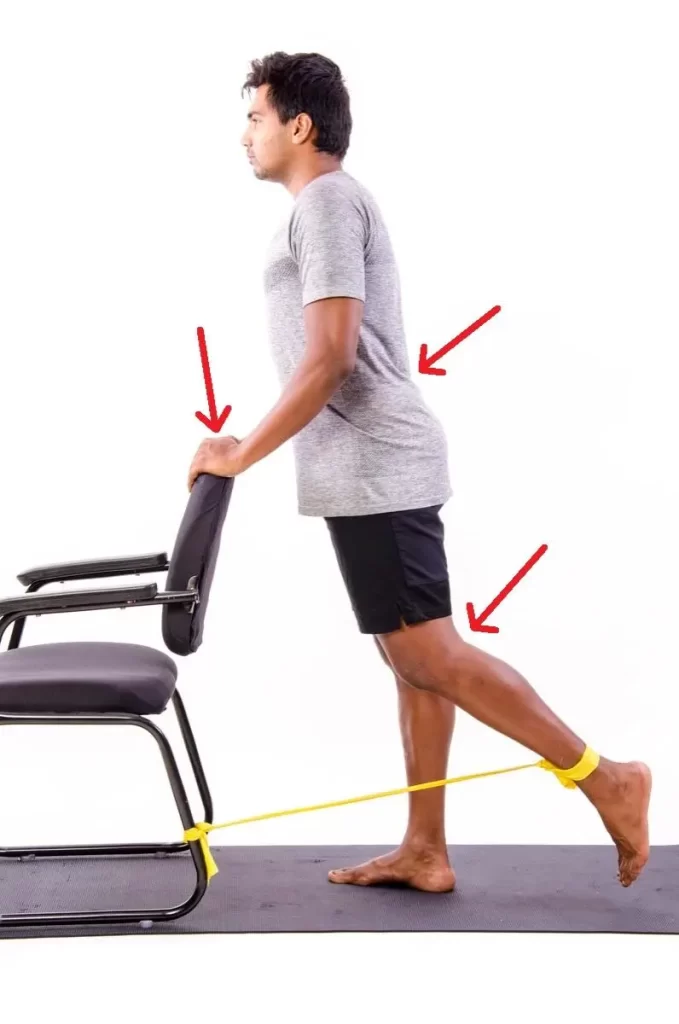
An efficient lower-body workout that strengthens the hamstrings and gluteus maximus while enhancing hip stability and balance is the standing hip extension. To complete this exercise, stand up straight, place your feet hip-width apart, and, if necessary, grasp onto a chair or wall for support.
You slowly stretch one leg backward without bending the knee or arching your lower back, maintaining a straight back and an engaged core. As you raise the leg, you should feel your glutes contracting, and the motion should originate from the hip joint.
Standing Forward Bend:
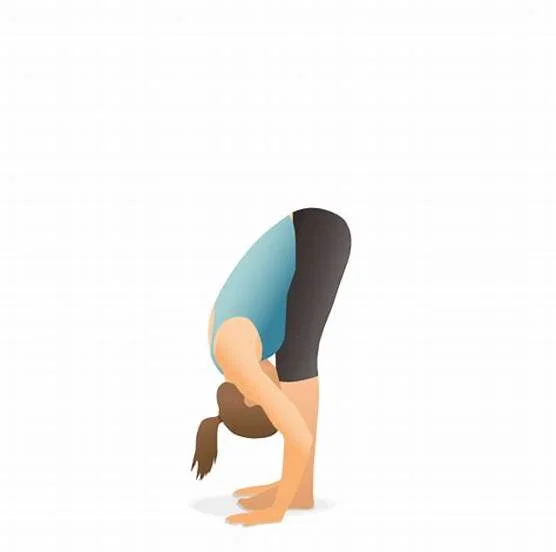
A traditional yoga pose, the Standing Forward Bend (also called Uttanasana) gently decompresses the spine while offering a deep stretch to the hamstrings, calves, and hips. This pose involves standing erect with your feet hip-width apart, then slowly bending forward from the hips such that your upper body folds over your legs, bending your knees slightly if necessary. This forward fold facilitates relaxation by soothing the nervous system, increases blood flow to the brain, and increases back body flexibility.
Conclusion:
The natural curves of the spine can be restored, flexibility can be increased, and weak muscles can be strengthened with the help of physiotherapy exercises for flat back posture. These exercises, which emphasize specific stretching and strengthening movements, aid in resolving muscular imbalances, reducing stiffness, and relieving related neck, hip, and back pain.
Regular practice also improves overall mobility, balance, and functional movement in daily tasks, in addition to improving posture and chiropractic alignment. When performed regularly and under appropriate supervision, physiotherapy exercises can be extremely effective in preventing additional postural problems and fostering long-term spine stability and health.
FAQs:
Can flat back syndrome be cured by a chiropractor?
The symptoms of flatback syndrome can be managed with conservative measures such as bracing, injections, chiropractic adjustments, physical therapy, and pain medications. These therapeutic approaches, however, usually fail to address the underlying cause of the issue, which is the spinal curvature.
What are the symptoms of weak abdominal muscles?
The body’s incapacity to adequately stabilize the spine and pelvis causes a weak core, which frequently shows up as instability during movement, poor posture (slouching), and persistent lower back pain. Among the main symptoms are, but are not restricted to, weariness after standing, trouble with everyday chores, diminished balance, and recurrent injuries.
Are flat backs better at healing?
Flatback earrings are one of the most pleasant and safest options for healing new piercings, in addition to being a fashion statement. For fresh piercings, titanium flatbacks are widely suggested due to their hypoallergenic nature and security.
Is flatback syndrome a serious condition?
As it affects posture and gait and causes severe pain, flatback syndrome can be a major cause of disability.
Can the spine be straightened with physiotherapy?
Physiotherapy can help you feel stronger, more mobile, and more in control of your body, but it won’t straighten your spine entirely. The main goals are symptom management, posture correction, and long-term spinal health preservation. The foundation of treatment is core strength and posture training.
For posture, is a physiotherapist or a chiropractor preferable?
You ought to consult a chiropractor about your posture. While both physiotherapy and chiropractic care can improve posture, chiropractic care concentrates on correcting the spine.
Is a flat back treatable by a chiropractor?
A person with Flatback Syndrome may be able to learn coping strategies from a chiropractor through gradual adjustments. Resolving subluxations when they arise, teaching improved posture, preserving range of motion, and maintaining open neural pathways are typically all part of this.
Is flatback reversible?
The lumbar spine’s natural curvature is lost as a result of this chronic illness, which causes the thoracic spine’s typical curve to straighten. The term “flatback” originates from this. Unfortunately, full reversal is extremely difficult for those who suffer from this illness.
In a flat back, which muscles are weak?
Additionally, you may have weak leg and pelvic muscles, as well as tight hamstrings and core (the central muscles of your body). Your lower back’s discs and joints may be under more tension and strain when you stand with a flat back.
Will physiotherapy help me with my posture?
One area of medicine that can be quite helpful in improving posture is physiotherapy. The forward bend (or backward bend) of the spine is typically discussed while discussing alignment. Naturally occurring curvature in the spine aids in the distribution of mechanical load.
Does a flat back condition benefit from physical therapy?
Physical therapy and anti-inflammatory drugs are the first steps in treating flat back syndrome, with a primary focus on restoring posture and gait. However, you might need surgery depending on how serious the structural issues are and how much pain they cause.
References:
- Back exercises in 15 minutes a day. (n.d.). Mayo Clinic. https://www.mayoclinic.org/healthy-lifestyle/adult-health/in-depth/back-pain/art-20546859
- Brian Chimenti, MD. (n.d.). 10 Exercises to improve posture and relieve lower back pain: The Woodlands Sports Medicine Centre: Orthopedic surgery. https://www.woodlandssportsmedicine.com/blog/10-exercises-to-improve-posture-and-relieve-lower-back-pain
- Doherty, L. (2020, September 28). Top 7 physiotherapy exercises to improve your posture — MOMENTUM Physical therapy | Okotoks Physio. MOMENTUM Physical Therapy | Okotoks Physio. https://www.momentumphysicaltherapy.ca/blog/okotoks-physiotherapy-posture-exercises
- Hospitals, M., & Hospitals, M. (2025, September 9). Flat back Syndrome treatment: How to restore your spine’s natural curve. Manipal Hospitals. https://www.manipalhospitals.com/patiala/blog/flat-back-syndrome-treatment-restore-spine-curve/