Crunches
Introduction
Crunches are a simple and effective abdominal exercise that primarily targets the rectus abdominis muscles. They help strengthen the core, improve abdominal tone, and support better posture when performed with proper technique.
It’s not a functional core workout because this exercise only works the abdominal muscles. Crunches may not be safe for everyone and can be stressful on the neck and back.
Your core includes abs with other muscles in your hips, pelvis, lower back, and oblique muscles on the sides of your trunk. These muscles work together to stabilise your body.
Although the crunch is a common core exercise, not everyone can safely perform it. It only works your abs, not the other muscles in your core, and it can put a lot of strain on your neck and back.
For many years, the basis of ab exercises has been the crunch. The rectus abdominis, the six-pack muscle that runs along the front of the torso, is the target of these exercises. Ab crunches can be incorporated into total-body or core strength exercises.
Muscles Activated During Crunches
- Rectus abdominis
- Hip flexors (iliopsoas and rectus femoris)
- Internal and external obliques
- Transverse abdominis
How to Do Crunches
Step 1
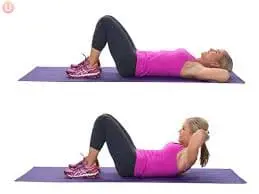
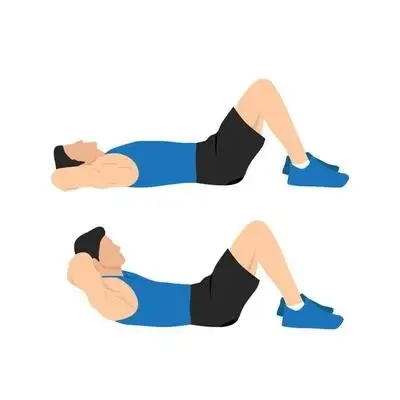
Starting Position: On a mat, lie supine (on your back) with your knees bent, feet flat on the ground, and heels up.
Step 2
Squeeze your scapulae (shoulder blades) together and pull your elbows back without arching your lower back as you place your hands behind your head. Throughout the exercise, keep your elbow in this position. During the upward movement of the exercise, keep your head parallel with your spine but allow it to flex slightly, bringing your chin closer to your chest.
Step 3
Upward Phase: Breathe out, tighten your core and abdominal muscles, flex your chin slightly toward your chest, and slowly curl your torso toward your thighs. Pulling your rib cage toward your pelvis should be the main goal of the exercise (the neck should remain relaxed while the chin is tucked toward the neck). Your lower back, tailbone, and feet should always be in contact with the mat. Until your upper back is lifted off the mat, keep curling up.
Step 4
Downward Phase: With your feet, tailbone, and low back in contact with the mat, slowly uncurl (lower) your torso back towards it while taking a deep breath.
For this exercise, to avoid putting too much strain on your low back, proper form is essential. People typically perform this exercise too quickly and use their hip flexors to help with the upward phase. This method should be avoided because it causes the pelvis to tilt anteriorly, which puts more strain on the lower back.
The movement should concentrate on bringing the rib cage and pelvis closer together while maintaining a relaxed neck and shoulders because the abdominals connect these two body parts.
What are the advantages and disadvantages of performing crunches?
Although the crunch has many advantages, there are some disadvantages as well. Before attempting this move, it’s important to consider these factors.
The Advantages
Isolates the abs: Only the abs are worked by crunches. If you’re looking to gain a six-pack, this is useful.
Can be done without gym equipment: The crunch is a bodyweight exercise that can be performed anywhere.
Beginner-friendly: Crunches are generally the best option for beginners.
The Disadvantages
Only targets the abs: If you want to strengthen your entire core, the crunch might not be the best exercise because it doesn’t work the obliques or other core muscles.
Risk for back and neck injuries: Crunches cause your spine to flex. This could strain your neck and back and raise your chance of getting hurt there.
Potentially unsafe for older adults: This exercise may not be safe for older adults, particularly those who have suffered a back or neck injury, because it requires flexing.
Abdominal Crunch Variations
1. Full Ab Crunches

- Engage your core while lying on your back.
- Imagine that you are bringing your ribs closer to your pelvis as you raise your shoulders one or two inches off the ground.
- As you rise, exhale while maintaining a straight neck and an elevated chin.
- Breathe continuously while holding at the peak of the exercise for a few seconds.
- Without completely relaxing, slowly descend back down.
- Repeat with perfect form for 15 to 20 repetitions.
2. Exercise Ball Crunch

- With your feet flat on the ground, place your upper to mid-back on an exercise ball.
- Use your abdominal muscles to crunch your ribs in the direction of your pelvis.
- Slowly slide over the ball after holding the crunch at the top for a count.
3. Bicycle crunch

An intermediate variation of the basic crunch is the bicycle crunch. It works the obliques as well as the abs.
To perform a bicycle crunch:
- Bend your knees as though you were going to do an oblique crunch or sit-up while lying on your back. Lift your chest while keeping your shoulders slightly off the ground.
- Place your hands behind your head.
- With your elbows bent.
- Try not to interlock your fingers during the bicycle crunch because you should never pull on your head or neck.
- Raise one leg off the floor and spread it out.
- Bend your knee to bring it closer to your chest as you raise your other leg. At this point, don’t forget to keep your other leg straight out.
- Raise your opposing elbow in a twisting motion toward your knee as you bend it toward you. You don’t have to put your elbow to your knee.
- To carry out the same motion, simultaneously lower your knee and elbow while raising your opposing limbs. It’s time to go from the left elbow to the right knee if you just went right elbow to left knee.
- Repeat as many times as you’d like. Start with 8–12 repetitions and 3 sets with proper form.
- Keep your shoulders away from your ears and your lower back on the floor to prevent strain. Instead of rotating from your neck or hips, rotate from your core.
4. Reverse crunch

- With your feet flat on the ground and your knees bent at a 90-degree angle, lie face-up on a mat or other soft surface. With your palms down, keep your arms close to your sides.
- Breathe out and prepare your core. Raise your thighs until they are vertical and lift your feet off the ground.
- Throughout the exercise, maintain a 90-degree bend in your knees.
- Tuck your knees as close to your face as is comfortable without lifting your mid-back off the mat.
- Your lower back and hips should rise off the floor.
- After a few seconds of holding, gradually bring your feet back down to the floor.
- At least ten or twelve repetitions should be performed. Start with one set, and as you gain strength, increase the number of reps and sets.
5. Russian twist crunch

- Keeping your knees bent, raise your feet off the ground while rooting into your sit bones.
- Make a V shape with your torso and thighs by extending and straightening your spine at a 45-degree angle from the floor.
- Stretch your arms out in front of you and clasp your hands together or connect your fingers.
- Twist to the right, then back to the center, and finally to the left using your abdominal muscles.
- There is one repetition of this. Perform two to three sets of eight to sixteen repetitions.
Ab Crunches: Common Mistakes
Correctly performing ab crunches is more difficult than it first appears. To maximize their effectiveness, keep clear of these mistakes.
Pulling on Your Neck
This takes away from working your abs in, along with straining your neck. Instead of starting the movement from your head, start it in your abs. When performing ab crunches, place your fist under your chin to maintain the proper alignment of your neck.
Crunching Too High
The shoulder blades are raised a few inches off the ground by the soft ab crunch. The exercise is less effective when the shoulders are jerked upward. Instead of using momentum to lift your body, take your time and finish the exercise slowly because it takes time to develop strength in your abs.
Relaxing Down to the Floor
While performing ab crunches, it’s easy to let your shoulders drop to the ground, but maintaining core tension throughout the exercise is an improved approach. You should never fully let your shoulders drop to the ground.
Back Arch
It used to be advised to perform the entire exercise with your back flat against the floor. It is now thought to be preferable to maintain a neutral spine, which puts your spine in the best possible position to support you.
You can quickly determine it by bending your pelvis back and then forward, then letting it relax in the middle of those two extremes. Your abs may take some time to strengthen if your back arches excessively. When performing ab crunches, try placing your feet on a platform or step to support your back.
Safety and Precautions
Consult your physician or physical therapist about the suitability of abdominal crunches if you have neck or back pain. They can strain the neck and compress the spine if performed incorrectly. If you have diastasis recti, you might need to stay away from ab crunches after the first trimester of pregnancy and after giving birth. For additional information, consult your healthcare provider.
FAQs
What will 20 crunches a day do?
Crunches are a great way to tone and strengthen your core muscles, especially your obliques and rectus abdominis, also known as your six-pack. Additionally, they enhance general stability, balance, and posture—all of which are crucial as we age.
Will 100 crunches a day lose belly fat?
The fact that you can’t spot reduce is even worse. This indicates that there are no particular exercises designed to reduce belly fat. Crunching 100 times a day won’t make you lose weight. That is simply not how it operates.
Are sit-ups or crunches better?
Choose crunches if you want to focus on your abdominal muscles in particular.
You either have lower back pain or are a novice.
You’re trying to find an exercise that won’t hurt you as much.
If you want to build strength in your core and lower body, sit-ups are a good choice.
You’ve worked out for a long time.
You don’t often have lower back and neck pain.
Are crunches better than planks?
Planks are the best way to strengthen your core because they target the deepest layer of your ab muscles. Because crunches mainly target the surface abs, or “six-pack” muscles, they are more effective at improving definition.
Can crunches burn belly fat?
No,
How to lose belly fat
Focus on losing fat in general: A calorie deficit occurs when you burn more calories than you take in. There’s no other way to reduce belly fat.
Incorporate cardiovascular activity: Exercises like walking, running, swimming, and dancing are great ways to burn calories, and they are most effective when paired with a healthy diet.
Perform body-wide strength training: Strength training, which involves lifting weights, helps build muscle. Muscle can boost your body’s overall fat-burning efficiency and burn more calories while you’re at rest because it has a higher metabolic activity than fat.
Eat a balanced diet rich in vegetables, lean meats, whole foods, and healthy fats. Reduce your intake of processed foods, sugar-filled snacks, and excessive salt.
Crunches are a good way to strengthen your abdominal muscles as part of a larger fitness plan, but they won’t burn belly fat. Therefore, incorporate them into a balanced routine. Keep in mind that doing too many crunches can cause injuries.
When should you avoid crunches?
Postpartum women are often advised to completely avoid crunches. Where is the source of this advice? Women who have recently given birth frequently experience diastasis recti, or separation of the abdominal muscles, as well as a lack of coordination and tone in the core and pelvic floor muscles.
References
- Austin, D. (2025, March 31). Crunches can help you get abs – but they do more than that. USA TODAY. https://www.usatoday.com/story/life/health-wellness/2025/03/31/what-are-crunches/82600237007/
- Cherney, K. (2023, April 7). Situps vs. Crunches. Healthline. https://www.healthline.com/health/fitness-exercise/sit-ups-vs-crunches
- Cpt, P. W. (2024, July 9). AB crunches: proper form, variations, and common mistakes. Verywell Fit. https://www.verywellfit.com/how-to-do-a-perfect-abdominal-crunch-1229513
- Crunch | Exercise Library | ACE. (n.d.). https://www.acefitness.org/resources/everyone/exercise-library/52/crunch/?srsltid=AfmBOoobdhmibBJ9BV8TVGeVRkC-bi2MurtP68-RkMy1BkSqU47Ydhj-
- The benefits of a reverse crunch and how to do it correctly. (2020, November 24). Healthline. https://www.healthline.com/health/reverse-crunches
- What muscles do Sit-Ups and Crunches work? (n.d.). Nike.com. https://www.nike.com/in/a/sit-ups-crunches-muscles-worked